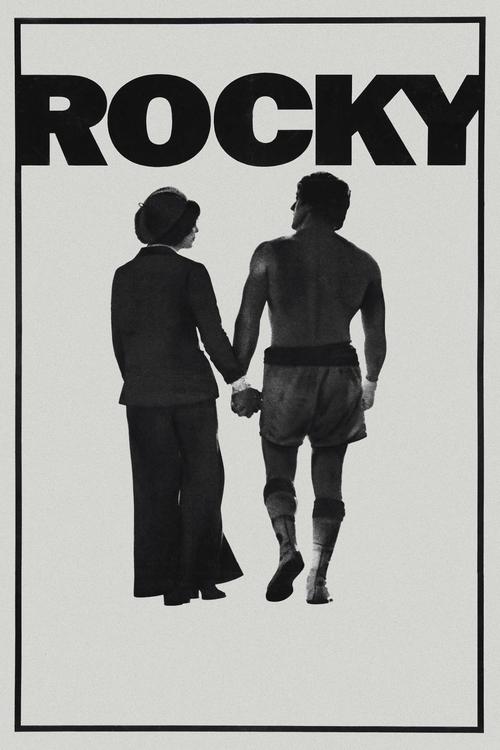
Rocky
1976 · John G. Avildsen
For when you need to believe in yourself again — the definitive underdog comfort watch, equal parts love story and pep talk. Reach for it when life has you counted out.
What it's about
A thirty-year-old Philadelphia club fighter, collecting debts for a loan shark and going nowhere, gets a freak shot: an exhibition bout against the world heavyweight champion. He knows he can't win — so he sets himself a different goal, just to go the distance and still be standing at the final bell, while a shy romance with a quiet pet-shop clerk gives him a reason to try.
The experience
Warmer and slower than its reputation suggests — more tender character study than fight picture for most of its running time, then genuinely rousing when the bell finally rings. It earns its uplift honestly; you'll want to run up some steps afterward.
Performances
Sylvester Stallone, then an unknown who refused to sell his script unless he could star, plays Rocky with a mumbling sweetness that's miles from the icon he became; Talia Shire matches him as Adrian, turning painful shyness into the film's emotional core.
The craft
Shot fast and cheap on real Philadelphia streets, it has a rough, almost documentary intimacy — including pioneering Steadicam work on those famous museum steps. Bill Conti's trumpet fanfare is one of the most instantly recognizable pieces of film music ever written.
Why it matters
The surprise Best Picture winner of 1976, it minted Stallone as a star overnight, launched one of Hollywood's most durable franchises, and became the template every underdog sports movie since has followed or fought against.
Snapshot
Rocky is a Philadelphia boxing melodrama that became the unlikely Best Picture winner of 1976 and one of the most consequential populist films of the New Hollywood era. Written by and starring Sylvester Stallone — then an obscure bit-part actor who refused to sell his screenplay unless he could play the lead — it tells of a thirty-year-old club fighter and small-time loan-shark enforcer who is plucked from obscurity for a bicentennial exhibition bout against the world heavyweight champion. The film's genius lies in its inversion of the sports-picture premise: victory is never the point. Rocky's ambition narrows to a single, achievable dignity — to "go the distance," to still be standing at the final bell. Around that modest stake the film builds a tender, almost neorealist character study of failure, loneliness, and late-blooming love before it detonates into a rousing fight finale. Produced on a shoestring by Robert Chartoff and Irwin Winkler for United Artists, it became a cultural phenomenon, launched a franchise that remains active a half-century on, and made Stallone a star overnight. Its blend of gritty location realism and unabashed sentiment helped recalibrate American cinema's trajectory at the very end of its most artistically adventurous decade.
Industry & production
Rocky is a foundational underdog story about its own making. Stallone, a struggling actor in his late twenties, wrote the screenplay quickly — the legend of three-and-a-half days is often repeated, though it is best treated as Stallone's own oft-told account rather than verified fact — reportedly inspired in part by Chuck Wepner's March 1975 bout against Muhammad Ali, in which a journeyman survived nearly fifteen rounds. Producers Chartoff and Winkler, who had a deal at United Artists, took the script but balked at Stallone's insistence on starring; the studio is widely reported to have floated established names. Stallone held firm, and the picture was greenlit at a low budget — figures around or below a million dollars are commonly cited, and the production was lean enough that family members filled roles (Stallone's father rings the bell; his brother Frank contributed to the soundtrack; Talia Shire and Burt Young anchored the supporting cast). The shoot ran roughly a month in late 1975 across Philadelphia and Los Angeles. The gamble paid off spectacularly: Rocky became one of the year's top earners and won three Academy Awards — Best Picture, Best Director for Avildsen, and Best Film Editing — from ten nominations, including acting and writing nods for Stallone. As an industrial event it signaled that modestly budgeted, emotionally direct populist filmmaking could outperform the auteur-driven New Hollywood product around it, a lesson Hollywood absorbed quickly.
Technology
Rocky holds a genuine place in the technical history of cinema as one of the earliest features to deploy the Steadicam, the body-mounted camera-stabilizing rig invented by Garrett Brown. Brown himself operated the device on the film, and the year 1976 marks the technology's public debut across several productions (notably Hal Ashby's Bound for Glory and Marathon Man). In Rocky the Steadicam enabled the now-iconic running shots — most famously Rocky's sprint up the steps of the Philadelphia Museum of Art and the fluid tracking through city streets and the Italian Market — with a smoothness impossible for handheld work yet a mobility impossible for dollies and tracks on those locations. The tool's contribution is inseparable from the film's effect: it let a low-budget production achieve kinetic, location-bound camera movement that reads as both documentary-immediate and lyrically smooth. Beyond the Steadicam, the production relied on conventional mid-1970s technology — 35mm photography, practical Philadelphia locations, and a studio-built fight arena — but its embrace of Brown's invention gives it lasting significance in any account of how camera mobility evolved.
Technique
Cinematography
James Crabe's photography balances two registers. The Philadelphia material is shot with a muted, wintry naturalism — grimy streets, a dim apartment, the pet shop, the meat locker — that aligns the film with the location aesthetic of 1970s American cinema. Against this, the training and fight sequences open up into more dynamic, propulsive camerawork, the Steadicam runs providing the visual lift that mirrors Rocky's rising spirit. Crabe favors close, sympathetic framing of faces during the quieter scenes, allowing the romance and the bruised interiority of the characters to register. The fight itself is photographed for maximum legibility and impact, the arena lighting hard and theatrical in contrast to the soft gray of the streets.
Editing
The editing, by Richard Halsey and Scott Conrad, won the Academy Award and is central to the film's design. The picture is patient for much of its first two acts, letting scenes breathe at the rhythm of conversation and routine — a deliberate slowness that makes the eventual acceleration land. The training montage, cut to Bill Conti's score, is the film's editorial signature: a compression of weeks of labor into a few exhilarating minutes, a structure so effective it became a template copied for decades. The final bout is edited for visceral exchange and emotional crescendo rather than strict boxing realism, building blow-by-blow toward the closing bell.
Mise-en-scène / staging
Avildsen stages Rocky around enclosure and release. The early scenes are boxed into cramped interiors — Rocky's cluttered room, Adrian's pet shop, Paulie's house, the gym — environments that physicalize the characters' stalled lives. The city is presented at street level, unglamorous and lived-in. Against these confined spaces the film sets images of opening out: the museum steps, the riverfront, the wide arena. Props and recurring motifs (the turtles Cuff and Link, the battered apartment, Mickey's gym) ground the world in specific, shabby detail. The staging of the romance is notably restrained and awkward in a way that reads as truthful rather than polished.
Sound
Bill Conti's score is among the most recognizable in film history. The main theme, "Gonna Fly Now," with its rising brass fanfare, became a hit in its own right and is permanently fused to the training montage and the steps. Conti's music does heavy lifting throughout, supplying the emotional swell the deliberately understated drama withholds in dialogue. Beyond the score, the sound design contrasts the ambient drabness of the streets — traffic, the dim murmur of bars — with the roar and percussion of the arena. The fight's sound, the thud of blows and crowd noise, intensifies the climax.
Performance
Performance is where Rocky earns its emotional credibility. Stallone plays the title role with a shambling, mumbling tenderness that undercuts the character's physical bulk; the punch-drunk gentleness and the loquacious patter (the one-sided monologues to Adrian, the turtles, the kids on the corner) make Rocky lovable rather than merely pitiable. Talia Shire's Adrian is a study in painful shyness gradually thawing into devotion, her transformation quiet and unforced. Burt Young's Paulie is abrasive and self-pitying, a sour counterweight. Burgess Meredith's Mickey, the crusty old trainer, supplies grizzled pathos. Carl Weathers's Apollo Creed — flamboyant, media-savvy, modeled on the showmanship of Muhammad Ali — provides the charismatic foil. The ensemble's lived-in chemistry is the film's bedrock.
Narrative & dramatic mode
Rocky operates in the mode of sentimental realism, fusing the grit of 1970s character drama with the uplift of classical melodrama. Its structure is unusual for a sports film: the central question is not whether the hero will win but whether he will endure, and the love story carries at least as much weight as the boxing. The first two acts are largely plotless in the conventional sense, a patient accumulation of small humiliations, routines, and tentative connection. The dramatic engine is internal — a man recovering self-respect — and the external contest functions as the arena in which that inner recovery is tested. Crucially, the film withholds the expected triumph: Rocky does not win the fight. He goes the distance and, in the bruised embrace with Adrian at the final bell, achieves the only victory that matters. This refusal of the conventional payoff, while delivering total emotional satisfaction, is the screenplay's most sophisticated move.
Genre & cycle
Rocky belongs to the long lineage of the boxing film, a genre with a rich Hollywood history (Body and Soul, The Set-Up, Champion, and later, as a darker counter-statement, Scorsese's Raging Bull in 1980). It also sits within the broader American underdog and self-improvement narrative. Where many earlier boxing pictures were noir-inflected, fatalistic, or exposés of corruption, Rocky turned the genre toward affirmation, effectively founding the modern inspirational sports cycle. Its training-montage-to-climactic-contest architecture became the dominant template for sports cinema that followed, and the film spawned its own franchise cycle — five direct sequels and the later Creed spinoffs — that constitutes a self-contained genre tradition.
Authorship & method
Authorship of Rocky is genuinely shared in a way worth stating plainly. Stallone is the originating creative force as writer and star, and the film is unimaginable without his conception and performance; his later career as director of several sequels underscores his proprietary relationship to the material. Yet the 1976 film is decisively shaped by John G. Avildsen, a director with documentary-leaning instincts (Joe, Save the Tiger) whose restraint kept the sentiment grounded and whose Oscar-winning direction earned the slow-build sincerity its payoff; Avildsen would later make The Karate Kid, reprising the underdog-and-mentor formula. The other essential authors are composer Bill Conti, whose score is arguably the film's most famous single element; cinematographer James Crabe; editors Richard Halsey and Scott Conrad; Steadicam inventor-operator Garrett Brown, whose technology shaped the film's signature images; and producers Robert Chartoff and Irwin Winkler, who took the financial risk on an unknown lead. Rocky is best understood as a collaboration in which a first-time screenwriter-star's vision was disciplined and elevated by experienced craftspeople.
Movement / national cinema
Rocky arrived at the tail end of the New Hollywood, the period of auteur ascendancy and American art cinema that ran roughly from the late 1960s through the 1970s. It shares that movement's commitment to location shooting, working-class milieu, naturalistic performance, and morally textured protagonists. Yet it also pulls against the movement's prevailing tone of irony, defeat, and ambiguity, restoring an earnest, affirmative populism that many critics see as a hinge point — a film that helped turn American cinema from the introspective 1970s toward the crowd-pleasing sensibility that, together with Jaws and Star Wars, defined the blockbuster turn of the later decade. As a national cinema artifact it is deeply American: a bicentennial-year fable of self-made dignity, set against a recession-era urban landscape.
Era / period
The film is saturated with its moment. Released in the United States Bicentennial year, it stages — pointedly — a championship bout themed around the nation's birthday, with Apollo Creed costumed as a showman-patriot. Its working-class Philadelphia, with shuttered prospects and economic stagnation, reflects the mid-1970s mood of urban decline and recession. The Apollo Creed character draws openly on Muhammad Ali's media persona, situating the film within the era's celebrity-saturated sports culture. Rocky's sincerity also answers a national appetite, after Watergate and Vietnam, for a story of ordinary perseverance and earned self-respect — which helps explain why it resonated so far beyond its modest scale.
Themes
At its core Rocky concerns self-worth: the difference between winning and proving oneself, between being a "bum" and going the distance. Dignity is the film's true subject, pursued not through triumph but through endurance. Closely bound to this is the theme of love as redemption — the parallel rise of Rocky and Adrian, two lonely, defeated people who lift each other out of isolation, gives the film its emotional spine. Other recurring concerns include mentorship and second chances (Mickey's late faith in Rocky), masculine pride and its frustrations (Paulie's resentment, Rocky's gentleness against a violent trade), and class — the texture of working-class life, the limited horizons, the longing for a single shot at something more. The film insists that the meaning of the opportunity lies in how one meets it, not in its outcome.
Reception, canon & influence
Rocky was both a critical and popular success on release, winning the Academy Award for Best Picture and becoming one of the year's biggest commercial hits; its sweep over more fashionable competition was itself a story. Over time its critical standing has been more debated — some commentators view its sentiment and its blockbuster legacy as a regrettable turning away from the 1970s' artistic high-water mark, a reading sharpened by the contrast with Raging Bull four years later — but its cultural canonization is beyond dispute, and it was selected for preservation in the National Film Registry.
The influences on the film run backward to the classical Hollywood boxing picture and the underdog melodrama, to the Italian neorealist tradition of working-class location drama, and to the immediate real-world spark of the Wepner–Ali bout and Ali's larger-than-life persona behind Apollo Creed. Stallone has also cited the broader populist tradition of the everyman hero.
The influence the film shaped is enormous. It established the modern inspirational sports film as a durable genre and made the training montage a permanent fixture of popular cinema, endlessly imitated and parodied. It launched a franchise — five sequels across the following decades, then the acclaimed Creed films, which extended the saga to a new generation. Bill Conti's theme entered the permanent soundtrack of American popular culture, and the museum steps became a genuine civic landmark, complete with a statue, where visitors reenact the climb daily — a rare instance of a film permanently rewriting the meaning of a physical place. Stallone's career, and a particular template of the self-made underdog star, flow directly from it. For all the debate over its sentiment, Rocky remains one of the most influential American films of its decade.
A Deleuzian reading
He comes home to a room the size of a regret and talks to two turtles.
The full Deleuzian reading of Rocky →
Reception
It won Best Picture over Taxi Driver, Network and All the President's Men — a choice film fans have relitigated ever since — while the original itself got retroactively flattened by its own franchise. The modern reappraisal: the 1976 film is a scrappy, melancholy low-budget character study, not the montage machine the sequels became.
How Rocky was received, from release to now →
Influences: the films it descends from and the films it influenced
- Body and Soul (1947) — James Wong Howe shot the climactic bout on roller skates inside the ropes for visceral in-ring immersion, establishing the morally-tested-fighter melodrama built around one redemptive final bout that Rocky's structure inherits.
- The Set-Up (1949) — Renders the seedy small-club fight world in near-real-time documentary grit; Rocky's washed-up club-fighter milieu and unglamorous gym/locker-room texture descend directly from this anti-glamour boxing realism.
- On the Waterfront (1954) — The 'I coulda been a contender' washed-up palooka, shot on location in working-class enclaves with Method inwardness — Rocky's bum-with-dignity who just wants to 'go the distance' is Terry Malloy's emotional descendant.
- Marty (1955) — Chayefsky's template of the lonely, inarticulate ordinary man courting an equally plain woman in unglamorous tenderness directly shapes the Rocky–Adrian romance and the film's sentimental working-class realism.
- Somebody Up There Likes Me (1956) — The Rocky Graziano biopic that supplies the very namesake — its street-kid-to-champ arc shot on gritty New York locations is the prototype for Rocky's underdog-from-the-neighborhood ascent.
- Bicycle Thieves (1948) — The Italian neorealist method of staging working-class drama in real streets with nonprofessional texture is the cited debt behind Rocky's Philadelphia location-naturalism and its dignity-of-the-poor framing.
- Joe (1970) — Avildsen's own documentary-leaning handheld grit and blue-collar milieu established the restrained, vérité-tinged directorial method he carried into Rocky to keep its sentiment grounded.
- Raging Bull (1980) — The direct anti-sentimental rebuttal: takes the boxing picture back into Method-modernist self-loathing and expressionist in-ring abstraction, defining its craft explicitly against Rocky's swelling uplift.
- The Shining (1980) — Uses Garrett Brown's Steadicam for its signature low-gliding tracking shots — the technology Rocky helped legitimize in its first year of feature use now matured into a defining stylistic device.
- The Karate Kid (1984) — Avildsen reprises his own Rocky machinery wholesale — the underdog-and-mentor bond, the training montage, and the withheld-triumph tournament climax — transposed from the ring to the dojo.
- Hoosiers (1986) — Codifies the inspirational-sports template Rocky founded: a swelling Conti-style score over a montage of grinding practice, building to a small-town underdog's withheld-triumph finale.
- Million Dollar Baby (2004) — Builds its boxing film on the Rocky core of a gruff mentor and a working-class fighter's hard-won self-respect via training montage, then deliberately darkens the genre's uplift into tragedy.
- The Wrestler (2008) — Inverts Rocky through handheld vérité location-naturalism — the aging broken fighter as documentary subject rather than sentimental hero — a craft argument that only legible against Rocky's template.
- Creed (2015) — The direct franchise continuation that revives Rocky's training montage and Bill Conti motifs for a new generation, fusing them with a single-take Steadicam fight round that extends the film's location-realist boxing craft.
- Warrior (2011) — The sports-film dramaturgy of physical training as character excavation and the underdog championship bout as cathartic endpoint within a working-class location that itself makes the class argument — Warrior is the most psychologically demanding heir to this template, inheriting the architecture while darkening its emotional logic.
- Whiplash (2014) — The training-montage-to-public-bout architecture in which the climactic performance proves the self rather than tallies a win — the sports-film structure Whiplash transposes to a drum solo.
- 8 Mile (2002) — Supplies the three-act underdog architecture and, crucially, the anti-triumphalist climax — Rabbit winning the final battle but walking back to the night shift rather than to stardom directly rewrites Rocky going the distance yet losing the decision.
- Tampopo (1985) — The underdog apprenticeship-and-training-montage arc, complete with a gruff coach drilling repetition toward mastery, is the sports-film skeleton Tampopo maps onto perfecting a ramen recipe.
- HAIKYU!! The Dumpster Battle (2024) — Structures an entire feature toward one climactic bout as event, with the underdog-versus-champion staging Haikyu restages as crows-vs-cats.
- Mean Streets (1973) — Shares the New Hollywood mode of ethnic working-class location energy and loose, behavioral hangout scenes among small-time neighborhood men — the same milieu Rocky renders with warmth rather than menace.
- Bound for Glory (1976) — The first feature to deploy Garrett Brown's Steadicam (its famous crane-to-walking shot), released the same year; Rocky used the identical inventor-operator and technology for its gliding street-run and stair-climb images.
- Marathon Man (1976) — A contemporaneous showcase for Garrett Brown's then-new Steadicam in chase/run sequences — sibling proof of the 1976 technological moment whose fluid pursuit shots Rocky shares.
- Days of Thunder (1990) — Defined the sports-melodrama 'overcoming-fear / earn-the-mentor's-faith' arc and training-montage structure that Towne's screenplay and the editors graft onto stock-car racing.
Similar films
- Creed (2015) — influence & lineage · same viewing thread
- The Wrestler (2008) — influence & lineage · same viewing thread
- Raging Bull (1980) — influence & lineage
- Million Dollar Baby (2004) — influence & lineage
- On the Waterfront (1954) — influence & lineage
- Bicycle Thieves (1948) — influence & lineage
- Body and Soul (1947) — influence & lineage
- Marty (1955) — influence & lineage
All the films related to Rocky →
Watch it with: curated runs of related films
- The Working-Class Long Shot — A run of men whose bodies and grit are their only capital, each grinding toward a single shot at dignity — watch them together and the American bootstrap dream and its bleaker European labor-film shadow start to rhyme.