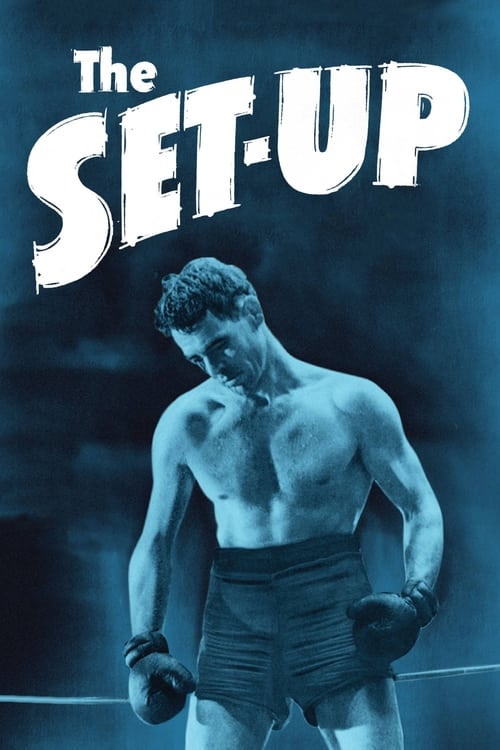
The Set-Up
1949 · Robert Wise
For when you want a lean, no-fat classic — a short, devastating noir for a night when you'd rather feel one thing deeply than watch something sprawl. It rewards a quiet, focused watch.
What it's about
Bill 'Stoker' Thompson is a thirty-five-year-old club fighter far past his prime, still convinced one win stands between him and vindication. What he doesn't know: his manager is so sure he'll lose tonight that he's quietly taken a gangster's bribe without even telling him to throw the fight. One night, one arena town, one bout — and a man fighting for his dignity while everyone around him has already cashed out on his defeat.
The experience
Taut and unglamorous — the film unfolds in close to real time over seventy-two minutes, and the tension of what Stoker doesn't know tightens around every scene. The fight itself is brutal, intimate, and completely gripping; the whole thing feels like a held breath.
Performances
Robert Ryan — a former college boxing champion — gives Stoker a weathered, wounded dignity that ranks among the great performances of the noir era; you believe every year of punishment on his face.
The craft
Robert Wise tells the story in near real time, an audacious formal constraint for 1949, and stages the ring scenes with a punishing physicality decades ahead of their moment. The cutaways to the bloodthirsty crowd are as pitiless as anything in the ring.
Why it matters
It's regarded as one of the most formally disciplined films of the classic noir era and a foundation stone of the boxing picture, its real-time structure and ringside brutality echoing through the genre ever since.
Snapshot
The Set-Up is a lean, seventy-two-minute boxing melodrama that has come to be regarded as one of the most formally disciplined pictures of the classic film-noir era. Robert Ryan plays Bill "Stoker" Thompson, a thirty-five-year-old club fighter far past his prime, still convinced that a single win stands between him and vindication. Unbeknownst to Stoker, his manager Tiny (George Tobias) has sold the fight to a small-time gangster, Little Boy, so certain his man will lose that he does not bother to cut Stoker in on the payoff. The drama turns on that omission: a man who has been written off fights, and wins, precisely because no one told him he was supposed to fall. Around this simple mechanism Wise builds a nearly real-time account of one night in a nameless arena town, in which the boxing ring becomes an arena of dignity, exhaustion, and the crowd's appetite for blood. Spare, unsentimental, and morally exact, it is the film in which Wise's training as an editor and RKO's late-1940s house style for low-budget noir converge most completely.
Industry & production
The Set-Up was produced at RKO Radio Pictures, the studio that, more than any major, industrialized the low-budget noir "B" picture in the 1940s through modest schedules, standing sets, and expressive economy. The picture belongs to a specific transitional moment. Dore Schary, RKO's production head, had made the studio a home for socially conscious, hard-edged material, but Schary departed for MGM in 1948 as Howard Hughes assumed control of RKO. The Set-Up, produced by Richard Goldstone from a screenplay by Art Cohn, is very much the kind of tough, unglamorous message-adjacent project that flourished under the outgoing regime, released as the studio's culture was changing around it.
The film's most-repeated production fact concerns its source. It derives from Joseph Moncure March's 1928 narrative poem The Set-Up, whose protagonist, Pansy Jones, was a Black boxer, and whose verse traced the arc of a fixed fight in hard-boiled couplets. The film transposes the material substantially: the boxer is rewritten as a white fighter, Stoker Thompson, and played by Robert Ryan. Wise discussed the change in later interviews, and it is a decision the historical record treats candidly — the studio was not prepared, in 1949, to build a picture around a Black lead, and the film loses the racial dimension central to March's poem even as it retains the poem's fatalism. It is worth stating plainly that the adaptation keeps the situation and the mood far more than the specifics of March's text.
Budgeted and scheduled as a modest production, the film relied on tight arena and hotel sets, a compact cast, and location-style crowding rather than spectacle. That economy is inseparable from its aesthetic: the confinement of resources becomes the confinement of the drama.
Technology
The Set-Up was made with the standard professional apparatus of a late-1940s Hollywood studio picture: 35mm black-and-white photography, the Academy 1.37:1 frame, and optical rather than mechanical or electronic effects. There is no technological novelty at the level of hardware; the film predates the CinemaScope widescreen conversion (which Wise himself would work within a few years later) and the postwar move toward location shooting that films like The Naked City had begun to popularize. What is notable, rather, is the deliberate rejection of technological "enhancement." The film largely forgoes a continuous orchestral score, leaning instead on the technology of recorded, layered diegetic sound — the ringside band, the public-address announcer, the roar and mutter of the crowd — to carry mood that scoring conventionally supplied. The clocks visible throughout the film are, in effect, a piece of narrative technology: they anchor the near-real-time conceit and make the arena's temporal architecture legible to the viewer.
Technique
Cinematography
Milton Krasner photographed the film in high-contrast black and white that is textbook noir without ever feeling decorative. The town's night streets are rendered in wet, glistening pavement and hard pools of light beneath signage; the arena interiors are smoky, low-ceilinged, and pressurized. Krasner and Wise favor deep, crowded compositions in which faces stack up behind the ropes, and they exploit the physical geography of the arena — the dressing room below, the ring above, the alley behind — as a vertical and lateral map the film returns to with precision. The camera is placed low around the ring during the fight, catching the fighters from the spectators' angle and from the canvas, so that the violence has weight and the audience's proximity to it becomes oppressive.
Editing
Editing is the film's signature, and appropriately so: Wise came up through the RKO cutting rooms and had edited Citizen Kane and The Magnificent Ambersons before directing. The credited cutter was Roland Gross, but the editorial intelligence is unmistakably Wise's. The fight sequences are constructed with a rhythmic clarity that reads every punch, every stagger, and every referee's count, intercut with reaction shots of the crowd, of Little Boy's men, and of the empty seat where Stoker's wife should be. The film sustains an unusually strict temporal discipline: events unfold in something very close to continuous, real screen time, matching story-time to running-time. The cutting never cheats duration for suspense; it lets the clock do the work.
Mise-en-scène / staging
The staging is organized around a handful of confined spaces — the fleabag Hotel Cozy room, the fighters' dressing room, the ring, the arena stands, the alley — and the film wrings maximum meaning from moving characters between them. The dressing room is a purgatorial waiting area where each boxer is called up in turn and returns broken or elated, a conveyor belt of bodies that frames Stoker's own fate. Wise choreographs the crowd as a collective character: individual grotesques recur — a gluttonous man eating steadily through the carnage, a blind spectator who follows the fight by ear, a woman screaming for blood — so that the mise-en-scène indicts spectatorship itself.
Sound
Sound is arguably the film's most radical technical choice. By minimizing non-diegetic music, Wise makes the soundtrack a documentary of the arena: the slap of gloves, the wet thud of body blows, the bell, the announcer, the layered ambient din of the crowd rising and falling. The absence of an orchestral safety net removes the usual emotional cushioning and heightens the sense of unmediated reality. In the climactic scenes, sound carries the horror that the image only implies.
Performance
Robert Ryan's performance anchors the film. Ryan had been an intercollegiate boxing champion during his student years, and that background lends physical credibility to his movement in the ring — his stance, his fatigue, the specific slump of a man whose body is failing him. But the performance is finally about a kind of stubborn interior dignity rather than athleticism; Ryan plays Stoker as a man clinging to a self-image the world has already discarded. Audrey Totter, as his wife Julie, plays the film's moral counterweight, a woman who can no longer bear to watch, and much of the drama's pathos rides on her absence from ringside. The supporting players — George Tobias as the compromised manager Tiny, Percy Helton as the trainer, and the actors filling the dressing room and stands — give the ensemble a worn, lived-in specificity.
Narrative & dramatic mode
The dramatic mode is compressed tragedy in a naturalist key. The film's governing formal idea is temporal unity: the story occupies roughly the span of its own running time, one continuous night, with clocks marking the passage so that the audience shares the characters' dwindling minutes. This near-real-time structure aligns The Set-Up with classical dramatic unities more than with the sprawling rise-and-fall biography typical of the boxing genre. The narrative is built on dramatic irony — the audience knows the fix is in and that Stoker has not been told, so every hopeful gesture the fighter makes is shadowed by our knowledge. Crucially, the film denies the tidy catharsis its structure seems to promise. Stoker's victory in the ring, rather than redeeming him, precipitates his punishment, and the film's resolution is bitter and physical rather than moralizing. The mode is fatalistic, but the fatalism is earned inside a tightly closed dramatic loop.
Genre & cycle
The Set-Up sits at the intersection of two cycles: the film-noir crime drama and the boxing picture, which in the late 1940s briefly fused into a small, potent sub-genre of "boxing noir." Its immediate companions are Robert Rossen's Body and Soul (1947), with John Garfield, and Mark Robson's Champion (1949), with Kirk Douglas — the latter, tellingly, also produced within RKO's orbit and directed by a fellow RKO-trained filmmaker. Where Champion and Body and Soul trace ambition and corruption across a career, The Set-Up strips the genre to a single fight and a single night, making it the most formally austere entry in the cycle. It shares noir's fixations — the rigged game, the small operator crushed by organized money, the nocturnal cityscape, the sense that the individual has no leverage against the system — while grounding them in the concrete, sweating physicality of the ring.
Authorship & method
The Set-Up is a foundational film in Robert Wise's authorship, made early in a directing career that had begun when RKO promoted him from the editing bench (and, controversially, assigned him to complete The Magnificent Ambersons after Welles's departure). Wise's method here is that of an editor-director: he thinks in cut points, durations, and rhythmic juxtapositions, and he trusts structure over flourish. His later career would range astonishingly wide — from the science-fiction gravity of The Day the Earth Stood Still (1951) to the musicals West Side Story (1961) and The Sound of Music (1965) — but the discipline visible in The Set-Up is a through-line: an unshowy craftsman's control of tempo and clarity.
The key collaborators are legible in the work. Cinematographer Milton Krasner supplied the hard noir lighting; screenwriter Art Cohn compressed March's poem into a taut, dialogue-economical scenario; the editing (credited to Roland Gross) executed Wise's temporal design. On music, the record supports caution rather than elaboration: the film is notable precisely for how little conventional underscoring it uses, and its "score" is largely the diegetic soundscape rather than the work of a composer writing dramatic cues. Producer Richard Goldstone shepherded the modestly budgeted project. The authorship, in short, is Wise's, but it is Wise as the coordinating intelligence of a small, aligned craft team working within RKO's economy of means.
Movement / national cinema
The film is a product of American studio filmmaking at the height of the domestic film-noir movement, itself shaped by émigré European sensibilities, Depression-era social realism, and the disillusioned mood of the immediate postwar years. It is not a movement film in a manifesto sense, but it participates fully in noir's national-cinema moment: the crime-inflected, shadow-lit American picture of roughly 1944–1955. Its unusual formal rigor and its interest in the crowd as a social organism also give it an affinity with a certain strain of realism that European critics prized, which helps explain its warm reception abroad.
Era / period
The Set-Up is a late-1940s film in every sense. It reflects a postwar America uneasy about corruption, organized crime, and the gap between the individual's aspirations and the machinery arrayed against him. It arrives at the tail end of RKO's most creatively adventurous period and on the cusp of the studio's decline under Hughes, and it belongs to the brief window when Hollywood's "social problem" impulse and its noir style overlapped most productively. The boxing milieu it depicts — small clubs, fixed fights, gangster money, journeyman fighters chewed up and discarded — is period-specific and rendered without nostalgia.
Themes
The film's central theme is dignity under erasure: the insistence of an aging, discarded man on being taken seriously, and the cost of that insistence. Closely bound to it is the theme of the fix — the individual as a pawn in an economy of bets and payoffs he cannot see, so worthless to the men above him that they will not even bribe him. A third theme is spectatorship and complicity: through its recurring gallery of crowd faces, the film interrogates the audience's hunger for violence and implicates the viewer in it. Time itself is thematic — the clock as antagonist, the sense of a life measured in rounds. And underlying all of it is a bleak account of marriage and loyalty, embodied in Julie's refusal to watch her husband be destroyed, which reframes Stoker's "win" as a private catastrophe.
Reception, canon & influence
Contemporary American critics received The Set-Up respectfully as a tough, well-made picture, and its reputation abroad was notably strong: it was recognized at the 1949 Cannes Film Festival, where it received a critics' prize — a mark of the esteem European critics held for its realism and formal control. (I'd flag that the exact wording of the Cannes citation is the kind of detail worth verifying against a primary source rather than paraphrasing loosely.) Over time its standing has risen steadily, and it is now widely treated as a canonical film noir and among the finest boxing films ever made.
Looking backward, the film's influences are legible: Joseph Moncure March's 1928 poem supplies the fatalist situation; the Body and Soul/Champion cycle establishes the boxing-noir template it refines; and the broader noir idiom — German-expressionist lighting filtered through the American crime film — supplies its visual grammar. Wise's own formation in the Welles unit at RKO informs its editorial confidence.
Looking forward, its legacy is considerable. Its near-real-time construction anticipates the compressed, clock-bound suspense that Fred Zinnemann's High Noon (1952) would make famous. Its unflinching, sound-forward physicality and its treatment of the fighter as a body being consumed prefigure the modern boxing film; Martin Scorsese has been among the directors who cite it as an influence on Raging Bull (1980), and its DNA is visible across later ring dramas that treat boxing as tragedy rather than triumph. Within Wise's own filmography it stands as the clearest early statement of a method he would carry into far larger productions. As a demonstration that severe formal constraint — one night, one fight, near-real time, minimal music — can produce maximal emotional force, The Set-Up remains a touchstone.
A Deleuzian reading
A blind man sits at ringside.
The full Deleuzian reading of The Set-Up →
Reception
Released as a modest 72-minute RKO B-picture, it's since been canonized as one of the great boxing films and a high-water mark of film noir — helped along by Martin Scorsese, who recorded a DVD commentary with Robert Wise and has long championed it as an influence on Raging Bull.
How The Set-Up was received, from release to now →
How to watch The Set-Up: what to notice on a first viewing
- Watch the camera crouch low around the ring. Krasner and Wise shoot from near canvas height during the fights, catching blows from the spectators' angle rather than a clean, elevated view. The low camera makes the violence feel close and heavy instead of staged for spectacle.
- Notice the same few faces recurring in the crowd. A man eating steadily through the fight, a blind spectator following by ear, a woman screaming for blood, Wise returns to them again and again. The crowd starts to feel like one single appetite instead of a room full of separate people.
- Listen for the absence of any musical score. The soundtrack stays almost entirely diegetic, gloves, the bell, the announcer, and the crowd's rising and falling noise, with no orchestra cushioning the action. Without music telling you how to feel, the arena noise itself becomes the film's real score.
- Notice clocks on the wall marking the time. The story unfolds in close to its own running time, with visible clocks reminding you exactly how much of the night is left. You share the same dwindling minutes the characters do instead of watching time get compressed for pace.
- Watch Stoker's stance and fatigue between rounds. Ryan, a former collegiate boxer, plays the exhaustion in his body rather than his face, a slump and a stubbornness that carry the character's whole self-image. You read his dignity in how he holds himself up, not in anything he says.
The whole guide to watching The Set-Up, with the keys for a rewatch →
Influences: the films it descends from and the films it influenced
- Citizen Kane (1941) — Wise cut the film, absorbing its deep-focus low-angle compositions with visible ceilings and its overlapping diegetic sound — the RKO visual and aural grammar he brings to the arena and locker room.
- The Magnificent Ambersons (1942) — Wise's editing apprenticeship in sustained long-take deep-staging taught him to build pressure through shot duration and layered crowd blocking rather than cutting for coverage.
- The Body Snatcher (1945) — Wise's own Val Lewton-unit training in high-contrast chiaroscuro and confined-space economy — suggesting menace through shadow and tight framing on a tiny budget.
- Body and Soul (1947) — James Wong Howe's handheld roller-skate ringside camera invented the in-the-ropes subjective fight shot that The Set-Up refines into its low-angle ringside coverage.
- Golden Boy (1939) — Established the boxing-as-tragedy scenario — the sensitive fighter ground up by a corrupt fight economy — that supplies the film's fatalist dramatic situation.
- High Noon (1952) — Extends the clock-bound near-real-time construction, using on-screen clocks to lock narrative duration to screen duration for compressed suspense.
- Killer's Kiss (1955) — Carries forward the expressionist ring cinematography and the doomed-pug protagonist, staging boxing as noir spectacle in high-contrast light.
- Somebody Up There Likes Me (1956) — Wise returns to the ring with documentary-styled, rhythmically cut fight choreography — the same editor-director control of the bout's tempo and physicality.
- The Harder They Fall (1956) — Robson's fixed-fight exposé extends the noir treatment of boxing as a corrupt racket that consumes the fighter's body as merchandise.
- Requiem for a Heavyweight (1962) — Compresses the washed-up fighter's downfall into a tight span, treating the used-up body and dignity under erasure as the whole subject.
- Fat City (1972) — Extends the deglamorized, down-and-out fight world of aging club pugs, sustaining the theme of dignity under erasure in low-rent gyms and arenas.
- Raging Bull (1980) — Scorsese cites The Set-Up directly; his sound-forward, subjective in-ring violence and treatment of boxing as tragedy rather than triumph descend from its physicality.
- The Wrestler (2008) — Treats the aging athlete's body as a spectacle being consumed by a complicit crowd, echoing the film's spectatorship-complicity and dignity-under-erasure themes.
- Million Dollar Baby (2004) — Wise's near-real-time portrait of an aging club fighter pioneered the patient, durational pacing and shadowed-arena restraint, refusing montage uplift in favor of a single fight observed to its grim end.
- They Shoot Horses, Don't They? (1969) — Near-real-time confinement inside a single arena where a paying crowd consumes one man's escalating physical punishment, scored only by diegetic noise — the staging grammar of bodies-on-display-for-an-audience.
- Rocky (1976) — Renders the seedy small-club fight world in near-real-time documentary grit; Rocky's washed-up club-fighter milieu and unglamorous gym/locker-room texture descend directly from this anti-glamour boxing realism.
- Cléo from 5 to 7 (1962) — Wise's strict real-time construction, with visible clocks marking every passing minute of the story, is the discipline Varda adopts and chapters explicitly with title cards.
- Rope (1948) — A contemporaneous experiment in classical unities and near-real-time continuity, matching story time to running time within a single confined setting.
- Champion (1949) — Same-year boxing noir by a fellow Welles/Lewton RKO alumnus, treating the ring as a rigged arena and cutting fight action for brutal rhythmic impact.
- 12 Angry Men (1957) — A chamber drama built on classical unities and near-real-time continuity in one confined room, tightening framing as tension rises — the same constraint-as-force method.
- The Naked City (1948) — A contemporaneous noir built on real-time unfolding and deep-focus urban crowds, sharing Naked City's documentary attention to the textures of city nightlife and anonymous bystanders.
- The Hurricane (1999) — Claustrophobic, near-real-time staging of the fighter trapped in a rigged system — the ring-as-cage compression that prefigures Hurricane's prison-cell-as-stage.
- Night and the City (1950) — Shares the seedy fight-game underworld and the unflinching, near-documentary staging of bodies in the ring — a parallel treatment of wrestling/boxing as noir arena rather than spectacle.
- Tatami (2024) — Confines its entire fight to a single arena told in near real-time, the running screen-clock synced to the bout — the exact real-time-single-location scaffold Tatami rebuilds around a championship mat.
- Mikey and Nicky (1976) — Supplies the real-time 'one long night' architecture and the structure of a marked man whose fate closes in over a single continuous span.
Similar films
- Body and Soul (1947) — influence & lineage
- Raging Bull (1980) — influence & lineage
- The Harder They Fall (1956) — influence & lineage
- The Killing (1956) — shared sensibility
- The Hustler (1961) — shared sensibility
- Carlito's Way (1993) — shared sensibility
- The Sting (1973) — shared sensibility
- The Asphalt Jungle (1950) — shared sensibility