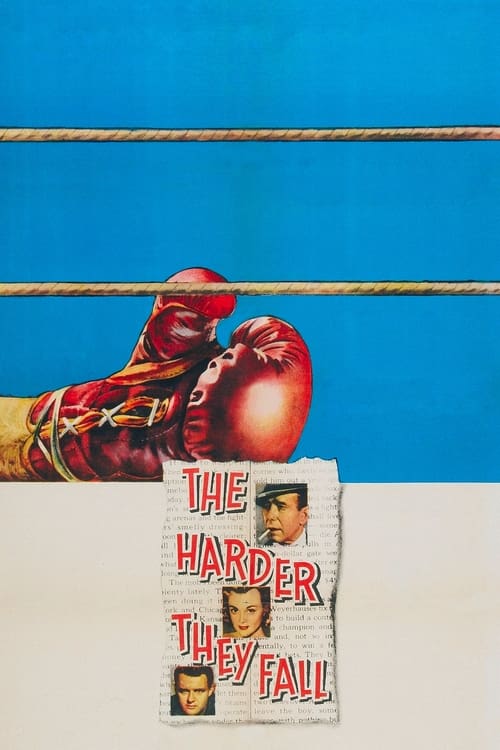
The Harder They Fall
1956 · Mark Robson
For when you want something tough and morally serious — a black-and-white drama that leaves a bruise rather than a warm glow. Reach for it when you're in the mood to watch a conscience get tested, not comforted.
What it's about
Eddie Willis, a sportswriter who's out of work and out of options, takes a paycheck from a crooked fight promoter to sell the public on Toro Moreno — a gentle Argentinian giant with a fearsome look, a feather-soft punch, and a glass jaw. As the syndicate steers Toro through a string of fixed fights toward a title shot he could never earn, Eddie's job is to keep the lie alive with his own good name. It's a story about the machinery behind the ring: the fixers, the press, and the men who get used up.
The experience
Hard-edged and increasingly queasy — it plays like a noir where the crime is a business plan, and you watch a decent man rationalize himself deeper into the dirt. The fight scenes land with real ugliness, and the tension comes less from who wins than from how much of himself Eddie has left to sell.
Performances
Humphrey Bogart, in his final screen role, is gaunt, weary, and quietly devastating — his real illness bleeds into Eddie's exhaustion, giving every compromise the weight of a man settling his accounts. Rod Steiger counters him as the promoter Benko with volcanic, fast-talking menace.
The craft
Mark Robson directs with a reporter's bluntness, and Burnett Guffey's stark black-and-white photography gives the arenas, locker rooms, and back offices a sweaty, documentary grit. The screenplay, from Budd Schulberg's novel, works like an exposé — each fixed bout another turn of the screw — and the unglamorous fight staging makes the violence feel like labor, not spectacle.
Why it matters
Remembered as Bogart's farewell, it also stands as one of the sharpest entries in the postwar cycle of films that dragged professional boxing's corruption into the light, helping cement the fight racket as one of American cinema's great subjects.
Snapshot
The Harder They Fall is a black-and-white boxing exposé released by Columbia Pictures in 1956, adapted from Budd Schulberg's 1947 novel of the same name. It is remembered, above all, as Humphrey Bogart's final screen performance; the actor was already gravely ill with the esophageal cancer that would kill him in January 1957, and his gaunt, weary presence gives the film an unintended valedictory weight. Bogart plays Eddie Willis, an out-of-work sportswriter who sells his credibility to a syndicate of fixers building a hollow heavyweight — the naïve Argentinian giant Toro Moreno — toward a title shot he could never earn honestly. Directed by Mark Robson from a screenplay by Philip Yordan and photographed by Burnett Guffey, the film belongs to the postwar cycle of American pictures that treated professional boxing not as a proving ground for heroes but as a rigged and predatory industry. It is a message picture in the most literal sense: it ends with its protagonist typing a call for the abolition of the sport.
Industry & production
The film was produced by Philip Yordan for Columbia, the studio that under Harry Cohn had built a reputation for tough, socially pointed pictures made on disciplined budgets. Its source, Schulberg's novel, drew transparently on the career of Primo Carnera, the enormous, low-skilled Italian heavyweight of the early 1930s who was widely believed to have been manufactured by mob-connected handlers through fixed bouts. That real-world lineage produced the film's most notable off-screen episode: Carnera is reported to have pursued legal action against Columbia over the resemblance, though the precise disposition of the matter is not something I can state with certainty from the historical record, and I flag it rather than embellish it.
The production also sits pointedly against its moment. The mid-1950s were the years of congressional and journalistic scrutiny of organized crime's grip on boxing — the era of the International Boxing Club monopoly and of figures like Frankie Carbo operating behind the sport's legitimate front. A muckraking picture about fixed fights and syndicate control was, in 1956, topical rather than merely melodramatic, and Columbia's willingness to make it reflects both the studio's house style and the appetite of the period for exposé.
Casting reinforced the documentary undertow. Two of the fighters on screen were the real article: former world heavyweight champions Max Baer (as the sadistic champion Buddy Brannen) and Jersey Joe Walcott (as the sympathetic cornerman George). Rod Steiger, as the promoter Nick Benko, was a rising exponent of the Method, and the frequently repeated account of on-set friction between Steiger's immersive technique and Bogart's contempt for it has become part of the film's lore; the anecdote is plausible and widely circulated, though I present it as reputation rather than verified fact.
Technology
The Harder They Fall was shot in black-and-white at a moment when the American industry was aggressively pushing color and large-format widescreen to differentiate the theatrical experience from television. Choosing monochrome was, by 1956, an aesthetic and economic decision rather than a default, and it aligns the film with the visual grammar of noir and social realism rather than the spectacle of the CinemaScope epic. The picture was made for the flat widescreen projection standard then becoming customary (roughly 1.85:1); I note some uncertainty about the exact intended aspect ratio and would not want to assert a precise figure I cannot confirm. What matters technically is the deliberate refusal of the era's dominant selling points — no color, no anamorphic scope — in favor of a harder, grayer register suited to smoke-filled gyms, arena tunnels, and hotel rooms.
Technique
Cinematography
The photography is by Burnett Guffey, one of the great craftsmen of American black-and-white and a cinematographer already associated with Bogart through Nicholas Ray's In a Lonely Place (1950). Guffey's work here earned an Academy Award nomination for Black-and-White Cinematography. His register is the low-key, high-contrast idiom of noir applied to the boxing milieu: deep pools of shadow in gyms and dressing rooms, hard overhead light on the canvas, the glare of arena spectacle set against the murk of the corridors where the real business is transacted. The fight sequences are shot to convey brutality and confusion rather than balletic grace, and the visual contrast between the manufactured glamour of the publicity machine and the squalor behind it is carried substantially by Guffey's lighting.
Editing
The cutting is credited to Jerome Thoms. It is worth remembering that Mark Robson himself came up as an editor in the RKO of the 1940s, apprenticed in the Val Lewton horror unit alongside Robert Wise, and directors of that formation tend to have a strong sense of rhythm and elision. The film's construction moves briskly through the machinery of the con — the sequence of fixed bouts, the mounting publicity, the geographic sweep of a barnstorming campaign — using montage-like compression to show a fraudulent career being assembled. The climactic championship fight is edited for punishment and duration, letting the beating land with a weight that the earlier fixed contests deliberately lack.
Mise-en-scène / staging
The staging draws a consistent moral geography: the bright, crowded fronts of the operation (press conferences, arenas, promotional stunts) versus the cramped back rooms where money and bodies are divided up. Robson stages the syndicate scenes as a claustrophobic ecology of men around tables, with Steiger's promoter at the center of the web. Toro Moreno — played by the towering Mike Lane in his screen debut — is blocked throughout as an outsized innocent, physically dominant yet perpetually surrounded and steered, his size making him both the product being sold and the person least in control of the transaction.
Sound
The soundscape leans on the roar of the crowd, the announcer's amplified patter, and the percussive violence of the ring to build the spectacle the plot is indicting. The musical score is the work of Hugo Friedhofer, one of the period's most respected Hollywood composers, with Columbia's music department under Morris Stoloff; I hold this attribution with reasonable but not absolute confidence and would flag it rather than overstate it. The scoring supports the film's tonal split between showmanship and disillusion without tipping into the heroic uplift that the boxing genre often invites.
Performance
Bogart's Eddie Willis is the film's center of gravity — a man of residual conscience who has rented out his integrity and knows it. The performance is spare and interior, and the actor's evident physical frailty lends the character's exhaustion an authenticity no direction could manufacture. Steiger, by contrast, plays Benko in a broader, more volatile key, and the friction between the two acting styles is legible on screen as well as in legend. Jan Sterling, as Eddie's wife Beth, functions as the film's moral conscience, the voice pressing him toward the truth. Among the fighters, Max Baer brings genuine menace to the champion, and Mike Lane's Toro carries the pathos of a man who never understands the game being played with his body.
Narrative & dramatic mode
The film operates as a conscience narrative wrapped inside an industry procedural. Its dramatic engine is not "will Toro win the title" — the audience knows the fights are fixed — but "when and how will Eddie tell the truth, and what will it cost." The mode is confessional and accusatory: an insider's account of a racket, told by a man implicated in it. Structurally it follows the manufacture and inevitable collapse of a fraudulent career, and it culminates not in a triumphant bout but in an act of writing — Eddie's decision to expose the whole apparatus. That the climax is a typed polemic rather than a knockout is the clearest signal of the film's priorities: it is finally a picture about testimony and complicity, not about sport.
Genre & cycle
The Harder They Fall is a late, hard-edged entry in the American boxing-corruption cycle, a strand of the sports film that runs adjacent to film noir. Its most direct genre kin are Golden Boy (1939), Robert Rossen's Body and Soul (1947), Robert Wise's The Set-Up (1949), and — significantly — Robson's own earlier Champion (1949, with Kirk Douglas), which established the director's fluency with the rise-and-corruption arc. These films share a conviction that the ring is a marketplace where working-class bodies are bought, used up, and discarded, and that the "sweet science" is a front for exploitation. The Harder They Fall pushes the cycle's cynicism about as far as it can go, indicting not just individual crooks but the institution itself.
Authorship & method
Mark Robson (1913–1978) directed. Trained as an editor at RKO and formed in Val Lewton's unit — where economy, atmosphere, and suggestion were house virtues — Robson became a reliable, versatile studio director of serious subjects: Home of the Brave (1949), Champion (1949), The Bridges at Toko-Ri (1954), and later Peyton Place (1957) and Von Ryan's Express (1965). The Harder They Fall fits his recurring interest in institutions that grind up individuals, and his second engagement with boxing gives the film the confidence of a director who already knew the terrain.
The screenplay is credited to Philip Yordan, adapting Schulberg's novel. Yordan is one of the more historically complicated authorship cases of the period, known both as a prolific screenwriter and as a name that at times fronted for blacklisted writers; I raise this as general context about how "Yordan" credits should be read with care, and I do not claim specific knowledge of ghostwriting on this particular film. Cinematographer Burnett Guffey is the key visual author, extending the noir grammar he brought to In a Lonely Place and would later carry to Bonnie and Clyde (1967). The editing is credited to Jerome Thoms and the score, per the best of my knowledge, to Hugo Friedhofer under Morris Stoloff's music direction. Behind all of them stands Budd Schulberg, whose novel supplied the material and whose broader career — most famously the screenplay for On the Waterfront (1954) — is bound up with the same postwar preoccupation with corruption, complicity, and the price of speaking out.
Movement / national cinema
This is a Hollywood studio production squarely within the tradition of the American social-problem picture — the vein of message-driven realism that studios like Columbia, Warner Bros., and later independents cultivated from the 1930s onward. It is not the product of an art-cinema movement, but its low-key monochrome aesthetic and its subject matter place it in the extended orbit of American film noir and of the postwar exposé film. Its national character is thoroughly American: it takes as its subject a distinctly American engine of manufactured celebrity and its underworld financing.
Era / period
The film is a creature of the mid-1950s. Industrially, it stands against the grain of the color-and-widescreen boom, keeping faith with black-and-white realism at a moment when that choice signaled seriousness. Culturally, it arrives amid national anxiety about organized crime's infiltration of legitimate business, boxing very much included, giving its muckraking a live topicality. And in the arc of Hollywood history it is a threshold film: Bogart, the defining star of the studio era's tough-guy tradition, was leaving the stage, and the picture reads in hindsight as the closing of a chapter.
Themes
The governing theme is commodification — the reduction of a human being (Toro) to a product to be manufactured, marketed, and discarded once his usefulness ends. Braided through it is the theme of complicity: Eddie is not a bystander but a paid participant, and the film's moral drama is his reckoning with what he has helped build. The corruption of the press and the manufacture of celebrity form a third strand — the film is unusually clear-eyed about the role of publicity and the sportswriter in fabricating a myth. Underneath all of it lies a sour interrogation of the American Dream, presented here as a rigged game in which the spectacle of upward mobility masks systematic exploitation. The closing gesture toward abolishing the sport crystallizes the film's argument that the rot is structural, not incidental.
Reception, canon & influence
Contemporary reception recognized the film as a strong, unsentimental exposé and, poignantly, as Bogart's farewell; the performance has since been read through the lens of his illness and death. Its most concrete institutional honor was the Academy Award nomination for Burnett Guffey's cinematography. I would characterize the critical reputation as respectful rather than rapturous — the film is admired as a tough, intelligent genre entry and treasured for Bogart's swan song, without being canonized at the level of Body and Soul or The Set-Up.
Looking backward, the film's influences are clear: Schulberg's own journalistic realism, the Carnera scandal, and the established boxing-noir cycle — Golden Boy, Body and Soul, The Set-Up, and Robson's Champion — which had already codified the rise-and-corruption template. Looking forward, it belongs to the through-line that carries the disillusioned boxing film into Requiem for a Heavyweight (1962), John Huston's Fat City (1972), and ultimately Scorsese's Raging Bull (1980), each of which treats the ring as a site of degradation rather than glory. Its thematic sibling is Schulberg's On the Waterfront, with which it shares a preoccupation with corruption, informing, and the moral cost of finally telling the truth. If the film's specific influence is harder to trace than its membership in a lineage, that lineage is where it durably belongs: among the American pictures that refused to romanticize the fight game and insisted on showing who profits and who pays.
Reception
A well-regarded boxing exposé in 1956, it's now remembered above all as Humphrey Bogart's final film — his farewell performance gives it a poignancy no one could have planned, and it's since settled in among the essential boxing pictures.
How The Harder They Fall was received, from release to now →
How to watch The Harder They Fall: what to notice on a first viewing
- Notice the shadows in the gyms, the glare on the canvas. Guffey shoots deep pools of shadow in gyms and dressing rooms against hard overhead light where the actual fighting happens. The lighting itself splits the film's world into where business gets done and where it gets seen.
- Watch where Benko's real business gets conducted. The bright, crowded fronts of press conferences and arenas contrast sharply with the cramped back rooms where money and bodies actually get divided up. The geography alone tells you which rooms are for show and which are for the real transaction.
- Watch how little Bogart's face has to do. Eddie Willis is played spare and interior, and Bogart's own visible physical frailty lends the character's exhaustion an authenticity no direction could manufacture. You believe he is worn out because the man playing him actually was.
- Listen for the crowd and the announcer building the spectacle. The roar of the crowd, the amplified announcer's patter, and the percussive violence of the ring construct the very showmanship the story is indicting. The same sounds selling you the fight are exactly what the film wants you to distrust.
- Notice how quickly the fixed fights fly by. The editing uses montage-like compression to show a fraudulent career being assembled, sweeping through fight after fight and town after town. The speed itself is the tell: these wins were never earned one at a time.
The whole guide to watching The Harder They Fall, with the keys for a rewatch →
Influences: the films it descends from and the films it influenced
- Kid Galahad (1937) — Established the Warner Bros. template of a cynical fight-racket manager (Bogart himself here) merchandising a naive heavyweight, the exact promoter-owns-the-flesh dynamic Bogart's disillusioned press agent inhabits from the other side.
- Golden Boy (1939) — Codified the rise-and-corruption boxing template of the fighter-as-commodity torn between his gift and the syndicate that owns his contract, the structural skeleton Schulberg's material inherits.
- The Seventh Victim (1943) — Robson's Val Lewton-unit apprenticeship in economy, shadow, and suggestion — cutting atmosphere from what is withheld — is the low-key craft discipline he carries into the ringside noir here.
- Body and Soul (1947) — Rossen and James Wong Howe's fight-fixing plot and inside-the-ropes, roller-skate-mounted handheld ring photography set the model of the crooked bout shot as physical assault that this film's crowd-and-ring coverage extends.
- Force of Evil (1948) — Polonsky's syndicate-procedural grammar — a compromised insider narrating his own complicity in a corrupt operation until conscience forces a reckoning — anticipates the conscience-procedural arc of the press agent's testimony.
- The Set-Up (1949) — Wise's near-real-time study of a fixed fight and its degradation, in stark low-key monochrome, is the tonal ancestor of treating the ring as a site of debasement rather than glory.
- Champion (1949) — Robson's own first boxing-noir gave him the montage-compression fight-career grammar and the confidence with the terrain that lets him direct this second engagement with the fight game economically.
- Home of the Brave (1949) — Robson's social-problem exposé method — an institution methodically grinding down an individual, dramatized as unsentimental procedural — is the authorial through-line feeding this film's institutional critique.
- In a Lonely Place (1950) — Burnett Guffey's low-key noir chiaroscuro built around a weathered Bogart face is the direct visual precedent Guffey extends in his Oscar-nominated photography here.
- The Hustler (1961) — Rossen returns to the corruption procedural — a gifted competitor owned and stage-managed by a mercenary backer — in Eugene Shuftan's low-key monochrome, the noir grammar of talent-as-property carried into the pool hall.
- Requiem for a Heavyweight (1962) — Directly extends the disillusioned-boxing through-line: a used-up heavyweight exploited by his handlers, the ring rendered as degradation and human wreckage rather than triumph.
- Fat City (1972) — Huston and Conrad Hall strip the fight film of glamour entirely — dim gyms, small-time bouts, bodies as expendable labor — the unromanticized-ring stance this film insisted on, pushed to naturalist bleakness.
- Raging Bull (1980) — The culmination of the refuse-to-romanticize lineage: Scorsese's black-and-white treats the ring as a site of self-destruction and commodified violence, the final term of the degradation-not-glory tradition this film belongs to.
- Bonnie and Clyde (1967) — Burnett Guffey carried his noir lighting grammar forward into this Oscar-winning work, a direct extension of the same cinematographer's low-key monochrome authorship visible here.
- Ace in the Hole (1951) — Wilder's portrait of a cynical newsman monetizing a human spectacle while the complicit crowd feeds on it shares the commodification-and-complicity exposé engine driving Bogart's press agent.
- On the Waterfront (1954) — Schulberg's other screenplay of the same period, built on the identical preoccupation with syndicate corruption, informing, and the moral cost of finally telling the truth — plus the Method-versus-studio performance friction.
- Rocco and His Brothers (1960) — Visconti transposes the boxing-corruption melodrama to neorealist Milan, keeping the fighter-exploited-by-handlers structure while pushing the moral-geography staging of family and syndicate.
Similar films
- The Set-Up (1949) — influence & lineage
- The Hustler (1961) — influence & lineage
- Body and Soul (1947) — influence & lineage
- Raging Bull (1980) — influence & lineage
- On the Waterfront (1954) — influence & lineage
- In a Lonely Place (1950) — influence & lineage
- High Sierra (1941) — shared sensibility
- The Maltese Falcon (1941) — shared sensibility