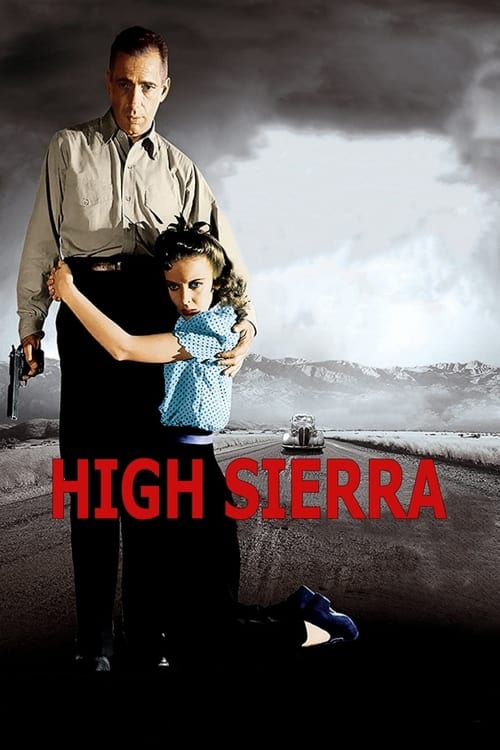
High Sierra
1941 · Raoul Walsh
For when you want classic Hollywood crime with a soul — a gangster picture that doubles as a story about growing old and running out of road. Satisfying both as a thriller and as a Sunday-afternoon classic.
What it's about
Roy Earle, an aging gangster, walks out of an Illinois prison — pardoned through the strings of a dying crime boss — and finds the world he was built for has moved on without him. He heads west for one last job: robbing a swanky resort in the Sierra Nevada foothills, saddled with amateur partners, a stray dog, and his own weariness. Along the way he reaches for something like a normal life, and the mountains wait at the edge of every frame.
The experience
Tough and fast on the surface, but shot through with melancholy — you're watching a man realize he's become a relic in real time. The final stretch in the mountains has a scale and fatalism that still lands hard.
Performances
This is the film that made Humphrey Bogart a star: after a decade of secondary heavies, he gives Roy Earle a genuine interior life — tired, decent, doomed. Ida Lupino matches him as Marie with a toughness and tenderness that anchors the whole picture.
The craft
Walsh directs with his trademark momentum, and the script — co-written by John Huston from W.R. Burnett's novel — gives pulp material real moral weight. The location shooting around Mount Whitney pays off spectacularly, trading studio backlots for genuine altitude and air.
Why it matters
It marked the moment the classic gangster cycle grew up, trading swagger for elegy, and it launched Bogart into the leading-man career that would define the decade. The 'last job' picture as we know it descends from here.
Snapshot
High Sierra is the film in which the American gangster picture grows old. Released by Warner Bros. in January 1941, it takes the studio's own most bankable formula — the criminal's rise and fall, told fast and hard — and turns it inside out by beginning at the end. Roy Earle emerges from an Illinois prison after years inside, pardoned through the intervention of a dying crime boss, and finds that the world he was built for has evaporated. The last job is a resort robbery in the Sierra Nevada foothills; the last act is a flight up Mount Whitney and a death on a rock face, shot from below by a sharpshooter, watched by newspapermen and gawkers.
The picture matters for three reasons. It gave Humphrey Bogart, after a decade of secondary heavies, a leading role with an interior life, and it did so months before The Maltese Falcon consolidated the persona. It gave John Huston, co-writing with W. R. Burnett from Burnett's own novel, the credit that helped lever him into directing. And it demonstrated that Raoul Walsh — a director of enormous physical fluency, working since the silent era — could stage a criminal's death as something closer to tragedy than to civic warning. The film sits at a hinge: still recognizably a Warners crime melodrama with a social conscience and a fast clip, already carrying the fatalism, the doomed romanticism, and the sense of a man out of joint with his period that the postwar critical vocabulary would name film noir.
Industry & production
High Sierra is a Warner Bros. product in the most specific sense: it belongs to a studio that had spent a decade industrializing the gangster film. Little Caesar (1931), adapted from a W. R. Burnett novel, and The Public Enemy (1931) established the house style — contemporary, urban, propulsive, morally hedged by an on-screen disclaimer. By 1941 the Production Code Administration had long since forced the cycle to reconfigure: the criminal could not be glamorized, could not go unpunished, and increasingly had to be reframed as an object of law-enforcement or reformist attention. Warners' adaptations of the middle and late thirties — the G-man variant, the prison-reform picture, the "environment made him" argument of Angels with Dirty Faces (1938) — are all products of that pressure. High Sierra takes the constraint and converts it into an aesthetic: because Roy must die, the film makes his death the subject rather than the punchline.
The property came to the studio as a Burnett novel published in 1940. Burnett was Hollywood's most reliable supplier of criminal-milieu fiction, and he worked on the screenplay alongside John Huston, then a contract writer at Warners who had already contributed to Jezebel, Juarez, and Dr. Ehrlich's Magic Bullet. Mark Hellinger produced — a former New York newspaper columnist whose feel for the criminal beat shaped several Warners crime pictures and who would later produce The Killers and The Naked City. Hal B. Wallis was the studio's executive production head over the period, and the picture bears the marks of the Wallis-era Warners assembly: efficient running time, location work integrated with studio interiors, a stock company of character actors.
The casting history is the part of the record most encrusted with anecdote, so it is worth stating what is solid and what is not. It is well established that Bogart was not the studio's first thought for Roy Earle and that Ida Lupino received top billing over him — a fact visible in the credits themselves and a fair index of their relative standing at Warners in early 1941. Beyond that, the frequently repeated stories about which stars turned the part down, and in what order, vary in their details across sources and should be treated as studio lore rather than settled fact. What is not in doubt is the consequence: the role transformed Bogart's standing, and Huston's The Maltese Falcon, released the same year, completed the transformation.
Lupino came to the film off They Drive by Night (1940), also directed by Walsh, also with Bogart in support, and the pairing of director and actress carried over. Warners' contract system supplies the rest of the cast: Alan Curtis and Arthur Kennedy as the young punks, Joan Leslie as the club-footed girl Roy sentimentally idealizes, Henry Hull as the disgraced doctor, Cornel Wilde as the hotel clerk, and — in a piece of casting that reads as pure studio pragmatism turned lucky — a dog named Pard whose bad-luck reputation becomes a running motif.
Technology
Nothing in High Sierra is technologically novel; everything in it is the mature state of an industrial art. It is a black-and-white picture shot on nitrate 35mm with the Academy ratio, on panchromatic negative of the fast, fine-grain generation that had arrived in the mid-thirties. That stock speed matters for the film's look: it permitted location shooting under available and lightly supplemented light, and it permitted interiors lit with less brute wattage and therefore with more selective, directional shaping — a precondition for the low-key style that noir would soon exploit.
Sound is recorded and mixed to the Vitaphone-era Warners standard, post-dubbed where location conditions demanded. Optical printing supplies the dissolves and the occasional in-camera-augmented transition; process photography — rear projection — handles a portion of the driving material, and the seams between rear-projected car interiors and genuine mountain-road exteriors are visible to a modern eye, as they are in nearly every studio film of the period.
The genuinely consequential technical decision was to go on location. Second-unit and principal photography in the Sierra Nevada, on the roads around Lone Pine and the Whitney Portal area, gave the film a scale and a specificity of terrain that no back-lot construction could match. Warners had been comfortable with location work for some years, but the extended use of real mountain geography as the arena of a climax was unusual for a gangster picture, whose genre home was the studio street.
Technique
Cinematography
Tony Gaudio photographed the picture. An Italian-born veteran who had been shooting since the earliest studio years, Gaudio had won the Academy Award for Anthony Adverse (1936) and had shot Little Caesar a decade earlier — a genealogy that makes him the ideal cameraman for a film about the gangster cycle looking back at itself. His work here is not showily expressionist. It is, rather, a controlled interplay between two registers.
The interiors — the roadhouse, the motor court, the hotel corridors during the robbery — are lit low and directionally, with faces carved out of surrounding darkness, pools of practical light, and shadow used to compress space. This is the visual grammar that critics would soon recognize as noir, arrived at by way of decades of German-influenced studio craft rather than by manifesto.
The exteriors invert everything. The mountain material is bright, deep-focused, and vast, with the human figure reduced to a mark on rock. The compositional argument of the film is carried in that inversion: Roy is a creature of enclosed rooms who is finally driven into open space, where enclosure was at least a kind of protection. The climactic material — the car climbing switchbacks, the abandoned vehicle, the scramble up the boulder field, the police cordon below — uses the real vertical relationship of the terrain, high-angle and low-angle setups that mean something because the height is genuine.
Editing
Jack Killifer cut the film, at the brisk Warners tempo. The construction is essentially two-movement. The first two-thirds are dispersed and novelistic: Roy's release, the drive west, the encounter with the Goodhue family and their granddaughter Velma, the camp with Babe and Red and Marie, the surveillance of the resort, the robbery. Scenes are allowed to breathe — the Velma material in particular is given room that a 1931 gangster picture would never have granted a subplot. The final movement compresses violently. Once the robbery goes wrong, the cutting tightens into an accelerating chase, cross-cutting Roy's ascent with the massing of police, the arrival of the press, and Marie's approach. The pattern — leisurely accumulation, then a rapid narrowing — is what gives the ending its sense of a trap closing rather than a fight ending.
Mise-en-scène / staging
Walsh's staging is founded on movement through real space. He blocks for continuous action, letting figures cross rooms and exit frames rather than cutting to reposition them, and he favors camera setups that keep the geography of a scene legible. The resort robbery is staged with that clarity: who is where, which corridor leads to which, how the alarm propagates.
The film's designed spaces do quiet thematic work. The Goodhue farmhouse and the Indiana-idyll fantasy Roy attaches to it are lit and dressed as a nostalgic dream he has no access to. The tourist camp is transient and shabby — cabins, a diner, everything provisional. The resort is a place of surfaces and moneyed leisure into which criminals are inserted as servants and intruders. And the mountain is the one location that is not designed at all, which is the point: it is the only space in the film that cannot be negotiated, bribed, or escaped.
Sound
Adolph Deutsch composed the score. Deutsch, a Warners staff composer of the period whose credits include The Maltese Falcon, writes in the studio's late-thirties symphonic idiom, with brass-heavy accents for action and a lyrical figure attached to the Roy–Marie relationship. The score is used sparingly in the film's mid-section and rises to full statement in the climb and the death, where it takes over from dialogue almost entirely.
More interesting is the film's use of unscored sound. The mountain sequence is built substantially on the acoustics of distance — the gunshots, the amplified voices of police, the sound of vehicles far below — and on Pard's barking, which is the device by which Roy's position is finally given away and which functions as the film's cruelest piece of sound design. The device is sentimental in conception and devastating in execution: the affection that briefly made Roy human is the thing that kills him.
Performance
Bogart's Roy Earle is the performance that made the rest of his career possible. It is built on stillness and on a specific kind of watchfulness — a man reading every room for exits, courtesy worn like a jacket over readiness. The famous early beat of Roy walking into a park after release, looking at grass and trees, establishes the register: not sentiment but a man checking whether the world is still there. Bogart plays the tenderness toward Velma without irony and the disillusion afterward without self-pity, and the combination of hardness and susceptibility is the template he would refine through Casablanca and beyond.
Ida Lupino's Marie is the other axis. Lupino plays her as a woman with no illusions who chooses attachment anyway, and she carries the film's final image — the appeal for Roy's freedom, spoken over his body. Henry Hull's Doc Banton supplies the film's diagnostic voice; Arthur Kennedy and Alan Curtis play the small-timers whose incompetence marks how far the criminal world has degraded since Roy's day; Joan Leslie's Velma is deliberately written and played as ordinary, which is what makes Roy's projection onto her legible as projection. Willie Best appears as Algernon, in a role written to the racial conventions of 1941 studio filmmaking — a limitation of the picture that a present-day account has to name plainly.
Narrative & dramatic mode
The film's structural innovation is to place the gangster's decline at the start. The classical Warners template — Little Caesar, The Public Enemy — is a rise-and-fall arc in which ambition is the engine and death the ledger's balancing entry. High Sierra has no rise. Roy is released into obsolescence; the boss who sprung him is dying; the associates he is given are amateurs; the job is a hotel heist rather than an empire. Every plot movement is a subtraction.
Onto that spine the film grafts two romances that function as alternative futures. Velma represents a fantasy of restoration — the farm, the small town, the ordinary life Roy imagines he can buy his way back into with an operation for her foot. Its collapse, when she rejects him for a boyfriend of her own generation, is the film's central deflation and its most novelistic passage. Marie represents the actual available future: shared exile, no illusion, love inside the criminal world rather than outside it. That the film lets the second be real, and lets the death happen anyway, is what separates it from moral melodrama.
The dramatic mode is therefore closer to fatalist tragedy than to cautionary tale. The picture's recurring language of luck — Pard as bad-luck dog, the small-time crooks' superstition, Doc's line of reasoning about men who "rush toward death" — supplies a vocabulary of destiny rather than of choice. Roy is not punished for greed; he is overtaken by time.
Genre & cycle
High Sierra belongs to the American gangster film and marks its late phase. The cycle's first wave (1930–1932) had been urban, immigrant-inflected, and topical, keyed to Prohibition. Code enforcement from 1934 fractured it, redirecting energy into law-enforcement pictures and reform dramas. By the end of the thirties, Warners was already looking backward: The Roaring Twenties (1939) — also directed by Walsh, also starring Cagney with Bogart in support — is explicitly an elegy for the Prohibition era, framed with newsreel-style narration. High Sierra extends that retrospective impulse into character.
It is also, formally, a heist film: the assembly of a crew, the casing of the target, the job, and the disintegration afterward. That structure — which Burnett and Huston would develop far more systematically in The Asphalt Jungle (1950), from another Burnett novel — makes High Sierra an important way station in the heist picture's development.
And it is a rural-flight film, joining the criminal narrative to American landscape in a way that anticipates the fugitive-couple and outlaw-on-the-road pictures. The move from city to mountain is the film's genre argument: the gangster's habitat is gone, so the gangster becomes an outlaw in the older, western sense, run to ground in open country.
Its relation to film noir is transitional. The term was applied retrospectively by French critics after the war to a body of American films whose characteristic fatalism, moral ambiguity, and expressive darkness High Sierra clearly possesses. But it lacks the flashback structure, the labyrinthine plotting, and the femme fatale of the fuller noir style, and it retains a sociological earnestness that noir would largely abandon. It is best read as a threshold work.
Authorship & method
Raoul Walsh's authorship is easy to underrate because it is unliterary. He had directed since the mid-1910s, had acted in The Birth of a Nation, and had made films across every studio genre; his method was speed, physical clarity, and a refusal of decorative technique. What recurs across his best work — The Roaring Twenties, High Sierra, White Heat (1949), They Died with Their Boots On (1941) — is a fascination with men whose vitality is inseparable from their destruction, staged with a directness that lets the tragedy register without underlining. Walsh does not psychologize Roy Earle; he places him in space and lets the space do the argument.
W. R. Burnett supplied the material and half the screenplay, and his contribution is the film's sociological texture: the argot, the hierarchy of the criminal economy, the sense of crime as a trade with generations and standards. John Huston's contribution is harder to isolate from Burnett's, since they wrote together and the source novel is Burnett's, but the dialogue's compression and the willingness to let a scene turn on a small human reversal are consistent with the work Huston would do immediately afterward as a director.
Tony Gaudio's photography, Adolph Deutsch's score, Jack Killifer's cutting, and Mark Hellinger's production sensibility complete the authorship. It is worth resisting the auteurist temptation to assign the film to any one of them: High Sierra is a studio object in the best sense, in which a director's spatial instinct, a novelist's milieu, a young writer's dialogue, and a veteran cameraman's light converge.
Movement / national cinema
The film is a product of classical Hollywood at its industrial peak, and specifically of Warner Bros. as the studio most identified with contemporary American subject matter — working-class settings, Depression economics, urban speech, topical plots. Within that, High Sierra participates in a broader late-Depression American structure of feeling: the closing of frontiers, the exhaustion of the individualist criminal as a figure of fascination, the sense that a period has ended.
Its stylistic inheritance runs partly through the German émigré presence in Hollywood — the low-key lighting and shadow-shaped interiors owe a debt to the Expressionist and Weimar street-film traditions that arrived with émigré cinematographers and directors through the twenties and thirties. But the film's dominant idiom remains American realism of milieu, not European stylization.
Era / period
January 1941 places the film in the last months of American non-belligerence. It is a Depression-shadowed picture made on the edge of the war economy, and the mood is legible in it: the migrant families, the tourist camps, the men with no place in the coming order. The Production Code is fully operative, and the film's negotiations with it are visible — Roy's death is structurally required, Marie's status is handled by implication, and Doc Banton's medical framing of criminality supplies the required interpretive scaffolding.
The Warners studio system is at its height and near its last unchallenged moment: the antitrust pressures that would culminate in the 1948 Paramount decision were already in motion, and television lay ahead. High Sierra, in that light, is a film made at the top of a system that was about to change, by a director trained in the silent era, for an audience about to go to war.
Themes
Obsolescence. The film's governing idea is that Roy Earle has outlived his historical moment. The men around him are amateurs; the boss who freed him is dying; the world of the twenties gangster no longer has institutions to sustain it.
The unavailable past. Roy's attachment to the farm, to Indiana, to Velma is nostalgia for a life he never had. The film treats that nostalgia with sympathy and then dismantles it, which is a harder and more honest maneuver than either endorsing or mocking it.
Luck, fate, and the "crashing out." The vocabulary of superstition — the dog, the omens, the sense that Roy is rushing toward something — recasts the Code-mandated death as destiny.
Tenderness as vulnerability. Every soft attachment Roy forms costs him: the money spent on Velma's operation buys nothing, the dog's affection reveals his position, the love for Marie makes his death an occasion for grief rather than for satisfaction.
Landscape as verdict. The mountain is neutral, indifferent, and final. The film's last movement replaces social explanation with geological scale.
Reception, canon & influence
High Sierra was well received in 1941 and was recognized at the time as a step up for Bogart, though the fullest articulation of its importance came later, as retrospective criticism traced the origins of noir and of Bogart's star persona. The specifics of its first-run financial performance vary across sources and are not reliably reconstructible here; what is clear is that it was successful enough to be a career-turning credit for Bogart and Huston and to be remade by Warners twice.
Influences on the film (backward). The Warners gangster cycle of the early thirties, and Little Caesar in particular, is the direct ancestor — the same novelist, the same cameraman, the same studio. The Roaring Twenties (1939) supplies the elegiac frame and the Walsh–Warners working relationship. Burnett's own body of crime fiction, with its procedural interest in the criminal trade, supplies the milieu. The Depression social-problem film supplies the migrant families and the environmental argument. German-influenced studio lighting supplies the interiors. And behind all of it stands the Western: the outlaw run to ground in high country is a nineteenth-century American story wearing a 1941 suit.
Legacy (forward). The most immediate effect was on Bogart, whose Roy Earle established the wounded-hard persona that The Maltese Falcon (1941), Casablanca (1942), and In a Lonely Place (1950) would develop. The second was on Huston, whose directing career began that same year. The third is generic: the Burnett–Huston heist structure recurs, far more rigorously, in The Asphalt Jungle (1950), which became the template for the modern caper film and for its European descendants. The fourth is the noir lineage itself — the doomed protagonist, the sympathetic criminal, the fatalist ending — which High Sierra helped make available to the decade that followed.
The film was remade directly as Colorado Territory (1949), Walsh's own Western transposition of the same story, and again as I Died a Thousand Times (1955) with Jack Palance. The 1949 remake is the more telling document: by moving the plot into the Western outright, Walsh confirmed what the original had implied about the gangster's kinship with the frontier outlaw. Walsh would also close his own gangster arc with White Heat (1949), whose ending — a criminal atop a structure, destroyed in open view — reads as High Sierra's mountain rewritten in fire.
The picture's reputation has been durable. It is a fixture in histories of noir's emergence, in accounts of the gangster cycle's transformation, and in studies of the Warner Bros. system; it was selected for preservation in the National Film Registry by the Library of Congress. What keeps it alive is not its innovations, which are modest, but its tone: the willingness to let a criminal be mourned, and to let the mourning be the film's last word.
A Deleuzian reading
A man comes out of prison and goes straight to a park.
The full Deleuzian reading of High Sierra →
Reception
A hit in 1941 that was read as the elegy for the 1930s gangster picture; today it's routinely claimed as proto-noir and, above all, remembered as the film that finally turned Humphrey Bogart from Warner's resident heavy into a leading man.
How High Sierra was received, from release to now →
How to watch High Sierra: what to notice on a first viewing
- Notice how dark the indoor rooms look compared to outdoors. Tony Gaudio lights roadhouses and hotel corridors low and shadowed, carving faces out of darkness, while every outdoor mountain shot stays bright and deep focused. Roy belongs to shadowed rooms, so watch what happens to him once he has nowhere left to hide but open ground.
- Watch characters walk fully across a room instead of being cut to. Walsh blocks scenes so people cross rooms and exit frame in a single continuous move, keeping the geography of a place clear at all times. You always know exactly where everyone stands, which is what makes the heist scene so tense to watch.
- Watch Roy's eyes when he first walks through the park. Bogart plays the scene without sentiment, more a man checking a room for exits than someone savoring freedom, courtesy worn over readiness. A single quiet scene tells you this is a man checking whether the world he knew is still there.
- Listen for the dog barking at odd, unprompted moments. Pard arrives early with a reputation as a bad luck dog, and his bark recurs through the film as a small, seemingly sentimental detail. A small piece of affection planted this early rarely stays harmless in a film built on subtraction.
- Notice how differently the farmhouse and the tourist camp look. The Goodhue farmhouse is dressed and lit like a nostalgic dream, while the camp where Roy actually lives is shabby, provisional, cabins and a diner. The film shows you which life is real and which one is only a picture Roy is holding onto.
The whole guide to watching High Sierra, with the keys for a rewatch →
Influences: the films it descends from and the films it influenced
- Underworld (1927) — Establishes the gangster's last stand as a geographic set-piece — Bull Weed barricaded, the police cordon drawn in tightening exterior long shots — the cornered-outlaw siege structure Walsh moves from tenement block to mountain rock.
- Little Caesar (1931) — Same source novelist (W. R. Burnett), same cinematographer (Tony Gaudio), same studio: High Sierra keeps Gaudio's hard low-key key light carving the criminal's face out of dark interiors while inverting Rico's rise-and-fall, beginning at the endpoint — the parole gate — and running only the fall.
- Scarface (1932) — Burnett worked on its script, and its finale — Camonte pinned inside a vertical stairwell shaft and shot from steep overhead angles — supplies the high/low vertical grammar Walsh reserves for Roy pinned on the rock face.
- I Am a Fugitive from a Chain Gang (1932) — The Warners social-problem method — grubby night exteriors, environmental causation argued through milieu rather than dialogue, and a protagonist finally dissolved into darkness instead of morally resolved — licenses High Sierra's refusal to convict Roy Earle.
- The Petrified Forest (1936) — Bogart's Duke Mantee — outlaw at bay in a desert roadside way station, held in stiff frontal medium shots as a fixed object — is the physical template High Sierra recasts, retaining the diner-and-highway geography while giving the same body an interior life.
- You Only Live Once (1937) — Lang's fugitive-couple flight, lit in German-derived low key with fog banks and raking beams, terminates with the man shot down in high wooded country — the precise terminal image and lighting logic Walsh's last reel reproduces on the Sierra slope.
- Stagecoach (1939) — Ford's deep-focus exteriors scale tiny human figures against monumental rock and make an escaped outlaw the moral center; High Sierra's Whitney long shots borrow that scalar contrast so the landscape, not the dialogue, delivers the verdict on Roy.
- The Roaring Twenties (1939) — Walsh's own elegiac gangster frame — the criminal killed in open public view, then immediately eulogized by a woman's line spoken over the body — is repeated structurally in Marie's closing question, and set the Walsh–Warners working method of fast continuous blocking over decorative cutting.
- The Maltese Falcon (1941) — Huston's directing debut, written and shot months after High Sierra: his method of transcribing a crime novelist's dialogue near-verbatim and staging it in long low-angle sustained takes was formed on the Burnett adaptation, and it inherits the wounded-hard Bogart register Roy Earle invented.
- They Live by Night (1948) — Ray extends the two-romances-as-futures device — an outlaw offered a domestic life he is structurally barred from entering — and keeps the fatalist coda in which the woman survives to pronounce the film's last word over the man's body.
- Colorado Territory (1949) — Walsh's own beat-for-beat Western transposition of the same Burnett plot, down to the cliff-dwelling finale and the hunted man cornered above a posse, making explicit the frontier chassis under the 1941 gangster body.
- White Heat (1949) — The mountain rewritten as a gas tank: a criminal elevated above a police cordon and destroyed in open view, cut in the same climactic crosscut rhythm, with amplified police voices carrying across open distance exactly as the loudspeaker reaches Roy on the rock.
- Gun Crazy (1950) — Lewis compresses the two-movement structure — job, then flight — into one continuous run that ends in fog-bound high marshland with the couple shot down, retaining the pattern of a barking-dog-scale accident of sound betraying the fugitives' position.
- The Asphalt Jungle (1950) — Burnett and Huston rebuild the heist rigorously — specialist crew assembled by trade, the financier's betrayal, the thief dying in pastoral home country — turning the loose Mendoza/Big Mac machinery of High Sierra into the modern caper template.
- Rififi (1955) — Dassin exports the Burnett–Huston crew-assembly-and-collapse architecture to Paris intact, keeping the closing movement in which the wounded thief drives toward a place of origin and dies short of it.
- Bonnie and Clyde (1967) — Penn's ambush climax crosscuts the assembled cordon against unaware criminals with the same accelerating rhythm Walsh uses on the mountain, and makes mourning the criminals — not judging them — the film's final gesture.
- In a Lonely Place (1950) — Gave Bogart the sympathetic-killer template of tenderness shadowed by lethal violence, the exact persona Ray fractures by casting him as a man we come to fear.
- The Getaway (1972) — Codified the aging professional criminal pulling one last job and fleeing into rugged terrain with a woman at his side, treating criminal competence as a personal code — the professionalism ethic McQueen's Doc inherits.
- Le Deuxième Souffle (1966) — The figure of the honorable outlaw hunted to an inevitable death — the doomed professional whose dignity is stillness — is the noir archetype Melville stylizes into Gu.
- Pursued (1947) — Walsh's own design of a fatalistic protagonist hunted to a death among the rocks supplies the trapped-man momentum he interiorizes and psychologizes in Pursued.
- The Grapes of Wrath (1940) — Toland's deep-focus staging of dispossessed migrant families around jalopies and roadside camps is imported almost intact for the Goodhue family, whose scenes carry the Depression film's environmental argument into a gangster picture.
- They Drive by Night (1940) — Walsh's immediate prior picture with the same Bogart–Ida Lupino pairing; Lupino's clenched, closed-off performance register and Walsh's unfussy fast highway staging transfer directly into Marie and the road sequences.
Similar films
- The Maltese Falcon (1941) — influence & lineage
- The Roaring Twenties (1939) — influence & lineage
- White Heat (1949) — influence & lineage
- The Asphalt Jungle (1950) — influence & lineage
- The Treasure of the Sierra Madre (1948) — shared sensibility
- A Fistful of Dollars (1964) — shared sensibility
- The Harder They Fall (1956) — shared sensibility
- Ride the High Country (1962) — shared sensibility