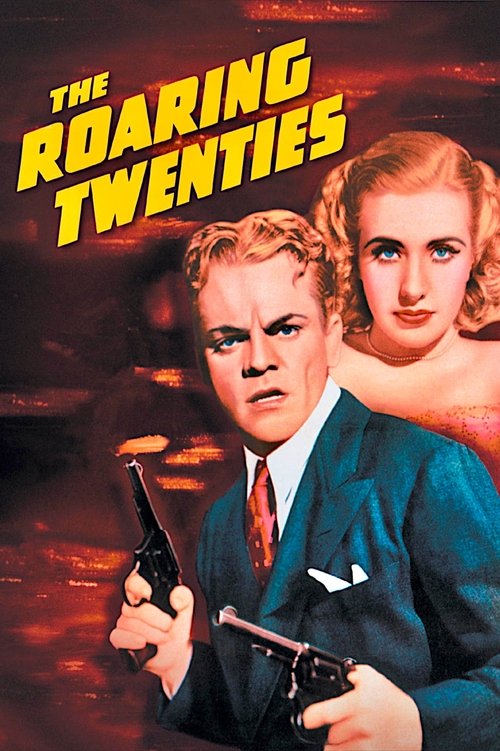
The Roaring Twenties
1939 · Raoul Walsh
For when you're in the mood for a classic crime saga with swagger and a broken heart — an old-Hollywood night where you want tommy guns, nightclubs, and an ending that stays with you.
What it's about
Three men come home from the trenches of World War I to an America with no place for them. One returns to law, one turns to bootlegging with a cold streak, and Eddie Bartlett — jobless and restless — drives a cab until Prohibition offers him a way up. He builds a liquor empire through the boom years of the 1920s, but love, loyalty, a ruthless partner, and the crash of 1929 are all waiting to collect.
The experience
Fast, punchy, and finally mournful — it barrels through a decade with montage-driven momentum, then slows into something surprisingly sad, a rise-and-fall story told with the weariness of hindsight. The last stretch lands with real emotional weight.
Performances
James Cagney gives one of his greatest gangster performances, all coiled energy and wounded pride, charting Eddie's rise and ruin with startling vulnerability. A young Humphrey Bogart is chillingly effective as his treacherous partner, and Gladys George is superb as the nightclub singer who sees Eddie clearly.
The craft
Raoul Walsh directs with tremendous pace, using newsreel-style narration and whirlwind montages to compress a whole American decade — the war, the speakeasies, the crash — into pulp history. The nightclub scenes and shootouts are staged with the confidence of a studio at the top of its craft, and the final images are among the most famous in the genre.
Why it matters
The elegiac capstone of the 1930s Warner Bros. gangster cycle, it closed the era that invented the American crime film and shaped every rise-and-fall gangster epic that came after.
Snapshot
The Roaring Twenties is Warner Bros.' elegiac summation of the gangster cycle it had itself invented at the start of the decade. Released in October 1939, it follows Eddie Bartlett (James Cagney), a doughboy who comes home from the Great War to no job and drifts into bootlegging, rises to command a liquor empire, and is finally ruined — first by the 1929 crash, then by love, loyalty, and the cold ambition of his partner George Hally (Humphrey Bogart). Where Little Caesar and The Public Enemy had been urgent bulletins from the criminal present, this film treats Prohibition-era crime as recent history, framed by a spoken newsreel narration and by written forewords that explicitly liken the picture to a newspaper account of a vanished age. It is at once the last major entry in the classic 1930s gangster cycle and a self-conscious act of retrospection — a film that mourns its own genre and its own decade. The closing image, with saloon hostess Panama Smith (Gladys George) cradling the dead Eddie on the snow-covered steps of a church, and her epitaph "He used to be a big shot," is among the most quoted endings in Hollywood crime cinema.
Industry & production
The film was produced by Warner Bros. at the height of the studio's identity as the house of topical, working-class melodrama. Its origins lie with Mark Hellinger, the former New York newspaper columnist whose story — variously titled in development and drawn from figures and incidents he claimed to have known from the Prohibition demimonde — supplied both the plot and the film's governing conceit of journalistic reportage. Hellinger's signed foreword frames the movie as a chronicle of an era the audience had lived through, and his newspaperman's sensibility shapes the whole enterprise. The screenplay is credited to Jerry Wald, Richard Macaulay, and Robert Rossen — the last a Warner staff writer of strong social-realist leanings who would later become a significant director in his own right — working from Hellinger's original story.
Production came during 1939, an extraordinary year for the American industry and a transitional one for Warner's gangster product. The Production Code, rigorously enforced since 1934, had made the unrepentant gangster protagonists of the early decade impossible; the studio had already begun recasting its criminals as socially explicable, doomed, or redeemed figures. The Roaring Twenties answers the Code partly by historicizing its violence — the lawlessness belongs to a closed chapter, safely past, its economic and moral causes laid out almost as sociology. Cagney, Warner's most valuable and most combative star, was near the end of his first long tenure at the studio; the film is often described as his last gangster role there before a period of contractual and creative realignment. The pairing with Bogart continued a run of films in which Bogart played the harder, colder foil to Cagney's volatile energy, following Angels with Dirty Faces (1938) and The Oklahoma Kid (1939).
Technology
Technically the picture is a mature product of the late-1930s studio system: 35mm black-and-white photography in the Academy ratio, recorded with the sound-on-film systems that had by then wholly displaced Warner's pioneering disc-based Vitaphone. Its most distinctive technological signature is the montage apparatus that Warner Bros. had refined into a house specialty — optical-printer superimpositions layering marching men, tumbling stock tickers, spinning newspapers, exploding shorelines of illegal liquor, and shattering champagne glasses into compressed passages of historical time. These sequences depend on the optical printer and the montage department's craft in combining stock footage, miniatures, and specially shot inserts under the driving voice of newsreel narration. The result is a technology of temporal compression: a decade and a half of national history — Armistice, the boom, speakeasy culture, the crash, the breadlines, Repeal — is conveyed less through dramatized scenes than through these engineered collages.
Technique
Cinematography
Ernest Haller photographed the film in the same remarkable year he shot Gone with the Wind, and his work here is a study in Warner's low-key, high-contrast urban idiom. The nocturnal world of garages, speakeasies, and rain-slicked streets is rendered in deep shadow and hard pools of light that anticipate, in mood and lighting logic, the film noir of the following decade. Haller's compositions favor functional clarity in the dramatic scenes and give way, in the transitional passages, to the density of the montages. The famous finale — Eddie's staggering, mortal walk and collapse on the church steps in falling snow — is staged and lit for maximum pictorial pathos, the diagonal of the steps and the isolating darkness turning a gangster's death into something close to a Pietà.
Editing
Jack Killifer receives the picture editing credit, but the film's editorial personality is inseparable from its montage sequences, whose construction is commonly attributed to Warner's montage unit and to Don Siegel, then working as a montage specialist at the studio before his own directing career. The montages do narrative labor that dialogue scenes would find impossible, collapsing years into seconds and binding the private fortunes of the characters to the public tides of the era. Between these bursts of accelerated time, the dramatic scenes are cut in the brisk, unfussy Warner manner, keeping pace with Cagney's kinetic performance.
Mise-en-scène / staging
The film's world is built from Warner's stock of Depression-era urban environments: the trench dugout of the opening, the cab garage, the shabby-then-lavish speakeasies, the newspaper-strewn streets of the crash. Staging repeatedly contrasts the crowded, energetic tableaux of the boom — packed bars, dancing, the machinery of the rackets — with the emptied, desolate spaces of Eddie's decline. Walsh choreographs the ensemble with an emphasis on movement and physical business rather than static composition, and reserves his most concentrated staging for the two great set pieces: the wartime prologue and the church-steps coda.
Sound
Sound is central to the film's design. A stentorian newsreel-style narration (delivered by an off-screen announcer) supplies the connective historical commentary, treating the fiction as documented fact. Period popular songs function almost as chapter markers and emotional barometers: numbers associated with the era — including the torch material sung by Priscilla Lane's Jean and the standards that fill the speakeasies — root the drama in the sound of the twenties and early thirties. Heinz Roemheld's scoring and the Warner music department's arrangements (the studio's musical direction of this period is closely associated with Leo F. Forbstein's department) weave these songs through the underscore so that the music itself becomes a vehicle of nostalgia and of dramatic irony.
Performance
Cagney gives one of his definitive performances — the coiled physical aggression, the sudden tenderness, the wounded pride of a man who believes decency will be rewarded and is proven catastrophically wrong. His Eddie is the sympathetic gangster the late-Code cycle required: a veteran failed by his country, driven to crime by unemployment, undone by a love that is not returned and a partner who feels no loyalty. Bogart's George Hally is the negative image — pragmatic, treacherous, without sentiment — and the role is a significant marker in Bogart's ascent from stock heavies toward stardom. Gladys George's Panama Smith supplies the film's rueful conscience and its final, famous line, while Priscilla Lane and Jeffrey Lynn carry the romantic subplot whose disappointments help seal Eddie's fate.
Narrative & dramatic mode
The film operates in a hybrid mode: a classical rise-and-fall gangster tragedy nested inside a pseudo-documentary chronicle of an era. The dramatic arc is the familiar parabola — ascent from nothing to criminal empire, then descent to ruin and death — but the framing insists that this personal trajectory is representative, a case study in what Prohibition and the Depression did to a generation of returning soldiers. The narration and montages give the picture an almost essayistic spine, periodically pulling back from the characters to survey the national weather. The tragedy is thus doubly determined: by Eddie's flaws (his loyalty, his refusal to see that Jean loves another, his misplaced trust in George) and by impersonal historical forces (economic collapse, the criminal marketplace) that no individual virtue could withstand.
Genre & cycle
This is the summation, and to some extent the eulogy, of the Warner Bros. gangster cycle that began with Little Caesar (1930) and The Public Enemy (1931). By 1939 the pure form had been rendered obsolete by the Code and by audience fatigue; The Roaring Twenties survives by historicizing the genre, presenting the gangster not as a present menace but as a figure of the recently dead past. In doing so it also anticipates film noir — in its fatalism, its shadowed cities, its doomed protagonist, and its cold antagonist. It belongs, too, to the strain of Hollywood filmmaking that fictionalizes contemporary history through the vocabulary of the newsreel, and to the sub-genre of the Depression-veteran social-problem film. Its "biography of an era" structure makes it a forerunner of the epic-scale gangster chronicle later exemplified by films that trace criminal lives across decades.
Authorship & method
Raoul Walsh directed, and the film sits comfortably within his body of work as a chronicler of energetic, physically expressive men brought low — a director whose reputation was later reclaimed by auteurist critics (Andrew Sarris placed Walsh among the important American directors), prized for narrative drive, unsentimental vigor, and a feeling for action and movement. Walsh's contribution here is the momentum and the emotional directness that keep a schematic story alive, and the staging of its indelible finale. But authorship of The Roaring Twenties is genuinely collaborative and studio-shaped. Mark Hellinger's original story and journalistic framing supply its documentary conscience; the screenplay by Wald, Macaulay, and Rossen articulates its social argument; Ernest Haller's cinematography gives it its shadowed look; the montage unit (with Don Siegel's involvement) engineers its historical sweep; the Warner music department binds it to the songs of the era; and Cagney and Bogart supply the two poles of its moral force. The film is a paradigm of Warner Bros. house authorship, in which a recognizable studio style and stable of talents matter as much as any single signature.
Movement / national cinema
The picture is a specimen of classical Hollywood at the peak of the studio system, and specifically of the Warner Bros. variant of it: topical, fast, working-class in sympathy, socially conscious in a populist register. It carries the studio's characteristic interest in economic hardship and institutional failure, filtered through star vehicles and genre formulas. It has no direct relationship to the European art cinemas of its moment, but its montage aesthetic descends, at a commercial remove, from the associative editing traditions that had entered Hollywood practice, and its fatalistic urban vision feeds the American movement — film noir — that would crystallize in the 1940s.
Era / period
The Roaring Twenties is a 1939 film about 1919–1933: made at the end of the Depression decade and on the eve of the Second World War, it looks back a mere handful of years to Prohibition and the crash. That short historical distance is the source of its peculiar power and its nostalgia; the era it depicts was still within living memory of nearly everyone in the audience. Its timing also marks a threshold — the last gasp of the pure 1930s gangster film, released in the same annus mirabilis as Gone with the Wind, Stagecoach, and Mr. Smith Goes to Washington, just before the industry's energies turned toward the coming war.
Themes
At its core the film is about the betrayal of the ordinary man by history. Eddie is a soldier who returns to find no place for himself, is pushed into crime by unemployment, prospers only within a corrupt economy, and is destroyed when that economy collapses — a pointed argument that criminality here is a symptom of social failure rather than innate evil. Loyalty and its absence structure the drama: Eddie's fatal fidelity against George's utter faithlessness. Prohibition itself is treated as a national folly that manufactured an underworld. Love, unattainable and misdirected, is the personal counterpart to economic ruin. And over everything hangs nostalgia and mortality — the sense of a whole era, gaudy and doomed, already passing into legend, memorialized in the final line's use of the past tense: he used to be a big shot.
Reception, canon & influence
Contemporary audiences received the film as a strong entry in Warner's crime output and as a showcase for Cagney; I will not attach specific box-office figures or individual critical quotations to it, since I cannot verify exact numbers or wordings, but its standing as a commercial and popular success of 1939 is well attested in the historical record. Its critical reputation has grown over time. It is now widely regarded as the capstone of the classic gangster cycle, the film that closed the genre it inherited even as it perfected the "portrait of an era" mode of crime storytelling. Walsh's own reputation, elevated by later auteurist criticism, has drawn renewed attention to it.
Looking backward, the film draws on the gangster template established by Little Caesar and The Public Enemy, on the newsreel and social-problem traditions of Warner's 1930s house style, and on Mark Hellinger's journalistic mythology of the Prohibition underworld. Looking forward, its influence is broad: its documentary-montage compression of history, its sympathetic-doomed-gangster figure, and its decades-spanning elegiac structure echo through later crime cinema, and its central pairing helped propel Bogart toward the stardom he would achieve in the following decade. The image of the big shot who ends up dead on the pavement, mourned by a woman who knew him when, became one of the genre's foundational tableaux — a template that later gangster epics would return to and enlarge. As a film that both consummates and buries its own genre, The Roaring Twenties occupies a distinctive place in the canon: the moment the 1930s gangster film became history and, in the same gesture, became myth.
A Deleuzian reading
The image you keep from *The Roaring Twenties* may be one with nobody in it.
The full Deleuzian reading of The Roaring Twenties →
Reception
In 1939 it landed as a solid hit but felt like a nostalgic capstone to a gangster cycle already going out of style; today it's ranked among the greatest of all gangster pictures, with a Criterion release in 2021 sealing the reappraisal.
How The Roaring Twenties was received, from release to now →
Influences: the films it descends from and the films it influenced
- The Musketeers of Pig Alley (1912) — Establishes the location-shot, tenement-realist staging of urban criminal milieu that Walsh treats as documentary texture rather than melodrama backdrop.
- Regeneration (1915) — Walsh's own Bowery-gangster feature pioneers the naturalistic rise-from-the-slums arc and kinetic street action he re-deploys here with more elegiac framing.
- Underworld (1927) — Codifies the sympathetic-doomed-gangster figure and the low-key, deep-shadow underworld lighting that Haller's cinematography inherits and hardens toward noir.
- Little Caesar (1931) — Supplies the rise-and-fall structural template — ambition, ascendancy, isolation, death on the street — that Walsh compresses and then mourns.
- The Public Enemy (1931) — Builds the Cagney gangster persona (explosive physicality, streetwise charm) and the Warner working-class-origins framing that Eddie Bartlett directly extends.
- Scarface (1932) — Perfects the rapid montage of headlines, gunfire, and calendar-time to compress a criminal career — the editing grammar Siegel's montage unit adopts for historical sweep.
- I Am a Fugitive from a Chain Gang (1932) — Models Warner's social-problem method — journalistic, quasi-documentary indictment of systemic failure — that supplies the film's Hellinger-driven documentary conscience.
- The March of Time (1935) — Its authoritative newsreel-narration-over-montage format is the direct model for the film's pseudo-documentary frame narrating history between the dramatic scenes.
- High Sierra (1941) — Walsh reworks the elegiac doomed-gangster arc — the aging outlaw out of his era, mourned by a woman, dying exposed — this time elevating Bogart to lead.
- Citizen Kane (1941) — Its 'News on the March' opening reel weaponizes the same newsreel-narration-plus-montage device to sketch a life-and-era before the drama proper begins.
- White Heat (1949) — Walsh and Cagney reunite to give the gangster a final apocalyptic curtain, extending the operatic, doom-shadowed death tableau Eddie Bartlett's staircase finale prefigures.
- Bonnie and Clyde (1967) — Revives the Depression-era-crime-as-national-myth mode and the sympathetic-doomed-outlaw framing, treating period detail and inevitable death as elegy.
- The Godfather Part II (1974) — Enlarges the decades-spanning rise-and-fall epic into a formal architecture, using period texture and historical time as the medium of a criminal's moral ruin.
- Once Upon a Time in America (1984) — Extends the elegiac, era-spanning gangster structure — Prohibition memory, mortality, the survivor mourning what was lost — to its fullest nostalgic scale.
- Goodfellas (1990) — Uses period-song needle-drops, first-person narration, and headline/montage compression to render a gangster's whole era rise and collapse — the film's sound-and-montage historiography perfected.
- Bugsy (1991) — The Warner Bros. gangster cycle's structure of the criminal as doomed businessman of vice, the rise-and-fall arc Bugsy reconstructs as period myth.
- Body and Soul (1947) — Warner social-melodrama rise-and-fall arc — a Depression striver climbs on rackets and is destroyed by them — that structures Charlie's parabola.
- Angels with Dirty Faces (1938) — Pairs Cagney and Bogart within the Warner house style one year earlier, rehearsing the doomed-gangster-and-treacherous-partner dynamic Walsh reprises.
Similar films
- Bonnie and Clyde (1967) — influence & lineage · often watched together
- White Heat (1949) — influence & lineage
- High Sierra (1941) — influence & lineage
- Scarface (1932) — influence & lineage
- GoodFellas (1990) — influence & lineage
- I Am a Fugitive from a Chain Gang (1932) — influence & lineage
- Once Upon a Time in America (1984) — influence & lineage
- The Big Sleep (1946) — often watched together