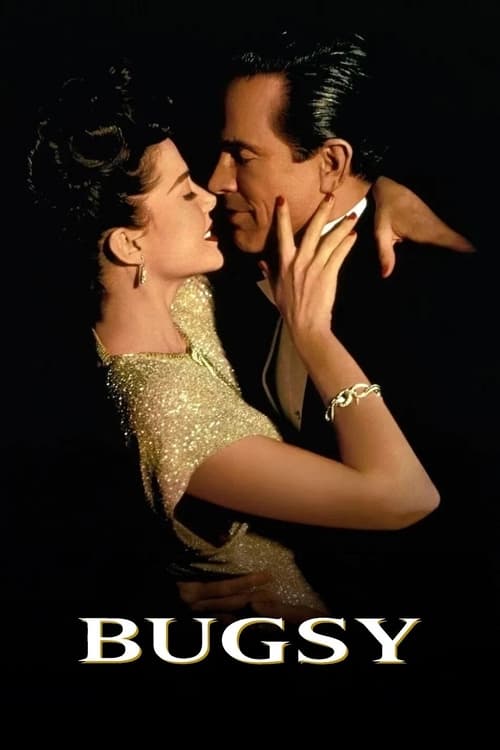
Bugsy
1991 · Barry Levinson
For an old-fashioned grown-up movie night: when you want glamour, crackling banter, and a big flawed dreamer to watch rise and overreach. More velvet than grit — comfort viewing for crime-saga lovers.
What it's about
Ben 'Bugsy' Siegel, a sharp-dressed New York mobster with movie-star looks and a hair-trigger temper, comes to 1940s Los Angeles on syndicate business and falls twice: for Hollywood, and for Virginia Hill, a whip-smart starlet who won't be handled. Then a run-down gambling joint in the Nevada desert gives him a vision — a glittering resort in the middle of nothing — and he starts spending other people's money to build it.
The experience
Lush and seductive rather than brutal — a gangster picture that plays like a doomed romance, with sudden flashes of violence to remind you what the charm is built on. It's witty, glamorous, and quietly tragic in its momentum.
Performances
Warren Beatty plays Siegel as a man performing himself — vain, charming, and genuinely frightening when the mask slips — and Annette Bening matches him beat for beat as Virginia Hill; their chemistry is the film's engine (and famously outlived the shoot). Ben Kingsley and Harvey Keitel add flint around the edges as the mob's cooler heads.
The craft
Barry Levinson and writer James Toback treat the gangster film as a story about self-invention, and the production drapes it in gorgeous 1940s period detail — the costumes and sets won Oscars. Ennio Morricone's romantic score and the honeyed cinematography make the desert-dream sequences genuinely swoon, best appreciated on a big screen.
Why it matters
A ten-nomination prestige hit that reframed the birth of Las Vegas as American myth, it marked a career peak for Beatty the producer-star and famously brought Beatty and Bening together off-screen as well as on.
Snapshot
Bugsy is Barry Levinson's lustrous, ironic biopic of Benjamin "Bugsy" Siegel, the New York–bred mobster who carried Murder, Inc. muscle to Los Angeles in the late 1930s and early '40s, fell in love with the movies and with the magnetic, mercurial Virginia Hill, and conceived the Flamingo — the resort that, in the film's romantic telling, dreams modern Las Vegas into being. Produced by and starring Warren Beatty, written by James Toback, and directed by Levinson at the crest of his prestige (three years after Rain Man swept the Oscars), the film treats the gangster picture as a vehicle for a larger American obsession: self-invention as both gift and pathology. It is less interested in the mechanics of organized crime than in the seduction of glamour, image, and vision — Siegel as a man who wants to be looked at, who rehearses his own diction with an elocution record, who sees in a stretch of desert not a swindle but a cathedral. Nominated for ten Academy Awards, winning for art direction and costume design, Bugsy sits in the same early-'90s gangster revival as Goodfellas and Miller's Crossing but pulls toward old-Hollywood gloss rather than streetwise realism.
Industry & production
Bugsy was a Mulholland Productions / Baltimore Pictures release through TriStar Pictures, a vehicle shaped from the start by Warren Beatty's clout as a producer-star. Beatty had long incubated the project, drawing on Dean Jennings's biography We Only Kill Each Other: The Life and Bad Times of Bugsy Siegel and on Toback's screenplay; Toback and Beatty had a working relationship dating to Toback's script for The Pick-up Artist (1987), which Beatty produced. The producing credit was shared among Beatty, Levinson, and Mark Johnson, Levinson's longtime producing partner from Baltimore Pictures. The film was a major-studio prestige production of the early 1990s, budgeted at a scale consistent with a star-driven period drama (reports place it around the $30 million range; I'd treat the precise figure with caution rather than assert it). It opened in limited release in December 1991 to qualify for awards before expanding.
Commercially, Bugsy is generally remembered as a respectable rather than blockbuster performer — a film whose returns were modest relative to its cost and prestige profile. I won't attach a specific gross to that characterization, as I can't verify the exact box-office figures with confidence. Its true industrial payoff was reputational: ten Oscar nominations, including Picture, Director, Actor, two Supporting Actor slots, Original Screenplay, Cinematography, and Original Score, and a Golden Globe for Best Motion Picture – Drama. A durable piece of off-screen lore: Beatty and co-star Annette Bening met on the production and married, ending the long bachelorhood that had become part of Beatty's public persona — a biographical fact frequently folded into readings of the film's romance.
Technology
Bugsy is a conventional 35mm photochemical production of its era, with no notable technical innovation; its sophistication lies in craft applied to period reconstruction rather than in novel apparatus. The relevant "technology" is the machinery of studio period filmmaking circa 1991: anamorphic-era lighting practice, large standing and dressed sets, and extensive costuming and set decoration to reconstruct late-1930s/1940s Los Angeles, New York, and the pre-development Nevada desert. The film predates the digital-effects turn, so its Las Vegas-that-isn't-yet — the lonely desert site that Siegel imagines transformed — is achieved through location, set construction, and art direction rather than CGI. Any claim beyond this about specialized rigs or processes would be speculation; the record I can stand behind is that the film's accomplishment is one of design and photography, not of technological firsts.
Technique
Cinematography
Allen Daviau, the cinematographer most associated with Steven Spielberg (E.T., The Color Purple, Empire of the Sun), shot Bugsy and earned an Academy Award nomination for it. His work leans into a burnished, golden classicism — warm interiors, glamorous close-ups, and a controlled palette that flatters both the period and the stars. The camera treats Siegel the way Siegel wants the world to treat him: as a leading man. Faces are lit for beauty; the Hollywood-mansion and nightclub interiors glow. Against that, the desert exteriors open the frame to emptiness and harsh light, visually staging the gap between Siegel's grandiose vision and the literal nothing in front of him. The cinematography is in service of the film's thesis that gangsterism and stardom share a vocabulary of surfaces.
Editing
The film was cut by Stu Linder, Levinson's regular editor across this period of his career. The editing favors classical clarity and performance — long enough takes to let Beatty's charm and sudden violence register, and a rhythm that privileges character and dialogue over kinetic montage. This is a deliberate contrast to the velocity of Goodfellas the year before: where Scorsese accelerates, Bugsy lingers, building its tension through conversation, seduction, and the slow swelling of Siegel's obsession. The cutting supports a tone of ironic romance rather than documentary propulsion.
Mise-en-scène / staging
Bugsy won its Oscars precisely here. Production designer Dennis Gassner (with set decorator Nancy Haigh) and costume designer Albert Wolsky took the statuettes for art direction and costume design respectively, and the film's surfaces are its argument. The world is staged as a continuous performance of taste and money: tailored suits, deco interiors, mansions, nightclubs, and the increasingly absurd opulence of the half-built Flamingo rising from the dirt. Levinson stages Siegel within these spaces as a man composing himself for an audience, and the production design makes the film's central irony tactile — the Flamingo's marble-and-velvet excess sprouting incongruously from barren desert is the visual punchline and tragedy at once.
Sound
The dominant sonic element is Ennio Morricone's score (discussed below under authorship). Beyond the music, the soundscape is period-appropriate and unshowy, supporting the dialogue-forward construction. I don't have specific, verifiable details about the sound design or mixing team to elaborate further without inventing them, so I'll leave the claim at the level of what the film audibly does: foreground performance and score.
Performance
Performance is the film's engine. Warren Beatty plays Siegel as a charismatic narcissist — courtly, vain, and capable of switching to terrifying violence without transition — and the elocution-record motif (Siegel rehearsing the phrase "twenty dwarves took turns doing handstands on the carpet") crystallizes the character's obsession with self-presentation. Annette Bening's Virginia Hill matches him as a sharp, willful equal rather than an accessory, and the chemistry reads on screen. The supporting cast is unusually deep: Harvey Keitel as Mickey Cohen and Ben Kingsley as Meyer Lansky both earned Supporting Actor nominations, Kingsley's Lansky offering a cool, calculating counterweight to Siegel's flamboyance. Joe Mantegna plays actor George Raft, Elliott Gould plays Harry Greenberg, and Bebe Neuwirth appears as well. The ensemble's register — theatrical, witty, slightly heightened — fits the film's view of gangsterdom as showbiz by other means.
Narrative & dramatic mode
The film is a biographical tragedy structured as a romance and a dream-of-empire. Its dramatic mode is ironic and elegiac rather than procedural: we know, as Siegel cannot fully admit, that the Flamingo will ruin him, and the film extracts its pathos from watching a charming man talk himself into a vision that the people financing him read as theft. Toback's screenplay braids two arcs — the volatile love affair with Virginia Hill and the escalating gamble of the Flamingo — so that romance and obsession become the same impulse. Violence punctuates rather than drives the narrative; the suspense is psychological and financial. The mode is closer to the romantic tragedy of an overreacher than to the rise-and-fall ledger of a typical crime saga, and the ending is delivered with a coda noting what the Flamingo would become — a final ironic gesture that converts Siegel's failure into prophecy.
Genre & cycle
Bugsy belongs to the gangster biopic and to the early-1990s revival of the gangster film, arriving in close company with Goodfellas (1990), The Godfather Part III (1990), Miller's Crossing (1990), and Billy Bathgate (1991). Within that cycle it is the glamour entry — the one that fuses the mob picture with the Hollywood-on-Hollywood film and the period prestige drama. It is also a Las Vegas origin myth, one of the foundational screen accounts of how the Strip's founding legend attaches to Siegel and the Flamingo (a legend the film knowingly romanticizes; historians have long complicated the "Bugsy single-handedly invented Vegas" narrative, and the movie is best read as myth-making rather than documentary). Its hybridity — crime, romance, showbiz satire, period epic — is exactly what distinguishes it from the harder-edged realism of its cyclemates.
Authorship & method
The film is a convergence of strong authorial signatures. Barry Levinson, fresh off Rain Man's Best Picture and Director wins and known for his humane, dialogue-driven Baltimore films (Diner, Tin Men, Avalon), directs with an emphasis on character, talk, and tonal control rather than visual aggression. Warren Beatty, as producer-star, is arguably the film's primary author in the auteur sense — Bugsy is continuous with his career-long fascination with charismatic, self-mythologizing men and with his own image (compare Reds, Heaven Can Wait, and later Bulworth). James Toback, the screenwriter, brings his recurrent preoccupations with obsession, risk, and masculine self-destruction; the script earned an Oscar nomination. Allen Daviau supplies the glamorous photography, Stu Linder the classical cutting, Dennis Gassner and Albert Wolsky the award-winning design and costumes, and Ennio Morricone the score — a lush, melancholic, romantic theme that nudges the film toward operatic tragedy rather than crime grit, and which received an Oscar nomination. The method, broadly, was prestige studio filmmaking organized around a star's long-gestating passion project, with top-tier department heads assembled for period verisimilitude and gloss.
Movement / national cinema
Bugsy is mainstream American studio cinema — Hollywood examining its own mythology from within. It does not belong to any avant-garde or national-cinema movement; its lineage is the classical Hollywood gangster tradition (Warner Bros. crime films, Little Caesar, Scarface) refracted through New Hollywood prestige filmmaking. Its most movement-adjacent quality is reflexive: it is an American film about the American dream machine, set partly inside the film industry (the George Raft subplot, Siegel's screen test, the lure of stardom), so that "national cinema" here means Hollywood turning the camera on the romance of America itself — money, reinvention, the frontier remade as a casino.
Era / period
Two periods matter. As a story, Bugsy is set in the late 1930s and 1940s, ending in 1947, and devotes enormous craft resources to reconstructing that world. As an artifact, it is a product of early-1990s Hollywood, when adult-oriented prestige dramas and gangster films commanded major budgets and awards attention, and when star-producer passion projects could still be financed at scale by studios. It reflects a moment when the gangster genre was being simultaneously revitalized (Scorsese) and romanticized (Beatty/Levinson), and when period authenticity in design and costume was a recognized awards currency. The film's nostalgia is double: a 1991 film nostalgic for 1940s glamour, made by an industry nostalgic for its own golden age.
Themes
The governing theme is self-invention — the American faith that a man can author himself, and the thin membrane between visionary and con man, dreamer and delusional. Siegel's elocution lessons, his screen test, his obsession with how he appears, all dramatize identity as performance. Linked to this is the convergence of crime, capitalism, and show business: the film insists that the gangster, the movie star, and the casino magnate are versions of the same figure, all selling image and spectacle. The American Dream as gamble runs throughout — the Flamingo is the dream literalized as a bet placed in the desert, and the film's tragedy is that Siegel believes in it more sincerely than his backers can tolerate. Obsessive love mirrors the obsession with the Flamingo; Virginia Hill and the hotel are rival, intertwined fixations. Finally, vision versus accountability: Siegel is destroyed not because his idea is wrong (the coda confirms its prophetic genius) but because, in the moral economy of his world, dreaming with other men's money is a capital offense.
Reception, canon & influence
Critically, Bugsy was received as a handsome, intelligent, well-acted prestige picture, and its awards performance confirms that standing: ten Academy Award nominations — including Best Picture, Best Director, Best Actor (Beatty), two Best Supporting Actor nods (Keitel and Kingsley), Original Screenplay, Cinematography, and Original Score — with wins for art direction/set decoration and costume design, plus the Golden Globe for Best Drama. Some critics found it more admirable than electrifying, praising the performances and design while noting that its glamour smooths the brutality of its subject; this tension between gloss and gangster grit is the recurring critical note. It is a respected film of its year rather than a perennial canon fixture, somewhat overshadowed in genre memory by Goodfellas.
Influences on the film (backward): the classical Hollywood gangster cycle; the Hollywood-on-Hollywood tradition; Beatty's own prior auteur projects (Reds above all) and Toback's obsession-and-risk themes; and the long American screen romance with Las Vegas and the self-made outlaw. Legacy (forward): Bugsy helped cement the popular screen myth of Siegel as Las Vegas's founding visionary, an image that recurs across later Vegas-origin storytelling and casino-history drama (the Mob-built-Vegas narrative that Casino and assorted documentaries and series would revisit). Its most concrete cultural footnote is biographical — the Beatty–Bening partnership it began — but its more lasting contribution is to the iconography of Vegas mythology and to the early-'90s case that the gangster, the dreamer, and the showman are one and the same American type. Beyond that, claims of direct, traceable influence on specific later films would be speculative, and where the record is thin I'd rather mark it than manufacture a lineage.
A Deleuzian reading
Picture a grown man — a New York enforcer who kills without flinching — alone with a phonograph, repeating a nonsense line into a mirror: *twenty dwarves took turns doing handstands on the carpet.* He is working on his diction.
The full Deleuzian reading of Bugsy →
Reception
A prestige juggernaut in 1991 — it led the Oscars with ten nominations and won the Golden Globe for Best Drama — but it lost Best Picture to The Silence of the Lambs and has since faded into 'wait, that won stuff?' territory, now quietly reclaimed as one of the great forgotten gangster pictures.
How Bugsy was received, from release to now →
Influences: the films it descends from and the films it influenced
- Scarface (1932) — Establishes the classical gangster rise-and-fall template Bugsy inherits — the ambitious vice-entrepreneur building a personal empire until his own appetites destroy him.
- The Roaring Twenties (1939) — The Warner Bros. gangster cycle's structure of the criminal as doomed businessman of vice, the rise-and-fall arc Bugsy reconstructs as period myth.
- White Heat (1949) — Cagney's charismatic-narcissist gangster — psychological volatility carried entirely by star magnetism — is the performance template Beatty channels for Siegel's seductive instability.
- Bonnie and Clyde (1967) — Beatty's own producer-star prototype: glamorizing outlaws as beautiful self-mythologizing celebrities, the New Hollywood auteur-star method he reuses to author Bugsy.
- The Godfather (1972) — Elevates the crime film to operatic, deep-ensemble prestige tragedy rather than grit — the lush, dignified register Bugsy adopts over street realism.
- Chinatown (1974) — Sun-bleached period-California reconstruction with glamour photography and ironic tragedy; the 1930s–40s Los Angeles palette and doomed-design sensibility Bugsy recreates.
- Reds (1981) — Beatty's prior long-gestating passion project about a charismatic, self-mythologizing idealist — the producer-star-as-auteur method and period-reconstruction prestige Bugsy directly repeats.
- Once Upon a Time in America (1984) — Direct scoring lineage: Morricone's melancholic-romantic gangster theme pushing crime toward elegiac opera — the score-forward, nostalgic register he reprises for Bugsy.
- Casino (1995) — Directly extends the Mob-built-Vegas origin myth Bugsy seeded, with the gangster reframed as visionary builder and the casino as cathedral of self-made ambition.
- L.A. Confidential (1997) — Inherits the glamour-lit period-LA reconstruction and Hollywood-meets-crime ensemble, the same tension between surface sheen and underlying violence.
- The Aviator (2004) — The charismatic-narcissist self-mythologizing-dreamer biopic with period-Hollywood glamour and a dual arc of grand vision and personal self-destruction — Bugsy's character architecture writ large.
- Public Enemies (2009) — Outlaw-as-celebrity gangster biopic romanticizing the doomed criminal as a glamorous self-aware icon, extending Bugsy's charismatic-narcissist focus.
- Gangster Squad (2013) — Glossy period-LA gangster reconstruction of the Siegel/Cohen era, openly trading on the same glamour-lighting-versus-brutality friction critics noted in Bugsy.
- The Cooler (2003) — Founds the nostalgic mythology of hand-built old Vegas that The Cooler's Shangri-La invokes as a doomed relic — the glamour of the original casino dream against the coming corporate sterility.
- The Untouchables (1987) — Contemporary prestige-gangster picture pairing a Morricone score with operatic period staging and glamour, the same gloss-over-brutality formula Bugsy runs.
- The Cotton Club (1984) — Fuses period-gangster glamour with show business — the gangster-as-showman conceit and lavish art-direction-forward design that Bugsy's performance-of-taste shares.
- Mobsters (1991) — Same-year, same-subject youth-gangster glamour treatment of the Luciano–Siegel circle, foregrounding stylized period iconography over crime grit.
Similar films
- Casino (1995) — influence & lineage
- Bonnie and Clyde (1967) — influence & lineage
- Once Upon a Time in America (1984) — influence & lineage
- L.A. Confidential (1997) — influence & lineage
- The Aviator (2004) — influence & lineage
- The Killing of a Chinese Bookie (1976) — shared sensibility
- GoodFellas (1990) — shared sensibility
- Ocean's Eleven (2001) — shared sensibility