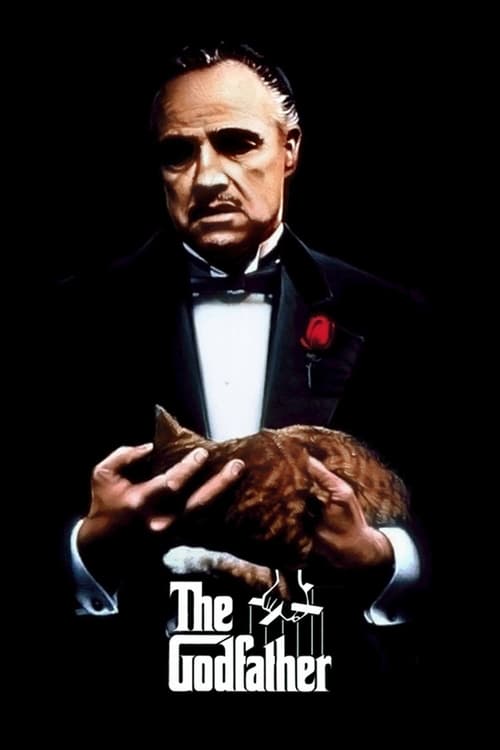
The Godfather
1972 · Francis Ford Coppola
Megalopolis is the decade's great folly narrative: self-funded with $120M of wine money, chaotic Cannes premiere, a pulled trailer with AI-fabricated critic quotes, on-set conduct allegations, and a defiant "I don't care" tour. The conversation is about the mythology of the last mogul-auteur.
For a long, immersive evening when you want to sink into something monumental — a film to give your full attention, not half-watch. It's a commitment, and it pays you back with interest.
What it's about
A New York crime family at the height of its power is thrown into war when its aging patriarch survives an assassination attempt. As the older generation's grip slips, the youngest son — a decorated veteran who wanted nothing to do with the family business — is pulled step by step into its center. It's a story about inheritance, loyalty, and revenge, told across ten years of weddings, funerals, and quiet negotiations where the real violence happens off to the side.
The experience
Slow-burning and stately, but never dull — it moves like a tightening fist, all hushed rooms and dark corners punctuated by sudden brutality. You watch a man change in increments so small you can't say when it happened, and it leaves a chill that outlasts the running time.
Performances
Marlon Brando's raspy, gesture-heavy Vito is one of the most imitated performances ever put on film, and Al Pacino does something quieter and scarier: he lets you watch warmth drain out of a face over three hours, almost without moving it.
The craft
Gordon Willis's famously underlit cinematography — amber rooms, faces half-swallowed by shadow — earned him the nickname 'the prince of darkness' and set the visual grammar for crime films ever after. Nino Rota's mournful waltz of a score is instantly recognizable, and the editing cross-cuts ceremony against violence in ways that still get taught. Watch it in the dark, on the biggest screen you have.
Why it matters
It turned the gangster picture into American tragedy, made Coppola the standard-bearer of the New Hollywood, and became the measuring stick nearly every crime saga since has been held against.
Snapshot
Francis Ford Coppola's adaptation of Mario Puzo's 1969 bestseller is a chronicle of dynastic succession and moral corruption rendered in the key of American tragedy. Over nearly three hours, it traces the Corleone family from a moment of peacetime authority — Vito presiding at his daughter's wedding — through the chaos of an attempted assassination and an escalating gang war, to the emergence of his youngest son Michael as a remorseless patriarch. The film works simultaneously as a meticulous period piece, a character study of transformation, and a meditation on the paradox of the immigrant American dream: that the institutions built to protect a family may ultimately consume it. Its synthesis of operatic ambition, classical Hollywood craftsmanship, and a new post-studio frankness about violence and moral ambiguity gave American cinema a template it has never entirely abandoned.
Industry & production
By 1971 Paramount was in financial difficulty and saw Puzo's novel — a publishing phenomenon that had sold millions of copies — as a potential commercial lifeline. The studio's initial instinct was to update the story to a contemporary setting and trim its budget accordingly. Coppola, then known primarily for You're a Big Man and the commercially disappointing The Rain People, was not Paramount's first choice; the project was reportedly considered by several established directors before landing with him, partly on the strength of his apparent ethnic and cultural proximity to the material and partly on cost. The studio's ambivalence toward Coppola persisted throughout production: he faced pressure over casting, budget, and creative decisions at nearly every turn.
The most contentious casting fight was over Marlon Brando for the role of Vito Corleone. Paramount executives were resistant — Brando's recent output had been regarded as commercially unreliable — and only agreed after Coppola staged an informal screen test in which Brando transformed himself at a makeup table, darkening his hair, stuffing his cheeks, and lowering his voice into the character. The studio also resisted the casting of Al Pacino, then a relatively unknown stage actor, as Michael; they favored more established names. Robert Duvall, James Caan, Diane Keaton, Talia Shire, Richard Castellano, and Sterling Hayden completed an ensemble that Coppola assembled with exceptional care, drawing heavily from New York theater and Method-trained performers.
Principal photography began in late March 1971 and ran approximately seventy-seven days. Locations included New York City (notably the Bronx and Little Italy), a private estate on Staten Island standing in for the Corleone compound, and Sicily — specifically the villages of Savoca and Forza d'Agrò — for the sequences depicting Michael's wartime exile. Producer Albert S. Ruddy navigated considerable practical obstacles, including reported friction with actual organized crime figures over the film's portrayal of Italian-Americans, though the extent and nature of that contact remains somewhat murky in the historical record. The production budget has been reported at approximately six to seven million dollars, which by contemporary standards was a mid-range studio investment; the film's returns would redefine the calculus of mainstream commercial filmmaking.
Technology
The Godfather made no conspicuous use of emerging technical novelties — no zoom-dependent New Hollywood handheld bravado, no split-screen experimentation. Its technological signature is instead conservative and deliberate: Coppola and cinematographer Gordon Willis shot on 35mm anamorphic using slow, fine-grain film stocks that rewarded controlled, low-intensity lighting. Willis chose lenses and stocks that would render deep shadows cleanly rather than dissolving them into noise, which was essential to the aesthetic he had in mind. The Sicilian sequences were photographed in available Sicilian light with somewhat different tonal qualities, giving those scenes a bleached, sun-baked contrast to the heavy interiors of New York. Sound recording on location in New York presented the typical challenges of a dense urban production, and the film's sound design — discussed further below — was substantially built in post-production.
Technique
Cinematography
Gordon Willis's work on The Godfather is among the most studied in American film history, and its innovations were sufficiently radical that the cinematographic establishment of the time was uncertain what to make of them — Willis received no Academy Award nomination for the film, a conspicuous omission that has since been widely regarded as a critical failure of that institution. His approach broke decisively with classical Hollywood lighting conventions: he employed very low key-to-fill ratios, motivated lighting almost exclusively from practical sources within the frame or implied sources above and behind, and exposed for midtones in a way that allowed deep shadow to fall across faces without any compensatory fill. The result was that actors' eyes — the traditional anchor of classical Hollywood close-ups — frequently disappeared into darkness. In the film's celebrated opening sequence, Vito Corleone is lit almost entirely from above, his upper face pooled in shadow while the lower half remains legible; the effect creates an authoritative imperviousness, a sense that this man is only partially knowable.
Film scholars have commonly invoked Caravaggio's chiaroscuro as a precedent for Willis's strategy, and Willis himself acknowledged an interest in the relationship between light and power. The technique extended throughout the film: the Corleone study, the hospital corridors, the diner where Michael shoots Sollozzo and McCluskey — all are environments from which ambient light has been strategically withheld. Willis's approach demanded absolute control of the production environment, which reinforced the preference for studio and location shooting under controlled conditions. It established a visual grammar for the crime film that persists: darkness not as a neutral condition but as an ethical index.
Editing
The film was edited by William Reynolds and Peter Zinner, working from Coppola's coverage to shape a narrative that moves, across nearly three hours, with a gravity-assisted inevitability. The editing's most celebrated achievement is the baptism sequence near the film's conclusion: as Michael Corleone stands at the baptismal font and formally renounces Satan on behalf of his nephew, the film cuts rhythmically to the simultaneous murders he has ordered against the heads of the rival families. The cross-cutting draws on a Griffithian tradition of parallel action — morally loaded juxtaposition as argument — and executes it with a mounting musical and rhythmic intensity that transforms the sequence into something operatic. The sacramental language of the liturgy spoken over the violence is not underlined or ironized through performance; the editing does all of it.
Throughout the rest of the film, the cutting is largely classical and patient: long takes to establish staging and give the actors room, cutaways used for dramatic rather than merely expository purposes. The wedding sequence that opens the film is structured as a mosaic of interactions, each brief scene establishing a relationship that will carry weight later. The overall tempo is slower than the commercial norm of 1972, which was itself a statement of confidence in the material and the performances.
Mise-en-scène / staging
Coppola's staging foregrounds doorways, thresholds, and rooms as moral architecture. Characters are frequently observed through frames-within-frames — door jambs, window openings, the interior of cars — which creates a surveillance quality and emphasizes the idea of being watched, of operating within a structure that sees everything. The Corleone study is a particularly managed space: visitors are received in an interior that is deliberately shadowed and enclosed, creating an asymmetry of visibility between Vito and those who come to him for favors.
Food and the communal table recur as a motif of family cohesion and concealed menace: the film opens with a wedding feast and moves through kitchen scenes, Sunday dinners, and the solemnity of the meal as a space where family loyalty is affirmed and betrayal is eventually plotted. The tomato-sauce scene in which Peter Clemenza instructs Michael in cooking is frequently cited as an example of Coppola's ability to embed character and future narrative implication into what appears to be domestic texture.
Sound
The sound design, supervised by Walter Murch (who received a credit for "post-production sound"), is a major component of the film's atmospheric authority. Murch employed a relatively spare sound palette by later standards: ambiences are present but not dense, dialogue is prioritized, and violence is punctuated rather than immersive. The gunshots in the film have a particular quality — sharp, flat, almost administrative — that distinguishes them from the stylized firearm sounds of earlier Hollywood. The contrast between the warmth of the domestic scenes and the austere acoustic texture of the murder sequences is deliberate. Murch's later articulation of sound design philosophy — particularly his thinking about the relationship between music, sound effect, and dialogue — can be traced in part to the aesthetic problems posed by this film.
Performance
Brando's preparation for the role of Vito Corleone involved physical transformation (he used a dental prosthetic to alter the shape of his jaw after the initial cotton-stuffed screen test) and a studied vocal register — husky, intimate, containing the authority of a man accustomed to being heard without raising his voice. His performance is a masterclass in economy: the famous opening scene, in which he listens to petitioners while absently stroking a cat that appeared on set by chance and which Brando incorporated into the take, demonstrates how fully he inhabited the character's stillness as a form of power.
Al Pacino's performance operates on a completely different register. Michael begins the film at a deliberate remove from the family's world — detached, educated, returned from the war with a girlfriend who represents the American mainstream. Pacino tracks the character's absorption into the family's logic as a gradual hardening: the bathroom scene before the restaurant murders shows Michael nearly unable to control his breathing, and by the film's final image — the door closing on his wife's view of Michael's hand being kissed — Pacino has engineered a complete, chilling transformation. Robert Duvall as Tom Hagen embodies the film's institutional intelligence, while James Caan's Sonny is the family's emotional heat given physical form.
Narrative & dramatic mode
The film's narrative architecture is broadly Shakespearean in its concern with dynastic succession and the corruption of the heir. The trajectory from wedding to consolidation follows the logic of a reluctant king drama: Michael insists at the outset that he is not his father's heir and is not party to the family's business; by the end he has not merely joined that business but surpassed his father's willingness to use violence as an instrument of policy. The film refuses to melodramatize this transformation or to locate its tragedy in a single moral failing; Michael's path is presented as structurally overdetermined, the product of loyalty, circumstance, and the internal logic of a world he enters in order to protect his family and which he cannot thereafter leave.
The film's dramatic mode is operatic in pace and in its conception of character as defined by an irresistible force pressing against individual will. Coppola has spoken of his debt to the opera tradition and to Verdi in particular, and the film's grand emotional movements — the attempted assassination, the funeral, the baptism finale — have the cadential weight of operatic set pieces.
Genre & cycle
The Godfather belongs to the gangster film lineage that runs from Little Caesar (1931) and Scarface (1932) through White Heat (1949), but it reframes the genre's premises substantially. The classical Hollywood gangster film typically traced a rise-and-fall arc that functioned as moral corrective: the criminal's success was always temporary, punished by narrative structure. Coppola's film dispenses with this corrective mechanism. Michael does not fall; he succeeds, and his success is the tragedy. The film also domesticates the gangster narrative in a way earlier examples did not, situating the criminal enterprise within a family structure that has its own legitimate emotional claims on the audience.
The film arrived at the apex of what critics have termed the New Hollywood period, but it sits somewhat apart from the more formally experimental films of that cycle — Bonnie and Clyde (1967), Easy Rider (1969), McCabe & Mrs. Miller (1971). It is classical in its construction even as it updates the moral valences of that classicism. Its success helped recalibrate studio assumptions about what scale and seriousness of address audiences would accept in genre pictures.
Authorship & method
The film's authorship is genuinely collaborative in ways that resist simple auteurist reduction. Mario Puzo co-wrote the screenplay with Coppola; Puzo had already shaped the essential architecture of the narrative in the novel, and the screenplay's structure hews closely to his source material, though Coppola made significant contributions to the dialogue's texture and the film's thematic emphases. (Robert Towne is reported to have contributed some uncredited script work, though the extent of this is not definitively established in the public record.)
Gordon Willis is, in any honest accounting, a co-author of the film's meaning: the visual grammar he established is inseparable from what the film argues about power and visibility. Nino Rota's score is elemental to the film's emotional architecture. His main theme — lyrical, mournful, built on a descending minor figure — has become one of the most recognizable musical identities in cinema. Rota's initial Academy Award nomination for the score was subsequently withdrawn because the Academy determined that the main theme had been used in an earlier Italian film, Fortunella (1958), which Rota had also scored; he ultimately received the Oscar for The Godfather Part II. Carmine Coppola, Francis's father, contributed additional music to the film. The editing contributions of William Reynolds and Peter Zinner have already been discussed.
Movement / national cinema
The Godfather is American cinema, but it is also a film about the hyphenated condition of Italian-American identity — the tension between assimilation and cultural persistence, between the American promise and the ethnic enclave's alternative authority structures. Coppola has spoken of his own Italian-American background as central to his engagement with the material, and the film reflects a genuine complexity about that identity rather than merely exoticizing it.
The film's visual and dramatic sensibility reflects several European influences that Coppola assimilated. The operatic structural ambition connects to a lineage of Italian art cinema, particularly Luchino Visconti's Rocco and His Brothers (1960), which similarly uses a family narrative to examine the violence embedded in codes of loyalty and honor. The film's patience with domestic ritual and its interest in the family as a social institution have more in common with European art cinema conventions than with the propulsive plotting typical of American genre films of the period.
Era / period
The film is set between approximately 1945 and 1955, and it was photographed with a period scrupulousness that extended to cars, clothing, signage, and interior decoration. This was a deliberate resistance to Paramount's preference for a contemporary setting: Coppola argued that the period setting was essential to the story's meaning, that its concerns required the specific post-war context of Italian-American social aspiration and the particular structure of organized crime in that era. The period reconstruction gives the film a quality of historical weight that reinforces its novelistic ambitions and distances it from the contemporary crime film, which at that moment was often associated with more visceral, exploitation-adjacent product.
Themes
The film's central thematic concern is the relationship between family loyalty and institutional violence — the argument that the structures built to protect and sustain a family require the same coercive force as any other power structure, and that participation in that force transforms those who exercise it. The Corleone family's self-conception is one of honor, protection, and reciprocity; the film systematically demonstrates that these values are inseparable from extortion, murder, and the brutal enforcement of hierarchy.
Closely related is the theme of American assimilation as a form of corruption. Michael's trajectory inverts the standard immigrant-success narrative: his education and military service represent the legitimate path, but it is precisely his absorption into the family's logic — his loyalty to blood over law — that forecloses the legitimate world. The film refuses the consolation of the immigrant success story without dismissing the emotional claims that make that story compelling.
Power and its performance are examined throughout: who sits and who stands, who is listened to in silence and who must fill the air with words, which rooms are accessible and which are closed. The film understands authority as theatrical, as something that must be staged and maintained.
Reception, canon & influence
Backward (influences on the film): The most direct generic predecessors are the 1930s Warner Bros. gangster cycle — Little Caesar, The Public Enemy (1931), Scarface — which established the basic iconography of the American organized crime film. Howard Hawks's Scarface in particular explored the family structure within criminal enterprise. Visconti's Rocco and His Brothers provided a European model for the immigrant-family tragedy on an operatic scale. Jean-Pierre Melville's crime films, particularly Le Samouraï (1967), offered a template for the treatment of violence as ritual and protocol. The influence of Italian neorealism — its attention to environment, to the material texture of community life — is present in the film's treatment of the wedding sequence and the neighborhood scenes.
Critical reception: The film opened in March 1972 to immediate critical acclaim and became the highest-grossing film of that year. Reviews recognized its achievement as exceptional within the genre and within American cinema broadly. It received ten Academy Award nominations and won three: Best Picture, Best Actor (Brando, who famously sent Sacheen Littlefeather to decline the award in protest of Hollywood's treatment of Native Americans), and Best Adapted Screenplay (Puzo and Coppola). Its absence from the editing and cinematography categories remains a noted anomaly in Academy Award history, particularly Willis's non-nomination.
Forward (legacy and influence): The film's influence on subsequent American cinema is difficult to overstate. The Godfather Part II (1974), which Coppola co-wrote with Puzo and directed, extended and deepened the original's concerns, and together the two films constitute one of the most sustained achievements in the history of the crime narrative. The subsequent trajectory of the crime film as a prestige form — Martin Scorsese's GoodFellas (1990) and Casino (1995), Michael Mann's work, the television form of The Sopranos (1999–2007) — is incomprehensible without The Godfather as a prior condition. The film established that the crime narrative could sustain novelistic complexity and moral seriousness; every prestige crime work since has operated in relation to that premise.
Willis's cinematographic approach diffused into the visual grammar of the serious American film: the use of shadow as a moral register, the rejection of fill light as a default, the willingness to let a face disappear into darkness. Nino Rota's score altered expectations for how musical themes could carry the weight of familial and cultural identity across a long narrative. And Coppola's demonstration that a film could be at once a large-scale commercial entertainment and a work of genuine artistic ambition recalibrated the relationship between the studios and a generation of filmmakers who had come up through the film school tradition.
The Godfather occupies a position on virtually every canonical list of significant American films, and its stature has not measurably diminished in the decades since its release — a relative rarity for a film so thoroughly identified with a specific cultural moment. Its opening line — "I believe in America" — has entered the lexicon as a formulation of the promise that the film then spends three hours quietly dismantling.
A Deleuzian reading
A man is talking in the dark.
The full Deleuzian reading of The Godfather →
Reception
No flop-to-classic story here — it was a phenomenon on arrival, becoming the highest-grossing film ever at the time and winning Best Picture. The only shift since is that 'masterpiece' hardened into 'the default answer to the greatest film ever made.'
How The Godfather was received, from release to now →
Influences: the films it descends from and the films it influenced
- Intolerance (1916) — The baptism-murder cross-cutting sequence directly models Griffith's parallel-action editing — intercutting morally contrasting simultaneous events to generate ironic counterpoint — a formal device Murch and Coppola explicitly named when constructing that sequence.
- Little Caesar (1931) — Established the rise-and-fall gangster arc whose mandatory moral-punishment ending The Godfather deliberately refuses, replacing genre condemnation with tragic coronation and forcing the form to accommodate a protagonist the audience is not invited to condemn.
- Scarface (1932) — Codified family loyalty as the criminal code's primary metaphor — the sister/brother dynamic Hawks frames as incestuous possession becomes in Coppola's hands the Sonny/Connie transposition — and established operatic intra-family betrayal as the gangster film's dramatic engine.
- Citizen Kane (1941) — Willis's deep-shadow chiaroscuro and frames-within-frames compositional strategy descend directly from Toland's deep-focus work here; the dynastic patriarch whose accumulation of power produces moral dissolution is the structural template Coppola inherits and transposes into an immigrant-crime register.
- On the Waterfront (1954) — Brando's Method physical self-construction here — the slumped posture, the mumbled interiority, the transformation through sensory preparation — established the performance grammar that Coppola deploys in Vito Corleone's self-presentation and shaped the rehearsal process Coppola used with his ensemble.
- Rocco and His Brothers (1960) — The fraternal-loyalty-versus-individual-ambition structure of a southern Italian immigrant family destroyed by urban assimilation is Coppola's direct narrative inheritance; Visconti treats violence within the family as tragedy rather than genre spectacle, the tonal precedent The Godfather sustains throughout.
- The Leopard (1963) — Coppola has named this as a direct formal model; Visconti's long-take staging of aristocratic ceremony — the ballroom sequence's management of social hierarchy across a vast space — shaped the wedding-sequence grammar, and the dynastic-family-in-decline narrative rendered as operatic period spectacle is the tonal template.
- The Conformist (1970) — Vittorio Storaro's geometric chiaroscuro — shadow deployed as moral state, faces withheld from light to signal complicity — is the immediate cinematographic precedent Willis studied; Bertolucci's use of architectural framing to entrap characters within institutional space prefigures Coppola's frames-within-frames staging strategy.
- Strike (1925) — The baptism sequence intercuts a Catholic christening with the murders Michael orders, deploying the same ironic counterpoint structure as Strike's cattle/worker massacre cross-cut, where ritual solemnity and slaughter achieve their full meaning only through juxtaposition.
- The Bad Sleep Well (1960) — Opens on a bravura wedding-ceremony set-piece that, exactly like Kurosawa's, uses a single protracted social ritual to introduce an entire corrupt organization's hierarchy, alliances, and buried crimes.
- Mafioso (1962) — Realizes at epic scale the touchstone Mafioso pioneered: the seamless cut between domestic ritual and murder, staging horror as an extension of family banality rather than as spectacle.
- The Heiress (1949) — The closing office door shut on Kay — camera left outside with the excluded woman as the frame narrows to black — is the Goetzes' bolted-door invention inverted, and the reason the closed door became American cinema's default shorthand for a verdict delivered without dialogue.
- Chinatown (1974) — Inherits Coppola's synthesis of classical Hollywood visual grammar — motivated lighting, anamorphic widescreen, period production design — with New Hollywood moral tragedy; the naïve protagonist hardened and finally destroyed by institutional corruption mirrors Michael's arc with the moral valence reversed.
- Once Upon a Time in America (1984) — Leone extends Coppola's dynastic immigrant-gangster epic into non-linear structure, using Morricone's spare recurring motif in explicit dialogue with Nino Rota's approach, and constructs a meditation on fraternal betrayal and dynastic succession that the baptism sequence's ironic counterpoint directly anticipates.
- Goodfellas (1990) — Inherits Coppola's Italian-American crime-family institution and social-history texture but replaces classical mise-en-scène and tragic elegy with kinetic steadicam and ironic celebration, constituting an implicit formal rebuttal to The Godfather's romanticization of the same material.
- Miller's Crossing (1990) — Barry Sonnenfeld's low-key chiaroscuro compositions directly cite Willis's visual grammar, and the reluctant-king arc — a political operator forced to choose between institutional loyalty and self-preservation — extends Michael's transformation template through a Hammett-derived moral architecture of nested betrayal.
- A Prophet (2009) — Audiard's gradual-character-hardening arc — a naïve prisoner methodically transformed into a criminal patriarch through accumulated ruthlessness — is the most direct structural descendant of Michael's reluctant-king trajectory; Tahar Rahim's controlled physical deterioration across the film mirrors Pacino's strategy of withholding interiority until transformation is irreversible.
- The Untouchables (1987) — Gordon Willis's chiaroscuro period lighting — amber pools against deep shadow, faces half-swallowed by darkness — established the visual grammar of prestige gangster cinema that Burum's cinematography for The Untouchables directly extends into the 1980s mainstream.
- The Dark Knight (2008) — Gordon Willis's low-key source-plausible cinematography—deep shadow fills, available-light logic that refuses expressive fill—is the direct ancestor of Pfister's unglamorous procedural palette in both IMAX and anamorphic material, especially in the interior Gotham scenes.
- The Godfather Part II (1974) — Willis established the anamorphic low-key palette here — extreme shadow, single-source motivated light, amber domestic interiors — that Part II then bifurcated into two differentiated registers: warm golden amber for Vito's immigrant past, cold silver-gray for Michael's present.
- Casino (1995) — Established costume-as-power-semiotics in the American crime epic — wardrobe meticulously tracking organizational rank and moral position — a convention Casino inherits and extends through Ace Rothstein's obsessively documented personal wardrobe.
- The Departed (2006) — The baptism sequence's cross-cut between Catholic ritual and simultaneous mob assassinations established parallel editing as a device for ironic moral juxtaposition in prestige crime ensembles — the specific editing architecture Schoonmaker deploys in The Departed's climactic cascade of institutional deaths.
- L.A. Confidential (1997) — Gordon Willis's amber-warm, underexposed portraiture lighting for men exercising institutional power establishes the visual grammar equating golden warmth with dangerous authority that Spinotti extends in L.A. Confidential's LAPD precinct and high-society interiors.
- Blow (2001) — The father-son relationship as the crime narrative's moral and emotional load-bearer — a son who fails his father and whose estrangement from his own daughter becomes the measure of his corruption — is a structural inheritance from The Godfather's Vito-Michael spine.
- McCabe & Mrs. Miller (1971) — Contemporaneous New Hollywood experiment in motivated, low-intensity natural-light cinematography (Zsigmond's copper-tinted interiors) applied to genre subversion; the two films' formal divergence — Altman's zoom-dependent handheld versus Coppola's controlled prime-lens classicism — constitutes a live debate about genre revisionism's available options.
- Mean Streets (1973) — Scorsese and Coppola simultaneously mapped Italian-American organized crime through Method performance and ethnic community texture, but where Coppola uses controlled classical staging, Scorsese's handheld restlessness and direct-address voiceover propose an alternative formal grammar for identical subject matter.
- The Funeral (1996) — The operatic Catholic-ritual family-crime epic against which the film defines itself, borrowing the ceremonial set-piece (here the wake/open casket) as the structuring frame while stripping out the romance and grandeur.
- The Irishman (2019) — The operatic, dynastic gangster grammar — sacramental family rituals, hushed conversational blocking — that The Irishman consciously inverts (its 'godfather-inversion' facet) into bureaucratic, unglamorous labor-mob drudgery.
- The Outsiders (1983) — Carries the Coppola family-collaboration method — Carmine Coppola's orchestral scoring and operatic, tableau-driven staging — that Coppola transplants onto teenage material here.
- Pariah (2011) — Gordon Willis's 'Prince of Darkness' underexposure and top-lit shadow is the low-light grammar Bradford Young adapts to render dark skin with deliberately withheld light.
- Eastern Promises (2007) — Source of the dynastic-crime grammar the film inverts: the crime family as respectable institution masking succession and cruelty, with the restaurant/business as legitimizing front — Semyon's Trans-Siberian restaurant is a deliberate descendant of the Corleone facade.
Similar films
- GoodFellas (1990) — influence & lineage
- Rocco and His Brothers (1960) — influence & lineage
- The Leopard (1963) — influence & lineage
- Once Upon a Time in America (1984) — influence & lineage
- Scarface (1932) — influence & lineage
- Chinatown (1974) — influence & lineage
- Mean Streets (1973) — influence & lineage
- On the Waterfront (1954) — influence & lineage
All the films related to The Godfather →
Watch it with: curated runs of related films
- Rise, Reign, and Ruin — Watch these together for the full arc of the self-made man — the hunger, the empire built on violence, and the rot that comes for whoever built it.
Film essays and courses that include it
- The Blockbuster Blueprint: From Epic to Universe
- Blood, Myth, and Grammar: The Gangster Film's Century
- American Cinema Breaks Open: New Hollywood 1967–1980
- Scope and Shadow: The Anamorphic Vision
- The Grammar of Shadow: Chiaroscuro from Expressionism to Digital Noir
- Blood Will Have Blood: Cinema's Long Reckoning with Revenge
- The Difficult Love: How Cinema Learned to See Inside the Family
- The Family Business: Ten Films That Built the Mob Movie
- No One Gets Away Clean: The Arc of Revenge Cinema
- The Ten Years the Directors Won
- The American Dream's Dark Twin
- The Courage of Darkness
- The Melody That Smiles and Weeps
- The Meaning Is in Your Head