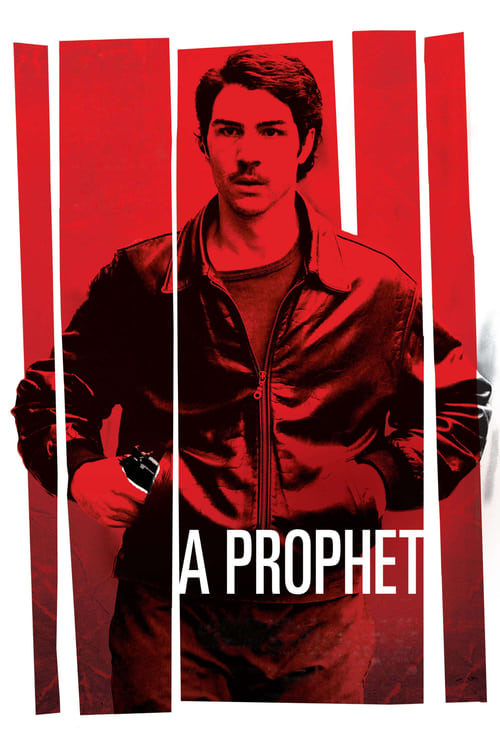
A Prophet
2009 · Jacques Audiard
Emilia Pérez went from Cannes triumph and 13 Oscar nominations to the most spectacular awards implosion ever — Mexican critics savaging its representation, his own dismissive comments about Spanish, and the Gascón tweet scandal. The cautionary tale every awards strategist now cites.
When you want a heavyweight crime epic to disappear into for a whole evening — tense, violent, and morally complicated. Not a comfort watch; a can't-look-away one.
What it's about
Malik is nineteen, Arab, illiterate, and utterly alone when he enters a French prison to serve six years — and he's immediately cornered by the Corsican gang that runs the yard. Forced into their service to survive, he starts learning: languages, loyalties, the mechanics of power. Over years inside, the film watches what an invisible man can build from nothing.
The experience
Gripping and immersive, with sudden spikes of brutal violence and unexpected passages of strange, almost dreamlike calm. It has the pull of a great crime saga — nearly three hours that move like one.
Performances
Tahar Rahim, in his first lead role, transforms by millimeters from frightened kid to quiet operator — a genuine star-making performance — against Niels Arestrup's chilling, paternal menace as the Corsican boss.
The craft
Jacques Audiard directs with muscular precision: handheld intimacy inside the cells, meticulous plotting across years, violence staged for impact rather than style. The dense sound design and jolts of music make it worth good speakers.
Why it matters
It took the Grand Prix at Cannes, swept the Césars, redrew the map of contemporary French crime cinema, and entered the canon of great prison films almost overnight.
Snapshot
A Prophet (Un prophète) is a 155-minute French crime drama that follows Malik El Djebena — young, illiterate, ethnically Arab — from his first helpless days inside a French correctional facility to his emergence as a figure of quiet, lethal authority. It is at once a genre exercise of the highest order and a social document: a prison film that doubles as an allegory of immigration, assimilation, and the impossible calculus of survival within a society that has already discarded you. By the time it collected the Grand Prix at Cannes in 2009 and swept nine Césars the following February, it had redrawn the coordinates of contemporary French cinema and installed itself, almost immediately, in the canon of great prison films.
Industry & production
The film originated with a screenplay by Abdel Raouf Dafri and Nicolas Peufaillit; Audiard acquired it and, with his then-new collaborator Thomas Bidegain, substantially reconceived and rewrote it. The rewrite pushed the character of Malik toward greater interiority and introduced the quasi-supernatural strand — the ghost of Reyeb, the first man Malik kills — that gives the film its prophetic register. Production was handled by Why Not Productions, the company run by Martine and Antoine de Clermont-Tonnerre, which had already backed Audiard on The Beat That My Heart Skipped (2005). The film received support from France 2 Cinéma and Canal+, the standard co-financing architecture of mid-to-large French prestige productions.
Casting was the central gamble. Tahar Rahim, a young French actor of Algerian descent with very limited screen credits, was cast as Malik after an extensive search; the decision proved transformative. Niels Arestrup, a veteran stage and screen actor who had won a César for The Beat That My Heart Skipped, returned to work with Audiard as the Corsican gang boss César Luciani — a performance of coiled, patriarchal menace. The supporting cast drew heavily on non-professional actors, including former inmates and individuals with lived experience of the milieu, a casting strategy that anchors the film's sociological texture in something verifiable.
Prison access was negotiated for location scouting and selected exteriors, with sets constructed to replicate the specific spatial grammar of the French correctional system — the segmentation of blocks, the choreography of population movement, the narrow economies of canteen and yard.
Technology
A Prophet was shot on 35mm film by Stéphane Fontaine, a format choice consistent with the expectations of prestige French production at the time and well-suited to the film's tonal range: it can hold the grime of cell blocks without losing the capacity for a more expressionistic image when the supernatural sequences demand it. Fontaine worked with both handheld and more controlled setups depending on the scene's register. The film predates the wholesale industry migration to digital acquisition, and its grain structure and depth of field belong unmistakably to the photochemical tradition — a quality that, in retrospect, has aged it well, lending an archival weight that matches its ambitions.
Technique
Cinematography
Fontaine's approach is predominantly observational without being falsely neutral. Much of the film is shot at close to eye level, the camera positioned within the social space rather than surveying it from outside, which produces a constant low-grade pressure: the viewer is inside the walls with Malik, subject to the same compressed geometries. Handheld work in the cell blocks and corridors creates a restless, tracking presence — not the shaky-cam of action excess but a measured mobility that registers alertness, the need to read a room in real time. The ghost sequences break with this mode deliberately: Reyeb's appearances are shot with an eerie stillness and a slightly different quality of light, marking them as belonging to another order of perception. Color palette runs from the institutional gray-green of the prison interior toward warmer, more saturated exteriors in Corsica, and that contrast functions as a register of power — the Corsican world is vivid, the prison world drains color.
Editing
Juliette Welfling's editing sustains a 155-minute film across multiple narrative registers — procedural thriller, character study, social drama, ghost story — without any of them collapsing the others. The cut is generally precise and close to classical in its scene construction, but it opens up at key moments: the murder of Reyeb is fragmented and extended, its repetitions across the film's first act functioning almost as a trauma loop. Time is compressed and expanded with confidence. The parallel structure of Malik's inside and outside worlds (his prison education, his courier work for the Corsicans, his growing relationship with his former cellmate Ryad) is managed without excessive cross-cutting; instead, the editing trusts the audience to hold both timelines.
Mise-en-scène / staging
Audiard's staging consistently works from constraint outward. The prison is a space of enforced proximity and enforced surveillance, and the blocking honors that: bodies are always conscious of who can see them, conversations are managed around blind spots, the social hierarchy expresses itself spatially in who gets to occupy which yard, which table. César's authority registers in the stillness he can afford; Malik must always be in motion, always managing multiple gazes. The Corsican block versus the general population is rendered architecturally as much as through dialogue — Audiard uses space as argument. When Malik eventually controls space, the staging shifts: he acquires the stillness.
Sound
Alexandre Desplat's score is deployed with considerable restraint. Large sections of the film rely on ambient prison sound — the acoustic environment of institutional confinement, its echoes and distances — rather than underscore. When Desplat's music arrives, it marks moments of subjective intensity or transition rather than simply ornamenting the image. The film's use of music from the Arab world (notably in sequences involving Malik's cultural context) is never exoticizing; it registers as part of Malik's interiority. The scene of Reyeb's murder is accompanied by almost unbearable nearness — breathing, fabric, the specific acoustics of a cell — before any musical intervention.
Performance
Tahar Rahim's performance is the film's load-bearing structure. Malik is a character who cannot afford legibility — he must read others without being read — and Rahim plays this as a constant slight recession, a face that processes rather than expresses. The arc from frightened boy to composed operator is traced in physical detail: posture, where the eyes go, the changing pace of movement. Against him, Arestrup plays César as a man whose authority is entirely habitual, held in place by decades of fear he has deposited in others; when that fear begins to drain away, Arestrup's performance registers it in tiny collapses of assurance. The chemistry between them — a perverse, structurally colonial relationship that the film refuses to romanticize — is the engine of the drama.
Narrative & dramatic mode
A Prophet is structured as a Bildungsroman in criminal form: the education of a man who arrives without resources and exits with power, having absorbed, discarded, and survived those who sought to use him. The narrative is rigorously causal — each phase of Malik's development follows from the previous one — but the causal chain is not straightforwardly triumphant. The murders and betrayals accumulate; so does Malik's literacy, his Arabic and Corsican, his understanding of how power circulates.
The supernatural strand complicates this otherwise procedural architecture. Reyeb's ghost appears without explanation and without resolution; the film does not rationalize the appearances or anchor them in psychology. They are simply there, as fact, and Malik receives them — the visions of burning birds before a death, the conversations with the dead — as information, as prophetic data. This registers the film in a mode that French genre cinema has always permitted: the fantastic at the edges of the real, used not as escape but as intensification. Malik's prophetic capacity is inseparable from his intelligence; both are forms of seeing further than others.
Genre & cycle
A Prophet enters a rich international tradition of the prison film — a genre whose formal logic almost always involves the tension between an institutional totality and individual will. Its most direct precursors in the French tradition include Robert Bresson's A Man Escaped (1956), which transforms incarceration into a near-spiritual test; but Audiard's film is tonally entirely different, invested in the sociological as much as the metaphysical. The rise-of-a-criminal structure aligns it with Hollywood templates — The Godfather, Scarface, Goodfellas — films that the script consciously inherits and is conscious of inheriting, as a kind of generic self-awareness. What the film does with this inheritance is locate it in a specifically French social context: the Corsican separatist networks, the Arab and African prison population, the way the French state's institutions become sites of ethno-criminal competition.
It also participates in a cycle of French films from the 2000s concerned with immigration, social exclusion, and the failure of the République to integrate — a cycle that includes La Haine (1995, a direct ancestor), L'Esquive (2003), and subsequently Audiard's own Dheepan (2015). A Prophet is the most genre-committed film in this cycle, which is part of what gives it its durability.
Authorship & method
Jacques Audiard came to directing after years working as a screenwriter, and his films consistently show a scenarist's confidence in structural load-bearing: the stories are built to hold weight, with setups that pay off and themes that operate through situation rather than statement. His previous films — A Self-Made Hero (1996), Read My Lips (2001), The Beat That My Heart Skipped (2005) — each take a genre form and run it against a character study, and A Prophet extends this method to its fullest development.
The collaboration with Thomas Bidegain, who had previously worked in television, proved decisive. Bidegain's contribution to the rewrite is difficult to disentangle from Audiard's at this distance — the record does not offer a clean division — but the partnership continued through Rust and Bone (2012) and Dheepan, suggesting a genuine creative complementarity. Bidegain subsequently built his own career as a screenwriter of distinction.
Stéphane Fontaine has continued as a collaborator of choice for Audiard's successors and for other filmmakers; his subsequent work includes Rust and Bone, Elle (2016, for Paul Verhoeven), and American productions including Captain Fantastic (2016) and Jackie (2016), a track record that reflects the quality of eye he brought to A Prophet.
Juliette Welfling edited all of Audiard's features from Read My Lips onward, and the editing sensibility across those films is consistent: dry, precise, unwilling to tell the audience how to feel about a cut.
Movement / national cinema
The film arrives at a complicated moment in French national cinema's reckoning with its own demographics. The dominant French cultural establishment had for decades produced a cinema largely indifferent to the lived experience of its North African and sub-Saharan populations except as social problem, threat, or exotic margin. La Haine had cracked this open in 1995; A Prophet pushes further by making an Arab protagonist not the subject of external observation but the organizing subjectivity of a genre film. Malik is not a study in marginalization; he is the camera's identification figure, the person through whose calculations we navigate. This is a formal argument, not merely a political one.
The film does not belong to what critics sometimes called cinéma de banlieue, though it is in conversation with it. Audiard is not from the communities he depicts, and the film's perspective is external in the sense that any fiction is; but the specificity of the cultural detail — language, prayer, loyalty structures, the prison's ethnic cartography — reflects substantial research and collaboration, and has generally been received as earned rather than appropriated.
Era / period
A Prophet was released in 2009, a period when French cinema was navigating questions of national identity with particular urgency. The French debates around laïcité, the 2005 banlieue riots, and the status of North African immigration remained raw. The film was not didactic about any of this; it used genre conventions to let the structural arguments become visible through story. In the wider European context, it arrived alongside a wave of Southern and Eastern European crime films (the Italian Gomorrah had appeared in 2008) that shared a commitment to systemic, rather than individualized, accounts of criminality.
Themes
The film's central thematic concern is with power as acquisition: how it is accumulated from nothing, what it costs, what it erases in the process. Malik begins without language — literally illiterate, without French that can navigate institutional registers, without Corsican or the Arabic his ethnicity nominally grants him — and the film tracks his accumulation of linguistic, social, and eventually criminal capital. Language is power in A Prophet in an almost literalist sense: each language Malik masters opens a sealed room.
Race and ethnicity operate not as fixed identities but as strategic resources and imposed constraints simultaneously. Malik's Arab identity is something Caesar exploits (using him as a runner precisely because he is not Corsican and therefore not counted), something other prisoners police, and something Malik himself eventually learns to deploy. The film refuses the sentimentality of a recovery narrative: Malik does not recover some authentic self suppressed by the system; he is constituted by the system's pressures and learns to turn them.
Reception, canon & influence
A Prophet was awarded the Grand Prix at Cannes 2009 — the second prize, behind The White Ribbon — by a jury presided over by Isabelle Huppert. The decision was widely felt to be close; some jury deliberation accounts suggest it came near to winning the Palme d'Or. At the 35th César Awards in February 2010, the film won nine prizes, including Best Film, Best Director, Best Actor (Tahar Rahim), Best Supporting Actor (Niels Arestrup — his third consecutive win in that category, an unprecedented run), Best Screenplay, Best Editing, and Best Cinematography. It was nominated for the Academy Award for Best Foreign Language Film.
Critical reception was immediate and largely ecstatic in France and internationally. The film appeared on numerous year-end and decade-end lists; it was placed by a range of critics alongside The Godfather as a high-water mark of the crime genre, a comparison the film itself seems aware of and which it invites without being defeated by the weight of the reference.
The film's backward influences are visible throughout: Bresson's spatial austerity (even if the emotional registers are entirely different); Melville's rigorous genre professionalism; the American gangster film from Coppola through Scorsese; the social realism of the British tradition (Ken Loach, Alan Clarke's prison films). The Italian neorealist inheritance — the use of non-professional actors, the insistence on location specificity — is filtered through French models.
Its forward influence has been considerable. It reoriented expectations for what French genre cinema could do with questions of identity and race. Tahar Rahim's career expanded substantially, with international productions including The Cut (2014) and The Looming Tower (2018). Thomas Bidegain's trajectory as a screenwriter was established by this film. Within French cinema, the willingness to build genre films around protagonists from non-dominant cultural positions has become more normalized, though progress remains contested.
Audiard himself has acknowledged A Prophet as the film that consolidated his method and his concerns; Rust and Bone (2012) and Dheepan (2015), which won the Palme d'Or, develop related thematic territory — the immigrant body, survival under duress, the provisional nature of identity — while exploring quite different formal strategies. The line from A Prophet to Dheepan is one of the more coherent authorial arcs in contemporary European cinema. As a prison film specifically, it now occupies the short list of the form's canonical achievements: alongside A Man Escaped, Cool Hand Luke, Midnight Express, and Hunger, it is a work by which future entries in the genre will continue to be measured.
A Deleuzian reading
The first thing the prison teaches Malik is how to hide a razor blade in his mouth.
The full Deleuzian reading of A Prophet →
Reception
Acclaimed from the moment it took the Grand Prix at Cannes in 2009, and unlike many festival darlings it never dipped — it's since been steadily canonized as one of the great crime films of the 21st century, a fixture of best-of-the-century lists.
How A Prophet was received, from release to now →
Influences: the films it descends from and the films it influenced
- A Man Escaped (1956) — Bresson builds the prison as an acoustic architecture — the scraping of tools, the cadence of guards' footsteps, silence as spatial information — establishing the ambient-over-score logic and surveillance-blocking sightline grammar that Audiard inherits wholesale; the cell is a system of sounds before it is a system of images.
- Le Trou (1960) — Becker's procedural staging of the cell as a spatial problem to be decoded — mapping guard sightlines, measuring concrete depth, timing routines — is the origin of A Prophet's space-as-argument grammar: the institution rendered as a system of exploitable geometry rather than a dramatic backdrop.
- Le Samouraï (1967) — Melville's controlled-recession performance grammar — the protagonist who survives by withholding interiority, becoming legible only through incremental procedural decision — is the direct behavioral template for Rahim's Malik, whose power accrues in inverse proportion to what he shows.
- The Godfather (1972) — Coppola's criminal-bildungsroman architecture — each moral compromise as an irreversible rung on an ascent, guilt externalized as vision — provides A Prophet's structural DNA and its supernatural-realism mechanism: the Reyeb haunting operates on exactly the logic of Michael's ghosts, conscience rendered as apparition within a procedural genre frame.
- Scum (1979) — Clarke's staging of the borstal as a surveillance system — camera fixed at institutional vantage points, recording dominance hierarchies with procedural detachment, no expressive angle — is the proximate source for A Prophet's surveillance-blocking: the penitentiary visualized as a series of observer and observed positions rather than a scene space.
- Pixote (1980) — Babenco casts actual juvenile detainees in a criminal-bildungsroman set inside a Brazilian reformatory, where non-professional performers carry authentic institutional knowledge in their bodies — establishing the casting and performance logic Audiard inherits: the institution legible in the performer's comportment, not acted but inhabited.
- Rosetta (1999) — The Dardennes' pressed-close handheld grammar — camera affixed to a non-professional performer's body, ambient sound entirely displacing score, character built through procedural accumulation without declared interiority — feeds directly into A Prophet's cinematographic and acoustic approach, the method arriving at Audiard via French-language social realism rather than British.
- La Haine (1995) — Kassovitz structures the banlieue as a space where argot and code-switching function architecturally — language demarcating who occupies a given social position — providing A Prophet's thematic schema for Arabic and Corsican as instruments of spatial power; the French institutional-color palette and the film's analysis of police surveillance as urban grammar are both directly cited.
- The Beat That My Heart Skipped (2005) — Audiard consolidates here the method A Prophet perfects: a genre-thriller chassis carrying a withheld-interiority character study, with Stéphane Fontaine's 35mm photochemical palette and controlled-recession performance grammar established as the authorial signature that carries wholesale into the penitentiary; the films form a continuous methodological arc.
- The Shawshank Redemption (1994) — The long-arc carceral bildungsroman in which an inmate accrues mastery and power within the institution's internal economy, extending the prison-as-society staging into a darker key.
- Miller's Crossing (1990) — Malik's trajectory — a subordinate who plays captors on both sides simultaneously, disclosing nothing while engineering the outcome — replicates the double-cross-labyrinth geometry of Tom Reagan's situation, and Tahar Rahim's performance of strategic opacity, the face as withheld information, is the clearest European descendant of Byrne's approach to inscrutability as gangster protagonist.
- Pusher (1996) — Audiard inherits Pusher's architecture of accumulation — a nobody entering a criminal economy and surviving through attrition rather than agency — and its staging for claustrophobic environments, extending the compression narrative into a fully institutional space with practical-source lighting throughout.
- Animal Kingdom (2010) — Michôd transplants A Prophet's criminal-bildungsroman architecture to Melbourne: a passive young male protagonist who survives by reading violence before performing it, power accruing through silence; James Frecheville's controlled-recession performance — interiority withheld, development announced only in retrospect — directly echoes Rahim's Malik and establishes the model as cross-cultural.
- Dheepan (2015) — Audiard and Fontaine extend A Prophet's surveillance-blocking grammar into suburban banlieue social housing — the institutional-color palette now rendering French periphery as carceral space without visible walls — while the Tamil refugee protagonist's controlled-recession performance and language-as-power arc complete the arc that Malik begins: the immigrant body navigating a system designed to expel it.
- Les Misérables (2019) — Ly adopts A Prophet's surveillance-blocking staging — here literalized as the drone's panoptical eye returning footage that triggers the film's crisis — and the language-as-power framework of French immigration cinema, with non-professional cast and ambient-over-score acoustics producing the banlieue as a carceral social space in direct formal descent from A Prophet's grammar.
- All Your Faces (2023) — Grounds French institutional drama in the observed textures of a closed system and its power dynamics, an ancestor for treating a bureaucratic apparatus (here prison) as the film's true subject and set.
- Ocean's Eight (2018) — Showcases editor Juliette Welfling's rhythmic elliptical cutting — compressing process into propulsive fragments — the technique she brings from Audiard's art cinema to Eight's heist montages.
- Captain Fantastic (2016) — Stéphane Fontaine's method imported wholesale — handheld at working distance inside a closed institution, faces lit by whatever the room actually has, and takes that hold on a confrontation past the point of comfort; the discipline that keeps the Cash compound documentary rather than twee.
- Sing Sing (2024) — Locks a handheld, shallow-focus camera to an unknown lead's sightline so the viewer learns the institution's unwritten procedure at exactly his speed; Sing Sing borrows the apprenticeship-of-perception structure but swaps the criminal economy for the theater program's rules.
- Hunger (2008) — McQueen arrives independently at the same formal syntax — prison as a sensory environment of concrete, skin, and breath; ambient sound displacing score; extended static frames that produce felt incarceration rather than dramatic representation — making Hunger and A Prophet the twin peaks of the contemporary prison film's formal renewal, their simultaneity reinforcing the logic of each.
- Entre les murs (2008) — Cantet's staging of the French classroom as an arena where immigrant languages — Darija, creole, Arabic — index power and exclusion, using non-professional students authenticated by their institutional roles, reproduces A Prophet's language-as-power formal argument in a complementary institutional space; both films belong to the same movement in French immigration cinema.
- Gomorrah (2008) — Garrone and Audiard simultaneously develop the crime film as a non-professional-cast procedural built on ambient sound, photochemical handheld observation, and institutional space as spatial argument — Gomorrah's Neapolitan housing projects functioning as an exterior prison with identical spatial-power logic, the camorra hierarchy a visible analog of the penitentiary's.
- Rust and Bone (2012) — The Audiard-Bidegain co-writing method — genre scaffold carrying a social-body argument, the immigrant subject under physical duress — continues directly from A Prophet, with Fontaine maintaining the 35mm institutional palette; the formal strategy is preserved and stress-tested in entirely different physical terrain, confirming it as a method rather than a setting.
- Sexy Beast (2001) — Audiard inverts crime-genre logic by making the acquisition of criminal power psychologically costly and structurally unglamorous — sharing with Sexy Beast the art-cinema insistence on replacing genre excitement with genre dread and on treating the criminal protagonist's internal state as the primary dramatic subject over plot mechanics.
- Outrage (2010) — Audiard's prison as total institution whose hierarchical logic entirely drives the plot—with ensemble staging of menace through deadpan containment rather than overt threat—runs a parallel formal course to Outrage's yakuza-organization-as-closed-system conceit, both films treating criminal bureaucracy as the only legible social reality.
- Headhunters (2011) — Controlled escalating editing rhythm that tightens the screw across the running time without gratuitous gear-shifts, and an unreliable protagonist whose survival depends entirely on performed identity — a parallel craft strategy to Headhunters deployed in French crime rather than Nordic noir.
- Conclave (2024) — Fontaine's cinematography in a sealed institutional space — corridors, cells, common rooms — where deep focus and spatial geography establish the power structure without expository dialogue; the same visual grammar he deploys in the Vatican's halls to map who moves freely and who is watched.
- A Most Violent Year (2014) — A slow-burn, procedural rise-through-crime study built on willed composure and behavioral observation rather than set-piece violence, sharing the institutional-realist crime grammar.
- Vada Chennai (2018) — Frames prison as the crucible that forges a naive newcomer into a criminal power, with the yard's ethnic factions as a society in miniature — directly mirrored in Anbu's carceral education.
- Head-On (2004) — Visceral handheld, genre-inflected social realism tracking a marginalized ethnic protagonist's violent self-transformation, extending the melodrama-realism hybrid into carceral register.
- Elite Squad (2007) — Runs a boot-camp-style institutional formation narrative — the prison as training ground that forges its subject through disciplined violence — mirroring Elite Squad's recruit-into-instrument arc.
Similar films
- Le Trou (1960) — influence & lineage · same viewing thread
- La Haine (1995) — influence & lineage
- The Beat That My Heart Skipped (2005) — influence & lineage
- Dheepan (2015) — influence & lineage
- A Man Escaped (1956) — influence & lineage
- Gomorrah (2008) — influence & lineage
- Le Samouraï (1967) — influence & lineage · same viewing thread
- Rififi (1955) — same viewing thread
All the films related to A Prophet →
Watch it with: curated runs of related films
- Cells, Vaults, and Codes of Honor — A run of methodical men — safecrackers, escapees, informers, resistants — filmed as pure process, where the suspense is less whether the job or the escape works than who honors the code and who breaks it first.