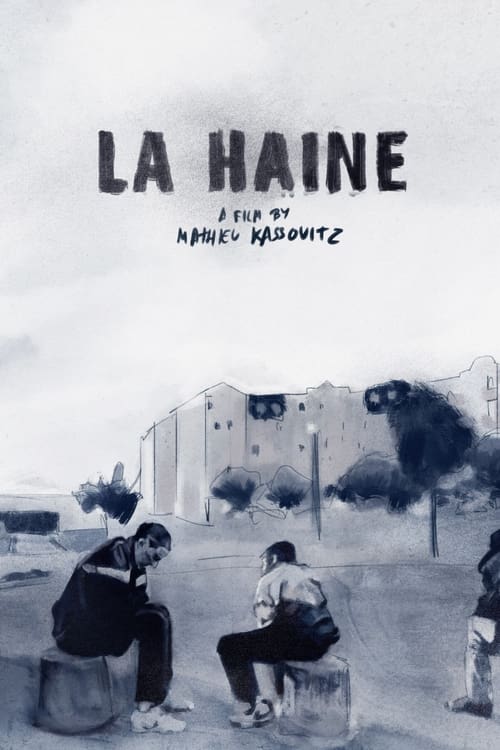
La Haine
1995 · Mathieu Kassovitz
For when you want to be gripped and shaken — a film that grabs you in the first minute and doesn't let go. It's confrontational rather than comforting, and it earns every ounce of the anger it carries.
What it's about
Over twenty-four hours in the housing projects outside Paris, three friends — Vinz, Jewish and seething; Hubert, a Black boxer trying to stay clean; Saïd, the wisecracking go-between — drift through the aftermath of a night of riots, waiting for news of a friend left in a coma by a police beating. A police revolver lost in the chaos has found its way into their orbit, and its presence charges every hour that follows.
The experience
Electric and coiled — it swings between hilarious hangout banter and moments where your stomach drops, all under a ticking clock that keeps reminding you what time it is. Few films build dread this patiently while staying this alive and funny.
Performances
A then-unknown Vincent Cassel is ferocious as Vinz, all twitchy bravado over fear, while Hubert Koundé's weary gravity and Saïd Taghmaoui's motor-mouthed charm complete one of the great screen trios — three performances so lived-in they feel documentary.
The craft
The black-and-white photography turns concrete estates into stark, monumental landscapes, and the camera pulls off audacious moves — including a flight over the projects set to a DJ mixing Édith Piaf into hip-hop — without ever feeling like showing off. Tight, propulsive editing compresses a whole social crisis into one day.
Why it matters
It hit France like a thrown brick in 1995, won Kassovitz the directing prize at Cannes, launched Vincent Cassel, and remains the reference point for films about police violence and life in the banlieues — cited anew with every fresh unrest.
Snapshot
La Haine is a twenty-four-hour chronicle set in the cités of Paris's outer ring, following three young men — Vinz (Vincent Cassel), Hubert (Hubert Koundé), and Saïd (Saïd Taghmaoui) — in the aftermath of a night of rioting triggered by the near-fatal police beating of their friend Abdel. Shot in black and white on the housing estates of Chanteloup-les-Vignes, the film arrives with the force of a social document and the formal discipline of an auteur work, its widescreen compositions refusing to let the banlieue be merely backdrop. Opening on a parable — a man falling from a skyscraper, passing each floor muttering "so far, so good" — and closing on an gunshot whose origin the film withholds for a half-second of agony, La Haine compresses systemic violence into a single day and refuses every consolation. It is among the defining European films of the 1990s.
Industry & production
Mathieu Kassovitz was twenty-seven when he made La Haine, working in the wake of his debut feature Métisse (1993), a considerably lighter romantic comedy that had nonetheless established him with French producers. La Haine was financed through Canal+ and Les Productions Lazennec with the involvement of several French co-producers — a configuration typical of mid-budget prestige French cinema of the period. The budget was modest relative to mainstream French production, though precise figures vary across sources and Kassovitz has not always spoken consistently about them; the film's austere aesthetic was partly a choice and partly a constraint.
Casting drew on actors of largely immigrant or mixed-heritage background in ways that were still unusual for French mainstream cinema: Cassel (the only established name, son of director Jean-Pierre Cassel) plays the Jewish protagonist Vinz; Koundé, trained at the Paris Conservatoire, plays the Afro-French boxer Hubert; Taghmaoui, who had no prior professional training, plays the Arab-French Saïd. The casting of three friends across ethnic lines was programmatic — the film insists on solidarity across the communautés that French republican ideology officially refuses to acknowledge as distinct constituencies.
Shooting took place primarily on location in Chanteloup-les-Vignes (Yvelines department, northwest of Paris) and in Paris itself, with additional cité locations. The production's presence in these estates required negotiating with local residents and youth; accounts suggest Kassovitz spent time embedded in banlieue communities during development, though the nature and depth of that research has been the subject of debate by critics who question whether a middle-class Parisian director could authentically render working-class suburban life.
The film was released in France on 31 May 1995, days after winning the Best Director prize at Cannes — a sequence that gave it unusual promotional momentum. French Prime Minister Alain Juppé reportedly organized a private screening for government ministers, and the film immediately entered political discourse.
Technology
La Haine is shot on 35mm in black and white, a deliberate regression from the color standard of the period. The format is anamorphic widescreen (approximately 2.35:1), an unusual choice for a social-realist film that would conventionally reach for the immediacy of a narrower, documentary-adjacent ratio. This combination — the spatial expansiveness of scope against the tonal austerity of monochrome — is central to the film's visual argument: these spaces are simultaneously marginalized and cinematic, deserving of the grandeur that wide-screen composition implies.
The black-and-white photography strips the cité of the ethnic and chromatic variety that color would foreground, producing a surface that reads as both timeless and newsreel-adjacent. Kassovitz has cited both an aesthetic preference and a practical ambition: to locate the film in the tradition of American urban cinema (Scorsese's early films, in particular) while giving it a documentary severity that color might soften.
There are no notable digital effects. The crane work and Steadicam passes rely on conventional optical technique, used with sufficient precision that the film rarely reads as technically straining against its budget.
Technique
Cinematography
Pierre Aïm's photography is one of the most disciplined achievements of French cinematography in the decade. Working in black and white, Aïm calibrates contrast to make the cité simultaneously harsh and beautiful — the gray towers of the estate photographed in high-contrast that turns concrete into something monumental, then cut against the sodium-lamp murk of the night sequences in Paris. The anamorphic frame is exploited with sophistication: characters are frequently placed at one edge of the frame, the widescreen space emphasizing isolation even within groups.
The film is notable for several extended crane and tracking shots that assert a formal ambition often absent from social-realist work. The overhead shots surveying the cité situate the protagonists within a geography from which escape is systemically blocked; the camera's distance at these moments is not cold but architectural, tracing the spatial logic of exclusion. At street level, Aïm's camera is more restless, mobile, and proximate — Steadicam work threading through the estate creates an immersive, almost procedural presence, following the three men the way a documentary camera might, but with the compositional deliberation of fiction filmmaking.
Editing
Kassovitz edited the film himself (with uncredited collaboration in some accounts — the documentary record on post-production division of labor is not entirely clear). The editing rhythm alternates between long, observational takes that let scenes breathe and suddenly compressed cuts that register violence or tension as interruption rather than escalation. The 24-hour structure is announced by inter-titles clocking the time at intervals, turning the film into a kind of countdown whose endpoint is known in register (violence is coming) if not in exact form. The final sequence — the gun, the shot, the cut to black, then the gunshot completed over silence — represents an editorial decision that transforms a conventional climax into an ethical refusal: by withholding identification of who kills whom, Kassovitz implicates the structure rather than the individual.
Mise-en-scène / staging
Staging in La Haine is alert to how bodies occupy institutional and informal space. In the cité, the three protagonists move with ownership — they know every corner, every rooftop, every passage. In central Paris, staging becomes an exercise in visible displacement: their bodies read as out of place, policed by gazes that Kassovitz's compositions register by showing both the protagonists and those watching them within the same frame. The art-world apartment party sequence makes this explicit: the mise-en-scène of that scene is almost satirical in its symmetry, placing the three young men in a milieu where every spatial convention signals their non-belonging.
The rooftop is a recurring space — a site of aspiration, of elevation above the estate's horizontal despair. DJ Cut Killer's famous rooftop sequence, in which the DJ mixes tracks through speakers turned outward over the cité below, is staged with ceremonial weight: music as claim, as temporary sovereignty over a landscape that otherwise refuses its inhabitants autonomy.
Sound
The sound design of La Haine operates at the intersection of hip-hop culture and silence. The Cut Killer rooftop sequence, in which the DJ blends tracks into an improvised mix heard across the estate, is among the most celebrated uses of popular music as political assertion in European cinema of the decade. The mixing — weaving French rap with reggae-inflected tracks and international hip-hop — functions as a kind of manifesto of hybrid identity, the cité as a space that has produced its own culture despite the republic's indifference.
Beyond this set piece, the sound design counterpoints the estate's ambient noise (voices, occasional music, traffic at distance) against the near-silence of Paris at night, in which the three protagonists move like intruders in a city that belongs to other people. The final gunshot — and the silence before it — is the culmination of a film that has been carefully managing when sound erupts and when it retreats.
Performance
The three central performances are stylistically distinct in ways that illuminate character. Cassel's Vinz is performatively aggressive, a study in the adoption of American gangster posture (he reenacts Travis Bickle's mirror scene from Taxi Driver, explicitly and with the film's full awareness) — the performance registers the degree to which his self-presentation is a borrowed identity, a mask over fear. Koundé's Hubert is the film's moral conscience, performed with introverted restraint that makes his moments of outrage carry disproportionate weight. Taghmaoui's Saïd operates in the register of physical comedy and improvisational energy, the three-character dynamic depending on his presence to relieve pressure and create space for the film's darker ironies.
Kassovitz rehearsed the three actors together extensively before shooting, allowing their dynamic to develop into something that reads as genuine rather than constructed.
Narrative & dramatic mode
La Haine is structured as a countdown, though what it counts down to is held in suspension. The 24-hour frame — marked by inter-titles — creates a temporal tightness that transforms ordinarily episodic material (waiting, drifting, small confrontations) into something that reads as inexorable. The narrative has almost no conventional plot machinery: characters don't pursue goals in the dramatic sense. They wander, they wait, they encounter the apparatus of state and class indifference in various forms. The Aristotelian unities (time, place, action) are maintained almost as formal discipline, the classical architecture applied to deeply anti-classical subject matter.
The film's mode is social realist in content and formalist in execution — a tension that has both enriched and complicated its reception. The parable of the falling man (repeated, and finally completed, at the film's end) frames the narrative explicitly as allegorical. The gun that Vinz recovers — belonging to a police officer lost during the riots — is less a Chekhov's gun than an emblem of the structural circulation of violence: weapons change hands, the state's instruments become available to those the state surveils, and the result is not empowerment but tragedy.
Genre & cycle
La Haine belongs to what became known as cinéma de banlieue, a cycle of French films in the early to mid-1990s dealing with life in the suburban housing estates. Other works in this cycle include Malik Chibane's Hexagone (1994) and Jean-François Richet's État des lieux (1995), but La Haine is the film that defined the cycle internationally and brought its concerns to canonical attention. It participates in a longer tradition of French social cinema — the poetic realism of the 1930s, the political films of the 1960s and 1970s — while also absorbing American genre influences: the urban crime film, the coming-of-age drama, the political documentary.
Within American genre terms, the film is in conversation with Spike Lee's Do the Right Thing (1989) most explicitly — a single day of urban tension, a multi-ethnic community under pressure, violence erupting from systemic rather than individual cause. Kassovitz has acknowledged this debt directly.
Authorship & method
Kassovitz wrote, directed, and edited La Haine — a degree of authorial control that positions him unmistakably as auteur, even if the film's social subject matter complicates the auteurist frame in interesting ways. His method combined location authenticity with formal deliberateness: spending time in banlieue communities before writing, then bringing Pierre Aïm's precise cinematographic intelligence to translate that material into a highly composed, visually coherent work.
Pierre Aïm's contribution as director of photography cannot be overstated. His ability to make black-and-white anamorphic work feel simultaneously documentary and formally exacting gives the film much of its rhetorical authority. Aïm went on to a distinguished subsequent career in French cinema.
The score and music supervision drew on the hip-hop and French rap scene of the early 1990s — DJ Cut Killer's rooftop performance is among the film's most iconic sequences and established Kassovitz's attentiveness to contemporary culture as a formal resource rather than mere background color.
Movement / national cinema
La Haine arrived at a moment when French national cinema was grappling with questions about who France was and who could be French. The Pasqua immigration laws of 1993 had tightened border policy dramatically; the Front National was consolidating electoral support; and the riots that followed police violence in estates across the metropolitan periphery were regular news events that mainstream French cinema had largely failed to address.
The film is part of a broader tendency in 1990s French cinema to engage with postcolonial identity — sometimes called cinéma beur in relation to films made by or about North African immigrants and their children, though La Haine's three-protagonist structure deliberately crosses ethnic lines that such categorizations tend to draw around individual communities. It represents the republic's promise of secular universal citizenship tested against the material reality of spatial segregation, unemployment, and police violence — and found wanting.
Era / period
The mid-1990s in France were marked by a deepening anxiety about immigration, integration, and social fracture that had no available cinematic language. Hollywood provided genre templates (the ghetto action film, the urban thriller) that could be adapted but not simply borrowed. The film registers the specific cultural formations of early 1990s banlieue life — hip-hop and its associated visual culture, particular modes of masculinity, the weight of American cinema as a mirror in which young men of the cité saw themselves — with enough precision that it remains a historical document of that cultural moment even as its formal properties give it durability beyond it.
The 1992 Los Angeles riots after the Rodney King verdict provided an international context that Kassovitz folded into the film's references; the film is aware that what it depicts in France rhymes with, and is shaped by, events in America, even as it insists on the specifically French character of its conditions.
Themes
The film's primary thematic concern is the structural production of violence — how states, through policing, spatial planning, and economic exclusion, create the conditions for the eruption they then suppress. The gun that circulates through the narrative embodies this: violence is not brought from outside but generated by the system and then recirculated back through it.
Masculinity and its performances are a sustained subject. All three protagonists are engaged in enacting versions of toughness that the film both respects and interrogates. Vinz's Travis Bickle mirror scene is the most overt instance, but the film is interested throughout in the gap between posture and vulnerability, between the performance of strength required to survive in the cité and the fear underneath it.
Solidarity across ethnic difference — among three friends, and its limits in the wider society — is both theme and formal argument. The film's insistence on a Jewish, Black, and Arab protagonist is not incidental. The republic's claim to universal citizenship, indifferent to particular identity, is shown to be fiction; what takes its place, in the film's world, is the specific solidarity of those left out together.
The ticking-clock structure translates systemic violence into felt duration. Waiting — for news of Abdel, for something to happen, for a city that perpetually defers their membership — is the film's fundamental experience.
Reception, canon & influence
La Haine won the Prix de la mise en scène (Best Director) at Cannes 1995, an unusually prominent recognition for a social-realist debut by a young director working with non-bankable stars. The Cannes prize gave it immediate critical prestige in France and internationally. French political response was divided: the film was both celebrated as necessary truth-telling and attacked as inflammatory, a mirror that some ministers preferred not to face. The government screening reportedly provoked discomfort rather than policy reflection.
Critical reception outside France recognized the film's formal achievement as well as its political content. Comparisons to Scorsese, Spike Lee, and the French New Wave were standard in English-language reviews — sometimes accurately, sometimes as a shorthand for "serious urban cinema by a young director." The film was released in the United States with significant critical attention and found an audience extending beyond French cinema specialists.
Influences on the film (backward): Kassovitz's formal debts are traceable with some precision. Scorsese's Mean Streets (1973) and Taxi Driver (1976) — cited explicitly through the Bickle mirror-scene quotation — provided the template for masculine urban drift as cinematic subject and for black-and-white New York as visual grammar. Spike Lee's Do the Right Thing (1989) established the single-day structure and the representation of multi-ethnic urban community under systemic pressure. The French New Wave's influence is formal rather than thematic — Godard's willingness to interrupt narrative with political reflection, and Truffaut's attention to youth on the social margin. American hip-hop cinema (John Singleton's Boyz n the Hood, 1991, is a plausible reference point for structure if not style) was part of the cultural atmosphere that banlieue youth inhabited and that Kassovitz registered.
The real-life case of Makomé M'Bowolé — a young man shot dead by a police officer while handcuffed in a Paris police station in April 1993 — is directly behind the film's narrative of Abdel, the friend injured in police custody. Kassovitz has cited this event as the film's immediate trigger.
Legacy and forward influence: La Haine established both a genre vocabulary and an ethical template for subsequent European cinema addressing immigration, urbanization, and state violence. Its most direct successors in French cinema include the work of directors dealing with similar banlieue material in the 2000s and 2010s — notably Ladj Ly's Les Misérables (2019), which explicitly positions itself in relation to La Haine, naming itself after Hugo and returning to the same geographic and social terrain twenty-four years on. Jacques Audiard, while not a direct follower of Kassovitz's style, has acknowledged the film as part of the environment in which French cinema opened itself to previously marginalized voices.
Internationally, the film has become a standard reference in discussions of politically engaged cinema — alongside Do the Right Thing, City of God (2002), and Children of Men (2006) — in a loose canon of films that use genre energy and formal sophistication to engage systemic injustice. Its influence on subsequent global cinema dealing with urban youth, police violence, and postcolonial identity is diffuse but real; it demonstrated that such material could achieve canonical prestige rather than merely political recognition.
The film remains in active critical circulation. Its continuing relevance to French political discourse — after the 2005 banlieue riots, the 2023 riots following the killing of Nahel Merzouk by police — has given it a durability that goes beyond aesthetic canonization; it functions as a reference point for journalists and politicians as much as for film scholars, the rarest category of cultural work: a film that matters outside the cinema.
A Deleuzian reading
A man falls past a window, floor after floor, and tells himself: so far, so good.
The full Deleuzian reading of La Haine →
Reception
It landed like a bomb in 1995 — Best Director at Cannes for a 28-year-old Kassovitz and a genuine national debate in France, with the Prime Minister arranging a screening for his cabinet. Thirty years on it's fully canonized, and every new wave of French unrest triggers another round of 'La Haine is still current' pieces.
How La Haine was received, from release to now →
Influences: the films it descends from and the films it influenced
- Do the Right Thing (1989) — Lee's single-day dramatic compression within a racially segregated urban block, with hip-hop deployed as political narration and violence structurally deferred until it implicates the entire social system, is the direct template for La Haine's Aristotelian unities and its climactic withholding.
- À bout de souffle (1960) — Michel Poiccard performing Bogart through cinematic citation is the structural precedent for Vinz's De Niro mirror routine — both films embed borrowed cinematic selfhood as the formal register of a young man who has learned masculinity from movies rather than from society.
- Raging Bull (1980) — Michael Chapman's black-and-white anamorphic cinematography — a deliberate color-era regression that makes bodies and urban spaces simultaneously brutal and monumental — is the direct photographic template Pierre Aïm works from, including the deployment of high contrast to grant harsh environments an unearned beauty.
- Mean Streets (1973) — Scorsese's extended Steadicam passes threading through confined ethnic-neighborhood spaces, with pop music deployed as ironic counterpoint to male violence and friendship under systemic pressure, are the technique Kassovitz cites in establishing La Haine's mobile, music-charged urban grammar.
- Taxi Driver (1976) — Vinz's direct quotation of Travis Bickle's mirror monologue makes the craft debt literal — both films use cinema-borrowed aggression as the formal symptom of alienation, and both stage the city as a space that produces violence in men who have no other language for their dispossession.
- Les Quatre Cents Coups (1959) — Truffaut's freeze-frame — a formal interruption that withholds resolution and suspends the protagonist between freedom and its impossibility — is the nearest ancestor of Kassovitz's withheld gunshot, which collapses the question of who fired into a half-second of agonized suspension before the cut to black.
- Shadows (1959) — Cassavetes' black-and-white ambulatory New York location shooting — following a mixed-race cast navigating racial friction through improvisatory-seeming performance over a compressed time frame — establishes the documentary-adjacent fiction technique that La Haine transposes to the banlieue.
- Salvatore Giuliano (1962) — Rosi's overhead shots that locate an individual body within a systemic geography — the drone-like distance that reveals the political logic of a space — are the compositional logic behind La Haine's crane surveys of Chanteloup-les-Vignes, which position the protagonists within an architecture of exclusion before descending to street level.
- Mamma Roma (1962) — Extends the borgata-as-moral-landscape into the French banlieue using high-contrast black-and-white and roaming tracking shots to monumentalize peripheral youth as tragic class subjects.
- L'Esquive (2004) — Kechiche's banlieue teenagers performing Marivaux as displacement of their real social position extends the logic of La Haine's borrowed-identity performance — and his mobile camera within the cité estate continues Kassovitz's refusal to treat the housing project as mere documentary setting rather than as cinematic space.
- Elephant (2003) — Van Sant's single-day Aristotelian compression within a fatal institutional geography — overhead tracking shots positioning figures within architecture that determines their fate — extends La Haine's formal grammar of spatial entrapment, including the sudden eruption of withheld violence whose inevitability the structure has been building toward.
- Entre les murs (2008) — Cantet's handheld that collapses documentary and fiction registers — shot with non-professional students in an actual banlieue school — extends La Haine's method of using a compressed spatial arena to perform systemic exclusion in real time, with the classroom doing what the cité courtyard does.
- Bande de filles (2014) — Sciamma's widescreen compositions grant cinematic dignity to banlieue spaces that French mainstream cinema ignores, while her deployment of Rihanna's 'Diamonds' as an emotionally and politically charged sound event inherits Kassovitz's method of using pop music to make the excluded audible within a formal cinema frame.
- Attack the Block (2011) — Cornish's council-estate spatial grammar — mapping corridors, stairwells, and sightlines as the film's primary formal concern, with grime functioning as his political hip-hop — extends La Haine's argument that housing-block architecture is simultaneously the cause and the form of the social entrapment its inhabitants navigate.
- Amores Perros (2000) — Kassovitz's 16mm handheld cinematography of the Paris banlieue — perpetually mobile, grain-forward, naturalistic in light — argued that a film's visual texture must implicate its subject; Rodrigo Prieto's methodology for Amores Perros is a direct translation of this principle from French periphery to Mexico City working-class neighborhoods.
- Mesrine: Public Enemy #1 (2008) — Kassovitz's handheld observational grammar for French banlieue subjects and the performance vocabulary developed with Cassel — whose volatile physicality Richet directly inherits — make La Haine the formal and actorly origin point for Richet's treatment of French social margins in Mesrine's early sequences.
- A Prophet (2009) — Kassovitz structures the banlieue as a space where argot and code-switching function architecturally — language demarcating who occupies a given social position — providing A Prophet's thematic schema for Arabic and Corsican as instruments of spatial power; the French institutional-color palette and the film's analysis of police surveillance as urban grammar are both directly cited.
- Athena (2022) — Establishes the banlieue grammar Athena inherits — a kinetic Steadicam gliding through the cité in a compressed pressure-cooker structure that escalates toward a fatal confrontation with police.
- City of God (2002) — Mapped the housing-project labyrinth with restless handheld tracking of youths across a single hostile geography, fusing social-realist youth-violence with show-off camera moves.
- Fruitvale Station (2013) — A day-in-the-life of marginalized youth that lets banal hours build over real time toward an inevitable fatal police confrontation the audience senses coming.
- Gully Boy (2019) — Codifies vertical geography as class geography — the rooftop as the only unsurveilled ground, with descent into the estate meaning re-entry into policing — the same ascent/descent axis Gully Boy uses for its terrace cyphers versus its Dharavi lanes.
- Kids (1995) — Clark's same-year 24-hour compression following disaffected urban youth through a city that criminalises them by neglect rather than spectacle — shot with non-professional cast in documentary proximity — maps directly onto La Haine's formal strategy for registering systemic violence as ambient rather than exceptional.
- Clockers (1995) — Malik Hassan Sayeed's high-contrast anamorphic scope photography of Black youth under constant police surveillance, released the same year, shares La Haine's formal argument that widescreen cinematography can grant cinematic dignity to communities the mainstream treats as backdrop.
- This Is England (2007) — Kassovitz's handheld blocking of three-person gang dynamics — the camera moving inside a tight group to track shifting hierarchy without explicit exposition — and his refusal to editorialize on marginalized youth radicalization is a parallel formal solution to the same problem Meadows addresses, developed independently in French banlieue social realism.
- Pixote (1980) — Applies handheld verite among marginalized banlieue youth with the same fatalist, redemption-denied trajectory toward sudden violence.
- American History X (1998) — Shares the high-contrast monochrome rendering of disaffected young men over a compressed day-into-night, treating urban racial violence as a formally controlled, almost monumental black-and-white object rather than gritty reportage.
- Menace II Society (1993) — The French banlieue transposition — Steadicam gliding through housing projects, day-in-the-life-to-fatal-ending structure, and the same conviction that systemic neglect makes the ending inevitable.
- Head-On (2004) — Diaspora-underclass social realism rendered as kinetic handheld cinema with post-punk energy, the immigrant-margin milieu that Head-On extends into the German-Turkish frame.
- Pusher II (2004) — Contemporary European sibling using episodic, near-real-time day-in-the-life structure and marginal-milieu blocking to follow disposable young men whose masculine posturing curdles into inevitable violence.
- Christiane F. (1981) — Modernist high-rise (banlieue) anomie and youth social-problem realism rendered in stark monochrome with roaming available-light staging.
- I'm No Longer Here (2019) — The estate crew moving as a single social body through a stylized youth subculture of dress and argot, the group-as-social-body staging Frías gives Los Terkos.
- Pusher 3 (2005) — Strict unity-of-time descent following marginalized outsiders through one deteriorating day toward violence, carried by immersive handheld immediacy.
Similar films
- The 400 Blows (1959) — influence & lineage · same viewing thread · often watched together
- Souleymane's Story (2024) — same viewing thread
- Taxi Driver (1976) — influence & lineage · often watched together
- Do the Right Thing (1989) — influence & lineage · often watched together
- Raging Bull (1980) — influence & lineage · often watched together
- The Battle of Algiers (1966) — often watched together
- The Intouchables (2011) — often watched together
- After Hours (1985) — often watched together
All the films related to La Haine →
Watch it with: curated runs of related films
- Cinema of the Dispossessed — A run of slum-and-favela dramas — Rio, Mexico City, Mumbai, the Paris banlieue — where children survive by their wits and the city itself is the antagonist.