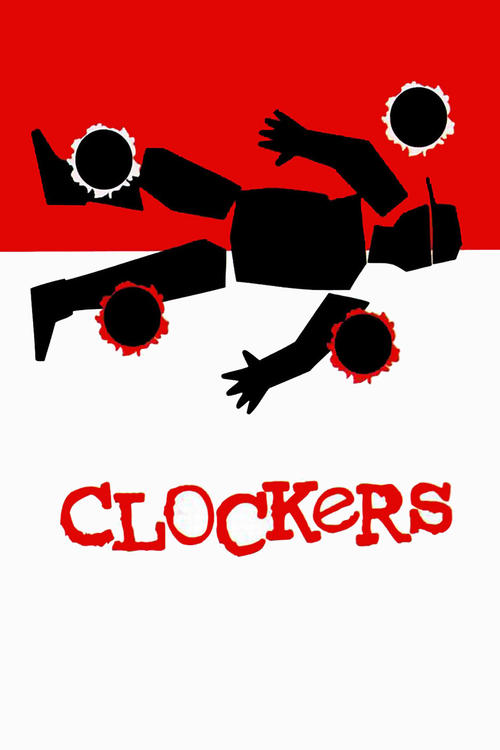
Clockers
1995 · Spike Lee
For when you want a crime story with real weight — something to chew on and argue about afterward, not comfort food. Choose it when you're up for a film that takes its world seriously.
What it's about
Strike is a young crack dealer working the benches of a Brooklyn housing project under Rodney Little, a drug lord who plays father figure and threat in the same breath. When a fast-food manager turns up shot dead, Strike's straight-arrow older brother confesses — and homicide detective Rocco Klein doesn't believe a word of it. The investigation tightens around Strike from both sides: the cops above him and Rodney beside him.
The experience
Tense and simmering rather than explosive — it plays like a murder mystery but feels like a pressure chamber, and it leaves you angry and thoughtful in equal measure. The dread comes from watching a kid run out of room.
Performances
Delroy Lindo is terrifying and magnetic as Rodney, switching from paternal warmth to menace mid-sentence, while Harvey Keitel gives the detective a weary, needling persistence. Mekhi Phifer, in his screen debut, carries the film with a haunted watchfulness.
The craft
Adapted from Richard Price's novel, it fuses procedural storytelling with Spike Lee's expressive style — bleached, grainy images, bold color shifts, and a mournful score that turns the projects' benches into a stage. The visual daring keeps a talky, novelistic story cinematically alive.
Why it matters
Landing at the end of the early-'90s wave of inner-city crime dramas, it deliberately complicated that cycle — less shootout than autopsy of a system — and its ground-level view of dealers and detectives shaped a generation of urban crime storytelling on film and television.
Snapshot
Clockers is Spike Lee's adaptation of Richard Price's 1992 novel, a procedural-inflected drama set among the low-level crack dealers ("clockers," who work the clock around the clock) of a Brooklyn housing project. At its center is Strike (Mekhi Phifer, in his screen debut), a young dealer with a bleeding ulcer who answers to the charismatic, paternal-menacing drug lord Rodney Little (Delroy Lindo). When a fast-food manager is found shot dead, Strike's churchgoing brother Victor (Isaiah Washington) confesses, and homicide detective Rocco Klein (Harvey Keitel) refuses to believe him, pressing instead toward Strike and Rodney. The film is best understood less as a whodunit than as a study of the conditions that make the question of "who did it" almost beside the point. Arriving at the tail end of the early-1990s "hood film" cycle, Clockers is simultaneously a participant in that cycle and a pointed critique of its iconography — a movie acutely conscious of how images of dead Black bodies circulate. It is also a landmark of Lee's visual experimentation, marking the feature debut of cinematographer Malik Hassan Sayeed, whose stylized palette would define Lee's later-1990s work.
Industry & production
The project's most consequential fact is its inheritance. Clockers was originally developed as a Martin Scorsese film, with Robert De Niro attached to play Rocco Klein, the detective who in Price's novel shares roughly equal weight with Strike. When Scorsese chose instead to make Casino (and De Niro followed him there), Scorsese stayed on as a producer and the directing passed to Spike Lee, working under his 40 Acres and a Mule Filmworks banner with Universal Pictures distributing. This lineage matters: Lee inherited a script shaped for a white-detective-centered crime drama and substantially reweighted it, collaborating with novelist Richard Price on the screenplay to push the brothers Strike and Victor, rather than Rocco, to the dramatic center. Keitel inherited, in effect, the De Niro role, and plays Rocco as a man whose certainty about the case is bound up with his own need to impose narrative order on the project's residents.
Lee made a second decisive intervention by relocating the story. Price's novel takes place in the fictional New Jersey city of Dempsy; Lee moved the action to Brooklyn, shooting in and around the Gowanus Houses, the kind of public-housing landscape that had been his subject since Do the Right Thing. The casting mixed Lee's stock company and Price's gritty realism: Lindo (fresh from Malcolm X and Crooklyn), John Turturro as Rocco's partner Mazilli, Keith David as the neighborhood cop Andre, Regina Taylor, and the young Pee Wee Love as Tyrone, the boy who idolizes Strike. The film opened in the autumn of 1995 to respectful but mixed reviews and modest commercial returns; precise box-office figures are not something I can verify with confidence here, but it was not a major hit and is generally remembered as a critical rather than commercial success.
Technology
Clockers was shot photochemically on 35mm in the mid-1990s, before digital intermediate workflows were standard, which means its striking color and contrast effects were achieved largely in-camera and in the photochemical lab rather than in a digital grade. The film is notable for its restless mixing of looks — shifts in stock, exposure, and processing that register as deliberate stylistic punctuation rather than continuity errors. Lee and Sayeed used the period's available tools (Steadicam, varied film stocks, optical and in-camera manipulation) expressively. The single most-discussed technological gesture is the opening-credits montage of crime-scene photographs: graphic, near-documentary images of dead Black bodies sprawled at actual-feeling crime scenes. Whether sourced or staged for the production, their photographic texture — flatly lit, evidentiary — sets the film's argument about images in motion before a line of dialogue is spoken. Beyond that, I'd be cautious about asserting specific lab processes (cross-processing, particular stock names) for Clockers without documentation, since several of the more extreme techniques associated with Sayeed are better attested on his subsequent Lee collaborations.
Technique
Cinematography
Clockers is the feature debut of Malik Hassan Sayeed, and it announces a sensibility. Where the dominant hood-film visual mode favored a sun-baked naturalism, Sayeed and Lee pursue heightened, sometimes lurid color and aggressive contrast. The project exteriors carry a particular over-saturated, heat-struck quality; interiors can tip into deep shadow or saturated single-color washes. Lee's signature devices recur — most memorably the double-dolly shot, in which subject and camera move together so the figure seems to glide untethered through the world, used here to externalize Strike's dissociation. The camera is mobile and subjective, frequently bound to Strike's bodily distress. The look directly shaped Lee and Sayeed's immediately following films, Girl 6 and He Got Game, making Clockers the origin point of a distinct late-1990s Lee visual idiom.
Editing
Sam Pollard, a long-running Lee collaborator (and later a distinguished documentarian), cut the film. The editing manages a tonal braid that is central to the movie's design: the procedural rhythm of Rocco's investigation against the looser, more associative texture of Strike's daily life. Pollard and Lee deploy abrupt inserts — the crime-scene photographs, Strike's model trains, the bottles of "Moo" chocolate drink Strike gulps to quiet his ulcer — as recurring motifs that interrupt narrative flow with bodily and psychological subtext. The structure deliberately withholds the conventional satisfactions of the mystery, letting scenes run toward discomfort rather than resolution.
Mise-en-scène / staging
The housing project is staged as a closed system: benches, stoops, and courtyards where the clockers conduct business under constant surveillance — by police, by Rodney, by each other, and by the camera. Lee organizes space around sightlines and watching, an apt subject for an atlas of the same name. Production designer Andrew McAlpine and costume designer Ruth E. Carter ground the world in lived-in specificity rather than glamour; the clothing and interiors avoid the fetishized cool that the film is partly critiquing. Strike's bedroom, with its elaborate model-train layout, is the film's key symbolic set — a child's escape fantasy of orderly motion and departure embedded in a world that permits neither.
Sound
Terence Blanchard, the jazz trumpeter who scored most of Lee's films of the era, provides music that leans toward melancholy and lyricism rather than the hip-hop-forward soundtracks then typical of the genre — a scoring choice that itself distances Clockers from the gangsta-rap iconography it interrogates. The film does engage rap and street sound diegetically, including a memorable sequence around the casual, performative talk of violence, but the non-diegetic score pulls toward elegy. The sound design foregrounds the body — Strike's labored swallowing, the wet sounds of his ulcer pain — keeping his physical deterioration audible.
Performance
Mekhi Phifer's Strike is the film's discovery: watchful, twitchy, evasive, a boy performing hardness he doesn't possess, his body literally rebelling against the life he's in. Delroy Lindo gives one of his finest performances as Rodney, modulating between avuncular warmth and sudden, total menace — a portrait of seduction and ownership rather than cartoon villainy. Harvey Keitel plays Rocco as abrasive, exhausted, and self-deceiving, a man whose pursuit of the "truth" is laced with condescension. Isaiah Washington's Victor anchors the moral stakes, and Pee Wee Love's Tyrone supplies the film's devastating fulcrum, the child whose corruption or salvation the whole story bends toward.
Narrative & dramatic mode
Clockers runs the machinery of a police procedural while systematically frustrating its logic. The genre's promise — that investigation yields truth and truth yields justice — is treated with deep skepticism. Lee subordinates the mystery (the question of who killed Darryl Adams) to a more diffuse inquiry into culpability: not who pulled the trigger, but what produces the trigger. The dramatic mode is tragic and quasi-naturalist, in the literary lineage of social fiction where environment is destiny; Price's journalistic, dialogue-rich realism supplies the texture, while Lee supplies a moral and visual editorializing voice. The result is a hybrid — half hard-boiled crime story, half social tragedy — that resolves Strike's arc through escape (the train out of the city) rather than through the courtroom-style closure the form leads us to expect.
Genre & cycle
The film lands at the close of the early-1990s African American urban-crime cycle inaugurated by Boyz n the Hood (1991) and intensified by Menace II Society (1993) and Juice (1992). Clockers is in dialogue with all of these, but its stance is revisionist and critical. Where the cycle had, in Lee's view, begun to aestheticize violence and risk glamorizing the very deaths it depicted, Clockers opens with corpse photographs precisely to refuse that glamour, and repeatedly frames the allure of the dealer's life as a trap closing on children. It functions, in effect, as the cycle's self-critique from within — a film that uses the genre's vocabulary to indict the genre's pleasures.
Authorship & method
Clockers is a characteristic Spike Lee work in its willingness to argue with its audience and its medium. Lee's method here is one of strategic reframing: taking an inherited, detective-centered property and rebalancing it toward the Black characters and their interiority, while retaining Richard Price's documentary ear for dialogue and procedure. The collaboration with Price (who co-wrote the screenplay) is essential — Price's reportorial density tempers Lee's editorializing, and Lee's formal aggression lifts Price's realism out of mere grit. The crucial new collaborator is cinematographer Malik Hassan Sayeed, whose debut here launched a partnership (Girl 6, He Got Game) that redefined Lee's visual style for the decade. Returning collaborators — composer Terence Blanchard, editor Sam Pollard, costume designer Ruth E. Carter, and the deep ensemble of 40 Acres regulars — give the film the signature of a sustained authorial workshop rather than a one-off.
Movement / national cinema
The film belongs to the wave of American independent and studio-financed Black filmmaking that Lee himself had done much to make commercially viable after She's Gotta Have It (1986) and Do the Right Thing (1989). It is American national cinema speaking from a specific, under-represented vantage — the Black urban working class and underclass of the post-industrial Northeast — and it carries forward a tradition of socially engaged realism while pushing toward formal experiment. Within Lee's own body of work it sits among his "chronicles of Brooklyn," extending the borough portraiture of Do the Right Thing and Crooklyn into darker territory.
Era / period
Clockers is a document of the mid-1990s crack era and the War on Drugs at its punitive height — a period of mass incarceration, aggressive policing, and the moral panics around "superpredators" and gangsta rap. The film registers the aftermath of the 1992 Los Angeles uprising and the broader national argument about images of Black death and criminality. Its preoccupation with surveillance, with who gets believed by police, and with the recruitment of ever-younger children into the drug trade speaks directly to the anxieties of its moment, and reads now as a near-prophetic critique of the carceral logic that defined the decade.
Themes
The film's governing themes are surveillance and the politics of looking; the body as a register of social stress (Strike's ulcer as the somatic cost of a life he cannot stomach); and the corruption of childhood, dramatized through Tyrone's drift toward Strike's orbit and toward violence. Running beneath these is a sustained meditation on images — on how photographs and films of Black suffering circulate, and on the viewer's complicity in consuming them, announced by the opening montage and sustained throughout. The model trains supply the counter-theme: escape, motion, a yearning for a clean line out of the closed system of the project. Finally, the film interrogates truth and authority itself — Rocco's confidence that he can read these lives, and the film's quiet insistence that he cannot.
Reception, canon & influence
Critical reception in 1995 was largely admiring if not unanimous, with particular praise for Lindo and Phifer and for the boldness of the visual style; some reviewers found the film's tonal mix and its subordination of the mystery frustrating. It was not a substantial commercial success, and for a period it was somewhat under-discussed within Lee's filmography relative to Do the Right Thing or Malcolm X. Over time its critical standing has risen, and it is now frequently cited as one of Lee's strongest and most formally adventurous films of the decade. Its influences run backward to Richard Price's social-realist crime fiction, to the Scorsese-De Niro crime tradition embedded in its origins, and to the hood-film cycle it both extends and rebukes. Its forward legacy is twofold: it inaugurated the Lee–Sayeed visual partnership that shaped late-1990s Black American cinema's aesthetics, and its skeptical, image-conscious approach to crime narrative anticipates the long-form, environmentally-determined storytelling later associated with prestige television — most often noted in connection with The Wire, given Richard Price's involvement in that series and the shared interest in the drug economy as a total social system. The genealogy from Clockers to The Wire is widely drawn by critics, and the affinity is real, though it should be described as kinship and shared authorship rather than direct causation.
A Deleuzian reading
Before a word is spoken, you are looking at the dead.
The full Deleuzian reading of Clockers →
Reception
Landed quietly in 1995 — respectful reviews, modest box office, and a sense it was overshadowed by the mid-'90s glut of hood films it was deliberately pushing against. It's since been reappraised as one of Spike Lee's most underrated joints, a bridge between the crime saga and the sociological street-level drama that TV would later perfect.
How Clockers was received, from release to now →
Influences: the films it descends from and the films it influenced
- Mean Streets (1973) — Establishes the jazz/pop-scored, handheld street-crime idiom and the De Niro–Scorsese property tradition Clockers literally inherited when the project passed from them to Lee.
- Taxi Driver (1976) — Models the subjective, expressionistically lit camera that frames a young man's moral corrosion inside a hostile city — the gaze Sayeed adapts to Strike's surveilled world.
- The French Connection (1971) — The location-shot, detective-centered vérité crime procedural whose cop's-eye realism Clockers deliberately inverts into its anti-procedural structure.
- Do the Right Thing (1989) — Source of Lee's own double-dolly floating shot and single-block closed-system staging, transplanted to the Nelson Mandela project benches.
- Boyz n the Hood (1991) — The hood-film coming-of-age template — a boy choosing between the corner and survival — that Clockers extends formally while rebuking its melodrama.
- Menace II Society (1993) — Opens on convenience-store surveillance footage of a killing; Clockers answers its nihilistic gaze with a self-conscious politics of looking and the snuff-photo motif inserts.
- Killer of Sheep (1978) — Foundational Black American observational realism that privileges everyday texture over plot, underwriting Clockers' patient, anti-procedural attention.
- The Battle of Algiers (1966) — Documentary-style staging of a policed community as a closed surveillance system, the spatial logic behind Clockers' over-watched projects.
- Girl 6 (1996) — Immediate continuation of the Lee–Sayeed partnership, extending the saturated, experimentally cross-processed photochemical palette debuted on Clockers.
- He Got Game (1998) — Lee/Sayeed reunion carrying forward Clockers' expressive color and ironic score juxtaposition (Copland against the projects) as a deliberated authorial aesthetic.
- Belly (1998) — Shot by Malik Hassan Sayeed, pushing Clockers' high-contrast, hyper-saturated photochemical experimentation into full music-video maximalism.
- 25th Hour (2002) — Lee crime narrative that again subordinates plot mechanics to a doomed protagonist's interiority and the city itself as a moral environment.
- The Wire (2002) — Richard Price joined its writers' room; it renders the drug economy as a total, environmentally-determined social system in the long form Clockers anticipated.
- Moonlight (2016) — Extends the Lee/Sayeed project of luminous, color-expressive cinematography on Black skin and the question of who is permitted to look and be seen.
- Fresh (1994) — Same crack-era subject of a child strategist navigating the drug trade, rendered through a quiet, chess-like narrative rather than gunplay spectacle.
- New Jack City (1991) — Crack-era crime film of the same cycle dramatizing the trade as a vertically organized enterprise, the economic system Clockers views from the bottom rung.
- La Haine (1995) — Malik Hassan Sayeed's high-contrast anamorphic scope photography of Black youth under constant police surveillance, released the same year, shares La Haine's formal argument that widescreen cinematography can grant cinematic dignity to communities the mainstream treats as backdrop.
- Deep Cover (1992) — Descendant drug-corner morality tale using heightened, near-hallucinatory saturated color and an institutional-critique lens on the war on drugs' Black casualties.
Similar films
- Boyz n the Hood (1991) — influence & lineage
- Do the Right Thing (1989) — influence & lineage
- He Got Game (1998) — influence & lineage
- 25th Hour (2002) — influence & lineage
- Menace II Society (1993) — influence & lineage
- Taxi Driver (1976) — influence & lineage
- Crooklyn (1994) — shared sensibility
- GoodFellas (1990) — shared sensibility
All the films related to Clockers →