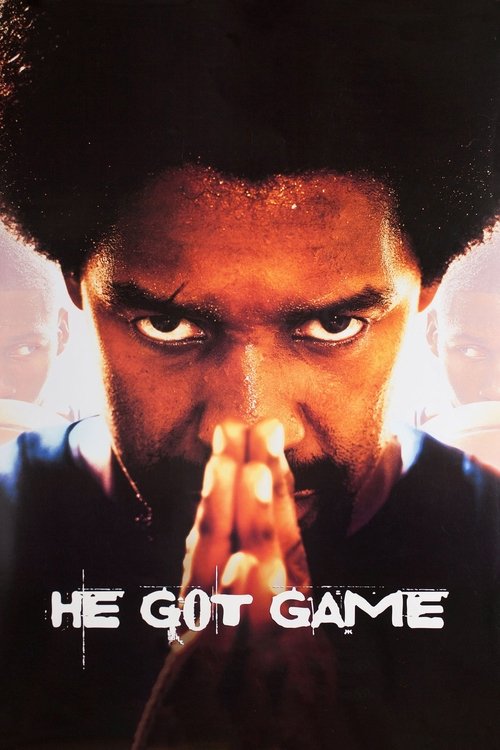
He Got Game
1998 · Spike Lee
When you want a drama with something on its mind — a film to argue with, about family, forgiveness, and money in sports. More challenge than comfort, but it earns its feelings.
What it's about
Jake Shuttlesworth is in prison for killing his wife when the state offers him a devil's bargain: a week of parole, and a shorter sentence if he can convince his estranged son to sign with the governor's alma mater. The son, Jesus, happens to be the most coveted high-school basketball prospect in America — and he has not forgiven his father for anything. Around them circles the entire recruiting machine: coaches, agents, hangers-on, everyone with a pitch and a price.
The experience
Angry, operatic, and surprisingly tender underneath — part sports movie, part father-son reckoning, part furious argument about who profits from young Black talent. It runs hot and long and preachy in places, but the central standoff between father and son has real ache.
Performances
Denzel Washington gives Jake a coiled mix of guilt, menace, and yearning that keeps you off-balance about how to feel about him. NBA star Ray Allen, in his acting debut, is startlingly natural as Jesus — wary, contained, and believable in a way athletes-turned-actors almost never are.
The craft
Spike Lee shoots basketball like myth and the recruiting circus like satire, scoring street games and family wounds to an unlikely, striking pairing of Aaron Copland and Public Enemy. It's a big, swinging piece of filmmaking that treats a sports story with the scale of an epic.
Why it matters
One of the definitive films about the business of amateur athletics, and a landmark of the sports drama that money-in-college-sports stories still get measured against. It also proved an active pro athlete could carry a serious dramatic lead.
Snapshot
He Got Game is Spike Lee's basketball morality play, a film that uses the recruitment of a phenom high-school point guard as a lens onto fatherhood, freedom, and the wholesale commodification of the young Black athlete. Denzel Washington plays Jake Shuttlesworth, a convict serving time for killing his wife, whom the state releases on a week's parole with a corrupt bargain: if he can persuade his estranged son Jesus — the nation's most coveted college prospect — to sign with the governor's alma mater, Big State, his sentence will be cut. The son is played by Ray Allen, then a rising guard for the Milwaukee Bucks, in an acting debut of unusual naturalness. Built around the collision of a father's desperation and a son's grievance, the film is at once a sports picture, a family melodrama, and a broadside against the machinery — colleges, agents, sneaker money, family hangers-on — that descends on an eighteen-year-old with a jump shot. Its most audacious gesture is musical: Lee scores the streetball and the pastoral alike to the concert music of Aaron Copland, laminating the Americana of the frontier myth onto the asphalt courts of Coney Island.
Industry & production
He Got Game was produced by Lee's Brooklyn-based 40 Acres and a Mule Filmworks and released in the spring of 1998 through Touchstone Pictures, the adult-oriented Disney label — a mainstream studio berth that placed a pointedly critical film about American institutions inside the apparatus it critiques. The picture belongs to the most productive stretch of Lee's career, the run of films he turned out in rapid succession across the middle and late 1990s (Crooklyn, Clockers, Girl 6, Get on the Bus, and, after this, Summer of Sam), and it reunited him with Washington for their third collaboration following Mo' Better Blues (1990) and Malcolm X (1992); they would work together again on Inside Man (2006).
The production's signature coup was casting. Rather than build the film around an actor drilled to look like an athlete, Lee cast a genuine professional — Ray Allen — and surrounded him with real figures from the basketball world playing themselves, so that the recruitment gauntlet is populated by recognizable coaches and players. The supporting cast paired that authenticity with seasoned performers: Milla Jovovich as Dakota, a sex worker in Jesus's motel; Rosario Dawson, early in her career, as his girlfriend Lala; former NFL great Jim Brown as Jake's prison handler Spivey; and Ned Beatty as the warden. Principal photography centered on Brooklyn — Coney Island and its housing projects stand in for Jesus's world — anchoring the film's mythology in a specific, unglamorous geography. Commercially the film was a modest performer, well received critically but not a major theatrical earner; exact grosses should be checked against a reliable database rather than asserted here.
Technology
The film was shot photochemically on 35mm, the standard of its moment, and it reflects the late-1990s sensibility in which a Lee production married studio-grade resources to a restless, hand-worked image. The most consequential technological decision was not in the camera but in the sound and music pipeline: Lee licensed a suite of existing Copland concert recordings and interleaved them with a full slate of original songs commissioned from Public Enemy, whose album He Got Game was released in tandem with the film. That soundtrack strategy — a canonical modernist American composer on one track, a landmark hip-hop group on the other — is itself a kind of technological argument about what "American music" can be made to carry. The visual technology is comparatively classical, but the era's tools for high-contrast printing and expressive lab work underwrite the film's shifts in texture between the burnished pastoral montages and the grainier street footage.
Technique
Cinematography
The images are by Malik Hassan Sayeed, the cinematographer of Lee's Clockers (1995) and Girl 6 (1996), whose work in this period is marked by bold contrast, saturated or deliberately degraded color, and a willingness to let the film stock itself become a texture. He Got Game opens with a bravura montage of basketball played across the American landscape — children on rural courts, players in city parks — photographed with a golden, mythologizing warmth that Sayeed then sets against the harder, more documentary look of Coney Island. The film also deploys Lee's most famous visual signature, the double-dolly "floating" shot in which actor and camera move together on separate platforms so the subject appears to glide, weightless, through the frame; here it is used to lend certain emotional passages a dreamlike suspension. Sayeed's compositions favor the isolating power of the single figure — Jake alone, Jesus surrounded yet solitary amid the recruitment crowd.
Editing
The cutting is by Barry Alexander Brown, Lee's longtime editor, whose work across the director's filmography gives the sprawling material its rhythm. He Got Game is structurally ambitious and, by design, discursive: it braids the ticking-clock parole plot with extended flashbacks to Jake's marriage and the killing, with satirical set pieces of the recruitment circus, and with the Copland-scored montages that function almost as choral interludes. Brown's editing has to hold together documentary interpolation, melodrama, and quasi-essayistic montage without the seams tearing; the film's length and diffuseness are a recurrent note in criticism, but the montage sequences in particular show a precise musical sense of how image and Copland's phrasing lock together.
Mise-en-scène / staging
Production design is by Wynn Thomas, another core member of Lee's repertory company. The film's spaces are legible as arguments: the cramped motel where Jake is billeted, the projects that shaped Jesus, the campus and gym of Big State, and the antiseptic corridors of the prison that bookend the story. Basketball itself is staged as ritual — the court as arena, church, and marketplace at once. Lee's staging repeatedly frames Jesus as the still center of a swarm, the object toward which coaches, relatives, agents, and hangers-on all lean, dramatizing commodification through blocking rather than exposition.
Sound
Sound design and music are inseparable in this film. The Copland works — drawn from his most nationally iconic scores — supply a mythic, open-prairie grandeur that Lee attaches, provocatively, to inner-city basketball, insisting that the playground game is as central to the American story as the frontier. Against and around that, Public Enemy's original songs, led by the title track that borrows the refrain of Buffalo Springfield's "For What It's Worth," return the film to the register of contemporary Black protest and street reportage. The dialogue mix, meanwhile, gives room to Washington's low, wounded delivery and to the film's percussive vernacular exchanges.
Performance
Washington's Jake is the performance the film is built to hold: a man corroded by guilt and confinement, alternately manipulative and genuinely paternal, forced to court the son who despises him. Critics widely singled out the work as among his strongest of the decade. Opposite him, Ray Allen — untrained as an actor — gives Jesus a guarded, credible interiority; the casting gamble is often cited as vindicated, with the athlete's ease on the court extending to an unforced screen presence. Jovovich and Dawson bring texture to roles that could have been functional, and the parade of real basketball figures playing themselves lends the recruitment scenes a satirical documentary charge.
Narrative & dramatic mode
The film's dramatic engine is the parole bargain: a deadline, a task, and a father and son who must negotiate an unbearable history in a compressed span. Onto that thriller-adjacent spine Lee grafts a melodrama of family rupture — the flashbacks to Martha Shuttlesworth's death supply the wound that motivates the son's refusal and the father's penance — and a satire of institutional appetite. The mode is deliberately hybrid and maximalist, shifting between realist confrontation, mythic montage, and pointed social caricature. The ending tips into the frankly symbolic: back in prison, Jake hurls a basketball over the wall, and it is answered — a magical-realist flourish that trades resolution for a gesture of impossible connection, leaving the reconciliation between father and son suspended rather than sealed.
Genre & cycle
He Got Game sits inside a mid-1990s cluster of American basketball films while working to subvert the genre's uplift. It shares direct thematic ground with Blue Chips (1994), the drama of college-recruitment corruption, and stands near White Men Can't Jump (1992), Above the Rim (1994), and — most importantly — the landmark documentary Hoop Dreams (1994), which had already exposed the economy of hope and exploitation surrounding gifted young players. Where the conventional sports film builds to the triumphant game, Lee displaces the climax onto a father-son one-on-one whose stakes are emotional and moral rather than athletic, and refuses the clean victory. The film is thus better understood as a family drama and social critique wearing the costume of a sports picture.
Authorship & method
The film is a characteristic 40 Acres production, made with Lee's stock company of collaborators and bearing his authorial preoccupations: the moral weather of Black urban life, institutions that consume the people they claim to serve, and a maximalist mixing of tones and registers. The key craftspeople are the recurring ones — cinematographer Malik Hassan Sayeed, editor Barry Alexander Brown, production designer Wynn Thomas — and the recurring lead, Denzel Washington. The most revealing authorial choice concerns the music: Lee's usual composer, Terence Blanchard, did not supply an original orchestral score here. Instead Lee reached outside his own idiom for Copland, and outward again for Public Enemy, effectively authoring the film's meaning through curation as much as composition. That decision — to yoke the concert hall's Americana to hip-hop's street witness — is the clearest signature of Lee's essayistic method, in which juxtaposition itself carries the thesis.
Movement / national cinema
Lee is the central figure of the wave of Black American filmmaking that broke through in the late 1980s and flourished in the 1990s, and He Got Game is a mature work of that movement: a Black-authored studio film that treats African American experience as the ground of a national story rather than a niche subject. His practice descends from independent Black cinema and runs parallel to the careers he helped make thinkable for a generation of Black directors. The film's insistence that basketball is quintessentially American — and quintessentially a site of Black labor being harvested for others' profit — is the movement's argument in miniature: an assertion of centrality, staged in the country's own mythic musical language.
Era / period
The film is a document of the late-1990s American sports economy at a moment of transformation, when the money surrounding college and professional basketball — television, sneakers, endorsements, agents — had swelled to the point that a teenage recruit was a multimillion-dollar asset before playing a college minute. The presence of contemporary NBA and college figures as themselves fixes the film precisely in its instant. It also captures Lee at a specific career juncture: post-Malcolm X, in a phase of prolific mid-budget studio work, confident enough to gamble on a non-actor lead and a Copland score. The cultural texture — the hip-hop of Public Enemy's comeback, the aesthetics of Coney Island in the Giuliani-era city — is thoroughly of its moment.
Themes
At its center is fatherhood as both bond and burden: Jake must earn a paternity he forfeited, and the film asks whether love offered under duress can ever be uncoerced. Freedom and imprisonment structure everything — Jake's literal cell mirrors Jesus's figurative one, hemmed in by everyone who wants a piece of his future. Commodification is the film's great social theme: the young Black athlete as a body to be bought, courted, and traded, his talent alienated from him by an economy of adults. Around these run temptation and corruption (the recruitment sequences as a procession of lures), guilt and redemption (Jake's penance for Martha's death), and, through the Copland montages, a meditation on what and whom the American dream is built on. The name Jesus Shuttlesworth — which the film ties to Earl "The Pearl" Monroe, the playground legend once nicknamed "Black Jesus" — folds in a strain of sacrifice and secular sanctity.
Reception, canon & influence
Critical reception was largely favorable, with particular praise for Washington's performance and for the surprise of Ray Allen's naturalism, and with admiration for the daring of the Copland scoring; the recurrent reservation concerned the film's length and diffuseness, the sense that Lee's ambitions outran the narrative's shape — a criticism often leveled at his most expansive work. On influences flowing into the film: it draws on the documentary exposure of recruitment's exploitation crystallized by Hoop Dreams and on the corruption drama of Blue Chips; on Lee's own essayistic tradition of montage and musical juxtaposition; and, in its symbolic ending, on a magical-realist strain that recurs across his cinema. Its own legacy is durable in a particular register: it is frequently cited as one of the finest basketball films and among the most searching about the economics of amateur sport, and the Public Enemy soundtrack became a canonical hip-hop album in its own right, arguably eclipsing the film's box-office footprint in cultural reach. The gambit of casting a real athlete in a demanding dramatic lead, and the yoking of Copland's Americana to the playground game, remain the film's most distinctive and most imitated ideas. Where the granular record is thin — precise grosses, specific production anecdotes — those particulars should be verified against primary sources rather than assumed.
A Deleuzian reading
A kid is shooting a basketball on a rural court somewhere out in the American middle distance, and the music coming up underneath is Aaron Copland.
The full Deleuzian reading of He Got Game →
Reception
Opened at #1 in 1998 but drew mixed reviews and modest box office, with many critics calling it overstuffed; it's since been reappraised as top-tier Spike Lee, and among basketball heads it now routinely wins the 'greatest hoops movie ever' argument.
How He Got Game was received, from release to now →
Influences: the films it descends from and the films it influenced
- Do the Right Thing (1989) — Introduces Lee's signature double-dolly 'floating' shot — actor and camera riding the same rig so the character glides through space — the exact device He Got Game reprises for Jake's release.
- Mo' Better Blues (1990) — Establishes the 40 Acres Denzel-Washington lead partnership and the swirling 360° dolly-around-the-performer that Lee ports from the bandstand to the basketball court.
- Malcolm X (1992) — Perfects the Lee–Washington directing method — long unbroken interior close-ups holding on Denzel's controlled stillness — later applied to the imprisoned father Jake Shuttlesworth.
- Clockers (1995) — Cinematographer Malik Hassan Sayeed's expressionist high-contrast look and cross-processed/reversal-stock color palette is the same visual grammar he brings to He Got Game.
- Hoop Dreams (1994) — The documentary that crystallized the recruitment machine preying on Black teenage athletes; Lee dramatizes its exposé of coaches, agents, and hangers-on circling a schoolboy phenom.
- Blue Chips (1994) — Casts real NBA players (Shaquille O'Neal, Anfernee Hardaway) in dramatic roles and builds its plot on under-the-table recruiting payola — the direct precedent for casting Ray Allen and for Jake's bargain.
- Bicycle Thieves (1948) — The neorealist practice of casting non-professionals for documentary authenticity is the deep DNA of trusting a working NBA guard, not a trained actor, to carry the lead.
- The Red Pony (1949) — Aaron Copland's pastoral, open-interval Americana score — the concert-hall idiom Lee lifts wholesale (Lincoln Portrait, John Henry, et al.) to yoke against the playground game.
- White Men Can't Jump (1992) — Foregrounds genuine on-court ability and the rhythm of playground trash-talk, staging streetball as performed authenticity — the register Ray Allen's naturalism extends.
- Raging Bull (1980) — The prestige-art sports film that renders athletics as subjective, expressionist spectacle — slowed, sound-warped, operatic — the ambition Lee borrows for his stylized game sequences.
- Love & Basketball (2000) — A 40 Acres production Lee shepherded; extends his basketball-as-life-structure and the merging of the Black romance register with the sport's on-court realism.
- Inside Man (2006) — Continues the stock-company auteur-plus-Denzel model, deploying Washington's coiled restraint within Lee's genre-subversion framework.
- Friday Night Lights (2004) — Docu-realist handheld shooting of a town's economy riding on teenage athletes; extends He Got Game's amateur-sports-economy subject into vérité texture.
- Moneyball (2011) — Builds a sports film around economics and front-office valuation rather than the play itself, extending the commodification-of-the-athlete thesis Lee foregrounded.
- Creed (2015) — A Black auteur reclaims the sports film with a virtuoso unbroken single-take fight round — the same ambition to elevate athletic sequence into formal set-piece.
- 25th Hour (2002) — Same essayistic montage-and-music thesis-by-juxtaposition method, Barry Alexander Brown's editing, and a recurrence of the double-dolly gliding walk.
Similar films
- Hoop Dreams (1994) — influence & lineage
- Clockers (1995) — influence & lineage
- Malcolm X (1992) — influence & lineage
- Inside Man (2006) — influence & lineage
- Creed (2015) — influence & lineage
- Love & Basketball (2000) — influence & lineage
- Do the Right Thing (1989) — influence & lineage
- BlacKkKlansman (2018) — shared sensibility