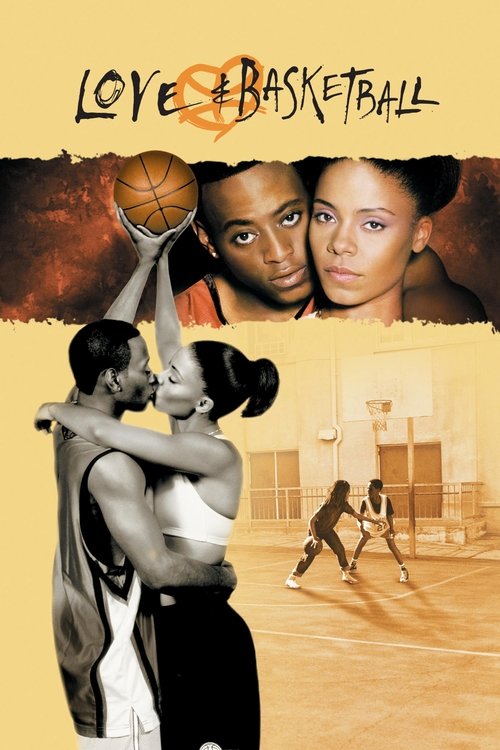
Love & Basketball
2000 · Gina Prince-Bythewood
For date night, or any night you want a love story with real substance — something to root for, argue over, and rewatch. Comfort viewing that still has something to say.
What it's about
Monica and Quincy grow up next door to each other in Los Angeles, both basketball-obsessed, both good enough to dream big — but he's a star player's son bound for the NBA, and she's a girl who has to fight for every inch of the same ambition. From a childhood driveway game through high school, college ball at USC, and the pros, the film follows two people trying to love each other while wanting the same thing that keeps pulling them apart.
The experience
Warm, sexy, and quietly bruising — it has the pleasures of a great romance and the competitive fire of a sports movie, but what stays with you is how honestly it weighs love against ambition. You'll swoon and you'll ache, often in the same scene.
Performances
Sanaa Lathan is the heart of it — fierce, guarded, and completely convincing as an athlete whose drive is never softened for likability — and Omar Epps matches her with easy charisma and wounded pride. Their chemistry, on the court and off, carries the whole film.
The craft
Gina Prince-Bythewood structures her debut in four titled "quarters" like a game, a simple device that gives a decades-spanning romance real shape, and she shoots basketball with the intimacy of a love scene and love scenes with the intensity of competition. The writing is what's radical: it gives the woman the jump shot and the ambition, and makes the man decide if he can live with it.
Why it matters
A modest hit that grew into a beloved touchstone of Black American romance and the definitive film about a woman athlete's ambition, it launched Prince-Bythewood's career and its influence echoes through two decades of romantic dramas since.
Snapshot
Gina Prince-Bythewood's first feature is a two-hander that runs on a simple, quietly radical premise: give the woman the jump shot and the ambition, and make the man the one who has to decide whether he can live with it. Structured in four titled "quarters" plus a coda, the film follows Monica Wright (Sanaa Lathan) and Quincy McCall (Omar Epps) from a 1981 driveway pickup game in Los Angeles's Baldwin Hills through high school, a shared freshman year at USC, and into the divergent professional lives that basketball forces on them — his to the NBA, hers to a semi-anonymous overseas contract in Barcelona, because in 1993 the United States had no women's professional league to send her to. Produced by Spike Lee's 40 Acres and a Mule Filmworks for New Line Cinema and developed through the Sundance Institute's labs, it premiered at Sundance in January 2000 and opened that April. It won Prince-Bythewood the Independent Spirit Award for Best First Screenplay, performed respectably in theaters, and then did the thing that matters more: it kept being watched. Twenty-five years on it is one of the most durable American romances of its decade and the founding text of a directing career that would run through Beyond the Lights, The Old Guard, and The Woman King.
Industry & production
The film sits at a specific industrial intersection. New Line Cinema in 2000 was a Time Warner subsidiary with an appetite for mid-budget genre and audience pictures, and one of the few major-affiliated companies with a working relationship to Black filmmakers and Black audiences. 40 Acres and a Mule supplied the producing muscle and the imprimatur: Spike Lee came aboard as producer after reading the script, with Sam Kitt — a longtime 40 Acres executive — producing alongside him. That combination gave a first-time director something rare: studio distribution without studio authorship.
The screenplay's route to the screen went through the Sundance Institute's Feature Film Program, the developmental pipeline that in the 1990s functioned as an alternative film school and a talent-laundering mechanism for the specialty divisions. Prince-Bythewood had come up in network television through the 1990s — writing on A Different World and later working in series television including Felicity — which is legible in the film's confident scene construction and its comfort with long emotional arcs.
Budget figures reported at the time put the production in the low eight figures, and its domestic theatrical gross modestly exceeded that; it was a real if unspectacular commercial success rather than a breakout. The more consequential economics were ancillary: a soundtrack album of period R&B and hip-hop that functioned, as such albums did throughout the 1990s, as both marketing engine and second revenue stream. Casting was contested — Prince-Bythewood has described fighting to keep Sanaa Lathan, then known mainly from The Best Man (1999), in a role the industry would have preferred to fill with a bigger name. The film shot on Los Angeles locations, including the USC campus, which grounds it in a real and specific civic geography rather than a generic "the city."
Technology
Love & Basketball is a photochemical 35mm production made at the precise moment American cinema's technological floor was shifting: 2000 is the year of Dancer in the Dark and Timecode, of the first widely noticed digital intermediate work, of the DV insurgency reaching the multiplex. The film participates in none of it, and that is the point. Its relationship to technology is not one of production but of quotation — the technology it engages is the technology of sports television.
The arena sequences borrow the camera positions and cutting grammar of NCAA and NBA broadcast: the elevated wide, the baseline low angle, the reverse from behind the backboard, the isolated slow-motion of a shot in flight, the arena PA and the compressed roar of a crowd mix. The film's audience in 2000 had been trained by twenty years of televised basketball to read these images fluently, and Prince-Bythewood exploits that literacy, then interrupts it — cutting away from the ball to a face, dropping the crowd out of the mix — to reassert that this is a drama and not a game. The closing WNBA sequence works the same trick in reverse, staging a professional women's game in the full visual language of live broadcast as an argument about visibility itself: this is what it looks like when the cameras are pointed at her.
Technique
Cinematography
Reynaldo Villalobos — a veteran whose credits run back through Urban Cowboy (1980) and Risky Business (1983) — shoots in a warm, unshowy naturalism keyed to Southern California light: golden late-afternoon exteriors, night scenes carried by practical warmth from windows and porch lamps, interiors that look lived in rather than designed. The register is closer to 1970s American character drama than to the high-contrast stylization of the contemporaneous hood cycle.
The basketball is photographed in two distinct modes. Driveway and playground games are covered loosely, often handheld, in takes long enough that the performers' actual competence is legible — the camera is a participant, and it does not cut away to hide a missed shot. Institutional games are covered harder and flatter, in the televisual idiom described above, with the human being progressively squeezed out of frame by the apparatus. The romance, meanwhile, lives in close-ups and shallow focus, and in one persistent spatial motif: the two adjacent houses and the window between them, an architecture of proximity that the film returns to across all four quarters as the measure of how far apart two people can be while standing twenty feet from each other.
Editing
Terilyn A. Shropshire — who had cut Kasi Lemmons's Eve's Bayou (1997) and would become Prince-Bythewood's editor for the next quarter-century, through The Secret Life of Bees, Beyond the Lights, The Old Guard, and The Woman King — gives the film its most distinctive formal decision: the four-quarter architecture, with title cards that turn the film's own duration into a game. Each quarter is a self-contained movement with its own crisis, and the cuts between them are hard elliptical jumps across years, trusting the audience to reconstruct what happened in the gap from costume, hair, and physical bearing.
Within sequences, the game footage is cut for emotional rhythm rather than spatial continuity of play; you rarely know the score, and the film does not want you to. The love scene set to Maxwell's cover of Kate Bush's "This Woman's Work" is the film's most-quoted passage and is built as a montage of held moments rather than a continuous action. The climactic one-on-one is cut the other way — patient, near-continuous, letting the physical contest carry its own metaphor without help.
Mise-en-scène / staging
The film's period markers are almost entirely costume, hair, and interior décor rather than set dressing or archival inserts: 1981's Afro puffs, the hi-top fades and Showtime-era Lakers iconography of 1988, the looser silhouettes of the early 1990s. The two houses do the class work. The McCall home, built on Zeke McCall's (Dennis Haysbert) pro salary, is glossy, spacious, and slightly hollow; the Wright home is the tighter, more anxiously maintained interior of Black professional strivers, and Camille Wright's (Alfre Woodard) kitchen is staged as the film's second arena — the site of its most concentrated verbal combat. Costume carries argument throughout: the uniform against the prom dress, the jersey as second skin, the bank teller's blouse that reads as a defeat before Monica speaks a line. The scar Monica takes on the court as a child stays on Lathan's face for the entire film, a small, permanent piece of staging.
Sound
Terence Blanchard's score treats the material as melodrama rather than sports picture — lyrical, jazz-inflected orchestral writing that swells for the relationship and largely withdraws from the games, refusing the triumphal brass the genre normally supplies. Against it sits a dense bed of diegetic needle drops, period-accurate R&B and hip-hop that does the chronological work the film declines to do with titles.
The most inventive sound design is the court itself. Sneaker squeak, the bounce and the snap of a net through a rim, the flat report of a ball on asphalt — these recur as a motif, sometimes carried across cuts into scenes with no basketball in them, so that the sport becomes an ambient condition of both characters' inner lives. In several sequences the crowd falls away entirely to isolate Monica's breathing, interiorizing a public event.
Performance
Lathan's is the performance the film stands on, and it is built physically. She trained extensively to play credibly, and the credibility matters: because the audience believes the body, it believes the ambition. Her Monica is a study in withheld affect — hunched shoulders, a set jaw, an inability to perform the ease that everyone around her keeps requesting — which makes her rare openings land hard. Epps plays Quincy's charm and his entitlement as the same trait, which is generous to the character and unsparing about him. Woodard's single kitchen confrontation, in which Camille finally refuses her daughter's contempt for the life she chose, is the film's best-acted scene and reframes the whole picture: it insists that the mother's homemaking was also labor and also a career, made under worse constraints. Haysbert and Debbi Morgan supply a parental generation whose compromises are visible without being explained.
Narrative & dramatic mode
The film is a double bildungsroman braided into a decade-spanning romantic melodrama, and its structural intelligence is to make the sports plot and the love plot the same plot. Monica and Quincy do not have careers that interfere with their relationship; their relationship is the negotiation of whose career is permitted to be primary. The film's engine is an asymmetry it states plainly — Monica's aggression on court is read as a character defect, Quincy's as competitive fire — and then dramatizes in incident after incident.
Its most decisive genre move is the displacement of the climax. The sports film's contract promises a final game with a title at stake; Love & Basketball substitutes a one-on-one on a driveway court, played for a heart, in which the outcome of the game and the outcome of the story deliberately diverge. The mode throughout is melodrama in the classical, non-pejorative sense: heightened emotional legibility, moral conflict externalized into gesture and object, a faith that domestic stakes are worth full dramatic weight. The epilogue — marriage, a daughter, Monica on the floor for the Sparks — resolves the double bind by wish, and it is the one place where the film's rigor relaxes into fantasy. Some viewers read that as a failure of nerve; others as a deliberate act of imagination about a future that, in 2000, had just barely become imaginable.
Genre & cycle
Love & Basketball belongs to two cycles at once. The first is the late-1990s wave of Black romantic and ensemble dramas that followed Waiting to Exhale (1995): Love Jones (1997), Soul Food (1997), How Stella Got Her Groove Back (1998), The Best Man (1999), The Wood (1999), and after it The Brothers (2001) and Brown Sugar (2002). These were largely first- and second-feature films, middle-class in setting, romantic in mode, and collectively constituted a deliberate turn away from the early-1990s hood cycle that had defined studio expectations of Black filmmaking since Boyz n the Hood (1991) and Menace II Society (1993).
The second is the basketball film — White Men Can't Jump (1992), Above the Rim (1994), the documentary landmark Hoop Dreams (1994), and Spike Lee's He Got Game (1998), released by the same producer two years earlier. Against all of these, Prince-Bythewood's contribution is categorical rather than incremental: the American sports film had essentially no precedent for a woman athlete as romantic and dramatic lead in a mainstream release, and the Black romance cycle had none for a heroine defined by physical ambition rather than professional or emotional aspiration. The film occupies the empty cell in the grid.
Authorship & method
Prince-Bythewood's authorship here is unusually direct: she wrote the film, and it draws on a life. A UCLA graduate who ran track for the university, she came to the material with an athlete's understanding of the specific loneliness of elite training and of what it costs a woman to want the thing openly. Her method, visible across the whole subsequent career, is to fuse genre satisfaction with emotional exactitude — to make a picture that works as popular cinema while refusing shortcuts in the interior lives.
The collaborators she found on this film became the core of that method. Terilyn A. Shropshire has cut nearly everything she has directed since. Terence Blanchard, Spike Lee's longtime composer and the scorer of Eve's Bayou, brought a melodramatic seriousness that a more conventional sports score would have flattened. Sanaa Lathan became a recurring lead, most notably in Disappearing Acts the same year. Her husband, the screenwriter Reggie Rock Bythewood, has been a career-long creative partner across their later television and film work. The lineage runs forward with remarkable consistency: the woman's body under strain, filmed seriously and at length, is as central to The Woman King (2022) as it is to a 1988 gym in Crenshaw.
Movement / national cinema
The film is American independent cinema of the Sundance era arriving at the studio door — developed in institute labs, premiered at Park City, released by a major's affiliate — and it marks the moment that pipeline began to admit Black women in more than token numbers. The precedents were few and recent: Julie Dash's Daughters of the Dust (1991), Leslie Harris's Just Another Girl on the I.R.T. (1992), Darnell Martin's I Like It Like That (1994), Kasi Lemmons's Eve's Bayou (1997). Prince-Bythewood is a UCLA product, and while she works in a frankly commercial idiom far from the L.A. Rebellion's radical formalism, she emerges from the same institution that produced Charles Burnett, Haile Gerima, and Dash — a genealogy worth naming even where the aesthetics diverge.
It is also, insistently, a Los Angeles film, and it maps a part of Black Los Angeles the movies had barely visited: Baldwin Hills and Ladera Heights, the professional-class enclaves, rather than the South Central of the hood cycle. Same city, different register, different assumptions about what Black domestic space looks like on screen.
Era / period
The film's 1981–1993 span is precisely the first full generation raised under Title IX (1972) — girls who were promised institutional athletics from grade school onward and then, at the end of the pipeline, found no domestic professional league waiting. Monica's Barcelona contract is not a plot contrivance but a documentary fact of that decade. The WNBA launched in 1997; the film arrived in 2000, three years into the league's existence and while its survival was still an open question. The closing Sparks sequence is therefore a wager on an institution, made in real time.
Its production era is equally specific: the last years of the 1990s independent boom, the height of the soundtrack-driven marketing model, and the tail end of a period when a mid-budget adult drama could get a wide theatrical release on the strength of a script and two rising leads — a business that had substantially contracted within a decade.
Themes
The governing theme is the gendered double standard applied to ambition itself, which the film states outright and then tests from every angle: on the court, in the family, in the bedroom, in the economics of who gets paid. Around it cluster several others. Mothers and daughters: Camille's domestic labor, dismissed by Monica as capitulation and finally recognized as its own constrained choice, gives the film a second feminism in argument with its first. Fathers and sons: Zeke's infidelity detonates Quincy's self-conception and reveals how much of his identity was borrowed. The body as capital, and its fragility — Quincy's knee injury is the film's structural rhyme for Monica's exile, two different ways a career can be taken away. And love as a problem of scheduling and geography as much as feeling: the film is unusually attentive to the mundane logistics — curfews, bed checks, time zones, contracts — through which institutions dismantle a relationship without anyone intending it.
Reception, canon & influence
Reviews in 2000 were broadly warm, praising the freshness of the premise, Lathan's performance, and the film's refusal of the easy inspirational register; the most common reservation concerned the final act's tidy resolution. Recognition came primarily from the independent and Black film worlds — the Independent Spirit Award for Best First Screenplay, and honors from the NAACP Image Awards and Black Reel Awards — rather than from the industry's mainstream awards apparatus.
Its backward-facing influences are legible and, in several cases, acknowledged. Prince-Bythewood has cited The Way We Were (1973) as a model for a romance that spans decades and ends in incompatibility rather than villainy. Spike Lee's work, and He Got Game two years prior, established both the producing context and a stylistic pole the film consciously moves away from. Hoop Dreams stands behind its documentary-inflected sense of what youth basketball ambition actually feels like. And Eve's Bayou is the closest neighbor of all — same editor, same composer, a Black woman's first feature made two years earlier — a working relationship that amounts to a small, self-sustaining production culture.
Forward, its influence has grown steadily and now outstrips its original commercial footprint. It became a generational text for women athletes, repeatedly named by WNBA players as the film that made a professional career picturable, and its cultural stock rose in tandem with the league's. In American film and television it functions as the reference point for the serious Black romance — a lineage visible in Prince-Bythewood's own Beyond the Lights (2014) and in later work such as Sylvie's Love (2020) and The Photograph (2020), and cited by television creators working in the same emotional register. For the sports film it remains the standing counter-example: proof that the genre's machinery works perfectly well when the athlete is a woman, and that the industry's reluctance to try again was never a question of whether audiences would come. And it launched a director who, two decades later, would take that same conviction about women's bodies, ambition, and screen time into a $50-million action epic and a historical war film — the through-line from a Crenshaw driveway to The Woman King being, on inspection, no line at all but the same argument at larger scale.
A Deleuzian reading
Monica takes the scar as a kid, on the court, in the film's first quarter.
The full Deleuzian reading of Love & Basketball →
Reception
A Sundance hit in 2000 that did solid-but-modest box office and was warmly reviewed, it spent years as a word-of-mouth favorite before full canonization — capped by a Criterion Collection release in 2021, a rarity for a sports romance.
How Love & Basketball was received, from release to now →
How to watch Love & Basketball: what to notice on a first viewing
- Watch the scar on Monica's face; it never fades. Monica takes the scar as a kid, on the court, in the first quarter, and it stays on Lathan's face through high school, USC, and Barcelona. Nobody ever mentions it again. The game leaves a permanent mark on her, carried silently the way a job leaves calluses.
- Watch the window between the two houses recur. The two adjacent houses and the window between them return across all four quarters, the same twenty feet measuring a different distance between Monica and Quincy every time. Standing near someone and being close to them turn out to be two very different things.
- Listen for sneaker squeak in scenes with no basketball. Sneaker squeak, the snap of a net through a rim, and the flat bounce of a ball on asphalt recur as a sound motif, sometimes carried across a cut into rooms where nobody is playing. Basketball stops being an event on a court and becomes something both of them carry inside them everywhere.
- Watch driveway games play out without a single cutaway. Playground and driveway basketball is shot handheld, in takes long enough that a missed shot stays onscreen; the camera does not look away to spare anyone. You end up believing Monica's ability because the film never lets an edit fake it for her.
The whole guide to watching Love & Basketball, with the keys for a rewatch →
Influences: the films it descends from and the films it influenced
- The Way We Were (1973) — Prince-Bythewood's acknowledged model: a decades-spanning romance partitioned into discrete era blocks with hard elliptical jumps between them, broken not by a villain but by irreconcilable vocation, and closed by a reunion coda that concedes the incompatibility instead of dissolving it.
- He Got Game (1998) — Supplies the 40 Acres producing apparatus, the one-on-one game staged as a binding contract negotiation, and the ESPN broadcast-voice/graphics inserts L&B quotes — while serving as the stylistic pole it moves away from, trading Lee's double-dolly oratory for flat naturalism.
- Eve's Bayou (1997) — Direct crew inheritance — Terilyn A. Shropshire's memory-inflected elliptical cutting and Terence Blanchard's chamber-jazz score — the pairing that lets a domestic drama carry operatic weight without a conventional swelling-strings cue.
- Hoop Dreams (1994) — Observational vérité grammar of youth recruitment: handheld court coverage held wide and long enough for real play to occur in-frame, and the campus visit / letter-of-intent beats treated as procedure rather than triumph.
- Boyz n the Hood (1991) — Establishes the South Central residential block as the primary staging unit — driveways, front lawns, one-story houses, and the sightline between adjacent bedroom windows — with the athletic scholarship as coded exit route; L&B keeps the geography and inverts its gendering.
- Love Jones (1997) — The Sundance-developed Black two-hander built on ellipses, separations and cross-country reunions, with a jazz-forward diegetic soundscape doing the emotional bookkeeping the dialogue deliberately withholds.
- White Men Can't Jump (1992) — Playground basketball shot in wide sustained takes with performers who can genuinely play, and the court's acoustic signature — ball on asphalt, chain net, trash talk — used as ambient score rather than buried under needle-drops.
- Personal Best (1982) — Sustained, unhurried attention to a female athlete's musculature and daily training labor — the body filmed as a working instrument on long lenses — plus the structure of rivalry nested inside intimacy.
- A League of Their Own (1992) — Proves a women's professional league can carry a real dramatic arena, using period newsreel/broadcast quotation as texture and a decades-later coda that pays off the elliptical year-jump structure.
- Rocky (1976) — The displaced climax: the bout's scoreboard result subordinated to a private stake settled in the same frame, plus the training-montage grammar L&B reassigns wholesale to a woman's body.
- Waiting to Exhale (1995) — The album-as-score model for Black adult romance, where a single curated needle-drop sequence carries a passage of narrative the scene refuses to speak — the technique L&B executes in the 'This Woman's Work' montage.
- Brown Sugar (2002) — Transposes the childhood-to-adulthood friends-to-lovers architecture onto hip-hop, using a shared craft as the couple's binding vocabulary and chaptering the film by era jumps keyed to the culture's milestones.
- Beyond the Lights (2014) — Same director-editor unit (Shropshire) restating the structure: a woman's professional performance filmed under sustained public strain, with the love plot made conditional on her keeping the career rather than trading it away.
- Creed (2015) — Sports melodrama in which the romance carries co-equal narrative weight and the finale's decision is displaced from the win; its unbroken in-the-ring long take extends L&B's insistence on unfragmented athletic action over cut-around coverage.
- Sylvie's Love (2020) — A Black romance measured in years and separations that ends on career asymmetry rather than betrayal, with a jazz score licensed to carry unironic melodrama — the Blanchard register inherited whole.
- The Woman King (2022) — The same argument at scale: women's bodies drilled and filmed at length in wide, held takes, with Shropshire compressing training into competence through the identical elliptical montage logic used on the Crenshaw court.
- Girlfight (2000) — Same Sundance Lab development pipeline and same commitment to athletic embodiment trained into the performer, climaxing in a sanctioned bout against the lover that literalizes the romantic stake in the sport's own rules — L&B's one-on-one wager by other means.
- Bend It Like Beckham (2002) — Stages gendered-ambition asymmetry as crosscutting between the match and the family obligation, and films the young woman's athletic body as competent rather than comic — the same refusal of the 'girl who plays' joke.
Similar films
- Hoop Dreams (1994) — influence & lineage
- He Got Game (1998) — influence & lineage
- King Richard (2021) — shared sensibility
- If Beale Street Could Talk (2018) — shared sensibility
- The First Slam Dunk (2022) — shared sensibility
- She's Gotta Have It (1986) — shared sensibility
- Challengers (2024) — shared sensibility
- One Night in Miami... (2020) — shared sensibility