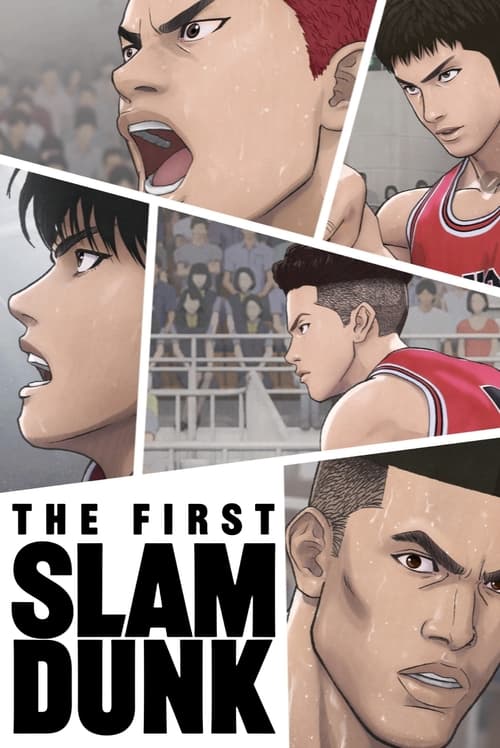
The First Slam Dunk
2022 · Takehiko Inoue
For when you need to feel inspired and don't mind sweating through the last ten minutes — perfect whether you love basketball, anime, both, or neither. An underdog rush with real grief underneath.
What it's about
Ryota Miyagi is the smallest player on the Shohoku high-school basketball team — a lightning-fast point guard whose composure hides a family grief that shaped him. The film drops you into one championship game against Sannoh, the untouchable national powerhouse, played out almost in real time, cutting between the court and the pasts that made each of these five teammates who they are.
The experience
Genuinely heart-pounding — the game has the tension of a great sports broadcast and the emotional weight of a family drama, and when the crowd noise suddenly drops out at a crucial free throw, the whole theater holds its breath with you. Expect to be wrecked, in a good way.
The craft
Manga author Takehiko Inoue directed the adaptation of his own work himself — an almost unheard-of arrangement — fusing motion-captured CG with the rough vitality of his ink line, so the animation reads like manga panels breathing. The sound design is spectacular: squeaking soles, sweat, sudden silence. This one earns the biggest screen and best speakers you can find.
Why it matters
A box-office phenomenon across Japan, Korea and China that proved sports anime could be event cinema, arriving twenty-six years after the original manga ended and vindicating a creator's total control over his own adaptation.
Twenty-six years after his basketball manga ended, Takehiko Inoue returned to direct the adaptation himself — an almost unheard-of arrangement — and rebuilt the story from the ground up, recentering it on Ryota Miyagi, the smallest man on the court, whose speed masks a family grief the original barely touched. The result is less a nostalgia piece than a formal experiment: a single championship game against the untouchable Sannoh, played out in something close to real time, intercut with the past that made each player. Inoue and his team fused motion-captured CG with the rough vitality of his ink line, so the animation reads like manga panels breathing — sweat, squeaking soles, the sudden terrifying silence when the crowd noise drops out at a free throw. A box-office phenomenon across Japan, Korea, and China, it proved sports animation could carry the dramatic weight of live-action cinema. The last minutes, played nearly without sound, are among the decade's great sustained set pieces.
A Deleuzian reading
A player steps to the free-throw line and the arena goes quiet.
The full Deleuzian reading of The First Slam Dunk →
Reception
Announced with a fully recast voice cast and a mysterious CG look, it drew real pre-release backlash from fans of the 90s anime — then opened and promptly won almost everyone over, running for months in Japan and becoming a box-office phenomenon across Korea and China.
How The First Slam Dunk was received, from release to now →
Influences: the films it descends from and the films it influenced
- Slam Dunk (1993) — The 1990s TV anime is the direct ancestor Inoue argues against: he re-storyboards the same Shohoku-vs-Sannoh match but strips its shonen-hero framing off Sakuragi and hands narration to point-guard Ryota, a deliberate protagonist-recentering of already-canonized material.
- Akira (1988) — Otomo's full-animation cel realism and weighty, physics-obeying character movement set the benchmark for hand-drawn kinetic bodies that Inoue's mocap-CG pipeline exists to reproduce without the labor cost.
- Ghost in the Shell (1995) — Pioneered compositing digitally-generated CG layers seamlessly beneath hand-inked cels, establishing the 2D/3D seam-hiding grammar that The First Slam Dunk's mocap-over-line-art depends on.
- Appleseed (2004) — The first anime feature to drive cel-shaded/toon-rendered CG characters entirely from full-performance motion capture — the exact technical pipeline Inoue adopts for the players on court.
- A Scanner Darkly (2006) — Interpolated rotoscoping keeps a trembling hand-drawn ink line locked onto captured human performance, the precedent for preserving a manga ink-line surface over otherwise photoreal body motion.
- The Adventures of Tintin (2011) — Fed full motion-capture into a deliberately non-photoreal, illustrative render, proving mocap could serve a drawn 2D-source aesthetic rather than uncanny realism — the same reconciliation Inoue stages.
- Raging Bull (1980) — Subjective ring sound that drops crowd noise to near-silence and isolates breath, flashbulbs and impact is the template for Slam Dunk's crowd-drop-out and silence set-pieces at the decisive plays.
- Rosencrantz and Guildenstern Are Dead (1990) — Retells a fully canonical narrative from the vantage of its marginal figures, the structural move Inoue makes by routing a famous game through Ryota's memory rather than the established hero.
- Ping Pong the Animation (2014) — Sibling manga-sports adaptation that intercuts a live match with players' interior flashbacks and warps line and framerate for kinetic emphasis, the same real-time-game-plus-backstory editing architecture.
- Spider-Man: Into the Spider-Verse (2018) — Renders 3DCG with comic-panel ink outlines, halftone and stepped framerates so the animation reads as printed page art — a parallel solution to putting a hand-drawn manga line onto CG geometry.
- Arcane (2021) — Paints hand-textured 2D detail directly onto 3D models to disguise the CG substrate, the same illustrative-over-dimensional surface treatment Inoue uses to keep his athletes looking penned.
- Blue Giant (2023) — Contemporary performance-anime sibling that switches into 3DCG for the real-time set-piece (the concert) while cutting to 2D flashbacks of loss, mirroring Slam Dunk's mocap-court / drawn-memory division.
Similar films
- Blue Giant (2023) — influence & lineage · often watched together
- Look Back (2024) — influence & lineage
- Akira (1988) — influence & lineage
- I Want to Eat Your Pancreas (2018) — often watched together
- Monster (2023) — often watched together
- Weathering with You (2019) — often watched together
- HAIKYU!! The Dumpster Battle (2024) — shared sensibility
- 100 METERS (2025) — shared sensibility