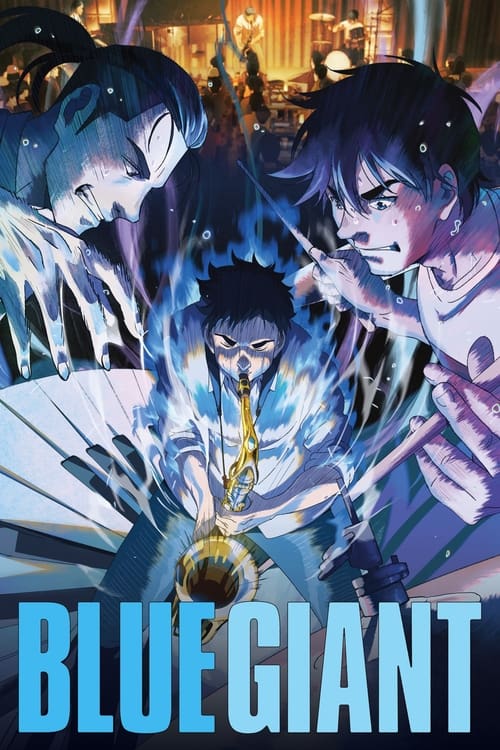
Blue Giant
2023 · Yuzuru Tachikawa
For when you want to be inspired and blasted by music in equal measure — a shot of pure, uncynical ambition. Turn the speakers up; this one's an event, not background.
What it's about
Dai Miyamoto, a high schooler from a sleepy town, hears jazz once and it rewires his life: he picks up a saxophone, moves to Tokyo, and declares he will become the best jazz player in the world. What follows is the grind behind that vow — practice, tiny clubs, a fledgling trio, and the question of what greatness actually costs the people chasing it.
The experience
Earnest and propulsive, with performance scenes that hit like a physical rush — the screen fractures into color and abstraction as the film tries to draw what a solo feels like from inside. Audiences routinely come out wanting to applaud a cartoon jazz club.
The craft
Director Yuzuru Tachikawa saves his full kinetic arsenal for the music: synesthetic visuals, vertiginous camera moves, animation that behaves like improvisation. The trump card is the score, composed and performed by pianist Hiromi Uehara, whose ferocious real playing gives the fictional trio an actual voice — this is a film that demands a big screen and good sound.
Why it matters
It arrived, improbably, as Japan's great jazz movie in anime form, and became the standard-bearer for animation as a way to capture live music that cameras can't.
Japan's great jazz movie arrived, improbably, as an anime. Adapted from Shinichi Ishizuka's beloved manga, Yuzuru Tachikawa's film follows a teenage saxophonist who moves to Tokyo with nothing but monstrous work ethic and the conviction that he will become the best jazz player in the world — a premise the film treats not as underdog formula but as a genuine inquiry into what greatness costs. Tachikawa, who sharpened his kinetic instincts on Mob Psycho 100 and Death Parade, saves his full arsenal for the performance scenes: the screen fractures into synesthetic color, abstraction, and vertiginous camera moves that try to draw what a solo feels like from inside. The trump card is the score — composed and performed by pianist Hiromi Uehara, whose playing gives the fictional trio a real, ferocious sound; audiences routinely report the club sequences landing like live concerts. Its blend of sports-manga drive and sincere reverence for the bandstand has made it a word-of-mouth phenomenon well beyond anime circles. Few films in any medium have rendered the physical labor of music — the reddened lips, the breath, the ten thousand hours — with such conviction.
Reception
A word-of-mouth hit in Japan in early 2023, it crossed over when GKIDS brought it to Western theaters that fall — and rather than fading, it kept climbing as music-film lovers passed it around like a secret handshake.
How Blue Giant was received, from release to now →
Influences: the films it descends from and the films it influenced
- Kids on the Slope (2012) — Animated its jazz jam sessions from live-recorded reference footage so fingerings, embouchure and drum strokes sync to the actual recording — the instrument-accurate performance-animation method Blue Giant builds its trio on.
- Whiplash (2014) — Cuts performance into visceral macro inserts of reeds, sticks, sweat and blistered hands to make jazz mastery feel physically punishing — the 'cost-of-greatness' cutting grammar Blue Giant inherits.
- Mob Psycho 100 (2016) — Tachikawa's own idiom of erupting into mixed-media paint, ink-wash and abstract animation at emotional peaks; Blue Giant's synesthetic saxophone solos are a direct extension of that mode.
- Fantasia (1940) — Pioneered rendering music as non-representational abstract imagery (the Toccata and Fugue segment), founding the synesthetic-abstraction tradition Blue Giant's solo visuals draw from.
- Round Midnight (1986) — Cast a real jazz musician (Dexter Gordon) and recorded the music live on set for authenticity — the same primacy-of-the-actual-performance ethos behind building Blue Giant's images around Hiromi Uehara's genuinely played score.
- Beck: Mongolian Chop Squad (2004) — Music-manga adaptation that stages live gigs as the narrative's emotional climaxes and treats a band's formation as an underdog quest — the structural blueprint Blue Giant follows with JASS.
- Perfect Blue (1997) — Built a language of subjective match-cut montage and disorienting edits to externalize psychological intensity — the editing ancestry behind Blue Giant's kinetic, interiorized performance cutting.
- Bird (1988) — Charlie Parker biopic that rebuilt performances around isolated original solo tracks and treated bebop virtuosity as self-destructive vocation — the 'genius pays in his body' jazz-film archetype Blue Giant channels through Dai.
- Bocchi the Rock! (2022) — Breaks into mixed-media collage, claymation and hand-drawn abstraction during its music sequences, extending the synesthetic-performance idiom into the same 2022–23 wave as Blue Giant.
- Look Back (2024) — Manga adaptation centered on the grueling, obsessive labor and personal cost of pursuing creative greatness, carrying forward Blue Giant's underdog-inquiry and labor-of-craft themes into anime film.
- Your Lie in April (2014) — Stages concert performance through drifting particles, bleeding color-fields and dissolving backgrounds, a template for translating a soloist's inner state into abstract on-stage imagery.
- Sound! Euphonium (2015) — Meticulous instrument-accurate ensemble animation paired with a labor-of-daily-practice ethos, sharing Blue Giant's insistence on showing the physical work behind the music.
- La La Land (2016) — Frames jazz purism as existential stakes and shoots performance in sustained, camera-mobile takes that ride the music — kin to Blue Giant's roaming stage camerawork.
- Ping Pong the Animation (2014) — Sports-manga adaptation that uses expressionist distortion and vertiginous, swooping camera to render competition as subjective inner experience rather than clean coverage — cousin to Blue Giant's kinetic camera.
- The First Slam Dunk (2022) — Sports-manga adaptation using CG-hybrid vertiginous camera swoops that fly through the arena during play, the same virtual-camera-in-motion approach Blue Giant applies to the concert stage.
- 100 METERS (2025) — A manga adaptation staking its climaxes on rendering a physical performance (jazz) as escalating bodily rhythm, it shares 100 Meters' project of animating the felt tempo of a performed act to a musical pulse.
Similar films
- The First Slam Dunk (2022) — influence & lineage · often watched together
- Look Back (2024) — influence & lineage
- Whiplash (2014) — influence & lineage · same viewing thread
- La La Land (2016) — influence & lineage · same viewing thread
- Liz and the Blue Bird (2018) — often watched together
- Swing Girls (2004) — often watched together
- Cosmic Princess Kaguya! (2026) — often watched together
- In This Corner of the World (2016) — often watched together
All the films related to Blue Giant →
Watch it with: curated runs of related films
- Burning to Be the Best — Watch these together for the shared fever of ambition — musicians, dancers and one table-tennis obsessive driving themselves past exhaustion toward a greatness that keeps costing more.