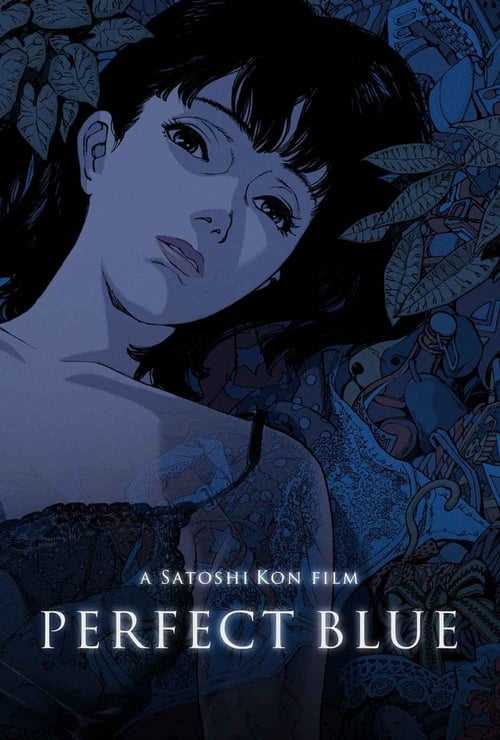
Perfect Blue
1998 · Satoshi Kon
When you're craving a real psychological scare — the kind that gets under your skin rather than jumping out at you — and you're willing to be confused on purpose. Challenge, not comfort; don't watch it half-asleep.
What it's about
A young pop idol quits her group to become an actress, and the reinvention curdles fast: her handlers push her toward darker roles, a stalker shadows her, and a fan-run website describes her private days with impossible accuracy. As people around her production start turning up dead, she can no longer tell her memories from her roles — or from the sugary public self she thought she'd left behind.
The experience
Genuinely disorienting — scenes bleed into dreams, rehearsals, and TV-within-TV until you're as unmoored as she is, and the dread builds to a pitch that's hard to shake. It's animated, but it plays like the most ruthless live-action thriller you've seen.
The craft
Satoshi Kon's editing is the star: he cuts on false continuities, matching one reality to the next so seamlessly that the ground keeps dissolving under you — a trick only animation can pull off this completely, executed with a thriller's discipline. Made on a lean budget, it wrings maximum unease from minimal means.
Why it matters
It announced Kon as a major director and its fingerprints are all over later psychological thrillers about performers coming apart — Darren Aronofsky bought the remake rights and restaged one of its images outright. Decades on, its portrait of a self dissolved by fans and public image reads more prophetic than ever.
Satoshi Kon's first feature, made at Madhouse on a lean budget, remains one of cinema's most unnerving studies of a self coming apart. A manufactured pop idol quits her group for an acting career; as her handlers push her toward darker material, a stalker, a ghostly double, and a fan-run website that seems to know her days better than she does begin to dissolve the line between the woman and the image sold under her name. Kon's genius is editorial: he cuts on false continuities, letting scenes bleed into rehearsals, dreams, and television within television until the viewer shares the heroine's vertigo — effects native to animation yet executed with a thriller's discipline, part Hitchcock, part giallo. Darren Aronofsky bought the remake rights and restaged its bathtub scream in Requiem for a Dream; Black Swan runs on its blood. Made in 1997, it anticipated with eerie precision the parasocial internet, the idol industry's cruelties, and the crisis of the online self. Kon died in 2010 at forty-six, four features into one of animation's great filmographies — this was the announcement.
A Deleuzian reading
Mima sits down at a borrowed computer and reads about her own day.
The full Deleuzian reading of Perfect Blue →
Reception
Barely released in the West in 1998 — it played festivals and art houses to a niche crowd — Perfect Blue has since been fully canonized, now routinely called one of the greatest animated films ever and the ultimate 'anime for people who don't watch anime' recommendation.
How Perfect Blue was received, from release to now →
Influences: the films it descends from and the films it influenced
- Psycho (1960) — Kon lifts Hitchcock's mid-film rug-pull and subjective-camera identification, luring the viewer to trust a protagonist whose reality is quietly compromised, then puncturing it in the bathroom/blood set pieces.
- Vertigo (1958) — The template of a woman being remade into a fabricated ideal — Mima's manufactured 'pure idol' vs. her real self mirrors Judy/Madeleine as a constructed doppelganger the camera fetishizes.
- Repulsion (1965) — Polanski's model of a young woman's psyche disintegrating in domestic space, staged through hallucinated intrusions that the film refuses to flag as unreal — Kon's reality-blurring inherits this refusal to mark subjectivity.
- The Tenant (1976) — Identity dissolution as literal transformation-into-another-person, with mirrors and glimpsed doubles used to dramatize a self being overwritten — a direct antecedent to Mima's pursuing 'other Mima.'
- Peeping Tom (1960) — Voyeurism and performance fused via the recording apparatus, where being watched/filmed is the violence itself — feeding Perfect Blue's parasocial-fandom horror and its diegetic screens (photos, webcam 'Mima's Room').
- Deep Red (1975) — The giallo grammar Kon quotes directly: the black-gloved killer's subjective POV, stylized primary-color murder set pieces, and the amateur sleuth misreading a crucial glimpsed detail.
- Persona (1966) — Two women's identities bleeding into one another, plus the meta-cinematic rupture of the film exposing its own artifice — the formal DNA of Mima's split self and the nested drama-within-the-drama.
- Images (1972) — A woman's schizophrenic break rendered by editing that seamlessly stitches hallucinated and real encounters into one continuous space, so the cut itself becomes the unreliable narrator — Kon's match-cut method distilled.
- Memories (1995) — Kon's directorial debut systematizes the technique his Magnetic Rose script prototyped: match-cut editing that collapses the seam between staged illusion/memory and reality until neither is trustworthy.
- Requiem for a Dream (2000) — Aronofsky bought Perfect Blue's remake rights expressly to recreate its scream-in-the-bathtub shot, and its snap-zoom/rapid-cut 'hip-hop montage' extends Kon's match-cut compression of psychological collapse.
- Black Swan (2010) — Its performer-losing-herself-to-a-doppelganger structure, mirror doublings, and hallucinated rival are Perfect Blue transposed to ballet — Aronofsky's most explicit inheritance of Kon's identity-dissolution device.
- Millennium Actress (2001) — Kon's own extension of the technique: match cuts that carry a character across decades and between film-sets and memory, perfecting the reality/media splicing prototyped in Perfect Blue.
- Paprika (2006) — The nested-media logic pushed to dream-within-dream architecture, where diegetic screens, parades, and reality interpenetrate via seamless graphic-match transitions Kon first tested on Mima.
- Inception (2010) — Nolan's nested-reality layers and match-cut transitions between levels descend from Kon's diegetic-boundary dissolves — a lineage Nolan and critics trace directly through Paprika back to Perfect Blue.
- Enemy (2013) — A man confronting an identical double as a manifestation of a fracturing self, staged with the same dread-laden ambiguity about which figure is 'real' that Kon built around the second Mima.
- All About Lily Chou-Chou (2001) — Maps the parasocial idol-and-fan bond and the splitting of an online-projected self from the real one, the fan's worship curdling into pathology.
- The Disappearance of Haruhi Suzumiya (2010) — Its match-cut editing that splices subjective delusion into objective space is the grammar for making the audience share the narrator's inability to tell which continuity is the real one.
- Helter Skelter (2012) — Kon's Japanese pop-idol whose self fractures under the manufactured public image is the immediate domestic precursor for Sawajiri's celebrity persona shattering into hallucination.
- Blue Giant (2023) — Built a language of subjective match-cut montage and disorienting edits to externalize psychological intensity — the editing ancestry behind Blue Giant's kinetic, interiorized performance cutting.
- Millennium Actress: Tracks (2001) — Kon's foundational technique of the smash match-cut between reality and delusion (a scream continued across cuts, a set that is also a memory) — the reality/performance dissolve that Millennium Actress systematizes and this making-of dissects.
- Lost in Starlight (2025) — Pioneered animated editing that warps and skips like a damaged recording to render a mind failing — the technical root of the skipping-record memory device.
- Pi (1998) — A contemporaneous paranoid subjective thriller built on percussive, hip-hop-cut montage of a fraying mind — the same year, arriving at a parallel editing grammar for psychological dissolution.
- Mulholland Drive (2001) — An actress's identity fracturing inside the entertainment machine, dramatized through a doppelganger and a narrative that retroactively exposes its own performed layer — the same unreliable-perspective architecture as Kon's.
- Fight Club (1999) — A contemporaneous unreliable-narrator thriller whose split-self is concealed by editing that presents hallucinated figures as physically present, weaponizing the cut to withhold the twist as Kon does.
- Ghost in the Shell (1995) — Kon inherits Oshii's essayistic montage of constructed vs. real identity but redirects it into psychological thriller: editing rhythm rather than philosophical dialogue dissolves the boundary between memory and performance, extending GitS's formal investigation of selfhood into subjective horror.
- Tokyo Godfathers (2003) — Establishes Kon's signature graphic match-cut and associative montage editing; Tokyo Godfathers keeps that seamless transition grammar but deliberately grounds it, refusing the hallucinatory dissolves ('against-hallucination').
- Neon Genesis Evangelion: The End of Evangelion (1997) — Kon's match-cut editing that fractures the boundary between reality, performance, and psyche is the contemporaneous sibling technique to EoE's animation-to-live-action rupture destabilizing the viewer's footing.
- Angel Dust (1994) — Runs a parallel psycho-thriller of dissolving identity under psychiatric and media manipulation, the same cold interrogation of a controlled, splitting mind rendered through unreliable perception.
- Ritual (2000) — Dissolves reality and performance through relentless frames-within-frames, the shared-fiction-as-refuge/menace device Ritual works in live action.
- Evangelion: 3.0+1.0 Thrice Upon a Time (2021) — Match-cuts that seamlessly fuse fantasy, memory, and reality across the same framing pioneered the abstraction-into-live-action editing grammar Eva weaponizes to break its own diegesis.
Similar films
- Paprika (2006) — influence & lineage
- Black Swan (2010) — influence & lineage
- Mulholland Drive (2001) — influence & lineage
- Pulse (2001) — same viewing thread · often watched together
- I Saw the TV Glow (2024) — same viewing thread · often watched together
- Ring (1998) — same viewing thread
- Vertigo (1958) — influence & lineage · often watched together
- Psycho (1960) — influence & lineage · often watched together
All the films related to Perfect Blue →
Watch it with: curated runs of related films
- Screens That Swallow You — A run of films where the screen — a pirate broadcast, a haunted website, a monitor, a late-night monster-of-the-week show — stops being a window and becomes a doorway that pulls the watcher bodily through into unreality.