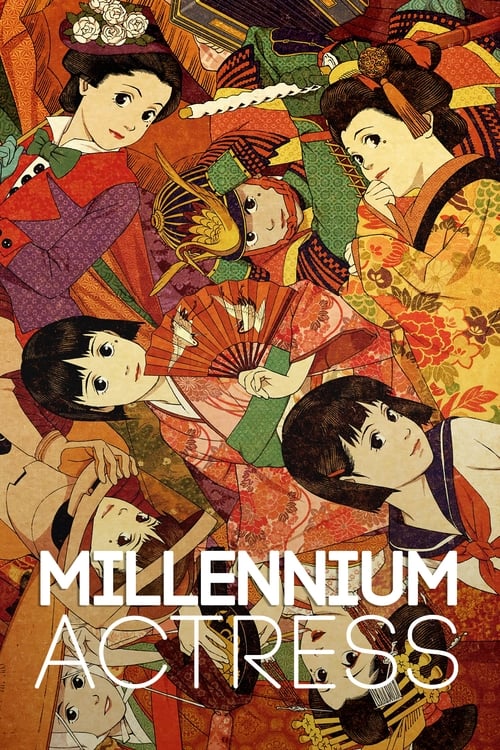
Millennium Actress
2002 · Satoshi Kon
For when you want to be swept up — a film about longing and the movies themselves, best watched alone and undistracted. A good cry dressed as an adventure; also the perfect answer to "show me what animation can do."
What it's about
A documentary filmmaker and his cameraman track down Chiyoko Fujiwara, a legendary actress who vanished from the screen decades ago, and hand her a key she lost long before. As she tells her life story, memory and movies stop being separate things: her recollections slide into scenes from her films — Edo-period sword fights, wartime melodramas — with the two interviewers swept along inside them. Threaded through it all is her lifelong pursuit of a man she met once, briefly, and never stopped chasing.
The experience
Swift, dazzling, and quietly devastating — 87 minutes that move like a dream, where a single cut can leap centuries. It builds to an emotional finish that lands harder for how playful the ride has been; expect to sit still through the credits.
The craft
Satoshi Kon's match cuts are the star: transitions that fuse Chiyoko's memories, her filmography, and the history of Japanese cinema into one continuous chase, doing things live action physically can't. Susumu Hirasawa's surging electronic score drives the momentum, and the animation shifts style era by era as the story runs through a century of filmmaking.
Why it matters
It cemented Kon as one of animation's great formal innovators, and its editing — reality and imagination cut together as equals — has influenced filmmakers well beyond anime. Widely considered his most emotionally generous film.
Snapshot
Satoshi Kon's second feature is an 87-minute act of double biography: it tells the life of a fictional Japanese screen star, Chiyoko Fujiwara, by telling the life of Japanese cinema itself. A documentarian, Genya Tachibana, and his skeptical cameraman arrive at the mountain home of a woman who walked away from stardom decades earlier. Genya brings a key she lost long ago, and the interview that follows does not stay an interview. Chiyoko's recollections slide sideways into her filmography, and the two men slide with them — Genya turning up in samurai armor, hauling a rickshaw, taking a sword blow, while the cameraman keeps rolling and complains about the lighting.
Where Perfect Blue (1997) treated the porousness between performance and self as horror, Millennium Actress treats it as devotion. The film's engine is a single unfinished gesture: as a teenager in the 1930s, Chiyoko shelters a wounded painter fleeing the military police, he leaves her a key "to the most important thing," and she spends a career — and a century — running after him. She never catches him. The film's closing line reframes the entire chase as its own reward, and in doing so reframes what we have been watching: not a romance, but an argument about why anyone submits to art at all.
Completed in 2001 and premiered that July at the Fantasia festival in Montreal, the film reached Japanese screens in September 2002 and the United States in 2003.
Industry & production
Millennium Actress was animated at Madhouse, the Tokyo studio co-founded by Masao Maruyama, who had backed Kon's move from manga and layout work into direction and who functioned as his institutional protector across four features. The production was produced by Taro Maki of Genco, financed through a production committee rather than a single studio's balance sheet — the standard Japanese arrangement of the period, and the one that let a mid-budget, commercially unobvious art film get made at all.
This matters to the film's shape. Kon was not working inside Studio Ghibli's vertically integrated system, with its in-house continuity of staff and its guaranteed domestic distribution muscle. He was assembling a crew per project around a small stable of regulars, on budgets that required efficiency in the drawing. Precise budget and box-office figures for the film are not reliably documented in accessible English-language sources, and I won't invent them; what is clear is that the film was a modest domestic performer whose reputation was built by festivals, critics, and home video rather than by opening weekends.
Its Japanese distribution was handled by Klockworx. In the United States, rights went to DreamWorks, which released it in 2003 through Go Fish Pictures, its short-lived specialty arm — the same corporate umbrella then handling Spirited Away. The release was small and the film subsequently fell out of print for years as rights lapsed, a fate that kept it comparatively obscure in the West well into the 2010s. It returned in 2019 in a restored version, given a new English dub and a repertory-and-event theatrical run, which is when a great many of its current admirers first saw it properly projected.
The timing of the original release is worth registering: 2001–02 is exactly the moment Spirited Away broke every Japanese box-office record and then took the Academy Award. Millennium Actress shared the Animation Division Grand Prize at the 2001 Japan Media Arts Festival with Miyazaki's film, and took the Mainichi Film Awards' Ōfuji Noburō Prize. It arrived, in other words, as the other Japanese animated feature of its year — critically decorated, commercially overshadowed.
Technology
The film sits precisely on the industry's hinge between cel animation and digital finishing. The drawing remained analog and hand-made; the coloring and compositing had by 2001 largely migrated to digital paint and compositing software, which is what permits the film's dense multiplane moves, its layered light and film-grain effects, and its rapid tonal shifts between eras. Detailed public documentation of the specific pipeline is thin, and I'd rather flag that than fabricate a toolchain.
What the technology buys, aesthetically, is the film's capacity for pastiche. Digital compositing made it cheap to give each historical stratum its own photographic signature — the silvery, high-contrast monochrome of a 1930s studio picture; the saturated, slightly blown-out color of a 1950s period spectacle; the coarser, grainier texture of a 1960s programmer; the video-noise flatness of the present-day camcorder frame. In a purely photochemical cel pipeline these would have been laborious optical effects. Here they are transitions, deployable in a single cut.
Technique
Cinematography
In animation, "cinematography" is really layout plus compositing, and Kon was a layout artist by training — he had done that work under Katsuhiro Otomo's orbit and on Mamoru Oshii's Patlabor 2 before directing. Hisao Shirai served as director of photography. The virtual camera in Millennium Actress is unusually mobile and unusually quoted: it does not simply move well, it moves like a specific historical camera. A domestic interlude is staged in low, static, tatami-level setups with characters addressing a near-frontal axis — an unmistakable Ozu register. A castle siege is shot with the telephoto compression and weather-lashed depth of a Kurosawa battle. A kaiju sequence adopts the wide, slightly stagey tokusatsu framing that flatters a man in a suit.
The unifying device is a repeated lateral tracking shot of Chiyoko running, which the film uses as a kind of connective tissue: she runs left-to-right through snow, through a burning corridor, alongside a train, across a launch gantry, and the camera simply keeps pace while the world behind her changes century.
Editing
Satoshi Terauchi cut all four of Kon's features, and the editing here is the film's signature achievement — the source of what has since become known, in online critical shorthand, as the "Kon cut." The film runs roughly ninety minutes and contains dozens of transitions built on graphic and kinetic matches: a movement begun in one era is completed in another, a door opened in 1938 is walked through in 1962, a falling object lands in a different film entirely. Nothing dissolves; nothing fades. The cuts are hard, and the continuity is carried by the body in motion.
This is not decoration. The grammar is the thesis. If memory and cinema are the same operation — assembling discontinuous fragments into a continuous self — then an edit that refuses to mark the seam between them is the only honest way to shoot the story. The film also makes its interviewers complicit in the cutting: Genya and the cameraman cross the seams too, so the documentary apparatus never gets to stand outside the fiction it is collecting.
Mise-en-scène / staging
Nobutaka Ike's art direction has to do something contradictory: render each era convincingly while keeping visible that these are sets. Sequences repeatedly reveal their own construction — a wall is a flat, a snowfield ends at a stage edge, an earthquake shakes a soundstage rather than a landscape. Two figures recur across every stratum as structural rather than realist presences: a spinning-wheel crone who curses Chiyoko to burn in the flames of eternal love, and a policeman-interrogator who reappears as inquisitor in period, wartime, and modern guises. Neither is bound to a single film-within-the-film; both are Chiyoko's psychology given costume.
The key itself is staged as pure MacGuffin, in the Hitchcockian sense and the Wellesian one: an object whose only property is that it is pursued.
Sound
Susumu Hirasawa's score, his first for Kon and the start of a partnership that ran through Paranoia Agent and Paprika, is the film's other great structural device. Its principal theme, "Rotation (LOTUS-2)," is built on driving, cyclical sequencer patterns and processed choral vocals that sound neither traditionally Japanese nor conventionally orchestral. Because the music refuses period signature, it can play continuously across cuts that jump forty years, holding the film together underneath its historical costume changes. Where the images pastiche, the score insists on one unbroken present tense.
Sound direction was handled by Masafumi Mima, a Kon regular. The mix leans hard on a small set of recurring effects — running footsteps, wind, the mechanical clatter of film equipment — which do the same era-bridging work as the score.
Performance
Chiyoko is voiced by three actresses at three ages: Fumiko Orikasa as the schoolgirl, Mami Koyama through the career years, and Miyoko Shōji as the woman in her seventies. Shōzō Îzuka plays Genya with a gruff, unglamorous warmth, and Masaya Onosaka's cameraman supplies the film's deflating comic skepticism.
The animation performance, under character designer and animation director Takeshi Honda, is notably restrained by the standards of the medium — small facial adjustments, weight in the walk, a physical vocabulary of aging that carries across the three voices. There is also a genuinely difficult second-order problem the film solves: Chiyoko must be shown acting badly early on and well later, which requires the animators to distinguish between a character's emotion and a character's performance of emotion, in the same face.
Narrative & dramatic mode
The armature is Citizen Kane's: an interviewer, a reclusive subject, a withheld object, a life reconstructed in fragments. Kon then removes Welles's safety rail. In Kane, each witness's testimony is bracketed and attributed; here the bracket dissolves, and the interviewers are absorbed into the testimony they came to record.
The mode is closer to Fellini — 8½, Juliet of the Spirits — in its refusal to distinguish memory, fantasy, and filmed fiction as separate ontological layers. But Kon's version is more rigorously motivated than Fellini's: every fantastical intrusion is legible as either something Chiyoko filmed or something she felt, and the film's late reversals depend on the audience having been able to track which is which even while the images insisted otherwise. The structure is finally a nested pair of revelations — one about the painter's fate, one about Genya's place in Chiyoko's history — arranged so that the emotional climax and the formal climax land on the same cut.
Genre & cycle
Nominally an animated romantic drama; functionally an anthology of Japanese genre cinema. Within one film it moves through jidaigeki, Bakumatsu political melodrama, wartime continental adventure set in occupied Manchuria, postwar shomin-geki domestic drama, giant-monster tokusatsu, and space-age science fiction. It belongs to the small cycle of films about film history that use pastiche as historiography — an animated cousin to the compilation-essay tradition, and to Japanese cinema's own habit of eulogizing its studio system.
Within anime it belongs to the late-1990s/2000s auteur feature cycle: adult-addressed, festival-oriented, released theatrically rather than direct-to-video, and made possible by the international market that Akira and Ghost in the Shell had opened.
Authorship & method
Kon co-wrote the screenplay with Sadayuki Murai, who had adapted Perfect Blue and whose structural ingenuity is legible in both films. Kon came to direction from manga and from layout and script work in Otomo's circle — including the screenplay for the "Magnetic Rose" episode of Memories (1995), a story of a woman whose recorded memories consume the men who enter them, which reads in hindsight as a first draft of this film's premise. His unfinished manga OPUS, in which an artist falls into his own comic, worked the same seam from the other side.
Kon's stated aim was to invert Perfect Blue: to take the same instability between fiction and self and make it generative rather than annihilating. The core collaborators are the ones who define his authorship as much as he does — Terauchi's cutting, Hirasawa's music, Honda's character animation, Ike's backgrounds, Shirai's photography, Mima's sound, Maruyama's institutional cover.
Movement / national cinema
The film is a compressed history of the Japanese studio system, told through a fictional studio, Ginei, whose arc from prewar expansion through postwar boom to television-era collapse mirrors the real majors. Chiyoko is widely and credibly read as a composite of Setsuko Hara — the great star who abruptly retired at the height of her fame and spent the rest of her life out of public view — and Hideko Takamine, whose career spanned child stardom to the 1970s and who chronicled the industry from the inside. The film's Manchurian sequences also refuse to sentimentalize: the studio's continental production is inseparable from the empire that made it possible, and the police who hunt the painter are the same state.
Era / period
Made at the millennium, the film is explicit about looking backward from a vantage where the thing it describes has ended: the opening establishes Ginei's demolition, and an earthquake in the present tense literalizes the ground giving way. It is also a film about the end of celluloid, made at the moment its own medium went digital, and released into the year Japanese animation achieved its greatest international legitimation.
Themes
The chase as vocation. Memory as editing. The key that opens nothing except more pursuit. Beneath these sits a sharper argument about women's labor in the studio system: Chiyoko's entire career is undertaken as private search, and the industry extracts three decades of work from a motive that has nothing to do with it. The crone's curse — to burn in the flames of eternal love — is legible as both blessing and sentence, and the film declines to choose. The final line, in which Chiyoko locates her love in the chasing rather than the object, converts a lifetime of apparent failure into the only kind of fidelity art permits.
Reception, canon & influence
Backward, the debts are open: Welles's interview structure, Fellini's permeable interiors, and direct formal quotation of Ozu, Kurosawa, and the tokusatsu tradition. Behind those sit Otomo's tutelage and Kon's own earlier work on memory-as-architecture in "Magnetic Rose."
On release the film was warmly received by critics in Japan and, in 2003, by American reviewers — though the Go Fish release was small, and the film's US profile was thin for a decade while it sat out of print. Its serious canonization came later, through home video, through the 2019 restoration and re-release, and through Kon's death in 2010 at forty-six, which turned a four-feature career into a closed and endlessly re-examined body of work.
Forward, its clearest legacy is grammatical. The match-cut-across-time became a portable technique, absorbed into music video, trailer cutting, and a generation of editors who learned it from Kon-focused video essays — a rare case of a specific director's cutting style entering general circulation under his name. Kon developed the device further himself in Paprika (2006), whose dream-architecture has been widely compared to Nolan's Inception; his influence on Aronofsky is documented most concretely with respect to Perfect Blue rather than this film. More broadly, Millennium Actress helped establish that animation could conduct film-historical argument at the level of a critical essay while still working as melodrama — a permission later Japanese directors, and a good deal of contemporary animated features worldwide, have drawn on since.
A Deleuzian reading
She runs left to right.
The full Deleuzian reading of Millennium Actress →
Reception
It slipped out quietly in the West in 2003, forever in the shadow of Spirited Away, and stayed the 'underseen one' in Kon's run. His death in 2010 and a 2019 theatrical remaster flipped the script — it's now routinely called his warmest film and, for many, his masterpiece.
How Millennium Actress was received, from release to now →
How to watch Millennium Actress: what to notice on a first viewing
- Watch Chiyoko run left to right through changing backdrops. A repeated lateral tracking shot follows her running stride through snow, fire, and later eras, the camera keeping pace while the world behind her changes century. Her stride never changes. Only the century behind her shoulder does.
- Notice a door opened in one era, closed in another. Terauchi builds hard cuts on matched movement, no dissolves, so an action begun decades earlier finishes in a completely different scene. The continuity is carried entirely by a body in motion, not by any transition.
- Spot the camera copying a specific director's style each era. Low tatami-level framing quotes Ozu, telephoto weather-lashed shots quote Kurosawa, and stagey wide framing quotes 1950s monster movies, each keyed to its decade. You can date a scene by its camera style alone, before anything in it happens.
- Listen for one driving piano melody playing across every decade. Hirasawa's cyclical piano and processed choral music refuses any single period's sound, so it can play unbroken across cuts that jump forty years. The images keep changing costume. The music insists there's only one present tense.
The whole guide to watching Millennium Actress, with the keys for a rewatch →
Influences: the films it descends from and the films it influenced
- Sherlock Jr. (1924) — Keaton's substitution-splice gag — the projectionist steps into the screen and the world cuts around a body held in identical position and motion — is the literal mechanic of the Kon cut: match-on-action used to carry a figure across ontological levels.
- Citizen Kane (1941) — Supplies the armature Kon retools wholesale: an interviewer with recording equipment assembles a life out of solicited testimony organized around a MacGuffin object (sled/key), with the interviewer's own body eventually standing inside the flashbacks he is collecting.
- Rashomon (1950) — Miyagawa's lateral tracking through the forest and the staging of mutually contradictory testimony as equally photographed fact; Kon quotes the jidaigeki blocking directly and inherits the refusal to arbitrate between versions of a memory.
- Tokyo Story (1953) — The shomin-geki interlude is pastiched at the level of technique — tatami-height camera, frontal eyeline-crossing reverses, still 'pillow' inserts of kettle and corridor — so the period is identified by lens height and cutting rule rather than by costume.
- Ugetsu (1953) — Mizoguchi's unbroken lateral track that carries a character across the boundary between the living and the dead inside a single move is the precedent for Kon's tracking shots that change historical era without cutting.
- Godzilla (1954) — The tokusatsu register — suitmation scale, miniature streets, optically composited beams and matte lines — is reproduced with period-correct compositing artifacts, so the pastiche names a specific studio's technology rather than generic monster imagery.
- 8½ (1963) — Fellini's permeable interiors, where memory walks onto the present set unannounced and the production the artist is directing keeps dissolving into their own biography, is the staging logic behind Kon's self-revealing sets.
- Akira (1988) — Otomo's layout discipline — camera position, focal length and perspective locked at the layout stage so animation moves like photography — is the working method behind Kon's 'layout as camera' and his photoreal background-to-cel matching.
- Magnetic Rose (1995) — Kon's own screenplay establishes memory-as-architecture: a woman's recorded past builds sets that reconfigure around whoever enters them, until the intruder can no longer locate the seam between her frame and his.
- Perfect Blue (1997) — The Kon cut is invented here — a scream or gesture begun in one diegetic level completed in another — and Millennium Actress runs the identical device with reversed polarity, fusing Chiyoko's lives where it shredded Mima's.
- Ritual (2000) — Cinema-about-cinema in which a woman's life is nested inside the frames of the films that filmed her — the frames-within-frames and shared-fiction craft, one year later.
- Memories (1995) — The mature form of Magnetic Rose's memory-palace — a protagonist walks bodily through her own reconstructed past via seamless time-and-space match cuts.
- Paprika (2006) — Kon pushes the transition into architecture: cuts occur inside continuous camera moves through geometrically mismatched spaces, with Hirasawa's score again supplying the metric grid the editing rides.
- Inception (2010) — Builds a feature around the Paprika model of dream-architecture — folding cities, corridors whose geometry indexes the dreamer, an elevator of memory rooms — using cross-level match-on-action as its primary continuity device.
- Scott Pilgrim vs. the World (2010) — Wright's gesture-matched whip transitions, which complete an action across a change of location and time, are explicitly modeled on Kon's cutting; the elision, not the establishing shot, carries the scene change.
- Your Name. (2016) — Makes the match-cut-across-time-and-body the film's structural engine rather than a transition: a gesture begun by one character is completed by another in a different year, Kon's grammar promoted to load-bearing plot mechanism.
- Everything Everywhere All at Once (2022) — Verse-jumping industrializes the Kon cut — a gesture-matched cut drops the protagonist into a fully pastiched genre-world (wuxia, Wong Kar-wai romance, chef farce), with one actress's alternate careers serving as the anthology's index.
- Violet Evergarden: The Movie (2020) — A whole life organized around waiting for an absent person, told through match-cut editing that folds decades together — the waiting-and-longing engine and time-collapsing montage Violet's letter arcs echo.
- Millennium Actress: Tracks (2001) — The doc's direct subject: it traces the graphic match-cuts that suture Chiyoko's memories, film roles, and history into one continuous chase, showing how Kon's storyboards pre-compose the seamless cuts frame-by-frame rather than discovering them in the edit.
- Lost in Starlight (2025) — Match-cuts seamlessly between memory and present around a chased inherited object (a key), making love-across-time a montage device — the warped-memory editing lineage.
- Weathering with You (2019) — Its match-cut montage collapsing distinct times and places into one continuous emotional line is the editing ancestor of Shinkai's climactic crosscutting between separated characters.
- Tokyo Godfathers (2003) — Same editor (Takeshi Seyama-school cutting under Kon's storyboards) applies the graphic-match logic to coincidence rather than memory — chance encounters joined on matched shapes and gestures — testing the device with the frame narrative removed.
- Mind Game (2004) — A Madhouse life-review structure that switches rendering technique mid-scene — rotoscope, photo-collage, flat cel — extending the premise that a character's history is narrated by changing the medium's surface, not the plot.
- The Wind Rises (2013) — An elegy for a 20th-century Japanese industry told through one maker's career, with era-bridging sound design — human-voiced engines and earthquake — doing the same period-coding work as Kon's era-specific effects track.
- Evangelion: 3.0+1.0 Thrice Upon a Time (2021) — Editing that dissolves the boundary between film-set fiction and physical reality — the camera crew walking into the movie — is the metafictional-collapse cut Anno deploys pulling combatants out onto the real production stage.
- Cosmic Princess Kaguya! (2026) — Folds a performer's public image and private self across eras via seamless media-to-media match cuts, the avatar-versus-self editing logic Kaguya applies to a streaming star.
- In This Corner of the World (2016) — Shares the era-spanning rupture editing that folds a woman's life across 20th-century Japanese history via match-cut transitions, a montage grammar cousin to this film's calendar-chronology and rupture-punctuation.
Similar films
- Paprika (2006) — influence & lineage · same viewing thread
- Mind Game (2004) — influence & lineage · same viewing thread
- Your Name. (2016) — influence & lineage
- The Wind Rises (2013) — influence & lineage
- Angel's Egg (1985) — same viewing thread
- Millennium Actress: Tracks (2001) — shared sensibility
- Perfect Blue (1998) — shared sensibility
- The Disappearance of Haruhi Suzumiya (2010) — shared sensibility
All the films related to Millennium Actress →
Watch it with: curated runs of related films
- Doubles, Dreams, and Dissolving Selves — Watch these when you want the floor to give way — dream machines, hypnotists, doppelgängers, and haunted houses where perception and identity quietly come undone.