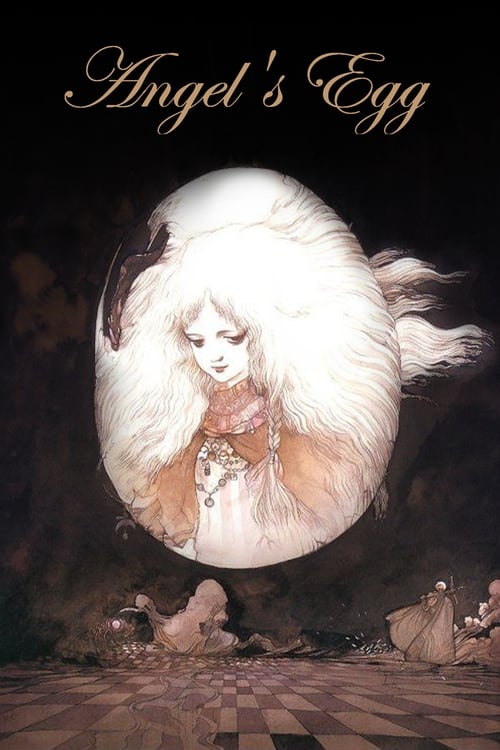
Angel's Egg
1985 · Mamoru Oshii
For when you want to surrender to pure atmosphere and mystery and are happy to leave without answers — a film to chew on for days, not a casual watch. Best alone, late, with the lights off.
What it's about
In a drowned, twilit city of Gothic ruins, a solitary girl carries a large egg everywhere she goes, guarding whatever sleeps inside it. A young man bearing a cross-shaped weapon appears, and the two drift together through the empty streets, trading questions about a bird he saw in a dream, an ark, and a flood. Almost nothing is explained; everything is felt.
The experience
Slow, silent, and trance-like — closer to wandering through a haunted cathedral than watching a story unfold. It's mysterious to the point of hermetic, quietly devastating, and it lodges in your memory like an image from your own dream.
The craft
Yoshitaka Amano's designs — all pale faces, flowing hair, and cavernous ruins — are rendered in some of the most painterly animation of the 1980s, and Mamoru Oshii directs with monastic patience, letting water, shadow, and silence do the storytelling. The imagery draws on the Book of Genesis; the sound design of rain and footsteps rewards good speakers as much as any score.
Why it matters
A commercial orphan on release that grew into a legendary cult object, it defined Oshii's contemplative style years before his cyberpunk landmarks and remains a touchstone for animators chasing pure mood over plot.
Snapshot
Angel's Egg (天使のたまご, Tenshi no Tamago) is a roughly seventy-minute animated feature — often categorized alongside the emerging OVA (original video animation) format of the mid-1980s — that stands as one of the most hermetic works in Japanese commercial animation. In a drowned, twilit world of Gothic ruins, a solitary girl cradles a large egg, guarding the life she believes sleeps inside it; a young man carrying a cross-shaped weapon arrives, and their brief, freighted encounter ends when he breaks the egg, an act that propels the girl toward death and a final, cosmic revelation. The film has almost no expository dialogue, no conventional plot resolution, and a symbolic vocabulary drawn heavily from the Book of Genesis. It marks the first sustained collaboration between director Mamoru Oshii and illustrator Yoshitaka Amano, and it is routinely cited as the point where Oshii's cinema turned decisively toward the meditative, philosophical mode that would define Ghost in the Shell a decade later. Long difficult to see legally outside Japan, it has accrued a durable cult reputation as a touchstone of "art anime."
Industry & production
Angel's Egg emerged from the specific commercial ferment of Japanese animation in the mid-1980s, when home video created a market for animated work made outside the constraints of weekly television and theatrical blockbusters. The production is associated with Tokuma Shoten — the publishing house then deeply invested in animation, and the same corporate world that supported Studio Ghibli's founding — and with Studio Deen, which handled animation production. The precise financing and release mechanics are documented only thinly in English-language sources, and accounts vary as to whether the film should be classed as a theatrical release, a video release, or something between; caution is warranted on specifics here.
What is well established is the film's reputation as a career-altering commercial and reception failure at the time. Oshii had come off the success of the Urusei Yatsura television series and its films — most notably Urusei Yatsura 2: Beautiful Dreamer (1984), an idiosyncratic feature that already showed his willingness to bend a popular franchise toward dream-logic and authorial obsession. Angel's Egg pushed that tendency to an extreme with no franchise safety net. The widely repeated (and plausible) account is that the film's opacity alienated backers and audiences and left Oshii unable to secure directing work for a period afterward, pushing him toward live-action experiments and other projects before his animation career recovered. The exact contours of that fallow period should be treated as received wisdom rather than fully verified fact.
Technology
The film was produced with conventional mid-1980s cel animation technology: hand-drawn, hand-inked, and hand-painted cels photographed frame by frame over painted backgrounds on an animation stand. There is no digital compositing here; every layered effect — mist, water, refracted light, the drifting motes in the air — was achieved optically and through the painter's and cameraman's craft. The technological interest of Angel's Egg lies less in innovation than in the sheer density of what traditional tools were made to do. The film is unusually dark, both literally and tonally, and much of its atmosphere depends on the photography stage (satsuei) coaxing subtle gradations out of paint and cel under low-key conditions — a genuine technical challenge in an analog pipeline, where underexposed or muddy compositing could easily flatten the image. The result is a film that treats the physical limits of cel-and-camera animation as an expressive resource rather than an obstacle.
Technique
Cinematography
Though "cinematography" in animation refers to the design of shots and the work of the photography department rather than a lens operator on a set, Angel's Egg is one of the most self-consciously "shot" anime of its era. Oshii favors long, held compositions, slow lateral tracks, and a near-static camera that lets the eye wander across immense architectural spaces. The framing is frequently monumental — tiny figures set against cathedral-scale ruins — and the depth is built in painterly layers rather than through motion. Light is the dominant compositional element: shafts breaking through cloud, the cold shine on wet stone, the girl's lantern glow against surrounding black. The palette is desaturated toward grays, blues, and sepias, and the overall effect is closer to a moving series of Symbolist paintings than to the kinetic cutting of mainstream animation.
Editing
The cutting is patient and rhythmically slow, organized around duration and contemplation rather than action or continuity efficiency. Oshii holds shots well past the point of narrative necessity, allowing environments to register as presences in their own right. The film's most celebrated editorial passage is a montage of ghostly, mechanized figures materializing to hurl harpoons at the shadows of enormous fish gliding through flooded streets — an extended, near-abstract sequence that suspends the story entirely in favor of mood and image. Transitions tend toward fades and dissolves that reinforce the dreamlike, unmoored temporality; there is little of the punchy match-cutting associated with the medium.
Mise-en-scène / staging
The staging is the film's core achievement and the arena of Yoshitaka Amano's contribution. The world is a single, coherent Gothic-industrial dreamscape: crumbling cathedrals, colossal derelict machinery, eyeless statuary, a great tree hung with the fossilized silhouettes of birds, and everywhere water — rising, dripping, mirroring. Figures are staged small within this vastness, emphasizing solitude and scale. Objects carry emblematic weight: the egg, the cross-shaped weapon the boy carries on his shoulder, the vast eye-like structure that descends near the climax, the ranks of female statues revealed at the end. Nothing in the frame is casual; the mise-en-scène functions as a system of symbols, and the staging repeatedly arranges characters and props into compositions that read as icons.
Sound
Sound design is as important as image to the film's effect. The soundscape is dominated by water — dripping, lapping, pouring — and by long stretches of near-silence that make each ambient event feel deliberate. Yoshihiro Kanno's score leans on choral and orchestral textures with a sacral, requiem-like quality that reinforces the film's religious iconography; music and silence are deployed as structural elements, swelling around the film's few pivotal actions. The sparse dialogue is delivered quietly, almost liturgically, so that speech registers as an interruption of the ambient hush rather than the film's primary channel of meaning.
Performance
Vocal performance is minimal by design. The two central figures — the girl and the young man — exchange only a small number of lines across the film, and much of the "performance" is carried by animated gesture, posture, and stillness: the way the girl clutches the egg, runs, sleeps, or peers into shadow. The pivotal spoken passage is the young man's recitation of a dark variant of the Noah's Ark story, in which the dove sent from the ark never returns and the waiting people are eventually rendered into stone. The restraint of the voice work is inseparable from the film's meaning; expression is deliberately withheld, and emotion is generated through image and score rather than acted affect.
Narrative & dramatic mode
Angel's Egg operates in a poetic, non-expository mode that refuses the causal scaffolding of conventional storytelling. There is a bare narrative armature — a girl protects an egg; a boy arrives, gains her trust, and breaks it; she dies and is transfigured — but motivation, backstory, and the rules of the world are all withheld. The film proceeds by association, symbol, and repetition rather than by plot. Its dramatic tension is metaphysical and thematic: it stages a confrontation between faith (the girl's belief in the unseen life within the egg) and doubt or knowledge (the boy's insistence on breaking it to see what is real). The Ark parable functions as the film's interpretive key without resolving it, and the ending — a vertiginous pull-back revealing the girl as one of countless statues affixed to an enormous ark-like structure adrift on an endless sea — invites allegorical reading while foreclosing any single, stable meaning. It is closer to visual poetry or religious parable than to narrative drama.
Genre & cycle
Nominally the film sits within animation, fantasy, mystery, and science fiction, but it fits none of these comfortably. It belongs most legibly to a small cycle of ambitious, auteur-driven Japanese animation of the mid-1980s that used the loosening commercial structures of the period — home video, publisher patronage — to pursue personal, non-formulaic work. Its closest kin are less other anime than the traditions of European art cinema and Symbolist and Romantic painting: Andrei Tarkovsky's contemplative long takes and preoccupation with faith and water are frequently invoked, as is a broadly Gothic sensibility. Within Oshii's own filmography it inaugurates a "cycle" of slow, philosophical, water-saturated works that runs through Ghost in the Shell (1995) and beyond. As a genre object it is best understood as art film executed in the animation medium.
Authorship & method
The film is above all an Oshii work, expressing a set of authorial concerns — faith and doubt, the reliability of reality, memory, water as a metaphysical medium, and long contemplative duration — that recur across his career. Oshii is credited with direction and with the screenplay, developing the film from an original concept rather than an adaptation. Interpretations connecting the film's crisis of faith to Oshii's own biography (his relationship to Christianity is frequently mentioned in discussions of the film) are common, though the details are best treated as interpretive tradition rather than firmly documented autobiography.
The decisive collaborator is illustrator Yoshitaka Amano, responsible for the film's imagery and design. Amano — already known and soon to become internationally famous for his work on the Final Fantasy video game series — brought his delicately linear, ornamental, painterly sensibility to the film's characters and world, and Angel's Egg is often regarded as a landmark in his move into animation. The composer Yoshihiro Kanno supplied the sacral score that is integral to the film's effect. Precise credits for the photography and editing departments are less widely circulated in English-language scholarship, and rather than risk misattribution it is fair to say the record here is thin; what is clear is that the film represents an unusually tight fusion of a director's temperament and an illustrator's visual imagination.
Movement / national cinema
Angel's Egg is a Japanese film that both belongs to and stands apart from the golden-age surge of anime in the 1980s. That decade saw Japanese animation mature into a medium capable of serious feature work — the same years produced Hayao Miyazaki's early Ghibli films and Katsuhiro Otomo's Akira (1988). Angel's Egg represents the medium's most austere, art-cinema wing: proof that anime could sustain the ambitions of the international auteur tradition. Its national-cinema significance lies in its demonstration that Japanese animation was not confined to genre entertainment but could pursue the same contemplative, symbolist territory associated with European art film, while remaining rooted in the specific craft traditions and industrial conditions of Japanese cel animation.
Era / period
The film is a product of the mid-1980s inflection point in Japanese animation, when the arrival of home video and sustained publisher investment briefly widened the space for non-commercial, personal projects. It sits at the front edge of the OVA boom and just before the late-1980s features (Akira, Grave of the Fireflies) that would cement anime's artistic credibility abroad. Coming immediately after Oshii's Beautiful Dreamer, it captures a director at a moment of maximal creative freedom and minimal commercial constraint — and, in its reception, it also captures the limits of that freedom, as the market's rejection of so uncompromising a work shaped the caution of the years that followed.
Themes
The film's governing theme is the tension between faith and knowledge: the girl's protective belief in the unseen life inside the egg against the boy's need to break it open and confront what is actually there. Around this axis cluster its other preoccupations — the fragility of belief in a fallen, post-diluvian world; the Noah's Ark parable reworked as a fable of a promise that never comes (the dove that never returns); mortality, transfiguration, and the passage from living being to stone; solitude and the longing for companionship; and the unreliability of memory and reality. Water saturates every level, functioning as image, sound, and metaphor — flood, mirror, tomb, and medium of dream. The recurring motifs of eggs, birds, fossils, and eyes weave a meditation on seeing, believing, and the loss of both. The film offers these themes as a symbolic web to be interpreted rather than a message to be decoded.
Reception, canon & influence
At release, Angel's Egg is generally understood to have been poorly received commercially and to have baffled contemporary audiences, contributing to a difficult stretch in Oshii's career — a narrative repeated consistently across accounts, though its finer details deserve the caveat that they rest largely on received history rather than granular documentation. Over the following decades its reputation inverted, and it is now widely regarded as a cult classic and one of the most important art films made in the anime medium. Its long unavailability outside Japan — no clean, widely licensed international home-video release for many years — paradoxically deepened its mystique.
Looking backward, the film's influences are stylistic and intellectual rather than industrial: the contemplative long-take cinema of Tarkovsky, Christian and specifically Genesis iconography, and Gothic and Symbolist visual traditions all inform its texture, filtered through Amano's illustration and Oshii's sensibility. Looking forward, its legacy is twofold. Within Oshii's own work it is the seedbed for the slow, philosophical, water-drenched style that culminates in Ghost in the Shell and its sequel — establishing the concerns and pace that made him internationally significant. More broadly, it became a reference point for artists interested in animation as a vehicle for the metaphysical and the oneiric; it is frequently cited by filmmakers and animators drawn to its mood, and it has been named as an influence by figures working in both animation and live action (Darren Aronofsky is often mentioned in this connection, and readers should treat such attributions as commonly reported rather than exhaustively sourced). Its imagery has proved durably resonant in later visual culture. In the atlas of influence, Angel's Egg sits at a quiet but consequential node: a commercial failure that became an artistic wellspring, marking the moment anime claimed the terrain of the philosophical art film for its own.
Reception
In 1985 it baffled nearly everyone — Oshii has said the film was so poorly received it hurt his ability to get work for years — and for decades it had no official Western release. Now it's a canonized cult masterpiece: a 4K restoration and its first-ever official North American theatrical run arrived in 2025 for its 40th anniversary, via GKIDS.
How Angel's Egg was received, from release to now →
How to watch Angel's Egg: what to notice on a first viewing
- Notice how tiny the girl looks against the ruined buildings. Oshii frames figures small within monumental Gothic-industrial ruins, using scale itself to convey solitude. The size difference makes isolation something you can measure with your eyes.
- Watch for shafts of light breaking through the darkness. Light is the film's dominant compositional element, with cold shafts through cloud and the girl's lantern glow set against surrounding black. Light becomes the main thing guiding you through an otherwise dim, wordless world.
- Listen for water, dripping, lapping, or pouring, in nearly every scene. The soundscape is built from water and long stretches of near-silence, so each ambient sound feels deliberate and weighted. Water becomes as constant a presence as any character.
- Notice how carefully the girl carries and holds the egg. Her posture and grip around the egg shift subtly across scenes, since dialogue is almost entirely absent. Her whole relationship to the egg is communicated through how she holds it, not through words.
- Notice how long the camera holds on empty architecture. Oshii lets shots run well past the point a conventional film would cut, allowing ruins and rooms to register as their own presence. The duration asks you to feel a space rather than just pass through it.
The whole guide to watching Angel's Egg, with the keys for a rewatch →
Influences: the films it descends from and the films it influenced
- Stalker (1979) — The model for Angel's Egg's durational grammar — pilgrimage staged as slow long-take traversal of a ruined, waterlogged landscape, with dripping-water sound design carrying the metaphysical weight instead of dialogue.
- Solaris (1972) — Establishes water as a mnemonic/metaphysical medium (rain, weightless liquid, submerged objects) linked by slow dissolve transitions — the exact 'water-as-consciousness' device Oshii adopts wholesale.
- Nostalghia (1983) — Its low-key, near-monochrome interiors lit by single candle/water reflections and its faith-crisis-as-ritual pacing prefigure Angel's Egg's desaturated palette and sacral stillness.
- The Seventh Seal (1957) — Builds a faith-versus-doubt allegory out of iconographic tableaux (the flood, the procession, medieval Christian imagery) — the symbolic-staging method Oshii reworks via the Noah's Ark parable.
- Ordet (1955) — Austere, glacially paced staging of a miracle where faith is tested through minimal speech and held compositions — the sparse, non-expository devotional rhythm Angel's Egg inherits.
- Belladonna of Sadness (1973) — The precedent for anime as moving illustration — Mushi Pro's watercolor stills and pans over a single artist's painterly line, privileging design texture over full animation, the same subordination of motion to image Amano's work demands.
- Fantastic Planet (1973) — An illustrator-driven (Roland Topor) surreal animated dreamscape where ornamental design and oneiric atmosphere override naturalistic movement — the European art-animation lineage Angel's Egg extends through Amano.
- Time Masters (1982) — Extends the director-plus-star-illustrator method (Yoshitaka Amano) into sparse-dialogue, held-tableau adult art SF that privileges design and atmosphere over animation.
- Ghost in the Shell (1995) — Its wordless canal montage — rain, reflections, and drifting cityscape scored to a sacral chant, halting the plot for pure contemplation — is the direct maturation of Angel's Egg's water-soundscape-plus-requiem interlude.
- Ghost in the Shell 2: Innocence (2004) — The baroque festival-procession sequence set to Kawai's sacral requiem, all gothic ornament and symbolic iconography over narrative, is Angel's Egg's dreamscape staging scaled up to digital maximalism.
- Patlabor 2: The Movie (1993) — Transposes Angel's Egg's held-long-take, low-key desaturated stillness to a live-action-styled thriller — the meditative bridge sequences prove Oshii carried the contemplative editing forward as method.
- The Sky Crawlers (2008) — Sustains the slow-contemplative editing and muted, overcast palette with long silences and minimal vocal performance, extending Angel's Egg's melancholic durational register into naturalism.
- Vampire Hunter D: Bloodlust (2000) — Carries Amano's delicately linear, ornamental gothic character design directly into animation, the same illustrator-to-anime translation Angel's Egg pioneered as a landmark of Amano's screen work.
- The Fountain (2006) — A frequently cited debt — slow, symbol-laden faith-versus-mortality meditation carried by a dolorous sacral score and recurring tree/water iconography, transplanting Angel's Egg's oneiric metaphysics to live action.
- The Tale of the Princess Kaguya (2013) — Foregrounds the drawn line and unfinished painterly texture as the subject of the animation itself, extending the Belladonna/Angel's Egg idea that an illustrator's hand, not fluid motion, can carry an entire film's emotion.
- Neon Genesis Evangelion: The End of Evangelion (1997) — Oshii's glacial, near-wordless animation built from oblique Christian symbols (arks, crosses, resurrection) legitimized religious iconography as pure atmospheric device in anime, which Anno deploys as apocalyptic staging.
- Puella Magi Madoka Magica the Movie Part III: Rebellion (2013) — Established the vertiginous gothic-cathedral architecture and near-wordless silhouetted figures dwarfed by looming structures that Rebellion's cinematography of impossible cityscapes descends from.
- Kizumonogatari Part 3: Reiketsu (2017) — Composes desaturated gothic-brutalist architecture and near-static cathedral-scale cityscapes as painterly held frames, prefiguring Kizumonogatari's depopulated concrete voids.
- Jin-Roh: The Wolf Brigade (1999) — Oshii's glacial contemplative pacing, near-monochrome palette, and religious/fairy-tale symbolism established the writerly schema of mythic overlay and slowness that Jin-Roh inherits from his script.
- Night on the Galactic Railroad (1985) — Contemporaneous quiet-metaphysical anime built on minimal dialogue, Christian iconography, and a hushed contemplative tempo — the same claim that animation can hold a spiritual art-film register.
- Urusei Yatsura 2: Beautiful Dreamer (1984) — Oshii's immediately prior experiment in unreliable reality and recursive dreamscape staging — the authorial obsession with 'is this world real?' that Angel's Egg strips down to pure mood.
Similar films
- Ghost in the Shell 2: Innocence (2004) — influence & lineage · same viewing thread
- Ghost in the Shell (1995) — influence & lineage
- The Tale of The Princess Kaguya (2013) — influence & lineage
- House (1977) — same viewing thread · often watched together
- Belladonna of Sadness (1973) — influence & lineage · same viewing thread
- Mind Game (2004) — same viewing thread
- Millennium Actress (2002) — same viewing thread
- Stalker (1979) — influence & lineage · often watched together
All the films related to Angel's Egg →
Watch it with: curated runs of related films
- Doubles, Dreams, and Dissolving Selves — Watch these when you want the floor to give way — dream machines, hypnotists, doppelgängers, and haunted houses where perception and identity quietly come undone.