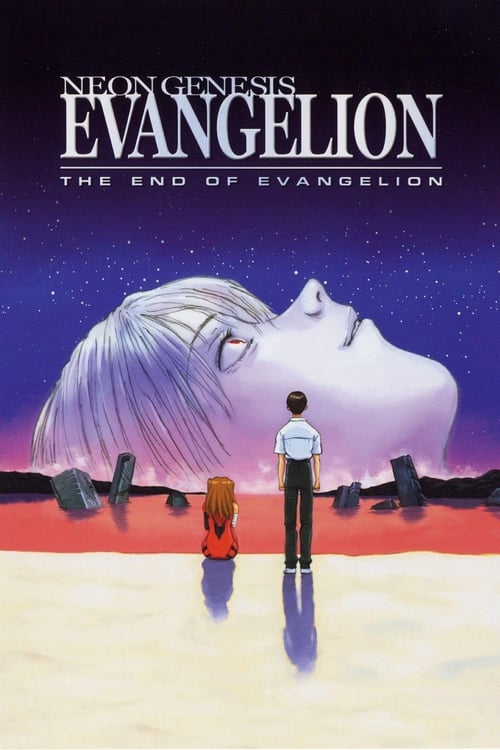
Neon Genesis Evangelion: The End of Evangelion
1997 · Kazuya Tsurumaki
For when you want to be flattened, not entertained — a film to chew on, argue about, and possibly recover from. Absolutely not comfort viewing; save it for a night when you're ready to be challenged. (See the series first.)
What it's about
The theatrical conclusion to the Evangelion saga: shadowy committee SEELE launches an all-out military assault on NERV to seize the giant Evas, while a shattered teenage pilot, Shinji, is dragged toward a decision about the fate of all humanity. What begins as a siege escalates into full apocalypse — psychological, spiritual, and cosmic at once.
The experience
Overwhelming is the only word — balletic military carnage giving way to imagery that shades into religious vision, all while the film digs mercilessly into its hero's despair. It is confrontational, sometimes punishing, and it will not leave you alone for days afterward.
The craft
Gainax's animators work at the edge of the possible, from meticulous mech combat to avant-garde passages that briefly abandon animation for live-action footage. Director Hideaki Anno pours his own depression and his fraught relationship with his audience directly into the film — real hate mail he received appears on screen. Demands good speakers and your full attention.
Why it matters
One of the most confrontational works ever released by a major animation studio, and the fiercely debated capstone that cemented Evangelion's status as anime's great psychological landmark.
When Hideaki Anno's television series Neon Genesis Evangelion ended in 1996 with two abstract, budget-starved episodes of pure introspection, the fan outcry was ferocious. This theatrical film is his second answer — an apocalypse rendered with the resources the series never had, and one of the most confrontational works ever produced by a major animation studio. It is at once a staggering feat of craft — Gainax's animators working at the edge of the possible, from balletic military carnage to imagery that shades into religious vision — and a raw act of self-exposure, Anno's depression and his vexed relationship with his own audience written directly into the film. Real hate mail he received appears on screen; a live-action passage briefly abandons animation altogether, as if the medium itself had buckled. Kazuya Tsurumaki co-directed; Shiro Sagisu's score sets annihilation to choral serenity. Few films have so thoroughly interrogated why we retreat into fiction while being an overwhelming fiction themselves. Its influence saturates mecha anime, but nothing since has matched its temperature — a work of genuine crisis, finished in fury and, somehow, ending on an open question.
A Deleuzian reading
About three-quarters of the way through, the picture burns.
The full Deleuzian reading of Neon Genesis Evangelion: The End of Evangelion →
Reception
In 1997 it landed as a shockwave — a brutal, confrontational 'real ending' delivered to a fanbase already at war over the TV finale, and plenty walked out baffled or furious. Today it's near-universally canonized, routinely called one of the greatest animated films ever made and the definitive way the story ends.
How Neon Genesis Evangelion: The End of Evangelion was received, from release to now →
Influences: the films it descends from and the films it influenced
- Persona (1966) — Its rupture of the celluloid itself — the film strip appearing to catch fire and tear to expose the projector — is the direct model for EoE's climactic cut to burning film and live-action theater seats that shatters the diegesis.
- 2001: A Space Odyssey (1968) — The non-narrative Star Gate finale — abstract imagery of cosmic transcendence set to massed, dissonant choral voices — is the template for the Human Instrumentality montage's abstraction-plus-choir装置.
- Space Runaway Ideon: Be Invoked (1982) — Tomino's theatrical apocalyptic finale, in which the entire cast is killed and their consciousnesses dissolve into a single cosmic rebirth, is the structural blueprint for Instrumentality's mass-death-and-merger ending.
- Mobile Suit Gundam (1979) — Established the 'real robot' innovation — mecha as fallible, maintenance-hungry military hardware piloted by frightened, traumatized adolescents — the genre grammar Eva inherits and then weaponizes against itself.
- Nausicaä of the Valley of the Wind (1984) — Anno personally animated the melting God Warrior's proton-beam sequence here; that liquefying-flesh energy-blast imagery reappears directly in the Angels' attacks and Eva Unit-01's berserker discharges.
- Devilman (1972) — Pioneered grafting Judeo-Christian angelology and literal Apocalypse onto a mecha/hero manga via grotesque body-horror transformation — the exact iconographic register of Eva's crosses, Angels, and Lilith.
- Angel's Egg (1985) — Oshii's glacial, near-wordless animation built from oblique Christian symbols (arks, crosses, resurrection) legitimized religious iconography as pure atmospheric device in anime, which Anno deploys as apocalyptic staging.
- Ultraman (1966) — Anno's formative tokusatsu obsession — a giant humanoid savior and miniature-set destruction shot in live action — motivates both Eva's kaiju-scale combat framing and the film's rupture into live-action interpolation.
- 8½ (1963) — The template for authorial self-exposure — a blocked artist putting his own creative and psychosexual crisis nakedly on screen — which Anno turns inward as EoE's confessional metafiction about his depression and his audience.
- Macross: Do You Remember Love? (1984) — Inverts victory-by-song into catastrophe-by-song: a vocal pop track carries an extended crosscut montage with dialogue withdrawn, while the mass-production Eva pursuit is staged as a textbook Itano Circus.
- Revolutionary Girl Utena: Adolescence of Utena (1999) — A standalone theatrical feature that radically re-imagines its own TV series rather than summarizing it — the same alternate-ending-as-separate-film strategy EoE takes toward the broadcast finale.
- FLCL (2000) — Tsurumaki's own follow-up carries forward the coming-of-age-via-mecha-metaphor and the violent, style-hopping animation ruptures (including manga-panel and live-action-texture inserts) he refined co-directing EoE.
- RahXephon (2002) — A near-explicit successor that recombines Eva's exact craft elements — an adolescent pilot, a bio-mechanical mecha, an elaborate religio-cosmological mythology, and a fusion-of-consciousness climax.
- Puella Magi Madoka Magica (2011) — Inherits Eva's deconstructive method — luring viewers with a wish-fulfillment genre (magical girl) then turning its mechanics into existential trauma — the same genre-subversion Anno performed on mecha.
- Evangelion: 3.0+1.0 Thrice Upon a Time (2021) — Anno re-authoring his own text decades later, escalating the live-action interpolation and authorial-self-exposure — literally pulling back to reveal the physical film soundstage as the site of his characters' release.
- Puella Magi Madoka Magica the Movie Part III: Rebellion (2013) — The founding genre deconstruction that swaps external spectacle for the protagonist's collapsing psyche and courts a fandom-splitting apocalyptic ending — the divisive-ending mold Urobuchi extends.
- Perfect Blue (1997) — Kon's match-cut editing that fractures the boundary between reality, performance, and psyche is the contemporaneous sibling technique to EoE's animation-to-live-action rupture destabilizing the viewer's footing.
- Serial Experiments Lain (1998) — Extends Eva's dissolution-of-the-self motif into direct metafictional address, staging the erasure of individual ego boundaries into a networked collective — Instrumentality reframed for the information age.
Similar films
- Evangelion: 3.0+1.0 Thrice Upon a Time (2021) — influence & lineage · same viewing thread
- Angel's Egg (1985) — influence & lineage
- The Matrix Revolutions (2003) — same viewing thread
- Akira (1988) — same viewing thread
- Godzilla Minus One (2023) — same viewing thread
- On the Silver Globe (1989) — same viewing thread
- Puella Magi Madoka Magica the Movie Part III: Rebellion (2013) — same viewing thread
- 2001: A Space Odyssey (1968) — influence & lineage · often watched together
All the films related to Neon Genesis Evangelion: The End of Evangelion →
Watch it with: curated runs of related films
- Bodies at the End of the World — A run of visionary, punishing films where flesh is scarred, melted, mechanized or sacrificed while the world tips into its last days — watch these back to back when you want cinema at its most extreme and transcendent.