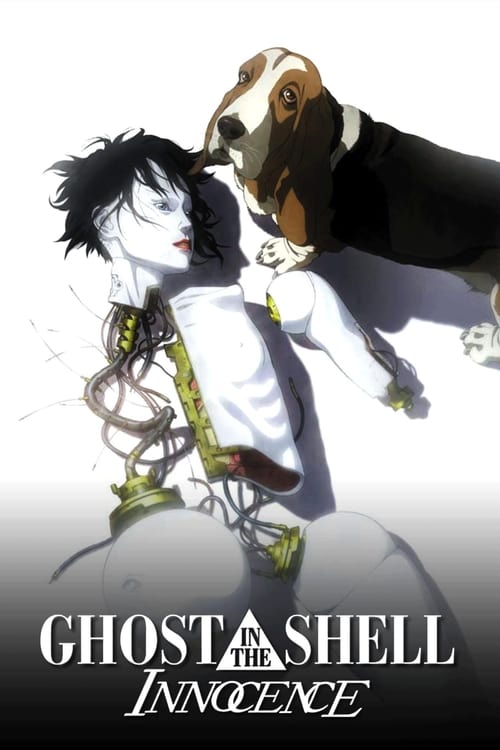
Ghost in the Shell 2: Innocence
2004 · Mamoru Oshii
For a late night when you want something gorgeous and strange to think with, not a plot to race through. Definitely a challenge — patient viewers are richly rewarded; anyone wanting a straight action sequel should recalibrate.
What it's about
In a future where bodies are as replaceable as software, cyborg detective Batou investigates a string of murders committed by gynoids — doll-like companion cyborgs that malfunction, kill their owners, and destroy themselves. One of them leaves behind a single file: a voice pleading for help. The case leads Batou and his very human partner through corporate labyrinths, hacked perceptions, and the question of what separates a person from a doll.
The experience
Slow, hypnotic, and cerebral — more a waking dream than a thriller, punctuated by bursts of startling action and imagery of overwhelming density. It's the kind of film you sink into rather than follow, and it leaves you turning it over for days.
The craft
Mamoru Oshii and Production I.G push hybrid cel-and-CGI animation to an extreme few films have matched — a carnival parade sequence and a gothic mansion set-piece that are among the most elaborate images in anime. Kenji Kawai's chanted, percussive score is half the experience; this one demands the biggest screen and best speakers you can find.
Why it matters
A rare animated film selected to compete at Cannes, it cemented Oshii's standing as anime's great philosopher-director and set a visual benchmark for the digital-analog hybrid era of Japanese animation.
Snapshot
Innocence is Mamoru Oshii's sequel to his 1995 landmark Ghost in the Shell, adapting motifs from Masamune Shirow's manga into an original, essayistic detective story. Released in Japan in March 2004 (the domestic title is simply Innocence; the "Ghost in the Shell 2" prefix was appended for international markets), it follows the cyborg Public Security agent Batou—now the protagonist in place of the vanished Major Motoko Kusanagi—as he investigates gynoids, sex-companion cyborgs that have turned murderous. The film is less a thriller than a meditation on the boundary between human, machine, doll, and animal, delivered through dense literary and philosophical quotation and some of the most elaborate hybrid cel-and-CGI imagery of its era. It was produced by Production I.G in association with Studio Ghibli and screened in competition at the Cannes Film Festival, an unusually prominent art-cinema platform for a work of Japanese animation.
Industry & production
Innocence was made by Production I.G, the Tokyo studio that had produced the first Ghost in the Shell and around which Oshii built much of his late-career work. Its most notable structural feature is the involvement of Studio Ghibli: Ghibli producer Toshio Suzuki took a producing role, lending the project the marketing and distribution weight of Japan's most prominent animation house, and the film was handled domestically in that orbit. This pairing of Production I.G's technical ambition with Ghibli's commercial reach was widely reported at the time as an unusual alliance between two studios more often seen as tonal opposites.
The film arrived during a period when Oshii and Production I.G were pushing feature animation toward heavy digital compositing. It was an expensive, long-gestating production—Oshii had spent much of the intervening decade on other projects, including live-action work—and the CGI-intensive imagery reflected years of pipeline development at the studio. Internationally, the film was picked up for U.S. release through Go Fish Pictures, a specialty label associated with DreamWorks, reflecting the crossover appetite for prestige anime that the first film's home-video success in the West had created. Precise budget and box-office figures I would not state with confidence; the commercial record is less clearly documented in English-language sources than the film's festival profile, and I will not invent numbers.
The signal industrial event was Cannes. Innocence competed for the Palme d'Or in 2004—one of a very small number of animated features ever admitted to the main competition—which functioned less as a box-office driver than as a statement about animation's claim to art-cinema seriousness, a claim Oshii's career had long advanced.
Technology
Innocence is a hybrid-animation film built at the moment when 2D cel-style artwork and 3D computer graphics were being fused into a single image rather than merely layered. Traditional hand-drawn character animation is combined with extensive CGI environments, vehicles, and set pieces, and, crucially, with digital compositing that unifies the two registers through lighting, atmosphere, and texture. The result is a densely material world—wet streets, ornamented interiors, mechanical dolls—whose surfaces carry far more visual information than conventional cel animation allowed.
The showcase is the film's parade/festival sequence, a hallucinatory procession of giant figures and floats often cited as one of the most ambitious pieces of integrated 2D/3D animation of its time. Here the CGI is not deployed for photorealism but for a deliberately artificial, overwhelming ornateness—a maximalism that serves the film's themes of manufactured beauty. Oshii and Production I.G used the technology to make the frame feel over-full and uncanny rather than seamless. This places Innocence at a specific technological juncture: after digital compositing had matured but before full-3D anime became routine, when the labor of marrying handcraft to computation was itself part of the artwork.
Technique
Cinematography
Because this is animation, there is no photographed cinematography in the live-action sense; the equivalent craft is the director of photography / compositing supervision (satsuei kantoku) that governs the virtual camera, lighting, and layering of the digital image. I will not attach a specific name to that role without certainty. What is clear from the film itself is a controlling visual sensibility: slow, gliding virtual camera moves; deep, layered compositions crowded with architectural and decorative detail; and a palette that swings between wet nocturnal blues and the golden, gilded density of the parade and of Kim's mansion. The camera favors long, contemplative holds and drifting perspectives over kinetic coverage, treating the frame as a space to be inhabited and studied rather than cut through.
Editing
The editing rhythm is deliberately slow and meditative, closer to art cinema than to action animation. Oshii repeatedly suspends the plot for extended dialogues and near-silent passages—Batou driving, feeding his dog, moving through spaces—so that the cutting foregrounds mood, reflection, and duration. Set pieces, when they come, are discrete islands in an otherwise ruminative flow. This measured pacing is a signature of Oshii's authorship and was, for some viewers, the film's central difficulty and, for others, its principal achievement.
Mise-en-scène / staging
Mise-en-scène is arguably the film's dominant expressive channel. Oshii stages his world as an accumulation of objects, textures, and ornament—Gothic and Baroque interiors, mechanical dolls, canals, cluttered rooms—so that meaning is carried by environment as much as by event. Recurrent doll imagery organizes the design: the gynoids, the puppet-like framing of characters, the parade's enormous figures. The staging repeatedly rhymes human and manufactured bodies, using composition to blur which is which. Batou's basset hound—Oshii is well known as a devoted basset hound owner, and the breed recurs across his films—anchors this world of artifice with a note of unguarded, living warmth.
Sound
Sound design and score are inseparable from the film's atmosphere. Kenji Kawai, who scored the first Ghost in the Shell, returns, and his contribution again centers on ritualistic choral chant—incantatory vocal music evoking sacred ceremony—used to lend the imagery a hushed, liturgical weight. The parade sequence in particular is carried by this chant. Between musical passages, the film relies on ambient sound and long silences that reinforce its contemplative tempo. Kawai's music is one of the strongest lines of continuity between the two films and a key reason the sequel feels of a piece with its predecessor.
Performance
The voice performances are grounded and understated, in keeping with the film's restraint. Batou is voiced by Akio Ōtsuka and his partner Togusa by Kōichi Yamadera—both continuing from the first film—and their weary, laconic exchanges give the dialogue-heavy script its human texture. The performances resist melodrama; much of the acting lies in silence, hesitation, and the flat delivery of characters who are themselves partly machine, which suits a film preoccupied with the difference between simulated and genuine feeling.
Narrative & dramatic mode
Formally, Innocence wears the clothes of a hard-boiled detective story: a murder investigation, a partnership, a descent into a criminal-technological underworld, a confrontation with a manufacturer. But the noir plot is largely a scaffold for philosophical essay. Long stretches consist of characters exchanging quotations and aphorisms—Batou and Togusa, and especially the hacker Kim, whose dialogue is a near-continuous montage of citations—so that the dramatic mode shifts toward the discursive and the meditative. The narrative also destabilizes its own reality in its later movement, folding perception, hacking, and repetition into a disorienting sequence that questions what the characters (and the viewer) can trust. The emotional engine is absence: Kusanagi's departure at the end of the first film hangs over the sequel, and the story is finally as much an elegy for a missing partner as it is a detective case.
Genre & cycle
The film sits at the intersection of cyberpunk science fiction, the detective/noir tradition, and the philosophical art film. Within anime it belongs to the mature, adult-oriented science-fiction feature lineage—Akira, Ghost in the Shell, and their successors—that positioned animation as a vehicle for serious speculative and philosophical content. As the second entry in the Ghost in the Shell screen franchise (which would go on to include television series and later works), it is a direct sequel, but Oshii treats the cycle idiosyncratically, shifting the protagonist and dialing down action in favor of contemplation. Its gynoid premise also connects it to a long science-fiction tradition of artificial women and mechanical Eves, which the film explicitly invokes.
Authorship & method
Innocence is emphatically an Oshii film. He wrote the screenplay and directed, and the work bears his recognizable preoccupations: dogs and dolls, cities as labyrinths of water and machinery, long philosophical digressions, and a suspicion of the boundary between the human and the constructed. His method here is citation-as-authorship—building dialogue and theme from a mosaic of literary, scriptural, and philosophical quotation—and staging-as-argument, letting elaborate environments carry ideas.
His central collaborators reinforce this authorship. Composer Kenji Kawai provides the ritual-choral score that binds the film to its predecessor. Producer Toshio Suzuki of Studio Ghibli lent the project institutional weight and reach. The film is an adaptation, at one remove, of Masamune Shirow's original manga, though Oshii's interests diverge substantially from Shirow's. The animation and compositing were executed by Production I.G's teams; the specific credited leads for character animation, art direction, and photography I will not name individually without confirmation, as I would rather flag that gap than misattribute craft roles.
Movement / national cinema
The film is a product of Japanese commercial animation at its most artistically ambitious, and specifically of the Production I.G house style associated with technically dense, adult science fiction. It also represents a moment of institutional convergence in Japanese animation, with Production I.G and Studio Ghibli—two poles of the industry—aligned on a single prestige project. Oshii's sensibility, however, is cosmopolitan: he draws on Western philosophy and literature, European art traditions, and the international auteur circuit as readily as on domestic anime convention. Innocence thus reads both as a Japanese national-cinema artifact and as a deliberate bid for a place in world art cinema.
Era / period
Innocence is a document of early-2000s anime in transition. It sits at the technological hinge between the cel era and full digital production, capturing the specific look of hand-drawn characters composited into elaborate CGI worlds before that hybrid became standardized. It also belongs to a mid-2000s moment when prestige anime enjoyed heightened international attention—Japanese animation was newly legible to Western festival and art-house audiences—which helps explain its Cannes berth and its specialty U.S. release. Thematically, its anxieties about artificial companions, networked identity, and the erosion of the human/machine line are of their turn-of-the-millennium moment.
Themes
The film's governing theme is the doll: the manufactured body that mimics the human and, in doing so, throws the definition of humanity into crisis. Through the gynoids, Oshii asks what separates a person from a perfect simulation, and whether the difference lies in the soul (the "ghost"), the body, memory, or love. Related motifs proliferate—the animal (Batou's dog) as a form of authentic, non-simulated life; the child and innocence gestured at by the title; the fragility of memory and perception under hacking and replication. The film is saturated with quotation drawn from a wide range of sources—scripture, classical and modern philosophy, and literature, including the tradition of the artificial woman—used to frame its questions rather than answer them. Underneath runs an elegiac strain: loss, absence, and the longing for a departed other give the philosophical inquiry an emotional core.
Reception, canon & influence
Critically, Innocence was received as a visually extraordinary but demanding work. Its Cannes competition slot was itself a milestone—one of the rare instances of an animated feature admitted to the festival's main competition—and it conferred serious art-cinema legitimacy on the project even though it did not take the Palme d'Or. Reviews frequently split along the same line: near-unanimous praise for the ambition and beauty of the animation, especially the parade sequence, alongside reservations about the film's slow pace and its dense, quotation-laden dialogue, which some found profound and others impenetrable. I would characterize its reputation as that of a respected, divisive art object rather than a broad popular hit.
Its influences run backward to a rich lineage: Oshii's own Ghost in the Shell (1995) and Shirow's manga most directly; the cyberpunk and hard-boiled-detective traditions; and a body of philosophy and literature on artificial beings, machines, and the soul that the film quotes explicitly. Forward, its legacy is strongest as a benchmark in the craft and ambition of hybrid 2D/3D animation and in the continued cultural durability of the Ghost in the Shell franchise, which has extended across television and later adaptations and remains a foundational reference point for screen cyberpunk. Perhaps its most lasting significance is emblematic: as evidence, staged on the world's most prominent film-festival platform, that animation could pursue difficult, essayistic, philosophically serious cinema on its own terms. Where the detailed commercial record is thin in the sources I can vouch for, I have declined to fill it with invented figures.
A Deleuzian reading
Partway into an investigation into murder, Batou stops to feed his dog.
The full Deleuzian reading of Ghost in the Shell 2: Innocence →
Reception
In 2004 it landed as a puzzle: a prestige Cannes competition slot, but critics split over a sequel that swapped action for characters trading philosophical quotations. Two decades on it's been reappraised as one of anime's most gorgeous and melancholy films — the 'actually, Innocence is great' take is now standard-issue.
How Ghost in the Shell 2: Innocence was received, from release to now →
How to watch Ghost in the Shell 2: Innocence: what to notice on a first viewing
- Notice how slowly the camera glides through each room. The virtual camera favors long, contemplative holds and drifting moves over kinetic coverage, treating each space as something to be studied rather than cut through quickly. You are meant to inhabit these rooms, not just pass through them on the way to the plot.
- Listen for choral chanting during the film's big set pieces. Kenji Kawai's score leans on incantatory vocal music that evokes sacred ceremony, lending even a murder investigation a hushed, liturgical weight. The music keeps telling you this is closer to ritual than to a police procedural.
- Notice how dolls and people are framed the same way. Oshii repeatedly composes mechanical dolls and human bodies with the same puppet-like stillness and framing, letting the arrangement blur which is which. The film is asking you to notice how hard it already is to tell a person from a doll.
- Notice Batou's dog moving through the mechanical, ornate rooms. Amid Gothic interiors, mechanical dolls, and cluttered technology, the basset hound is the one unguarded, uncomplicated living thing the camera keeps returning to. One ordinary animal anchors a whole world of artifice in something plainly, simply alive.
- Listen for how flatly the characters deliver dense dialogue. Batou and his partners trade long exchanges built from literary and philosophical quotation, spoken in weary, laconic, almost affectless voices rather than dramatic delivery. Restraint in the voice matches characters who are themselves partly machine.
The whole guide to watching Ghost in the Shell 2: Innocence, with the keys for a rewatch →
Influences: the films it descends from and the films it influenced
- Ghost in the Shell (1995) — The direct progenitor: Kenji Kawai's wedding-chant 'Making of a Cyborg' choral motif and the wordless 'urban stroll' montage of slow tracking shots over a canal-city return as Innocence's core musical and structural DNA.
- Angel's Egg (1985) — Establishes Oshii's signature of near-silent, glacially paced allegory carried by water-drenched Gothic architecture and accumulated ornament rather than plot, the method Innocence scales up.
- Patlabor 2: The Movie (1993) — Its extended still-life city montage — empty streets, bridges and canals held in long takes scored to Kawai — is the exact template for Innocence's contemplative interstitial passages.
- Blade Runner (1982) — Codifies the hard-boiled detective moving through a perpetually rain-lit, neon-and-Asian-signage megacity where the central 'case' is really the question of whether the artificial has a soul.
- Metropolis (1927) — Originates the 'false Maria' gynoid archetype — the manufactured woman built to seduce and deceive — that Innocence's malfunctioning, revolt-prone sexbot dolls literalize.
- Solaris (1972) — Models the philosophical-SF mode of long dwelling takes and characters reciting texts aloud, privileging metaphysical rumination on memory and the human over narrative incident.
- 2001: A Space Odyssey (1968) — Legitimizes protracted, near-dialogue-free spectacle and machine-consciousness dread as serious cinema, licensing Innocence's music-driven set pieces to run without exposition.
- The Bride of Frankenstein (1935) — Foregrounds the pathos of the constructed female body assembled and animated by others — the doll-as-made-object rhyme that Innocence's autopsy and manufacture imagery revives.
- Jin-Roh: The Wolf Brigade (1999) — Oshii extends the same elegiac slowness, the recurring basset-hound/dog motif, and philosophical fatalism into a later I.G production, continuing the authorial thread Jin-Roh scripted.
- The Sky Crawlers (2008) — Oshii pushes Innocence's photoreal-CG-environment-under-2D-character compositing further, sustaining the same elegiac stasis and doll-like figures trapped in eternal repetition.
- Paprika (2006) — Its swelling parade of animate dolls and household objects as an escalating processional set piece takes Innocence's yakuza-mansion festival parade as a clear precedent.
- Ergo Proxy (2006) — TV anime that inherits Innocence's citation-heavy philosophical dialogue and its gloomy, uncanny doll-android (AutoReiv) motif almost wholesale.
- Ex Machina (2014) — Stages the interrogation of a seductive gynoid's interiority as a citation-laden chamber drama, extending Innocence's 'philosophy of mind as dialogue' into live action.
- Blade Runner 2049 (2017) — Contemplative long-take futurism where a synthetic companion (Joi) and questions of manufactured personhood are rendered through immaculate digital compositing and slow, ornamental world-holding.
- Ghost in the Shell (2017) — The live-action Hollywood adaptation lifts Innocence/1995 imagery directly — the geisha-robot faces peeling open and the towering neon-hologram cityscape — as production-design quotation.
- Mars Express (2023) — Turns gynoids loaded with copied souls into a procedural-as-philosophy; its melancholy robot-partner-and-cop dyad is the direct model for Aline and the android Carlos.
- Ghost in the Shell: Stand Alone Complex (2002) — Production I.G's parallel franchise expansion sharing the Section 9 milieu and Kawai's sound-world, but choosing procedural episodic form over Innocence's essayistic digression.
- Appleseed (2004) — A contemporaneous full-3DCG adaptation of a Shirow manga tackling the same 2D-to-3D cyberpunk translation problem from the opposite technical direction (cel-shaded CG over Innocence's painted-2D-on-3D compositing).
- Her (2013) — Extends the artificial-companion elegy of absence through understated, interiorized voice performance rather than action, echoing Innocence's tone of mourning a love object that was never fully present.
Similar films
- Angel's Egg (1985) — influence & lineage · same viewing thread
- Paprika (2006) — influence & lineage · same viewing thread
- Ghost in the Shell (1995) — influence & lineage
- Patlabor 2: The Movie (1993) — influence & lineage
- Blade Runner 2049 (2017) — influence & lineage
- Millennium Actress (2002) — same viewing thread
- Mind Game (2004) — same viewing thread
- Séance (2004) — same viewing thread
All the films related to Ghost in the Shell 2: Innocence →
Watch it with: curated runs of related films
- Doubles, Dreams, and Dissolving Selves — Watch these when you want the floor to give way — dream machines, hypnotists, doppelgängers, and haunted houses where perception and identity quietly come undone.