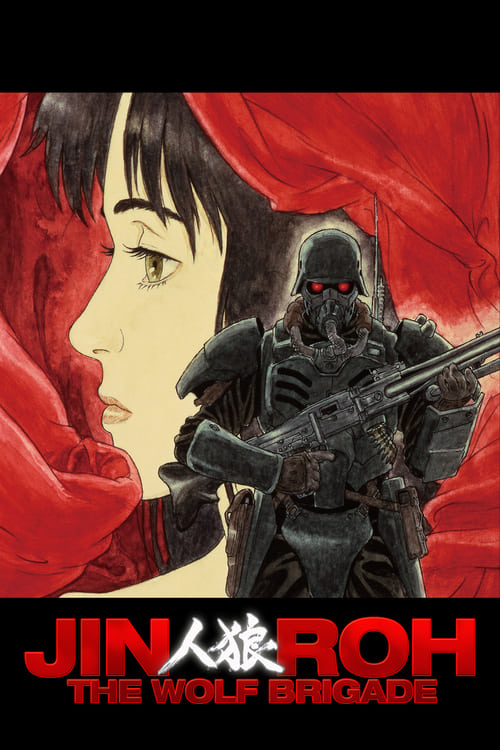
Jin-Roh: The Wolf Brigade
1999 · Hiroyuki Okiura
For when you want animation that treats you like an adult — a heavy, haunting film to chew on for days, not a comfort watch.
What it's about
In an alternate postwar Japan simmering with armed insurgency, a trooper in an elite armored police unit freezes when ordered to shoot a teenage courier, then watches her detonate a bomb in front of him. Sent back for retraining, he drifts into a relationship with the dead girl's sister — unaware that he's become a pawn in a power struggle between rival security agencies, with the Little Red Riding Hood fairy tale threading darkly through it all.
The experience
Slow-burning, somber, and quietly devastating — a thriller that trades action-movie catharsis for mounting unease and a grief that settles into your chest. It asks patience and pays it back with real weight.
The craft
Hand-drawn at Production I.G with an almost perverse commitment to realism: muted colors, weather, weight, faces animated with the restraint of live-action performance. Written by Mamoru Oshii as part of his Kerberos Saga, it uses the Brothers Grimm fairy tale as a chilling counter-melody to the political machinery, and the sound design's rain and gunfire deserve good speakers.
Why it matters
A landmark of serious adult animation, proof that anime could carry political tragedy without spectacle or comic relief, and the film that announced Hiroyuki Okiura as a major director in his own right.
Snapshot
Jin-Roh: The Wolf Brigade (Jinrō) is a hand-drawn political tragedy disguised as a science-fiction thriller, the animated centerpiece of Mamoru Oshii's long-gestating "Kerberos Saga." Set in an alternate postwar Japan where reconstruction has bred armed anti-government insurgency and a militarized police apparatus, it follows Kazuki Fuse, a trooper in an elite paramilitary unit who freezes when ordered to shoot a teenage courier — a "Red Riding Hood" — and watches her detonate herself before him. His subsequent entanglement with the dead girl's sister becomes the vehicle for a conspiracy among rival security agencies. Directed by Hiroyuki Okiura in his feature debut and produced at Production I.G, the film is renowned for the austerity of its realism: no super-powered heroics, no comic relief, a muted palette, and a fatalism borrowed as much from French crime cinema and the Brothers Grimm as from anime convention. It stands as one of the defining "adult" anime of the late 1990s, a companion piece to Oshii's own Ghost in the Shell (1995) in tone and ambition, though markedly more grounded.
Industry & production
The film was produced by Production I.G, the Tokyo studio whose reputation for technically exacting, thematically dense work had been consolidated by Ghost in the Shell. Jin-Roh originates in Oshii's decade-spanning "Kerberos" project, which he had previously developed as the manga Kerberos Panzer Cop (illustrated by Kamui Fujiwara) and two live-action films, The Red Spectacles (1987) and StrayDog: Kerberos Panzer Cops (1991). Oshii wrote the screenplay but, by his own account in interviews, chose not to direct, entrusting the picture instead to Hiroyuki Okiura — until then one of the most respected key animators in the industry, whose credits included work on Akira, Ghost in the Shell, and the Patlabor films. Placing a first-time director at the helm of a demanding, dialogue-heavy feature was a notable act of studio confidence.
Exact budget and box-office figures for Jin-Roh are not well documented in reliable English-language sources, and I will not invent them; the film's commercial profile appears to have been modest, with its lasting reach owing more to festival exposure and home-video/cult circulation than to theatrical returns. It premiered in 1999 and rolled out internationally over the following year. The production is emblematic of a period in which Japanese studios were willing to finance mature, uncompromising animation aimed at adult audiences rather than franchise-friendly properties.
Technology
Jin-Roh sits at the technological hinge between traditional cel animation and the digital compositing that would soon dominate the industry. It is overwhelmingly a hand-drawn film, prizing the weight and friction of realistically rendered human movement over spectacle. Where digital tools are used, they serve integration and atmosphere — layered lighting, smoke, the sodium glow of tunnels — rather than overt computer-generated objects. The signature "Protect Gear" armor of the Kerberos troopers, with its full-face helmet, glowing red optical clusters, and heavy German-pattern silhouette, is animated as a physical burden: characters move slowly, deliberately, encumbered. This commitment to a tactile, un-flashy image is itself the film's technological argument — a deliberate refusal of the frictionless dynamism that anime often celebrates.
Technique
Cinematography
Though animated, the film is "shot" with the restraint of live-action realist cinema: eye-level framings, patient holds, shallow staging in cramped interiors, and a preference for the observational long take over the dynamic cut. Art director Hiromasa Ogura's backgrounds — rain-slick canals, concrete underpasses, dim tenement rooms — are rendered with a naturalistic desaturation that reads as overcast and wintry throughout. Light sources are motivated and often low, and the palette leans toward grays, browns, and muted greens, with red reserved as a charged accent (the couriers' capes, the armor's optics, blood). The camera rarely calls attention to itself; its discretion is the point, lending the political machinery an air of documentary inevitability.
Editing
The film's editing rhythm is unusually slow and deliberate for its genre, built on sustained shots and measured dissolves rather than kinetic montage. Dialogue scenes are allowed to breathe; the recurring recitations of the "Red Riding Hood" fairy tale are cut against images so that word and picture comment on one another. The two set-piece sequences — the opening riot and sewer bombing, and the climactic underground massacre — punctuate an otherwise conversational structure, and their comparative velocity lands harder for the stillness around them. I do not have a firmly documented English-language credit for the film's editor and will not attribute one speculatively; what is verifiable is the picture's overall temporal patience, a signature it shares with Oshii's directorial work.
Mise-en-scène / staging
Staging is where the film's realism is most legible. Interiors are spatially coherent and lived-in; characters occupy rooms rather than posing in them. The Protect Gear is blocked to emphasize mass and menace — troopers advance as an implacable line, their red eyes the only "expression" available. Crucial to the design is the alternate-history iconography: German-derived weaponry (the belt-fed machine gun most prominently), helmets, and uniforms signal a divergent postwar in which Japan's reconstruction took an authoritarian, continental-European inflection. The recurring wolf motif — imagery, the fairy tale, the very name "Wolf Brigade" — is woven into props, dialogue, and framing rather than stated outright.
Sound
Hajime Mizoguchi's score is elegiac and sparing, built around cello and voice, with choral passages that lend the tragedy a liturgical solemnity. Music is withheld as often as it is deployed, so that ambient sound — rain, footsteps, the mechanical clatter of weaponry, silence in the sewers — carries much of the film's tension. The sound design treats the armored troopers as heavy machines, their movements weighted and resonant, reinforcing the man-as-beast theme through aural means.
Performance
The Japanese voice performances are pitched toward naturalism and restraint, matching the film's grounded register; Fuse in particular is played as withdrawn and affectless, a man whose interior life is deliberately opaque. (I am not fully certain of the complete principal voice cast from memory and will not assert names I cannot verify.) The animation's realism places extraordinary demands on the actors and animators alike, since micro-expression and body language — a hesitation, a downward glance — must do the work that plot exposition does not.
Narrative & dramatic mode
The dramatic mode is tragic and fatalistic rather than heroic. The narrative braids three strands: a political thriller about a turf war among the Capital Police's armed Kerberos unit, the Public Security Division, and the intelligence apparatus; a doomed, ambiguous romance between Fuse and Kei, the sister (or purported sister) of the dead courier; and a mythic overlay drawn from "Little Red Riding Hood," recited in voiceover and dramatized until the fairy tale's logic swallows the plot. The film withholds and misdirects: much of what appears to be intimacy is revealed as maneuver, and the audience, like Fuse, is kept uncertain who is predator and who is prey. Its structure is deliberately anti-climactic in the conventional sense — the "twist" is less a shock than the slow confirmation of a trap that was always closing. This is drama built on dread and inevitability, in which character is destiny and institutions are the real agents of the story.
Genre & cycle
Jin-Roh is a hybrid: alternate-history political thriller, tragic romance, and war-of-conscience drama, delivered through the vocabulary of "hard" adult anime. It belongs firmly to the Kerberos Saga cycle, sharing its world, its armored motif, and its author with Oshii's live-action entries and the source manga. More broadly it participates in a late-1990s wave of mature, philosophically weighted Japanese animation — alongside Ghost in the Shell, Neon Genesis Evangelion, and Satoshi Kon's Perfect Blue — that treated the medium as a vehicle for serious ideas about identity, the state, and violence. Within that cycle, Jin-Roh is the most resolutely realist, eschewing cyberpunk gadgetry and apocalyptic scale for a chamber-scale political tragedy.
Authorship & method
Authorship here is genuinely divided, and the tension is productive. Mamoru Oshii, as screenwriter and originator of the Kerberos world, supplies the film's political fatalism, its recursive fairy-tale scaffolding, and its preoccupations with dogs, wolves, and men who are made into weapons — motifs that run through his whole body of work. Hiroyuki Okiura, directing, translates that material into something more emotionally immediate and physically grounded than Oshii's own often cerebral, essayistic style; drawing on his mastery as a character animator, Okiura insists on human weight, on faces and hesitation, giving the abstractions a beating heart. Okiura also handled character design, anchoring the realism at the level of the individual figure. The mechanical and armor design derives from the Kerberos manga lineage associated with Oshii and Kamui Fujiwara. Hiromasa Ogura's art direction establishes the overcast, concrete world, and Hajime Mizoguchi's score gives it its mournful voice. The method, in sum, is a hand-off in which the writer's schema is warmed and humanized by the director's animator's eye — a collaboration whose seams are part of the film's distinctive texture.
Movement / national cinema
The film is a product of the Japanese animation industry at a moment of artistic high confidence, and specifically of the "Oshii school" of politically and philosophically inflected anime nurtured at Production I.G. It is also, in spirit, unusually cosmopolitan: its fatalism, its trench-coated doomed men, and its interest in the individual crushed by clandestine institutions recall the French crime cinema of Jean-Pierre Melville, while its European weaponry and iconography deliberately estrange the Japanese setting. As national cinema, it engages Japan's own postwar reckoning — the memory of occupation, of protest movements, of a reconstruction whose prosperity coexisted with unrest — refracted through counterfactual history.
Era / period
Released in 1999, at the close of Japan's post-bubble "lost decade," Jin-Roh speaks to anxieties about state power, security, and the individual's disposability within large systems. Its diegetic period is an alternate late-1950s/early-1960s Japan whose civil unrest evokes the real Anpo-era protests, transposed into a timeline where the postwar order took a harsher, more militarized form. The film thus operates on two temporal registers at once — a turn-of-the-millennium production looking back at an imagined mid-century — and its melancholy belongs to both.
Themes
The governing metaphor is the wolf among sheep — or the man who is really a wolf, dressed in human clothing, as the fairy tale insists. The film interrogates dehumanization: the conversion of men into instruments of the state, the "Protect Gear" as a carapace that both shields and erases the human within. Duty and love are set in irreconcilable opposition, and the film's cruelty lies in suggesting that, for a wolf, there is no escape into tenderness. Related themes cluster tightly: institutional betrayal and the anonymity of power; the predator/prey cycle and the impossibility of stepping outside it; the loss or foreclosure of individual conscience; and the way myth and story (the recited fairy tale) can pre-script a life. The recurring imagery of dogs and wolves — loyal beasts and wild ones — encodes the film's central question of whether a trained killer retains any humanity to betray.
Reception, canon & influence
Jin-Roh was received as a serious, adult work and has grown in stature over time into a canonical example of mature, realist anime; it circulated notably on the festival and home-video circuits and earned a devoted critical following, though I will not cite specific awards or figures I cannot verify. Critics have consistently singled out its restraint, its emotional bleakness, and the quality of its hand-drawn realism as distinguishing it from more spectacle-driven contemporaries.
Its lines of influence run backward and forward. Backward, the film draws on the Grimm fairy tale "Little Red Riding Hood" as explicit structuring myth; on Oshii's own prior Kerberos works (The Red Spectacles, StrayDog, the Kerberos Panzer Cop manga) for its world and iconography; on the fatalistic European crime tradition (Melville's doomed loners are a frequently cited touchstone) for its tone; and on Japan's postwar political memory for its counterfactual backdrop. Forward, it helped cement Production I.G's and Okiura's reputations, and it demonstrated that animation could sustain a slow, dialogue-driven political tragedy without action-genre concessions. Its most concrete legacy is the South Korean live-action remake Illang: The Wolf Brigade (2018), directed by Kim Jee-woon, which relocates the story to a near-future Korea — a testament to the durability of the film's premise across national and medium boundaries. More diffusely, Jin-Roh remains a reference point for arguments that anime can be a vehicle for austere, morally serious drama, and Okiura's insistence on realist character animation continues to be cited as a high-water mark of the hand-drawn craft.
Reception
It barely made a ripple at the Japanese box office in 2000, but the international festival circuit embraced it, and over two decades of home-video reissues it's climbed from 'the other Production I.G movie' to a fixture of every serious-anime-cinema list.
How Jin-Roh: The Wolf Brigade was received, from release to now →
Influences: the films it descends from and the films it influenced
- Le Samouraï (1967) — Melville's model of the taciturn, code-bound professional killer filmed in long silent procedural stretches supplies Jin-Roh's restrained, fatalistic solitary protagonist and its refusal to psychologize through dialogue.
- Army of Shadows (1969) — Its desaturated portrait of a clandestine paramilitary cell consumed by internal betrayal and quiet executions is the template for Jin-Roh's Public Security intrigue, where loyalty to the organization becomes the instrument of doom.
- Angel's Egg (1985) — Oshii's glacial contemplative pacing, near-monochrome palette, and religious/fairy-tale symbolism established the writerly schema of mythic overlay and slowness that Jin-Roh inherits from his script.
- The Red Spectacles (1987) — The originating live-action Kerberos film supplies the Protect-Gear armor iconography, the man-as-wolf mythology, and the counterfactual security-state world Jin-Roh dramatizes.
- Grave of the Fireflies (1988) — Takahata's naturalistic character acting, refusal of spectacle, and treatment of animation as a vehicle for austere historical tragedy is the precedent for Jin-Roh's serious realist drama in cel.
- Akira (1988) — Otomo's density of hand-drawn mechanical and architectural detail and its adult political-dystopian ambition helped define the theatrical adult-anime idiom Jin-Roh works within.
- StrayDog: Kerberos Panzer Cops (1991) — A direct entry in the Kerberos saga, it deepens the same dog/wolf iconography and the melancholy of the discarded armored soldier that Jin-Roh's protagonist embodies.
- Patlabor 2: The Movie (1993) — Oshii's realist alternate-Tokyo political-military thriller—long procedural tension, coup intrigue, and observational cityscape montage animated with I.G realism (Okiura among its animators)—is the immediate aesthetic and tonal blueprint for Jin-Roh.
- Ghost in the Shell (1995) — Production I.G's photoreal hand-drawn urban environments and observational long-take montage, with Okiura as supervising animator and Hiromasa Ogura's overcast art direction, are the concrete craft workshop Jin-Roh emerged from.
- Ghost in the Shell 2: Innocence (2004) — Oshii extends the same elegiac slowness, the recurring basset-hound/dog motif, and philosophical fatalism into a later I.G production, continuing the authorial thread Jin-Roh scripted.
- The Sky Crawlers (2008) — Oshii returns to fatalistic young soldiers trapped in an endless institutional war, using restrained naturalist performance and mournful pacing that carry forward Jin-Roh's tragedy of the human-as-weapon.
- A Letter to Momo (2011) — Okiura's own directorial follow-up foregrounds the same insistence on human weight—hesitation, faces, physical realism in character animation—that anchored Jin-Roh's realism at the level of the individual figure.
- Illang: The Wolf Brigade (2018) — The direct live-action remake relocates the Protect-Gear, Red Riding Hood scaffolding, and Special Unit political intrigue to a near-future Korea, testing whether Jin-Roh's craft survives translation to another medium and nation.
- Le Cercle Rouge (1970) — Its ritualized, elegiac cool and the sense of characters moving inexorably toward a preordained end share Melville's fatalist grammar of doomed loners that Jin-Roh transposes into animation.
- Blood: The Last Vampire (2000) — A Production I.G contemporary that likewise fuses realist adult character animation with an alternate-history occupied-Japan setting and restrained, grounded staging over spectacle.
- In This Corner of the World (2016) — Katabuchi's restrained, everyday-realist hand-drawn wartime tragedy continues the lineage of anime as austere, morally serious historical drama that eschews action-genre concessions.
- Memories (1995) — Extends Cannon Fodder's militarism-allegory register — an alt-history security state rendered in meticulous retro-tech detail and muted, tragic cel realism.
Similar films
- Patlabor 2: The Movie (1993) — influence & lineage
- Grave of the Fireflies (1988) — influence & lineage
- Akira (1988) — influence & lineage
- Wolf Children (2012) — shared sensibility
- Ninja Scroll (1993) — shared sensibility
- The Boy and the Heron (2023) — shared sensibility
- The Wind Rises (2013) — shared sensibility
- Berserk: The Golden Age Arc III - The Advent (2013) — shared sensibility