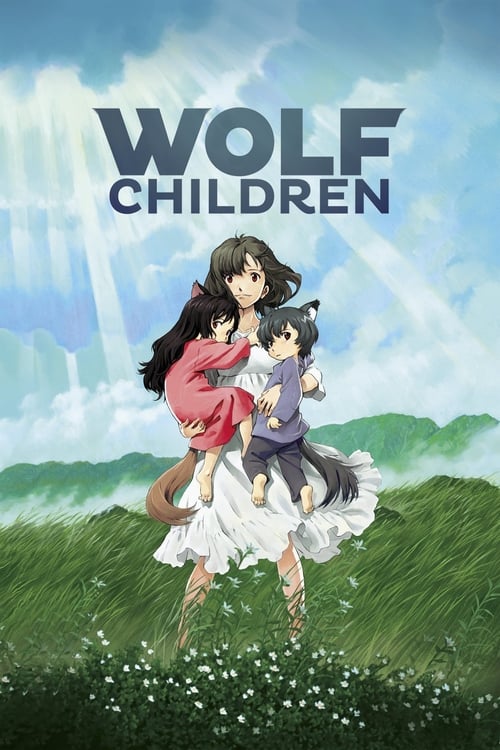
Wolf Children
2012 · Mamoru Hosoda
The anti-Ghibli Ghibli heir whose Belle and his pointed comments about how legacy anime portrays women keep him at the center of anime auteur discourse.
When you want a good cry that feels earned rather than engineered — or a warm, unhurried film about family for a quiet evening. Comforting on the surface, but it will wreck you a little, especially if you're a parent.
What it's about
A young university student falls in love with a man who carries a secret: he's the last of a line of wolf-people. They have two children — Yuki, born on a snowy day, and Ame, born on a rainy one — and when he dies suddenly, she's left to raise two kids who can sprout ears and tails at any moment. She moves them from Tokyo to a ramshackle house in the mountains, where the story follows thirteen years of her raising children the world must never fully see.
The experience
Gentle, patient, and quietly devastating — it plays like a memory of childhood, full of snow days and muddy fields, and then lands emotional blows you never see coming. It builds slowly and earns every tear; the ache of watching children grow up and away has rarely been drawn this honestly.
The craft
Hosoda's animation pours its detail into the everyday — cooking, farming, a house being repaired, seasons turning over the same mountain valley — so that the one fantastical element feels completely real. The hand-drawn landscapes are gorgeous, and a snowbound sequence of pure kinetic joy is one of the most exhilarating passages in modern animation.
Why it matters
The first film from Studio Chizu, it cemented Hosoda's standing as one of Japan's great animation directors outside Ghibli and became a touchstone for animated films that use a single fantastic premise to tell a grounded family story.
Snapshot
Wolf Children (おおかみこどもの雨と雪, Ōkami Kodomo no Ame to Yuki — literally "The Wolf Children Ame and Yuki") is Mamoru Hosoda's third feature and the first produced under Studio Chizu, the production house he co-founded with producer Yuichiro Saito. Where his previous films had leaned on genre engines — the science-fiction conceit of The Girl Who Leapt Through Time (2006), the virtual-world spectacle of Summer Wars (2009) — Wolf Children pares the fantastical down to a single premise and pours everything else into domestic realism. A university student, Hana, falls in love with a man who is the last of a line of wolf-people; they have two children, Yuki (born on a snowy day) and Ame (born on a rainy one). When the father dies abruptly, Hana relocates from Tokyo to the rural mountains to raise two children who can, at any moment, become wolves. The film spans roughly thirteen years and resolves not on a fantastical climax but on each child's quiet choice of what to be. It is best understood as a maternal melodrama in fantasy clothing — a portrait of single parenthood, rural resettlement, and the terror and grace of letting children become themselves.
Industry & production
Wolf Children marks Hosoda's institutional independence. His breakthroughs had been made at Madhouse, the veteran Tokyo studio; for this film he and Saito established Studio Chizu (the name plays on chizu, "map") to give Hosoda a stable creative home and greater authorial control. Madhouse remained involved in the production, and the film was distributed theatrically in Japan by Toho, the country's dominant exhibitor — the standard pipeline that had also carried Summer Wars. This arrangement placed Hosoda in the small class of Japanese animation directors, alongside the Studio Ghibli filmmakers, whose original (non-franchise, non-adapted) features could open wide as event cinema rather than as extensions of a manga or television property.
The production reunited Hosoda's core collaborators from the Madhouse films: screenwriter Satoko Okudera, who had scripted both The Girl Who Leapt Through Time and Summer Wars, and character designer Yoshiyuki Sadamoto, the Neon Genesis Evangelion designer who had given those earlier films their clean, slightly angular character line. The commercial reception in Japan was strong — the film was a domestic success and swept up major industry recognition (see Reception) — though precise grosses are outside what can be responsibly cited here without a verified source.
Technology
Wolf Children is a digital production that deliberately restrains the digital. Hosoda's Summer Wars had been, in part, a showcase for CG spectacle — the candy-colored combinatorial vastness of its "OZ" cyberspace. Wolf Children inverts that emphasis: the technological ambition is turned toward the invisible integration of computer assistance into a hand-drawn, naturalistic idiom. Character animation remains predominantly 2D, composited over lushly detailed digital background art depicting the seasons of a mountain valley.
The film's most discussed technical set piece is a snow sequence in which Hana and the two children bound, roll, and race across a fresh drift, the children flickering between human and wolf forms as they run. The passage blends full 2D character animation with digitally assisted motion and camera movement to sustain an unbroken, exhilarating flow that would be difficult to keep coherent by hand alone. Comparable care governs the transformation moments and the animal running cycles, where the challenge is less spectacle than credibility — a wolf's gait, a toddler's collapse into a cub. The general principle across the production is subtractive: technology is used to make the fantastical elements feel weighted and ordinary rather than to make them dazzle.
Technique
Cinematography
As an animated film, Wolf Children has no photographic cinematography, but it has a highly deliberate visual grammar, and it is a strong example of Hosoda's "virtual camera." His compositions favor frontality and stability: broad, often symmetrical wide shots that hold the full body within an environment, planimetric staging that reads almost like theatrical tableaux, and a patience with the long establishing view of a house, a field, a mountainside. This restraint is a signature — Hosoda tends to let a fixed or slowly gliding frame observe action within the shot rather than chase it with cuts. The countryside is photographed (in the animator's sense) with an almost documentary attentiveness to light and weather across the year, so that the setting accrues the density of a real place. Against that stability, the kinetic sequences — the snow run, the children's wolf-sprints — read as eruptions of release.
Editing
The film's cutting is unhurried and sequential, organized around the passage of time: pregnancies, first steps, first days of school, the slow divergence of two temperaments. Hosoda and his editorial team favor scenes that breathe, allowing domestic routine (cooking, planting, reading child-rearing manuals) to play at length so that the rhythms of parenting register as duration rather than montage shorthand. Elisions across years are handled cleanly, trusting the audience to read growth from the children's changed designs and voices. (The specific editor is not something to attribute here without confirmation.) The overall effect is a chaptered, chronicle-like structure that resists conventional escalating-crisis pacing.
Mise-en-scène / staging
Production and background design carry an unusual share of the film's meaning. The narrative pivots on space: the cramped precarity of the Tokyo apartment, where two wolf-children cannot be safely raised, versus the dilapidated rural house Hana restores, where a wild hillside offers room to run and hide. The staging repeatedly contrasts enclosure and openness, the human-built and the wild treeline, and it uses seasons as structural punctuation. Interiors are dense with the lived detail of a struggling household; exteriors render the mountain in changing weather with real topographical specificity. The wolf-hybrid design is itself a staging problem solved with tact — the children read as convincingly canine and convincingly childlike, so that a shift between the two never breaks the domestic register.
Sound
The score is by Takagi Masakatsu, an experimental musician and visual artist whose piano-forward, ambient-inflected compositions give the film a delicate, pastoral tenderness rather than orchestral swell. The music tends to underscore intimacy and landscape, and it withdraws to let natural sound — wind, rain, snow, the valley — carry many passages. The film's emotional signature song, associated with the theme of maternal love, closes the picture on a note of quiet benediction. Sound design throughout privileges the textures of weather and rural quiet, reinforcing the movement from urban noise to natural stillness that mirrors Hana's journey.
Performance
The vocal performances are calibrated toward naturalism. Aoi Miyazaki voices Hana across more than a decade of the character's life, carrying her from lovestruck student to exhausted, resolute mother, and the performance's restraint anchors the film's emotional credibility. Takao Osawa voices the wolf-man, the father, whose early death makes his warmth a felt absence for the rest of the runtime. The children are voiced at multiple ages, with the divergence of Yuki (initially wild, later choosing human society) and Ame (initially timid, later choosing the mountain) traced substantially through vocal characterization. The overall performance mode is understated — pitched to domestic realism rather than the broad affect of much commercial anime.
Narrative & dramatic mode
The film's dominant mode is the maternal melodrama, structured as a chronicle rather than a plot. Its inciting fantasy — a werewolf lover — is dispatched with startling economy in the first act, and the death of the father converts the film from romance to survival narrative. From there the drama is generated not by antagonists but by the ordinary, unrelenting difficulty of raising children who do not fit any available category: no pediatrician and no veterinarian can treat them; no school and no forest fully claims them. The central tension is developmental and internal — who will each child choose to become — and the climax is an act of relinquishment rather than triumph. Hosoda frames the whole as retrospective testimony, narrated from the vantage of the grown daughter, which lends the chronicle the tone of memory and eulogy.
Genre & cycle
Wolf Children sits at a crossroads of genres it refuses to fully inhabit: it is a fantasy that suppresses spectacle, a coming-of-age story split between two protagonists, and a family drama that borrows the werewolf as metaphor. Within Hosoda's own emerging cycle it is the keystone of what became a loose thematic series about family and its stages — followed by The Boy and the Beast (2015), on surrogate fatherhood, and Mirai (2018), on siblinghood and family lineage. In the broader landscape it belongs to the tradition of the theatrical anime family drama that Studio Ghibli had defined, and specifically to the pastoral strain of that tradition. It also participates in a long line of "creature as difference" allegories, using the wolf inheritance the way other works use hybridity to talk about belonging.
Authorship & method
Hosoda is the film's clear author, and Wolf Children is often read as his most personal work, made around the period of his own entry into parenthood; its sympathies lie unmistakably with the labor and grief of raising children and then losing them to their own choices. His method is collaborative but consistent: he reunited screenwriter Satoko Okudera, whose scripts had shaped his previous two features and who helped translate a high-concept premise into grounded domestic scenes, and character designer Yoshiyuki Sadamoto, whose restrained figure work keeps the fantasy human-scaled. Composer Takagi Masakatsu replaced the more conventional scoring of the earlier films with a gentler, more experimental sonic palette suited to the pastoral material. Hosoda's authorial fingerprints — frontal, stable compositions; a fascination with the family unit; the fusion of fantastical premise and everyday texture; the recurring image of running as freedom — are all present and, in this film, distilled. His biography informs his authorship: a Toei Animation alumnus who worked on franchise features before his breakout, he was famously attached to direct Ghibli's Howl's Moving Castle before departing that project, a history that positioned him both in dialogue with and in deliberate distinction from the Miyazaki lineage.
Movement / national cinema
The film is a landmark of post-Ghibli Japanese theatrical animation — the moment when it became clear that original anime features with adult emotional ambitions could be sustained outside Ghibli by an auteur with his own studio. Hosoda is central to the critical narrative of a generation of anime directors who inherited the prestige and the audience of Miyazaki and Takahata while asserting different sensibilities. He tends to resist the direct comparison to Ghibli, but Wolf Children unavoidably converses with that studio's pastoral works and their reverence for the Japanese countryside. Nationally, the film is also a document of a particular Japan: the depopulating rural interior, the tradition of neighborly mutual aid and communal agriculture that sustains Hana, and the tension between metropolitan Tokyo and a mountain village life that the film treats as arduous but redemptive.
Era / period
Released in 2012, the film belongs to the mature digital era of anime, when computer assistance had become invisible infrastructure rather than novelty, and to a moment of studio realignment in which director-led boutiques like Studio Chizu emerged alongside the established houses. It arrives before the mid-decade global surge in anime's international profile (the crossover phenomenon of Makoto Shinkai's Your Name came in 2016), and it helped consolidate Hosoda as a festival-circuit and art-house name abroad. The film's turn toward nature, rural life, and continuity across generations can be read within its cultural moment — a Japanese cinema attentive, in the years after 2011, to landscape, community, and resilience — though any tight causal link to specific events should be treated as interpretive rather than documented.
Themes
The film's governing theme is motherhood as sustained, largely unwitnessed labor — the film dignifies the daily grind of feeding, protecting, and worrying over children with unusual seriousness, and its emotional climax is the parental necessity of letting go. Around that core cluster several others: the tension between nature and civilization, embodied in two siblings who resolve it in opposite directions, with Yuki choosing integration into human society and Ame choosing the wild; identity and belonging, as the wolf inheritance becomes a flexible metaphor that critics have read variously as heritage, disability, difference, or the simple fact of children being unlike their parents; the autonomy of children to choose paths their parents would not choose for them; and the ethic of community, expressed through the villagers who teach Hana to farm and, in effect, help raise her family. Underlying all of it is a meditation on time and impermanence — love, childhood, and the family unit itself are shown as things that must be relinquished as they change.
Reception, canon & influence
Critically, Wolf Children was warmly received in Japan and abroad and is widely regarded as one of Hosoda's finest films, frequently cited as the work that confirmed him as a major auteur in his own right rather than a promising genre stylist. It was recognized at the top of Japan's industry awards, winning the Animation of the Year at the Japan Academy Film Prize; it was similarly honored at other domestic ceremonies, though specific citations beyond the Japan Academy award should be verified before being stated as fact.
Looking backward, the film's most legible influences are the pastoral works of Studio Ghibli — the rural reverence and the child's-eye wonder associated with Miyazaki's countryside films, and the nostalgic, agrarian realism associated with Takahata — even as Hosoda deploys these inheritances toward a more adult, parental point of view and publicly distinguishes his project from Ghibli's. Behind that lies the broader tradition of Japanese family and shomin-geki domestic drama, and the long international lineage of the werewolf used as a figure for otherness, which Hosoda strips of horror and repurposes as tenderness.
Looking forward, Wolf Children established the template and the studio infrastructure for Hosoda's subsequent family-themed features (The Boy and the Beast, Mirai, and later Belle), and it strengthened the commercial and artistic case that a non-Ghibli auteur studio could make original prestige anime for a wide audience — part of the ecosystem out of which the international anime boom of the later 2010s grew. Its influence is felt less in direct imitation than in its demonstration that animated fantasy could carry the emotional weight of realist domestic drama, and that the subject of a mother's ordinary heroism was worthy of a major theatrical film. It remains a touchstone in discussions of Hosoda's authorship and of anime's capacity for intimate, adult feeling.
A Deleuzian reading
A young mother sits on the floor of a small Tokyo apartment with a child-rearing manual open in her lap.
The full Deleuzian reading of Wolf Children →
Reception
A hit in Japan on release — it won the Japan Academy Prize for Animation of the Year — and over the following decade streaming turned it into one of the West's most beloved gateway anime films, the emotional core of the whole 'Hosoda is the next Miyazaki' narrative.
How Wolf Children was received, from release to now →
How to watch Wolf Children: what to notice on a first viewing
- Count the scenes that are only cooking, planting, and laundry. Hosoda plays the ordinary work of raising children at full length. Hana fails at the field, then does better. She reads the child-rearing manual. None of it is compressed into a montage under a song. Parenting is presented as a length of time you are inside rather than a run of events leading somewhere.
- Notice how often the camera sits at kneeling height. The virtual camera favors broad, frontal, often symmetrical wides that hold whole bodies inside a room or a field. It rarely chases anything. Action happens inside a frame that stays put. You are placed where an adult on the floor with small children would be, and left there to watch.
- Watch the difference between the apartment and the hillside. Tokyo is cramped, thin-walled, and impossible. The rural house is falling apart, and behind it the treeline runs up the mountain with room to run and hide. The film keeps cutting between enclosure and open ground. The family's whole problem is spatial. Two children who cannot be raised in one kind of room need another kind of country.
- Watch how a child loses balance when she turns. Most werewolf films spend everything on the instant of change. Here the shift is animated as an ordinary stumble, a toddler collapsing into a cub, a gait that reads as wolf rather than as effect. Being a wolf becomes a way of having a body, which is exactly the problem these children spend the film working out.
- Listen for the piano dropping out so weather can play. Takagi Masakatsu scores in sparse piano and ambient texture instead of orchestral swell, and he withdraws often. Wind, rain, snow, and valley quiet carry whole passages on their own. The move from city noise to rural stillness is done in the sound mix before anyone comments on it.
The whole guide to watching Wolf Children, with the keys for a rewatch →
Influences: the films it descends from and the films it influenced
- My Neighbor Totoro (1988) — Hosoda inherits its child's-scale framing of the countryside — the move to a rural farmhouse, wonder rendered at a kid's eye-level, and the running-through-open-fields motif as the visual signature of freedom.
- Only Yesterday (1991) — The template for retrospective narration structuring a whole life as a chronicle of remembered rural episodes, filtered through an adult reflective point of view rather than a child's immediacy.
- Grave of the Fireflies (1988) — Its durational pacing of mundane caregiving labor — cooking, foraging, tending a dependent — and observational realism of a makeshift family surviving in the countryside is the domestic-realist mode Wolf Children applies to fantasy.
- Pom Poko (1994) — Supplies the creature-as-difference device: shape-shifting between human and animal forms as a figure for otherness, dramatizing the nature-versus-civilization conflict that Hosoda internalizes into Ame and Yuki.
- Tokyo Story (1953) — The source of the film's planimetric frontality and low, stable eye-level compositions, and of the shomin-geki grammar of a domestic drama built on generations quietly parting.
- The Girl Who Leapt Through Time (2006) — Establishes Hosoda's core method later distilled here — Satoko Okudera's script grounding a high-concept premise in everyday domestic scenes and Yoshiyuki Sadamoto's restrained figure design keeping fantasy human-scaled, plus running as the recurring image of freedom.
- Summer Wars (2009) — Rehearses the extended-family-unit ensemble gathered in a rural farmhouse, staged in frontal, stable compositions that organize communal domestic space — the staging vocabulary Wolf Children pares down to a single mother's household.
- The Wolf Man (1941) — The werewolf-as-affliction-and-otherness that Hosoda directly inherits but strips of horror, converting lycanthropy from monstrous curse into a matter of inheritance, difference, and tenderness.
- Whisper of the Heart (1995) — Ghibli's naturalist register of everyday-texture staging and understated vocal-performance realism, carrying emotional weight without fantastical spectacle — the intimate mode Hosoda adopts for his domestic scenes.
- Princess Mononoke (1997) — Carries forward the human/wolf-spirit hybrid identity and the rural-nature reverence, rendered with Ghibli-descended layout and Miyazaki-style multiplane forest depth.
- Kiki's Delivery Service (1989) — Builds an iyashikei mode of healing, mundane domestic texture — seasons, chores, small growth — descended from Kiki's insistence that everyday routine can carry a whole film's drama.
- The Boy and the Beast (2015) — Extends the Studio Chizu family cycle directly out of Wolf Children — surrogate parenthood, the running motif, and the subtractive-CG-integrated-into-2D pipeline reused and expanded.
- Mirai (2018) — Carries forward the domestic melodrama of parenthood staged around a single house-and-garden as an enclosure-versus-openness system, with Takagi Masakatsu's ambient-piano scoring continued as the studio's sonic signature.
- Belle (2021) — Scales up the hybrid 2D/3D-CG technique and the Studio Chizu model of a non-Ghibli auteur producing original prestige anime for a mass theatrical audience.
- Maquia: When the Promised Flower Blooms (2018) — A parallel maternal melodrama that uses a fantasy premise — an ageless mother raising a mortal child — to foreground motherhood-as-labor and the grief of children growing away, the same emotional architecture as Wolf Children.
- Your Name (2016) — Proves the same commercial-artistic case Wolf Children opened — a non-Ghibli auteur studio making original mature-digital prestige anime that reaches a mass theatrical audience, part of the late-2010s boom.
- In This Corner of the World (2016) — Shares the durational realism of domestic labor — cooking, chores, household improvisation rendered in delicate everyday texture — building an animated melodrama around a woman's ordinary, unspectacular heroism.
- Wolfwalkers (2020) — Independently develops the wolf-child as a figure of difference and the nature-versus-civilization theme, with wolf-running through wild landscape as the visual emblem of freedom.
- A Silent Voice (2016) — A post-Ghibli intimate realist melodrama that carries adult emotional weight through quiet planimetric staging and vocal naturalism rather than spectacle, extending the same craft of animated domestic feeling.
- From Up on Poppy Hill (2011) — Non-Ghibli hand-drawn domestic melodrama grounding maternal/family drama in naturalistically observed place and season rather than spectacle.
- Suzume (2022) — Contemporary non-franchise anime auteur working the same grief-and-remembrance melodrama with photoreal rural Japan backgrounds and a road/relocation structure — the closest peer to Shinkai's director-driven theatrical model.
Similar films
- My Neighbor Totoro (1988) — influence & lineage · same viewing thread
- Only Yesterday (1991) — influence & lineage · same viewing thread
- The Boy and the Beast (2015) — influence & lineage
- Maquia: When the Promised Flower Blooms (2018) — influence & lineage
- Wolfwalkers (2020) — influence & lineage
- Your Name. (2016) — influence & lineage
- Grave of the Fireflies (1988) — influence & lineage
- Spirited Away (2001) — same viewing thread
All the films related to Wolf Children →
Watch it with: curated runs of related films
- The Studio Ghibli Canon — A run through the whole hand-drawn shelf of Miyazaki and Takahata — start with the childhood-wonder crowd-pleasers and drift toward the studio's quieter, adult, more elegiac corners.