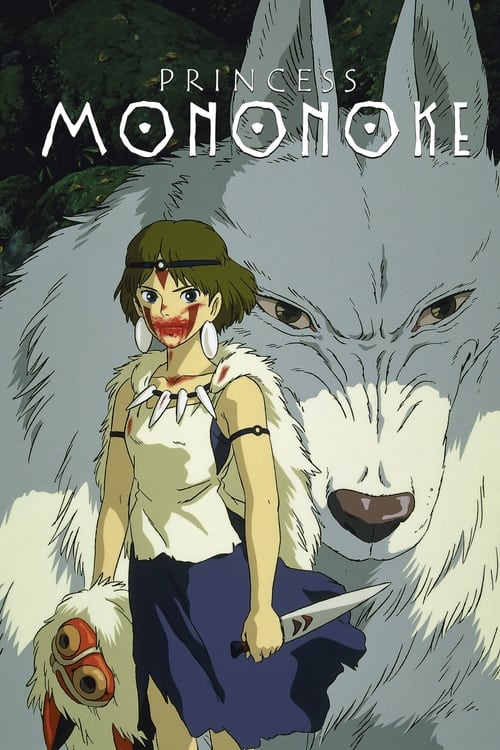
Princess Mononoke
1997 · Hayao Miyazaki
The Boy and the Heron's no-marketing release and second Oscar fueled the eternal "final film" watch, while his resurfaced "an insult to life itself" AI clip made him the patron saint of anti-AI-art sentiment. Ghibli-style AI image generation controversies keep him at the center of a fight he never asked to join.
When you want a full-blooded epic that takes you seriously — something vast, violent, and morally complicated to be swallowed by for two hours. Challenge more than comfort, though the beauty is its own reward.
What it's about
In a mythic late-medieval Japan, Ashitaka, a young prince cursed by a rampaging demon boar, rides west seeking a cure and lands in the middle of a war. On one side is Lady Eboshi's ironworks, a refuge for outcasts that is devouring the mountain; on the other, the forest gods and San, a girl raised by wolves who fights for them with feral devotion. Ashitaka, poisoned arm and all, tries to stand between two sides that both have justice on their side.
The experience
Epic and ferocious — battles are shockingly visceral for animation, the forest is genuinely eerie and sacred-feeling, and the moral weight never lets up because the film refuses to give you a villain to root against. It's awe and dread braided together, and it lingers.
The craft
Hayao Miyazaki at his most ambitious: Studio Ghibli's biggest production of its era, almost entirely hand-drawn with sparing digital assistance, and every frame of the forest, the ironworks, and the writhing curse itself is dense with detail. Joe Hisaishi's surging score and the film's monumental imagery make it one of animation's great big-screen experiences.
Why it matters
A domestic box-office phenomenon in Japan and a landmark that forced Western audiences to take animation seriously as adult, epic filmmaking — arguably the film that opened the world's door to Ghibli.
Snapshot
Princess Mononoke (Mononoke-hime) is Hayao Miyazaki's epic of ecological war, a period fantasy set in an mythologized late-medieval Japan where the industrializing human world and the animist world of the forest gods collide. Ashitaka, an exiled Emishi prince carrying a lethal curse, moves between two camps that the film refuses to sort into good and evil: San, the human girl raised by wolves who would die to protect the forest, and Lady Eboshi, whose ironworks shelters lepers and former prostitutes even as it consumes the mountain. Produced by Studio Ghibli at the largest scale the studio had yet attempted, the film married almost entirely hand-drawn animation to a limited but pointed use of digital tools. It became a landmark of Japanese cinema — a domestic box-office phenomenon on release — and, through its later English-language distribution, a decisive step in Ghibli's passage from national institution to global auteur brand. Its refusal of tidy moral resolution and its dense, blood-and-mud materiality distinguish it sharply from the gentler register of Miyazaki's children's films.
Industry & production
By the mid-1990s Studio Ghibli, founded in 1985 on the success of Nausicaä of the Valley of the Wind and consolidated through the 1980s and early 1990s, occupied a singular position: a prestige animation house whose feature films were reliably among the top-grossing domestic releases each year, distributed through the Tokuma Shoten group with which Ghibli was affiliated. Princess Mononoke was mounted as the studio's most ambitious and most expensive production to date, a fact reflected in its long gestation, its very high cel count, and its epic 133-minute running time — unusually long for an animated feature.
Miyazaki had carried the Mononoke title and some of its imagery for years; image boards and an illustrated concept from around 1980 bear the name but describe a quite different story, closer to a beauty-and-the-beast fable. The 1997 film reused little beyond the title and a general fascination with a girl aligned with beasts. The realized project grew instead out of Miyazaki's long-running preoccupations with forests, iron, and the violence of civilization, threads also present in his 1983 illustrated book The Journey of Shuna and in the Nausicaä manga he continued through 1994.
On release the film became, at the time, the highest-grossing domestic film in Japanese box-office history, a record it held until Titanic arrived. Its international rollout was handled through Disney's arrangement with Tokuma, with Miramax managing the English-language release in North America. A widely repeated anecdote holds that when Miramax pressed for cuts, a Ghibli representative — the story usually names producer Toshio Suzuki — sent a katana with the message "No cuts"; the anecdote is well attested in interviews though its exact staging varies in the telling. The English version, released in 1999, was adapted by author Neil Gaiman and did modest theatrical business in the United States, but its cultural footprint — and the goodwill it built — helped set up the far larger crossover of Spirited Away a few years later.
Technology
Princess Mononoke sits at a hinge point between traditional cel animation and the digital era. The overwhelming majority of the film was drawn and painted by hand in the classical Ghibli manner. Miyazaki has often been cited as personally checking and retouching an enormous number of drawings; the figure of roughly 80,000 cels corrected by his own hand is frequently repeated, and while such counts should be treated as illustrative rather than audited, they reflect a genuine and famous degree of hands-on supervision.
The film also incorporated a modest amount of computer-assisted work — on the order of a few minutes of screen time — for effects that were impractical to achieve by hand: the writhing, tentacular curse-flesh of the demonized boar god; certain morphing and dissolving transformations of the Forest Spirit; digital compositing and ink-and-paint on selected shots; and some texture and color blending. This was among Ghibli's earliest sustained uses of digital compositing, and it prefigured the more integrated digital pipelines the studio would adopt on later films. Crucially, the technology is deployed to serve a hand-drawn aesthetic rather than to announce itself; the CGI is folded into the painterly surface so that the seam is deliberately hard to find.
Technique
Cinematography
As an animated film, Princess Mononoke has no photographed camera, but its "cinematography" — the design of framing, layout, and virtual camera movement — is central to its authority. Miyazaki, who did extensive layout and storyboard (e-konte) work himself, favors composed, often stately shots that give the widescreen frame room to breathe. The film is celebrated for its use of ma, the charged pause or interval: moments of stillness where nothing "happens," a character simply sits, water drips, or a landscape holds, before the drama resumes. Against this stillness the action sequences are staged with sudden kinetic violence — arrows severing limbs, animals surging in mass. Background art by Ghibli's art department renders the ancient forest with a dense, luminous naturalism, and the layered depth of the mountain landscapes recalls the multiplane traditions of hand-drawn animation while using compositing to extend them.
Editing
Editing was handled by Takeshi Seyama, a longtime Ghibli collaborator. The cutting supports Miyazaki's rhythmic contrast between contemplative stillness and eruptive action: long-held establishing views and unhurried character beats are set against tightly cut battle and chase passages. The film's considerable length is managed through this modulation, allowing the epic scope to register without the momentum flagging.
Mise-en-scène / staging
The film's constructed world is unusually materially specific. The Tatara ironworks — the bellows-driven foundry at the heart of Eboshi's settlement — is depicted with attention to labor, machinery, and social organization: women working the great foot-bellows, ox-drivers hauling rice and iron, lepers manufacturing firearms. This granular attention to the means of production grounds the fantasy in a plausible political economy and gives the environmental conflict its moral weight, since the forest is being destroyed by people with understandable reasons. Costume, weaponry, architecture, and the physiognomy of the animal gods are all rendered with an ethnographic seriousness that separates the film from generic medievalism.
Sound
Joe Hisaishi, Miyazaki's regular composer since Nausicaä, provided the orchestral score, one of his most expansive and often thunderously symphonic. The main theme is stately and elegiac; the title song "Mononoke Hime" is performed by a countertenor voice, a choice that lends it an eerie, otherworldly quality suited to the film's numinous register. The sound design gives physical presence to the forest — insects, water, the shifting of the Kodama tree spirits, the guttural presence of the great beasts. The demonic curse is signified sonically as well as visually. Sound and score together carry much of the film's sense of the sacred and the doomed.
Performance
In the original Japanese, the voice cast includes Yōji Matsuda as Ashitaka, Yuriko Ishida as San, and Yūko Tanaka as Lady Eboshi, with Kaoru Kobayashi as the wily monk-mercenary Jigo. The performances are pitched toward restraint and gravity rather than the broad expressivity common in commercial animation, matching the film's adult seriousness. The 1999 English dub — adapted by Neil Gaiman — assembled a notable cast including Billy Crudup as Ashitaka, Claire Danes as San, Minnie Driver as Eboshi, Billy Bob Thornton as Jigo, and Gillian Anderson as the wolf god Moro. Gaiman's adaptation is generally credited with working hard to preserve the film's ambiguity and its unfamiliar cultural and religious concepts rather than domesticating them.
Narrative & dramatic mode
The film's dramatic mode is tragic epic rather than the coming-of-age adventure its premise might suggest. Ashitaka is a classic outsider-mediator: cursed, exiled, and therefore unaligned, he moves between the warring parties trying to "see with eyes unclouded by hate." But the film denies him — and the audience — the satisfaction of a resolution in which the right side wins. The structure is dialectical: nearly every faction has a legitimate claim, and the climactic catastrophe is precipitated by the collision of these claims rather than by a single villain's scheme. Death, mutilation, and irreversible loss are shown plainly. The ending offers a chastened, conditional hope — the possibility of coexistence and regrowth — but not a restoration of what was destroyed. This willingness to sit inside irresolvable conflict is the film's most distinctive dramaturgical feature.
Genre & cycle
Princess Mononoke fuses several genres: the historical period film (jidaigeki), high fantasy, and the ecological allegory. It belongs to a cycle within Miyazaki's own work — running from the Nausicaä film and manga through to later films — that treats the relationship between technological civilization and the natural world as a central and unresolved problem. Within animation it stands as a landmark of "adult" animated cinema, insisting that the medium can carry violence, moral complexity, and philosophical weight without the reassurances of the family film. It also participates in a broader Japanese cultural cycle of works reimagining the archaic, pre-modern past — the age of iron, the Emishi, the animist gods — as a lens on modern anxieties.
Authorship & method
The film is unmistakably an auteur work: Miyazaki wrote, directed, and drove its visual design, and his habit of deep hands-on involvement in layout and drawing correction is legendary. But it depended on an exceptional core of collaborators. Producer Toshio Suzuki managed the studio's business and public strategy. Composer Joe Hisaishi supplied the score in a partnership that had by then become one of the defining director-composer relationships in animation. Editor Takeshi Seyama shaped its rhythm.
The animation leadership was central: the film's supervising animators and key animators included figures such as Masashi Ando and Kitarō Kōsaka, and the beloved animator and director Yoshifumi Kondō, whom Miyazaki regarded as a likely successor and whose death in 1998, not long after the film, was a serious loss to the studio. The art and background departments — a hallmark of Ghibli — rendered the forest world with the painterly richness for which the studio is known. Neil Gaiman's English-language screenplay adaptation constitutes a distinct authorial contribution to the film's international life.
Movement / national cinema
The film is a monument of Japanese national cinema and of the specific institution of Studio Ghibli, which by 1997 functioned almost as a movement unto itself — a house style, a set of recurring themes, and a level of craft that set the benchmark for feature animation in Japan. It draws deeply on indigenous religious and folkloric material: Shinto animism, the kami who inhabit natural things, the idea of the mountain and forest as sacred and inhabited. The setting among the Emishi and in the Muromachi-era iron country situates it within a national conversation about Japan's own pre-modern history and the peoples and practices marginalized by the standard historical narrative. At the same time, its themes and craft made it exportable, and it became one of the vehicles through which anime's artistic seriousness was recognized abroad.
Era / period
The film is set in a mythologized version of Japan's Muromachi period, an age of iron manufacture, firearms, and encroaching state power — a moment when older ways of life and belief were under pressure from a consolidating, technologizing civilization. Miyazaki uses this transitional setting deliberately: it is the hinge at which the animist forest world and the human industrial world can still meet and fight. Produced in the mid-1990s, the film also reflects the environmental anxieties of its own era, though it resists reduction to any single contemporary allegory, keeping its conflict rooted in a specific imagined past.
Themes
The film's governing theme is the war between nature and human civilization, staged without a villain. Nature is not idyllic — the gods are proud, violent, and capable of curse-bearing hatred — and civilization is not simply rapacious, since Eboshi's iron town is also a refuge for society's outcasts. Related themes cluster around this core: hatred and the way it demonizes and consumes (literalized in the curse that spreads through the body); the moral cost of progress; the ambiguity of all parties; and the possibility, however fragile, of coexistence. Shinto animism supplies the film's metaphysics — a world thick with spirit, where the Forest Spirit gives and takes life. San embodies the impossibility of a clean human/nature reconciliation: she is human but will not rejoin humanity, and the film honors rather than resolves that impasse. Disease, disability, and social marginality are treated with unusual directness for the medium.
Reception, canon & influence
Princess Mononoke was a major critical and commercial event in Japan, becoming the highest-grossing domestic film there at the time of its release and confirming Miyazaki's standing as the country's preeminent filmmaker in any medium. Internationally, its 1999 English release earned strong reviews and admiration for its ambition and moral complexity, even as its box office remained modest relative to its stature; the exact commercial figures for that release are not something I can state precisely, and the film's foreign impact is better measured in influence than in receipts.
Backward, the film draws on Japanese folklore and religion, on the jidaigeki tradition of the historical epic, and on Miyazaki's own earlier work — the ecological vision of Nausicaä, the imagery of The Journey of Shuna with its elk-mount and life-giving forest deity. Its debt is less to any single prior film than to a synthesis of literary, folkloric, and religious sources filtered through Miyazaki's long-developing personal cosmology.
Forward, its legacy is substantial. It expanded the perceived range of what animated cinema could address, demonstrating that a hand-drawn feature could carry tragic weight, graphic violence, and unresolved moral argument for an adult audience. It significantly advanced Studio Ghibli's international reputation and helped pave the way for the global breakthrough of Spirited Away, which would win the Academy Award for Best Animated Feature. It has become a fixture in the canon of animated film and is routinely cited among the medium's greatest works. Its ecological seriousness and its refusal of simple heroes and villains have influenced later animation and fantasy that aspire to comparable moral complexity. Within Miyazaki's own career it stands as the fullest statement of the nature-versus-civilization theme he would continue to explore, and as one of the defining achievements of Japanese animation.
A Deleuzian reading
A boar the size of a barn comes out of the treeline wearing worms.
The full Deleuzian reading of Princess Mononoke →
Reception
It briefly became the highest-grossing film ever in Japan in 1997 — a genuine national event — but its 1999 Miramax release in the US barely registered at the box office. Now it's arguably the consensus pick for Miyazaki's masterpiece and a fixture near the top of every animation canon.
How Princess Mononoke was received, from release to now →
How to watch Princess Mononoke: what to notice on a first viewing
- Watch the stain spreading on Ashitaka's right forearm. The mark darkens and creeps as the film goes on, and Ashitaka keeps checking it, hiding it, testing what it lets him do. It is a clock and a compass at once, forcing him to act without ever letting him fully choose a side.
- Notice how often Miyazaki simply holds a shot doing nothing. Water drips, someone sits, a landscape is held still, and only then does the drama resume, cut against sudden bursts of violence. The stillness is not filler; it is what makes the eruptions of violence land as hard as they do.
- Watch the women working the ironworks bellows. Their rhythm, the ox-drivers hauling iron, the bandaged lepers assembling firearms, all render Tatara as a working economy rather than a backdrop. You see how the town eats, which is why the people destroying the forest cannot be dismissed as villains.
- Listen for the countertenor voice singing the title song. Hisaishi's score is otherwise thunderous and orchestral, elegiac in its main theme, but this one voice sounds unlike anything else in the mix. The strange register of that voice announces the film's world as sacred and not fully human-scaled.
The whole guide to watching Princess Mononoke, with the keys for a rewatch →
Influences: the films it descends from and the films it influenced
- Nausicaä of the Valley of the Wind (1984) — Establishes the same wide-vista aerial layout language and the ambivalent forest-toxin ecosystem staging that Mononoke rebuilds as the Deer God's forest, with an identical female-warrior-astride-flying-mount blocking.
- The Journey of Shuna (illustrated novel) (1983) — Miyazaki's own watercolor picture-book supplies the elk-mount design, the golden grain-quest, and the life-giving forest deity later transposed directly into Ashitaka's yakul and the Shishigami.
- Seven Samurai (1954) — The jidaigeki template of massed peasant-vs-force set-pieces, mud-and-iron village geography, and telephoto flattening of moving crowds is restaged in Mononoke's Tatara ironworks siege choreography.
- Kwaidan (1964) — Its painterly, artificial folkloric landscapes and slow ma-driven dread of animist spirits model Mononoke's treatment of forest gods as materially present, uncanny presences rather than metaphor.
- Princess Iron Fan (1941) — Asia's first animated feature pioneers the folkloric fantasy epic in hand-drawn form and the elemental-spirit adversary that Miyazaki's tradition of feature-length mythic animation extends.
- Horus, Prince of the Sun (1968) — Toei's proto-Ghibli epic, on which Miyazaki did scene design, pioneers the community-defense narrative with morally ambiguous antagonists and large-scale layout that Mononoke inherits wholesale.
- Ran (1985) — Miyazaki assigns opposing forces a systematized color logic — warm industrial tones for the ironworks humans, cool organic tones for the forest spirits — and renders large-scale battle sequences through formalized visual design rather than conventional action editing, inheriting Ran's system for making the moral stakes of warfare legible through color information at the level of production design.
- Dreams (1990) — Extends the animist-Shinto ecological cinema of 'Village of the Watermills' and 'The Peach Orchard' — forest kami, water-wheels, and an imagined non-industrial modernity rendered with the same reverence for landscape spirit.
- Spirited Away (2001) — Extends Mononoke's Shinto-animist bestiary and the polluted river-god purification set-piece, deepening the digital-compositing-over-cel workflow the earlier film first integrated at scale.
- Wolf Children (2012) — Carries forward the human/wolf-spirit hybrid identity and the rural-nature reverence, rendered with Ghibli-descended layout and Miyazaki-style multiplane forest depth.
- The Tale of the Princess Kaguya (2013) — Advances Mononoke's animist folklore into a brushstroke aesthetic while keeping the tragic-epic register and the theme of an earthly world too corrupted for its divine visitor.
- Avatar (2009) — Openly borrows Mononoke's sentient bioluminescent forest network, the arrow-and-mount ecological insurgency, and the mining-corporation-vs-nature dialectic as a live-action/CG epic.
- Nausicaä's successor Ōkami (as game influence excluded) — Ponyo (2008) — Reprises the Miyazaki nature-deity-in-revolt motif and the Hisaishi symphonic surge, distilling Mononoke's ocean/forest-god wrath into a gentler but structurally identical elemental-balance fable.
- Mind Game (2004) — Exemplifies the adult-animation seriousness Mononoke legitimized in Japan, using hand-drawn feature form to carry violence, mortality, and unresolved moral argument for grown audiences.
- The Red Turtle (2016) — A Ghibli-produced feature extending Mononoke's ma-pause pacing and dialogue-light communion with a mythic natural world where nature is an animate moral force.
- Wolfwalkers (2020) — Stages wild-versus-civilization as forest spirits against an industrial iron-town, and its wolf-raised girl San is the clear character template for feral Mebh and the wolfwalker pack.
- The Wild Robot (2024) — Hand-painted teeming ecosystems and the collision of industrial technology with a sentient forest model the film's dense wildlife staging and its tech-in-the-wild tension.
- When Marnie Was There (2014) — Supervising animator Masashi Ando, who co-directed Marnie's animation, brought here the same expressive restraint in facial acting — emotion legible in micro-shifts rather than broad cartoon gesture.
- Kubo and the Two Strings (2016) — Miyazaki's design of monumental nature-spirit deities and his fusion of folkloric awe with mortal grief shape Kubo's spirit-creatures and its refusal to soften death for a family audience.
- Weathering with You (2019) — Its humanist restoration of balance between nature and humanity is the exact resolution Weathering refuses; Shinkai's anti-cathartic 'let Tokyo drown' ending is a direct inversion of the Ghibli reconciliation.
- Castle in the Sky (1986) — Same Miyazaki/Hisaishi symphonic-leitmotif partnership and the ruin-in-nature staging, sharing the strong-boy-meets-fierce-girl dyad and industrial-catastrophe climax reworked into Mononoke's severed-god sequence.
- Pom Poko (1994) — The immediately preceding Ghibli film shares Mononoke's forest-vs-development dialectic and shape-shifting animist creatures, staged with the same refusal to grant either side a clean moral victory.
- Whisper of the Heart (1995) — Directed by Mononoke's presumptive Ghibli heir with the same supervising-animator team, sharing the studio's painterly background department and restrained, weight-bearing character acting.
- Warriors of the Wind (1984) — The mature restatement of Nausicaä's thesis — a girl mediating between vengeful nature-spirits and industrial humanity — with the Shishigami's toxic bloom echoing the Ohmu-swarm's golden-tendril climax.
- Howl's Moving Castle (2004) — Companion anti-war epic using Joe Hisaishi's leitmotif orchestration and densely detailed, layered painterly backgrounds to weight ecological/martial catastrophe with elegiac gravity.
- Ponyo (2008) — Extends the 'poisoned nature strikes back' theme — Ponyo's polluted, trawler-scarred ocean is the marine counterpart to Mononoke's despoiled forest, both framed as a moral reckoning delivered to children.
- Sword of the Stranger (2007) — A jidaigeki rendered as drawn animation where combat retains bodily consequence and momentum, sharing Ando's insistence on physical legibility over stylized abstraction.
Similar films
- Spirited Away (2001) — influence & lineage · same viewing thread · often watched together
- Castle in the Sky (1986) — influence & lineage · same viewing thread · often watched together
- The Tale of The Princess Kaguya (2013) — influence & lineage · same viewing thread
- Wolf Children (2012) — influence & lineage · same viewing thread
- Seven Samurai (1954) — influence & lineage
- My Neighbor Totoro (1988) — same viewing thread · often watched together
- Ponyo (2008) — same viewing thread · often watched together
- The Wind Rises (2013) — same viewing thread · often watched together
All the films related to Princess Mononoke →
Watch it with: curated runs of related films
- The Studio Ghibli Canon — A run through the whole hand-drawn shelf of Miyazaki and Takahata — start with the childhood-wonder crowd-pleasers and drift toward the studio's quieter, adult, more elegiac corners.