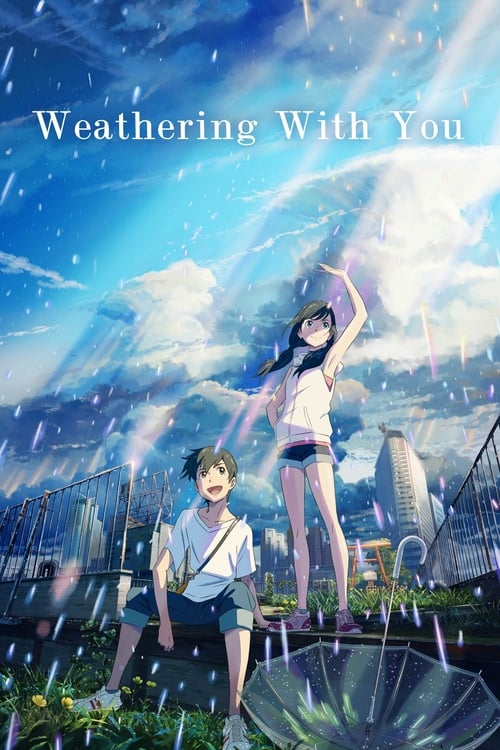
Weathering with You
2019 · Makoto Shinkai
Suzume completed his disaster-trilogy and cemented the "next Miyazaki" label he keeps rejecting; his global box office made anime's theatrical dominance a mainstream industry conversation.
For when you want to be swept up — a rainy-evening film for falling in love and feeling a little heartbroken at the same time. Comfort viewing on the surface, with a defiant streak that gives you something to argue about after.
What it's about
Sixteen-year-old Hodaka runs away from his island home to Tokyo, where it won't stop raining, and scrapes by writing for a shady occult magazine. Then he meets Hina, an orphaned girl with an impossible gift: when she prays, the sky clears. They turn her talent into a small business selling sunshine to a waterlogged city — but the weather, and her gift, have a price neither of them understands.
The experience
Gorgeous and rain-soaked, swinging between scrappy street-level comedy and huge, swooning emotion. It's a teenage romance played at the scale of the sky, and it builds to choices that feel genuinely risky rather than tidy.
The craft
Makoto Shinkai's animation of weather is astonishing: individual raindrops, sun breaking through cloud, Tokyo rendered in obsessive, glowing detail. With songs by Radwimps woven through the story, it's built for the biggest, brightest screen and the best sound you can give it.
Why it matters
As the follow-up to one of the biggest animated hits ever made in Japan, it confirmed Shinkai as anime's defining romantic voice and became a touchstone for how popular cinema talks about a changing climate.
Snapshot
Weathering with You (Japanese title Tenki no Ko, literally "Child of Weather") is Makoto Shinkai's follow-up to the record-shattering Your Name (2016), and it arrives self-consciously in that film's shadow. A teenage runaway, Hodaka, drifts into a rain-drowned Tokyo and falls in with Hina, a "sunshine girl" who can clear the sky by prayer — a gift that, the film discloses, exacts a bodily price. Out of that premise Shinkai builds a work that is at once a lushly animated adolescent romance and a fable about climate, sacrifice, and the refusal to sacrifice. Where Your Name engineered a cosmic reconciliation, Weathering with You ends on a deliberately unreconciled note: the boy chooses the girl over the world, and Tokyo is left partly submerged. It is a major commercial film — a Toho tentpole, Japan's official Oscar submission — that nonetheless courts moral discomfort, and that tension is its defining feature.
Industry & production
The film was produced by CoMix Wave Films, the boutique studio that has housed Shinkai's work since the mid-2000s, with the powerful backing of a production committee assembled and led by Toho — Japan's dominant distributor and the company that had turned Your Name into a phenomenon. Producer Genki Kawamura, a central architect of the Your Name rollout, returned. That continuity of personnel and capital matters: Weathering with You was conceived and financed explicitly as the "next Shinkai film," with the marketing weight of a guaranteed event release rather than the slow word-of-mouth builds of his earlier career.
It opened in Japan on 19 July 2019 and became one of the year's biggest domestic hits, reported to have earned well over ¥14 billion at the Japanese box office — a figure that placed it among the top-grossing films of the year in Japan, though below the extraordinary heights of its predecessor. Japan selected it as its entry for the Academy Award for Best International Feature Film, an unusual honor for a piece of commercial animation (it was not ultimately nominated). International distribution was handled through GKIDS in North America and various partners elsewhere, following the template that had by then normalized theatrical anime abroad. The production is a useful marker of anime's turn-of-the-decade economics: a director-auteur brand, a major-studio committee, and simultaneous ambitions toward blockbuster returns and festival-and-awards prestige.
Technology
Weathering with You is a digital production built on a hybrid pipeline that has become Shinkai's signature: hand-drawn or digitally hand-painted 2D character animation composited over extraordinarily dense, photo-referenced digital backgrounds, with selective 3DCG for vehicles, crowds, and complex camera moves. The film's defining technical problem is water — rain in every register, from drizzle to deluge to the fantastical fish-shaped water-creatures of the sky. Rain is rendered as layered particle and effects animation, motion-blurred and composited with lens-flare, bokeh, and refraction passes that mimic the behavior of a physical camera lens. This "photographic" digital compositing — treating the frame as though shot through glass, with light blooming and scattering — is the studio's most recognizable technological fingerprint. Precise proprietary-versus-commercial tool breakdowns are not fully documented in the public record, but the workflow sits within the standard contemporary anime toolset (digital compositing suites layered over 2D and 3D animation software). The film was finished and exhibited digitally, with IMAX and premium large-format presentations part of its release.
Technique
Cinematography
Shinkai's virtual camera is the film's most immediately legible authorial trait. The "cinematography" here is entirely constructed — there is no lens — yet it insistently imitates one: shallow focus, racking focus, anamorphic-style flares, dust and water on an implied lens, and a bright, high-saturation palette that pushes skies toward jewel tones. Compositions favor the sublime scale of Tokyo — establishing tableaux of rooftops, rail lines, and neon under weather — intercut with intimate close framing of the two leads. The camera frequently ascends: prayer, flight, and the vertical axis between street and sky organize the visual grammar, culminating in Hina's ascent into the cloudscape. The result is a "hyper-real" image that is simultaneously more detailed and more idealized than photography.
Editing
Shinkai has historically cut his own films, and the editing bears his rhythmic hallmarks: rapid montage sequences — often set to full RADWIMPS songs — that compress time and interiority, alternating with sustained, quiet held shots. The song-montage functions almost as a structural unit, an emotional accelerant borrowed from the music-video and the J-pop tie-in tradition; several sequences operate as effectively self-contained musical set-pieces. The cross-cutting climax, intercutting Hodaka's desperate pursuit with the collapsing supernatural weather, is the film's most conventionally kinetic passage. Where Your Name used editing to sustain an elaborate time-and-body-swap puzzle, Weathering with You is comparatively linear, its cutting weighted toward lyricism over plot mechanics.
Mise-en-scène / staging
The film is fanatically attentive to a real, recognizable Tokyo — Shinjuku, Ikebukuro, the rooftops and back alleys and rail infrastructure of the actual city, rendered with near-topographic fidelity and then bent by weather. The dilapidated occult-magazine office of Hodaka's employer Suga, the rooftop shrine, the love hotel, the McDonald's-like fast-food restaurant: these lived-in, specific spaces ground the fantasy in a grubby, precarious urban realism (Hodaka's poverty, gun subplot, and brushes with exploitation give the film a harder social edge than its predecessor). Weather itself is the master element of the staging — light, wetness, and sky are dramaturgical, not decorative, tracking the characters' fortunes.
Sound
Sound design leans heavily on water and city ambience — the omnipresent texture of rain is as much a character as any human — set against the pop-orchestral songs. The interplay of naturalistic soundscape and highly produced music is characteristic. Specific technical credits for the sound team are less prominent in the international record than the music credits, and I won't invent them.
Performance
The film was cast with relative newcomers rather than star seiyū: Kotaro Daigo voices Hodaka and Nana Mori voices Hina, both young performers chosen partly for freshness and naturalism. Supporting voices include established actor Shun Oguri as the world-weary Suga and Tsubasa Honda as his colleague Natsumi. The vocal performances favor understatement and adolescent hesitancy over the broad theatricality of much commercial anime — consistent with Shinkai's pursuit of an intimate, everyday register.
Narrative & dramatic mode
The film's mode is romantic melodrama fused with modern fantasy fable. Its engine is a bargain: Hina's power to clear the sky draws on her own life force, and the mythology positions her as a potential human sacrifice whose death would restore meteorological order to Tokyo. The dramatic question is therefore explicitly ethical — will the world be balanced at the cost of a girl, and should it be? Shinkai stages a genuine reversal of the sacrificial-heroine convention: Hodaka refuses the trade, chooses love over civic salvation, and the film endorses him even as Tokyo floods. The closing movement is notably anti-cathartic — no restored order, only two young people asserting that they chose each other and must live with it. This willingness to leave the moral ledger open is what most distinguishes the film's dramaturgy from the tidier reconciliations of mainstream fantasy romance.
Genre & cycle
Weathering with You sits at the intersection of several cycles: the anime teen romance (seishun / coming-of-age), the supernatural "power-girl" fantasy, and — increasingly — the climate-anxiety film. It belongs recognizably to a Shinkai cycle of yearning-across-distance romances, and it forms an informal loose trilogy with Your Name (2016) and the later Suzume (2022), each pairing a young protagonist with a supernatural disruption of the natural or spatial order and each threading in disaster imagery that resonates with post-3.11 Japan. Cameo appearances by Taki and Mitsuha from Your Name make the shared-world lineage literal. Within the broader tradition it converses with Studio Ghibli's ecological fables while pointedly diverging from Ghibli's typical humanism: Shinkai's protagonist lets the world drown.
Authorship & method
Shinkai is a near-total author here — writer, director, and, in his customary practice, editor — extending a career built on singular control (his early works were famously near-solo productions). His method by 2019 was to marry that authorial vision to a full studio apparatus while retaining the emotional signature of the early shorts: weather, distance, longing, the poetry of ordinary infrastructure.
The key collaborators are by now a stable ensemble. Music is by RADWIMPS (led by Yojiro Noda), returning from Your Name; the band's songs — including "Is There Still Anything That Love Can Do?" and "Grand Escape" (the latter featuring vocalist Toko Miura) — are structurally integral, not incidental, and the collaboration is central to Shinkai's late style. Character designs are by Masayoshi Tanaka, and animation direction by Atsushi Tamura, both continuing from Your Name and giving the two films a visual family resemblance. Background art and photographic (compositing) direction are handled by CoMix Wave's art department; individual department-head names are documented in the film's credits but are less consistently reported in English-language sources, and I'd rather flag that than misattribute a role. Producer Genki Kawamura again shaped the project's development and positioning. The through-line is a director who functions as both intimate poet and franchise brand.
Movement / national cinema
The film is a landmark of contemporary Japanese commercial animation and of the specific phenomenon of Shinkai as the industry's most bankable auteur after Hayao Miyazaki. It belongs to no formal "movement" but to a national-cinema moment in which anime became Japan's leading theatrical export-and-prestige form. Its DNA is thoroughly Japanese — the meteorological folklore of weather-maidens and sky-prayer, the specific geography of Tokyo, and the shadow of natural catastrophe that has haunted Japanese popular culture since the 2011 Tōhoku earthquake, tsunami, and Fukushima disaster. That post-3.11 sensibility — cities imagined as vulnerable to sudden, total inundation — is the national-cinematic bedrock beneath the fantasy.
Era / period
Weathering with You is a document of the late 2010s: a film explicitly about climate and weather made as global climate anxiety was cresting, and about precarity — youth homelessness, gig labor, the informal economy — in an era of visible economic insecurity for the young. Technologically it belongs to the mature digital-anime era, when photo-real background compositing and pop-song montage had become the dominant commercial idiom. Industrially it belongs to the brief window when a single anime feature could plausibly aim at both the domestic megahit and the international-prestige circuit at once.
Themes
The film's central theme is sacrifice and its refusal — the moral scandal of choosing one beloved life over the collective good, and the film's startling endorsement of that choice. Around it cluster: weather as emotion and fate, the pathetic fallacy literalized into plot; climate and the human relationship to a disordered nature, with the flooding of Tokyo read as both catastrophe and a chastened return to an older, watery state (the film gestures at the idea that the city was reclaiming land that was always the sea's); adolescent agency and precarity, the runaway and the orphan carving out survival at society's margins; and the tension between individual love and social order. Its final posture — "we chose this, and we'll live" — reframes what might be selfishness as a defiant assertion of the right of the young to their own lives against a world that would spend them.
Reception, canon & influence
Critically, the film was received warmly but with more division than Your Name. Reviewers widely praised its animation — routinely called among the most beautiful in contemporary features — and the ambition and moral daring of its ending, while some found its narrative looser, its wish-fulfillment more strained, and its product-placement-laden realism uneven. The provocative climax was itself a critical talking point: admired by many as a bracing inversion of sacrificial cliché, faulted by others as glib. Commercially it was a decisive success and a validation that Shinkai's audience was durable rather than a one-film fluke; Japan's selection of it for the Academy Awards signaled institutional esteem.
Influences on the film (backward): it draws on the Japanese folkloric figure of the weather-maiden and sky-prayer traditions; on the ecological-fable lineage most associated with Studio Ghibli (while defining itself against Ghibli's humanist resolutions); on the post-3.11 disaster imaginary in Japanese cinema; and, self-referentially, on Shinkai's own body of work — the distance-lovers of Voices of a Distant Star and 5 Centimeters per Second and the body-and-fate mechanics of Your Name. The RADWIMPS-driven song-montage structure extends a J-pop-tie-in tradition long native to anime.
Legacy (forward): the film consolidated the "Shinkai formula" — real-city photorealism, weather-as-feeling, band-scored montage, supernatural-tinged teen romance — as an influential and much-imitated template in commercial anime, and confirmed the director as a franchise-scale brand. It completed the thematic bridge to Suzume (2022), with which it forms a loose disaster-romance trilogy, deepening Shinkai's engagement with catastrophe and place. More broadly it stands as one of the emblematic "climate-anxiety" films of its moment and part of the wave that normalized big-canvas anime as global theatrical event cinema. Its longer canonical standing is still settling — it is generally regarded as a strong, divisive successor rather than an unqualified peak — and it would be premature to fix its final place with more certainty than the record yet supports.
A Deleuzian reading
Watch the rain long enough and you start noticing the drops on the glass.
The full Deleuzian reading of Weathering with You →
Reception
Landed in 2019 with impossible expectations — the follow-up to Your Name, the biggest anime hit ever — and was received as 'gorgeous, but is it just Your Name again?' It's since been reappraised as the bolder, thornier film: messier, more romantic about defiance, and the one Shinkai defenders now argue is secretly his most interesting.
How Weathering with You was received, from release to now →
How to watch Weathering with You: what to notice on a first viewing
- Watch the rain gather on a lens that isn't there. Every frame is painted, yet Shinkai builds in shallow focus, rack focus, flares, and water droplets as if a real camera stood in the rain with the characters. The city feels witnessed, not drawn, because the film insists someone is standing there filming it.
- Watch the color of the sky when Hina prays. She clasps her hands, closes her eyes, and goes still, and a saturated blue drops over the whole frame as the clouds shear open above her. One color change carries the whole feeling of the scene without a word of dialogue.
- Notice how little effort her stillness takes. She never strains or gestures like she's working. She just stops, and the sky does everything, cloud breaking open and light dropping onto wet roofs around her. Something is happening to her, and the film shows it by showing you the sky instead of her face.
- Notice how real the streets look before the rain bends them. Shinjuku, Ikebukuro, and the city's rooftops and rail lines are drawn with near-topographic fidelity, ordinary and specific, before weather reshapes what you're looking at. The fantasy only works because the city underneath it is drawn like a place that actually exists.
- Notice when a full song takes over the editing. Shinkai cuts rapid montages to complete RADWIMPS songs, compressing time and feeling the way a music video does, not just underscoring a scene but structuring it. For minutes at a time, the song is doing the storytelling, not the images alone.
The whole guide to watching Weathering with You, with the keys for a rewatch →
Influences: the films it descends from and the films it influenced
- Your Name (2016) — Established the template Weathering reuses wholesale: RADWIMPS songs as load-bearing structural montage rather than score, Masayoshi Tanaka character designs over CoMix Wave photoreal backgrounds, and a climax built on crosscutting two separated bodies toward a single convergent instant.
- 5 Centimeters per Second (2007) — Perfected the pop-ballad song-montage finale (Masayoshi Yamazaki's 'One More Time, One More Chance') and the distance-lovers structure where cutting rhythm and lyric drive the emotional climax instead of dialogue.
- The Garden of Words (2013) — Developed the hyper-detailed rain compositing and layered rain-ambience sound design — individual droplet highlights, puddle refraction, Shinjuku Gyoen mapped to real topography — that Weathering scales up into weather-as-dramaturgy.
- Voices of a Distant Star (2002) — His near-solo desktop production that fixed the single-author digital-compositing method — lens flare, bloom, and light diffusion applied by the director himself — later industrialized in the studio work.
- Nausicaä of the Valley of the Wind (1984) — Set the ecological-fable grammar — a young protagonist mediating between humanity and an angry natural order — that Weathering inherits as genre scaffolding for its climate-anxiety premise.
- Princess Mononoke (1997) — Its humanist restoration of balance between nature and humanity is the exact resolution Weathering refuses; Shinkai's anti-cathartic 'let Tokyo drown' ending is a direct inversion of the Ghibli reconciliation.
- Ghost in the Shell (1995) — Pioneered the 2D-cel-over-3DCG digital compositing of a rain-soaked, vertically layered cityscape — the technical lineage behind Shinkai's photoreal Tokyo built from hand-painted planes and CG camera moves.
- Blade Runner (1982) — The anamorphic lens-flare and neon-refracted-on-wet-asphalt palette that Shinkai's flare-compositing and high-saturation night-rain Tokyo openly quote.
- Millennium Actress (2001) — Its match-cut montage collapsing distinct times and places into one continuous emotional line is the editing ancestor of Shinkai's climactic crosscutting between separated characters.
- Tokyo Godfathers (2003) — Used precise, recognizable Tokyo geography and a single weather event (snowfall) as the engine of coincidence and plot — the topographic-Tokyo-plus-weather dramaturgy Shinkai adopts.
- I Want to Eat Your Pancreas (2018) — Extends the post-Your-Name template of literary youth romance sold on a band's tie-in songs and weather-as-emotion color coding, riding the same late-2010s exportable anime-melodrama market Pancreas helped prove.
- The Girl Who Leapt Through Time (2006) — Extends the wide-sky weather compositions and the irreversibility-versus-choice climax, again scoring the emotional turn to a recurring pop motif.
- Suzume (2022) — Completes the post-3.11 disaster-romance trilogy, extending weather-and-place-as-dramaturgy into seismic catastrophe while carrying forward the refusal-of-fate and band-scored montage structure.
- Hello World (2019) — Rode the post-Your Name wave by fusing photoreal-city backgrounds, aggressive 3DCG camera, and teen SF-romance fate-mechanics — the Shinkai template applied to a full-CG production.
- Bubble (2022) — Extends the formula into a weather-transformed (flooded, gravity-warped) photoreal Tokyo scored around a pop centerpiece, foregrounding water and cityscape as the same expressive material Shinkai uses.
- Cosmic Princess Kaguya! (2026) — Pushed volumetric god-rays and rain-refracted light as emotional weather, the layered digital-light compositing Yamashita borrows for celestial-beam sequences.
- Children Who Chase Lost Voices (2011) — His explicit Ghibli-eco-fable experiment — a trial run at marrying supernatural-folkloric world-mythos to his compositing style, the bridge between solo shorts and the Weathering formula.
- A Silent Voice (2016) — KyoAni's contemporaneous teen realism using shallow-focus bokeh, lens-flare light bleed, and newcomer-cast naturalism over photoreal municipal locations — parallel craft to Shinkai's without the supernatural turn.
- Belle (2021) — Builds emotional climaxes on the 2D-character-over-3DCG-world hybrid and a full song performance as narrative peak — a parallel deployment of the band-scored, CG-hybrid spectacle mode Shinkai normalized for global theatrical anime.
- Violet Evergarden: The Movie (2020) — Contemporary showcase of water-and-glass light cinematography — rain, reflection and volumetric sun — the same photographic register Violet's compositions pursue in the same era.
- 18x2 Beyond Youthful Days (2024) — Extends the marquee pop-song collaboration (RADWIMPS) as a headline selling point fused to weather-and-landscape-as-emotion, the same craft package 18x2 assembles around Mr. Children.
- Maquia: When the Promised Flower Blooms (2018) — A post-Your Name original-auteur fantasy feature betting on emotional maximalism and lavish weather/lighting spectacle in the same original-IP theatrical lane Maquia argues for.
Similar films
- Your Name. (2016) — influence & lineage
- Suzume (2022) — influence & lineage
- I Want to Eat Your Pancreas (2018) — often watched together
- In This Corner of the World (2016) — often watched together
- Kiki's Delivery Service (1989) — shared sensibility
- The Boy and the Heron (2023) — shared sensibility
- The Wind Rises (2013) — shared sensibility
- Spirited Away (2001) — shared sensibility