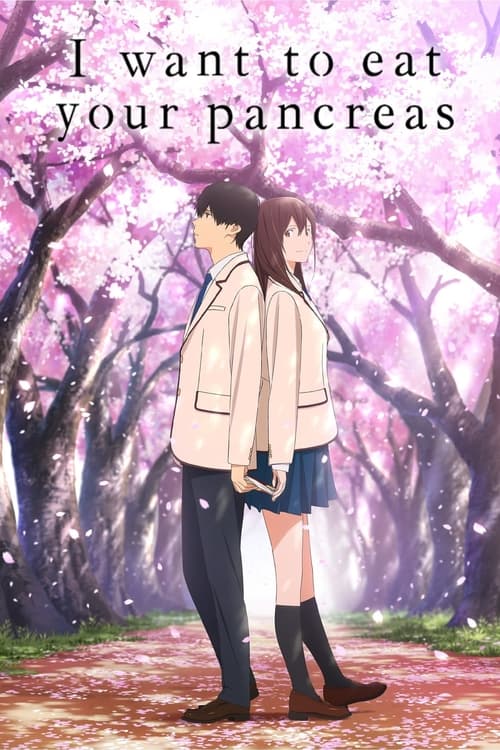
I Want to Eat Your Pancreas
2018 · Shinichiro Ushijima
For when you need a good cry — the cathartic kind that leaves you grateful rather than wrecked. A film for a quiet solo night when you want to feel your feelings all the way through.
What it's about
A withdrawn high schooler who keeps everyone at arm's length accidentally discovers a classmate's secret: Sakura, the most sociable girl in school, has a terminal pancreatic illness, and he's the only one outside her family who knows. She drafts him into helping her live out her ordinary-extraordinary wish list, and an unlikely companionship grows between a boy who's never needed anyone and a girl running out of time. The unsettling title resolves into something tender: an old folk saying about wanting to carry part of another person with you.
The experience
Warm, funny, and quietly devastating — it earns its tears rather than demanding them, spending most of its runtime on banter, day trips, and the strange intimacy of a shared secret. Bring tissues; it's a gut-punch delivered gently.
The craft
Studio VOLN's animation gives everyday Japan — classrooms, train platforms, cherry blossoms — a soft, luminous glow that makes ordinary days feel precious, which is exactly the film's point. The adaptation trusts stillness and conversation over melodrama, letting the title's strange promise gather meaning as it goes.
Why it matters
Part of the wave that brought literary anime tearjerkers to international audiences, adapting one of Japan's biggest recent YA novels and cementing the terminal-illness romance as a genre that travels.
Snapshot
I Want to Eat Your Pancreas (君の膵臓をたべたい, Kimi no Suizō wo Tabetai) is a feature-length animated adaptation of Yoru Sumino's 2015 debut novel, directed by Shinichiro Ushijima and produced by Studio VOLN. Released in Japanese cinemas on September 1, 2018, it belongs to a lineage of literary teen melodramas — the terminal-illness romance, or jun'ai/"pure love" tearjerker — that has been a durable commercial staple of Japanese cinema and publishing for decades. The film's most immediately arresting feature is its title, which reads as horror but resolves into two intertwined meanings within the story: a folk belief that eating a diseased organ heals the corresponding organ in oneself, and, more importantly, a metaphor for wanting to absorb and be permanently part of another person. That gap between shocking surface and tender interior is, in miniature, the film's whole strategy. The narrative follows an unnamed, deliberately withdrawn high-school boy (his namelessness is a formal device retained from the novel) who accidentally discovers a hospital "living with dying" journal belonging to his vivacious classmate Sakura Yamauchi, learning that she has a terminal pancreatic disease known only to her family. Their subsequent secret companionship structures the film. It arrived notably as the second screen adaptation of the same novel, following a 2017 live-action version, which shapes how it should be read industrially and critically.
Industry & production
The film sits at the intersection of two robust Japanese commercial engines: the light-novel/bestseller adaptation pipeline and the theatrical anime melodrama that Makoto Shinkai's Your Name (2016) had recently supercharged commercially. Sumino's novel, published by Futabasha in 2015, was a substantial bestseller, and its intellectual property was exploited across media in short order — a manga serialization, the 2017 live-action feature directed by Sho Tsukikawa (starring Takumi Kitamura and Minami Hamabe), and this animated feature. That the property earned two distinct theatrical adaptations within roughly a year is itself a marker of its commercial value and of a market confident that animation and live action address overlapping but non-identical audiences.
Production was handled by Studio VOLN, a comparatively young studio then best known for the television series Ushio and Tora and Karakuri Circus. A delicate, dialogue-driven romantic drama represents a marked tonal departure from that action-genre catalog, and the film is often read as VOLN demonstrating range. Precise budget and definitive box-office figures are not something I can state reliably from memory, so I will not invent them; the film is generally understood to have performed respectably in its domestic theatrical window and to have found a substantial afterlife internationally through festival play, subtitled/dubbed home releases, and licensing (Aniplex of America handled the North American theatrical and home-video rollout, with a limited U.S. release in early 2019). The broader industrial context matters: by 2018, distributors had clear evidence that a well-marketed, emotionally direct anime feature aimed at teenagers and young adults could travel beyond the traditional otaku market into general and international arthouse audiences.
Technology
The film is a work of contemporary digital 2D animation, using hand-drawn character animation composited and finished in a digital pipeline — the standard methodology for Japanese theatrical anime of the period. There is no indication that it pursued technical novelty as such; its ambitions are painterly and atmospheric rather than technological. Where the digital toolset is most visible is in its lighting, color, and background work: soft gradient skies, bloom and lens-flare effects, layered depth-of-field, and the seasonal color grading that the story leans on heavily (cherry blossoms, summer greens, the visual vocabulary of the school year). These are the kinds of effects that digital compositing makes economical and repeatable, and the film deploys them in service of a heightened, slightly idealized naturalism rather than spectacle. If there is a "technology" story here it is a negative one — the deliberate restraint of a studio with an action pedigree choosing understatement.
Technique
Cinematography
The film's "camera," in the animated sense, favors stability and observation over kineticism. Compositions lean on the grammar of live-action romantic drama: two-shots that hold the protagonists in shared frames, over-the-shoulder exchanges, and a recurring use of physical distance within the frame to chart emotional distance between the reserved boy and the outward-facing Sakura. Landscape and travel imagery — trains, a trip away from home, streets and hospital corridors — provide the film's sense of movement, with the "virtual camera" often lingering to let a held image carry feeling. Cherry-blossom and sky motifs recur as compositional anchors. The visual approach is unshowy by design; it wants the audience watching faces and gestures, not technique.
Editing
Structurally the film is built on a framing device: it opens near the end, at Sakura's funeral and its aftermath, and the body of the story is recovered as memory. This is faithful to the novel's construction and gives the editing a retrospective, elegiac cast — the audience knows the destination, so the cutting is oriented toward accumulation of shared moments rather than suspense about the outcome. Pacing is deliberately unhurried, allowing conversations to run and silences to hold, which is characteristic of the jun'ai register. A late structural turn — which I will not spoil in detail — deliberately withholds and then delivers a piece of information through the mechanics of the framing device, and the editing's patience is what makes that turn land.
Mise-en-scène / staging
The production design is grounded in recognizable, unglamorous contemporary Japan: the classroom, the hospital, the family home, the library where the protagonist works. This ordinariness is load-bearing — it makes the emotional heightening feel earned rather than fantastical, unlike the more visually maximalist Shinkai school of anime romance. Seasonal staging carries thematic weight, with the calendar of the school year mapped onto the arc of Sakura's remaining time. Color functions as staging: warm palettes cluster around Sakura and shared happiness, cooler and more muted tones around the protagonist's isolation.
Sound
Music is central to the film's affect. The score, composed by Hiroko Sebu, works in a restrained, piano-and-strings idiom typical of the genre, cueing sentiment without, for the most part, overwhelming it. The rock band Sumika contributed theme/insert songs, and the songs function as emotional punctuation, particularly toward the climax — a common structure in Japanese theatrical anime, where a pop act's tie-in song is both an artistic and a marketing element. I am not fully certain of every exact song title and placement from memory, so I flag that rather than assert specifics. Ambient sound design is naturalistic and often sparse, using quiet to make the film's turns toward music more effective.
Performance
The vocal performances anchor the film. Sakura is voiced by Lynn, who gives the character her defining brightness — a performed, sometimes willed cheer that the film gradually reveals as both genuine and a kind of armor against fear. Mahiro Takasugi voices the reserved protagonist, playing flatness and withholding that slowly thaws; the contrast between the two vocal registers is the drama. The performances are calibrated to the naturalistic staging: understated where a more melodramatic reading would be available, which keeps the sentiment from curdling.
Narrative & dramatic mode
The dramatic mode is intimate two-hander melodrama, organized around a secret shared between two people and withheld from everyone else. The engine is not plot but the incremental disclosure of interiority: the closed-off boy learning to want connection, and the outwardly open girl revealing the fear beneath her performance of vitality. The retrospective frame converts the film into an act of mourning and reconstruction — the story is being assembled by a survivor trying to understand what happened and who he became through it. The famous title operates as the narrative's central conceit and recurring line, its meaning deepening on each repetition. The film also stages a quiet argument about the value of a life measured not in length but in the choices and relationships that fill it — a thesis the dialogue voices fairly explicitly. A crucial late reversal reframes the entire preceding romance around the arbitrariness of death, a choice inherited from the source novel that distinguishes the story from a purely disease-driven weepie.
Genre & cycle
The film belongs squarely to the Japanese terminal-illness romance, a well-established cycle with roots in jun'ai melodrama and a long lineage in film, television, and publishing (the "crying" genre, nakeru stories designed to move audiences to tears). Sekai Kanzawa's and others' bestsellers, the Crying Out Love, in the Center of the World phenomenon of the mid-2000s, and a steady stream of manga and light novels form the backdrop. Within animation specifically, it participates in a late-2010s wave of literary, emotionally direct anime features and series aimed beyond the child audience — a space that overlaps with, but is distinct from, the fantasy-inflected romance of Shinkai and the coming-of-age dramas associated with studios like Kyoto Animation (whose A Silent Voice, 2016, is a frequent comparison point for its serious, realistic teenage subject matter). The title's horror-adjacent misdirection also lightly plays against genre expectation as a marketing and thematic device.
Authorship & method
The controlling authorial source is the novelist Yoru Sumino, whose 2015 debut supplies the plot, structure, central conceit, and thematic argument; any account of the film's "authorship" has to begin with the adaptation's fidelity to that source. Director Shinichiro Ushijima is credited as the animation film's principal author, and the film is frequently cited as an early signature feature for him; he would go on to further work in the industry, and Pancreas functions as a calling card for a restrained, character-first sensibility distinct from Studio VOLN's action output. On the music side, composer Hiroko Sebu shapes the film's emotional texture, with the band Sumika supplying tie-in songs. Beyond these, I want to be candid that I cannot reliably attribute the specific individual credits for character design, art direction, or editing from memory without risking error, and I will not fabricate names; the honest scholarly position is that the film's authorship is best described as a collaboration led by Ushijima, faithful to Sumino, and finished by VOLN's production team. The method throughout is adaptation-as-preservation: the film prioritizes retaining the novel's voice, framing device, and thematic content over reinventing them.
Movement / national cinema
This is a firmly national work — a product of the Japanese commercial anime and literary-adaptation industries, legible within domestic genre traditions before it is anything international. It reflects a particular late-2010s moment in Japanese cinema when anime features, buoyed by the crossover success of works like Your Name, were increasingly treated as mainstream theatrical events with broad audiences and export potential, not niche products. Culturally, it is embedded in Japanese conventions of the school-set narrative, seasonal symbolism (the cherry blossom as an emblem of transience, mono no aware — the pathos of impermanence), and a national storytelling tradition comfortable with foregrounding mortality in youth-oriented drama.
Era / period
The film is very much of the 2010s: a smartphone-era, contemporary-set story, adapted from a mid-decade publishing hit, arriving at a peak of confidence for theatrical anime as a global commercial form. Its dual-adaptation history (2017 live action, 2018 anime) is characteristic of the period's aggressive, fast-turnaround multimedia exploitation of successful source novels. Its international rollout in 2018–2019 also coincides with the maturation of streaming and specialty-distributor pipelines that made subtitled and dubbed anime features far more accessible to Western audiences than in prior decades.
Themes
The central themes are mortality, the meaning of a life measured in connection rather than duration, and the way intimacy transforms identity. The film argues, through Sakura's chosen brightness and the boy's gradual opening, that living fully is an act of will and of relationship. The title's conceit — wanting to eat the other, to internalize and carry them — dramatizes a theme of continuity: how the dead persist inside the living who remember and were changed by them. Names and namelessness carry thematic weight, with the protagonist's identity effectively conferred through his relationship to Sakura. The late narrative reversal introduces a harder, more unsettling theme — the sheer randomness of death and the limits of the "final days" framework the story seemed to promise — which complicates what might otherwise be a conventional weepie into a meditation on contingency. Cherry blossoms and the school-year calendar keep impermanence continuously in view.
Reception, canon & influence
Critically, the film occupies a familiar position for the terminal-illness romance: warmly received by audiences drawn to its emotional directness and moving central performances, while more skeptical critics have noted the genre's inherent sentimentality and the melodramatic machinery of the premise. Its provocative title drew disproportionate attention and functioned as an effective hook. I am wary of quoting specific review verdicts or aggregated scores from memory, so I will characterize the reception in general terms rather than cite figures I cannot verify: it is best understood as a commercially successful, audience-favored tearjerker that also earned a durable following among international anime viewers.
Looking backward, the film's influences run through Sumino's novel and, beneath that, the deep tradition of Japanese jun'ai melodrama and the "crying story" — a lineage stretching through decades of illness-romance fiction and film, and adjacent to serious contemporary anime dramas about disability, grief, and adolescence such as A Silent Voice. Structurally it inherits the retrospective, memory-framed construction common to the form. Looking forward, its most concrete legacy is as a prominent, exportable example of the late-2010s anime-melodrama wave — a proof point that a restrained, literary, non-fantasy romance could succeed theatrically and internationally. It helped consolidate Studio VOLN's and director Ushijima's profiles beyond the action genre and reinforced the industry pattern of turning bestselling emotional novels into animated features for a crossover audience. Its longer-term canonical standing is that of a beloved genre exemplar rather than a form-changing landmark: influential less as a stylistic model than as a demonstration of the market and emotional appetite for this kind of story on screen.
A Deleuzian reading
He finds a book in a hospital.
The full Deleuzian reading of I Want to Eat Your Pancreas →
Reception
It arrived in 2018 as the second adaptation of Yoru Sumino's bestselling novel — a year after a hit live-action version — and had to prove it wasn't redundant; it's since carved out its own space as one of the go-to 'anime that will destroy you' recommendations, passed around with A Silent Voice and Your Lie in April.
How I Want to Eat Your Pancreas was received, from release to now →
How to watch I Want to Eat Your Pancreas: what to notice on a first viewing
- Watch how little the boy's face reacts to big news. He finds Sakura's hospital journal, learns she is dying, and barely responds. Takasugi plays him flat and withholding throughout, a stillness that only slowly thaws as the story goes on. He learns something enormous and has nothing he can do with it, so the film makes you watch a person simply absorb a shock.
- Notice warm colors around Sakura, cool ones around him. The palette clusters warm tones around Sakura and shared happiness, and cooler, muted tones around the boy's isolation. The color changes with the season, mapped onto the arc of the school year. The drawing itself is doing the feeling. Every warm or cold frame was a deliberate choice, not something a camera happened to catch.
- Watch how far apart the two sit inside one frame. The film leans on two-shots that hold both of them together, using the physical gap between their bodies to chart the emotional distance between his reserve and her openness. The distance in the frame tells you how close they actually are before either character says a word about it.
- Listen for quiet stretches before a song arrives. Sebu's score stays restrained, mostly piano and strings, and the sound design leaves real silence between lines. Sumika's songs arrive only at chosen moments, functioning as emotional punctuation rather than constant underscore. The quiet makes you lean in, so that when the music does arrive it lands instead of just accompanying the scene.
- Notice the film opens at a funeral, not before it. The story starts near the end and recovers everything else as memory. Because you already know the destination, the film is free to build toward accumulated moments instead of a hidden outcome. Knowing where this ends lets you watch for what gets said and shared along the way, not for what happens next.
The whole guide to watching I Want to Eat Your Pancreas, with the keys for a rewatch →
Influences: the films it descends from and the films it influenced
- Grave of the Fireflies (1988) — Establishes the anime elegiac-retrospective frame in which the narrative is spoken from beyond a foreknown death, so the whole film plays as mono-no-aware memory rather than suspense — the retrospective machinery Pancreas adopts.
- Love Letter (1995) — Codifies the memory-triggered Japanese melodrama that withholds a dead loved one's true connection until a late reversal, keyed to snow-season symbolism — the withheld-reveal + seasonal-marker technique Pancreas reuses.
- Crying Out Love, at the Center of the World (2004) — The bestseller-jun'ai template proper: an adult narrator's frame story slowly recovering the memory of a terminally-ill first love, the exact adaptation-as-preservation structure and withheld-grief pacing Sumino/Ushijima inherit.
- 5 Centimeters per Second (2007) — Model for the pop-song-scored elegiac montage that measures emotional distance through passing seasons and time — the tie-in-song-over-retrospective-cutting device behind Pancreas's Sumika usage.
- The Garden of Words (2013) — Refines the intimate two-shot staging of two people in a bounded seasonal space (rain/garden) where weather color-codes their emotional state — the seasonal, color-coded two-shot grammar Pancreas leans on.
- A Silent Voice (2016) — Directly cited comparison: restrained naturalistic character acting that carries adolescent guilt and interiority through downcast eyes, hands, and footwear framing instead of dialogue, adapting a manga about disability and atonement.
- Anohana: The Flower We Saw That Day (2013) — Perfects the 'crying-story' engine of withheld emotion released in a single cathartic late crescendo among a friend group mourning a dead peer — the delayed-grief detonation Pancreas builds toward.
- Clannad ~After Story~ (2009) — The visual-novel nakige ('crying game') that standardized the illness-loss-family tearjerker beats and their piano-cued emotional swells, the melodramatic machinery Pancreas operates within.
- Weathering with You (2019) — Extends the post-Your-Name template of literary youth romance sold on a band's tie-in songs and weather-as-emotion color coding, riding the same late-2010s exportable anime-melodrama market Pancreas helped prove.
- Her Blue Sky (2019) — Continues the Nagai/Okada emotional-realist mode of restrained character drama and music-triggered memory, part of the bestseller-emotion-to-feature pipeline consolidated by Pancreas's crossover success.
- Josee, the Tiger and the Fish (2020) — Descendant of the literary-melodrama adaptation wave: a restrained, non-fantasy realist romance foregrounding disability and interior growth, animated in the same digital-2D character-first register Pancreas exemplified.
- Words Bubble Up Like Soda Pop (2021) — Carries forward the seasonal color-coding, tie-in-pop-song scoring, and gentle two-shot adolescent romance, extending the same restrained emotional-anime craft into the post-Pancreas market.
- Your Lie in April (2016) — Contemporary sibling built on the same piano-and-strings scoring, contrasting vocal registers, and elegiac retrospective narration around a concealed terminal illness.
- Your Name (2016) — Shares the late structural reversal that retroactively reframes the entire film plus a rock-band (RADWIMPS) tie-in-song montage — the same withheld-turn + pop-anthem crossover formula, released into the same melodrama wave.
- Let Me Eat Your Pancreas (live-action) (2017) — Parallel adaptation of the identical Sumino source, using the same withheld-protagonist-name conceit and frame-story-from-the-survivor's-future — the twin fidelity-to-novel method Ushijima's version also follows.
- Orange (2016) — Same-wave novel adaptation whose grief plot turns on withheld letters and a late reveal aimed at averting a foreknown death — sibling deployment of the delayed-reversal + retrospective-correspondence device.
- A Silent Voice: The Movie (2016) — Descendant in the KyoAni-adjacent register of restrained teenage grief, staging emotional weight through hesitation and withheld confession.
- Drawing Closer (2024) — The definitive light-novel song-to-film title of the boom, driven by the dramatic irony of a hidden terminal illness and a diegetic reveal — the pipeline and irony device Drawing Closer inherits.
Similar films
- Weathering with You (2019) — influence & lineage · often watched together
- Your Name. (2016) — influence & lineage
- Grave of the Fireflies (1988) — influence & lineage
- In This Corner of the World (2016) — same viewing thread · often watched together
- Dou kyu sei – Classmates (2016) — same viewing thread
- Kaguya-sama: Love Is War -The First Kiss That Never Ends- (2022) — same viewing thread
- Look Back (2024) — same viewing thread
- Violet Evergarden: The Movie (2020) — same viewing thread
All the films related to I Want to Eat Your Pancreas →
Watch it with: curated runs of related films
- Anime's Dreaming Adolescents — Watch these together for the ache of being young — first crushes, imaginary worlds, and the small transformations that feel enormous when you're inside them.