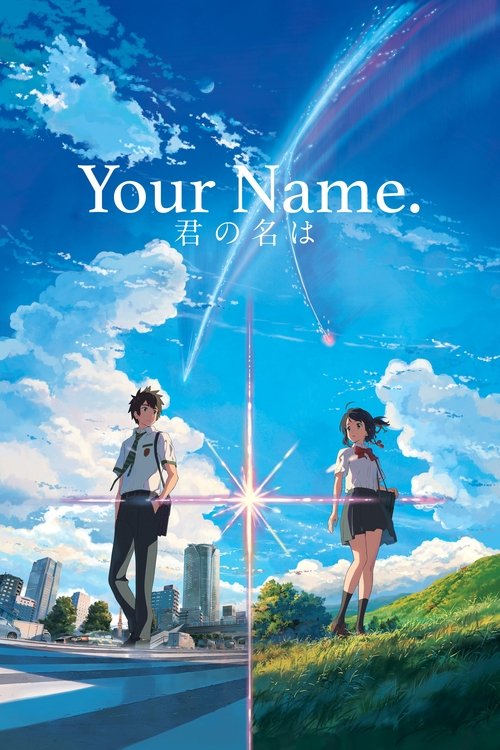
Your Name.
2016 · Makoto Shinkai
Suzume completed his disaster-trilogy and cemented the "next Miyazaki" label he keeps rejecting; his global box office made anime's theatrical dominance a mainstream industry conversation.
For when you want to fall in love and get wrecked a little — a big, sincere, swoony night in. Comfort viewing with real emotional stakes; bring someone, or tissues.
What it's about
A boy in Tokyo and a girl in a remote mountain town start waking up in each other's bodies, no explanation, no warning — just each other's lives to fumble through. What begins as a body-swap farce of phone memos and mutual sabotage deepens into a longing to actually meet, as a once-in-a-millennium comet approaches overhead. It's a teen romance strapped to something much bigger.
The experience
Funny and breezy for its first stretch, then it pivots into full-body yearning — a race-against-time sweep that has made theaters full of strangers cry. It's earnest, propulsive, and gorgeous almost to the point of unfairness.
The craft
Shinkai draws light like no one else in animation: lens flares, glowing twilight skies, cityscapes more luminous than photography allows, all organized around the magic hour when two worlds might briefly touch. RADWIMPS's pop score is stitched into the storytelling itself, driving whole sequences like music video and montage fused. This is a film to see as big and loud as you can manage.
Why it matters
It became the highest-grossing anime ever worldwide on release, ending decades of that conversation belonging only to Studio Ghibli, and turned Shinkai from a cult miniaturist of longing into a global phenomenon.
Makoto Shinkai had spent fifteen years as anime's great miniaturist of longing — distance, missed connections, skies rendered with a jeweler's obsession — before this body-swap romance made him a global phenomenon. A boy in Tokyo and a girl in a mountain town wake in each other's lives, and what begins as farce deepens into something stranger, entangled with a once-in-a-millennium comet. The film became the highest-grossing anime ever worldwide on release, ending decades of that conversation belonging solely to Studio Ghibli, and its success remapped what original (non-franchise) animation could do commercially. Shinkai's signature is light: lens flares, glowing crepuscular skies, cityscapes more luminous than photography allows — the recurring hour of 'kataware-doki,' twilight, when two worlds might briefly touch. Beneath the pop sheen (a wall-to-wall RADWIMPS score) runs a distinctly post-2011 Japanese ache, the knowledge that a town can vanish and a country must remember it. The braided-cord motif — time as strands that twist, tangle, and reconnect — gives the intricate structure its emblem.
A Deleuzian reading
Twilight, on the rim of a crater where a town used to be.
The full Deleuzian reading of Your Name. →
Reception
A record-smashing phenomenon in Japan in 2016 that became a global word-of-mouth hit, it has since settled in as THE gateway anime film of the 2010s — though the arrival of Shinkai's later, similar-shaped films sparked some 'was it lightning in a bottle?' revisionism.
How Your Name. was received, from release to now →
Influences: the films it descends from and the films it influenced
- Voices of a Distant Star (2002) — Shinkai's solo-produced debut established his core formal device — a romance sustained across an unbridgeable gap (here relativistic time-dilation) rendered as parallel monologues over widescreen skies, the template Your Name. inverts into a body-swap.
- 5 Centimeters per Second (2007) — Codified Shinkai's signature palette that Your Name. inherits wholesale: photoreal painted backgrounds, anamorphic lens flare and bloom on every light source, and a pop-song music-video montage (Yamazaki's 'One More Time') used as the emotional climax's narrative engine.
- The Garden of Words (2013) — Shinkai's immediate precursor in rendering — hyperreal Tokyo (Shinjuku Gyoen) with individually-lit raindrops, refractive puddles, and layered atmospheric depth — the material-surface realism carried directly into Your Name.'s Tokyo and Itomori.
- Whisper of the Heart (1995) — The Ghibli film that proved a teen romance could run entirely on meticulously hand-painted contemporary Tokyo suburbia and commuter trains as romantic geography — the grounded-realism-plus-yearning register Shinkai adopts before adding the fantastical.
- Spirited Away (2001) — Supplies the Shinto grammar Your Name. runs on — musubi (name/knot/binding), the theft-and-recovery of a name as identity, and twilight thresholds as sites of crossing between worlds.
- The Girl Who Leapt Through Time (2006) — Model for the high-school SF-romance that plays a time mechanic as bright teen farce before pivoting to melodramatic loss — the farce-to-melodrama tonal architecture and 'race to undo catastrophe' third act Your Name. reuses.
- I Are You, You Am Me (Tenkōsei) (1982) — The foundational Japanese boy/girl body-swap film; establishes the comedic-embodiment beats — waking in the wrong body, mishandling the other's social role and physiology — that Your Name.'s first act stages almost gesture-for-gesture.
- Only Yesterday (1991) — Ghibli precedent for braiding two time-frames and a rural/urban split into one melancholic structure, and for treating the depopulating countryside as elegiac subject — Itomori's lake-town lament descends from this.
- Tokyo Godfathers (2003) — Inherits Kon's graphic match-cut and place/identity-swapping transitions to bind separated characters across a mapped Tokyo, a debt Shinkai's editing directly extends.
- The Disappearance of Haruhi Suzumiya (2010) — Scales the exact formula — photoreal Tokyo naturalism plus a reality-rewrite undertaken to save one specific person — into blockbuster form.
- K-ON! The Movie (2011) — Fuses light-as-character rendering with adolescent impermanence and a graduation/separation ache, popularizing for a mass audience the melancholy-of-transience mood K-ON! distilled.
- Millennium Actress: Tracks (2001) — Adopts Kon's signature match-cut across time and body-swap memory, using graphic continuity between disparate spaces/eras — the technique this doc traces to Kon's storyboards — as its core emotional-editing engine.
- Weathering with You (2019) — Shinkai's direct follow-up doubles down on the exact toolkit — RADWIMPS scoring the montages, lens-flare-drenched skies, a meteorological/celestial catastrophe braided with adolescent romance and a Tokyo-vs-nature reckoning.
- Suzume (2022) — Extends Your Name.'s post-3/11 memory craft explicitly — a journey across disaster sites, a threshold-door motif replacing the twilight crossing, and mourning geography rendered in the same photoreal-plus-flare style with a driving pop-rock score.
- Lost in Starlight (2025) — Crosscuts two separated consciousnesses bound by an inherited object (the braided cord), rendered in hyper-detailed light-flare skies — the inherited-object motif and split-lovers editing.
- Cosmic Princess Kaguya! (2026) — Canonized the bloom-and-flare digital-light grammar — anamorphic lens streaks, glazed skies, comet-light haloes — that defines Kaguya's cinematography of the descending moon.
- In Waves (2026) — Braided, time-crossed memory structure fused to luminous naturalistic light and a pop-song score used as load-bearing structural device rather than accompaniment — the orchestral/pop-scored braided-memoir model.
- A Silent Voice (2016) — Released the same year; the KyoAni counterpart in contemporary teen melodrama built on optical realism — rack-focus, lens bokeh, sunlit water and foliage used as emotional register rather than Shinkai's flares, but the same photographic sensibility.
- I Want to Eat Your Pancreas (2018) — Post–Your Name. teen romance-of-loss that adopts the Shinkai grade — golden-hour skies, glinting light on water, sentimental J-pop montage — while structuring the story around a withheld twist about mortality.
- Fireworks, Should We See It from the Side or the Bottom? (2017) — Rode the same wave with an overtly Your Name.-adjacent pitch — a wish-driven time-loop teen romance set in a summer festival town, marketed on skyscape spectacle and a pop theme song.
- Belle (2021) — Hosoda's answer in the post–Your Name. blockbuster-anime economy — rural-girl protagonist, catastrophe-scale emotional climax, and a chart-topping original song sequence deployed as the film's dramatic peak.
- Words Bubble Up Like Soda Pop (2021) — Descends from the same commercial-animation lineage — a summer teen romance whose visual identity is saturated pastel skies and light-bloom, structured around a music/media hook, in the mold Shinkai's CM-derived style popularized.
- Your Lie in April (2014) — KyoAni-adjacent teen melodrama that pioneered the light-drenched, lens-flare-and-bokeh 'sparkle realism' and withheld-tragedy structure adjacent to Your Name., pairing it with a music-performance emotional engine.
- Evangelion: 3.0+1.0 Thrice Upon a Time (2021) — Layers hand-drawn characters over photoreal composited landscapes and grounds cosmic disaster in a pastoral rural interlude — the same hybrid rendering plus 'ordinary-life' village respite as 3.0+1.0's Village-3 farming section.
- A Silent Voice: The Movie (2016) — The box-office sibling that 'overshadowed' it — released the same year, defining the 2016 teen-anime-drama moment against which A Silent Voice's quieter craft is measured.
- From Up on Poppy Hill (2011) — Shares the dual-braided two-strand plot architecture and a hyper-warm, nostalgic-longing color palette in which townscape and light do much of the emotional work.
- Wolf Children (2012) — Proves the same commercial-artistic case Wolf Children opened — a non-Ghibli auteur studio making original mature-digital prestige anime that reaches a mass theatrical audience, part of the late-2010s boom.
- When Marnie Was There (2014) — A contemporaneous sibling built on the same structural device — a late reversal that reframes an intimate cross-time relationship, with the emotional payload deliberately withheld until the mechanism of connection is revealed.
- Entergalactic (2022) — Uses pop songs to structure time-skip montages and a hyper-saturated, light-drenched urban color palette to romanticize the city — the music-video-montage romance and expressive-color grammar Entergalactic shares.
Similar films
- Weathering with You (2019) — influence & lineage
- Suzume (2022) — influence & lineage
- The Girl Who Leapt Through Time (2006) — influence & lineage
- Spirited Away (2001) — influence & lineage
- I Want to Eat Your Pancreas (2018) — influence & lineage
- Kaguya-sama: Love Is War -The First Kiss That Never Ends- (2022) — shared sensibility
- Cosmic Princess Kaguya! (2026) — shared sensibility
- Your Name Engraved Herein (2020) — shared sensibility
All the films related to Your Name. →