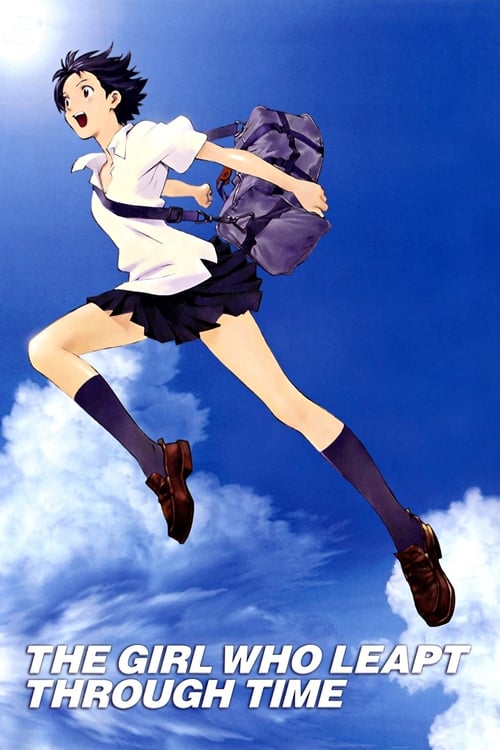
The Girl Who Leapt Through Time
2006 · Mamoru Hosoda
The anti-Ghibli Ghibli heir whose Belle and his pointed comments about how legacy anime portrays women keep him at the center of anime auteur discourse.
For when you want something sweet with an ache in it — a golden-hour watch about being young and wasting time, perfect when you're nostalgic for summers you can't get back. Comfort viewing that still earns its tears.
What it's about
Makoto is seventeen, chronically late, undecided about everything, and happiest playing baseball after school with her two best friends — until she discovers she can physically leap backwards through time. Naturally she spends the gift on retaking quizzes, extending karaoke sessions, and dodging awkward conversations, only to learn that every do-over ripples outward, and that some moments can't be redone forever.
The experience
Light on its feet and full of summer-afternoon warmth, then quietly devastating when it counts — it starts as a comedy of teenage do-overs and sneaks into real longing. The kind of film that leaves you smiling with a lump in your throat.
The craft
Hosoda's animation finds beauty in the mundane — school corridors, riverside bike rides, huge summer clouds — and stages the time leaps with a physical, comic energy that makes the fantasy feel bodily real. The screenplay is a small marvel of construction, paying off its loops with emotional precision rather than puzzle-box cleverness.
Why it matters
Hosoda's breakthrough, and one of the films that proved Japanese animation had major voices outside Studio Ghibli — a touchstone for the wave of time-bending teen anime romances that followed.
Snapshot
The Girl Who Leapt Through Time (時をかける少女, Toki o Kakeru Shōjo) is Mamoru Hosoda's breakthrough feature and one of the defining Japanese animated films of the 2000s outside the Studio Ghibli orbit. Produced by Madhouse from a screenplay by Satoko Okudera, it takes the perennial premise of Yasutaka Tsutsui's 1967 juvenile novel — a schoolgirl who acquires the power of time travel — and reframes it not as a fresh adaptation but as a loose continuation set roughly four decades later, following the niece of the original book's heroine. The result is a small-scale, emotionally exact coming-of-age story disguised as science fiction: seventeen-year-old Makoto Konno discovers she can physically "leap" back through time, squanders the gift on trivial teenage self-interest, and gradually learns that a life cannot be endlessly rewound without cost to the people around her. Modestly released in the summer of 2006, it became a word-of-mouth success and a critical touchstone, announcing Hosoda as a major auteur and effectively launching the career that would run through Summer Wars, Wolf Children, and Mirai.
Industry & production
The film emerged from a specific inflection point in Hosoda's career. A Toei Animation veteran who had directed television work and two Digimon features, Hosoda had been tapped by Studio Ghibli to direct Howl's Moving Castle before departing that project; the film ultimately reverted to Hayao Miyazaki. The Girl Who Leapt Through Time was made after Hosoda moved to Madhouse, the Tokyo studio then led by Masao Maruyama and known for director-driven work (Satoshi Kon's films among them). This lineage matters: the film sits in the tradition of the personal, mid-budget anime feature rather than the tentpole blockbuster.
It was conceived as a comparatively lean production and released initially in a limited number of theaters in July 2006, expanding as positive reception built. The precise theatrical grosses and screen counts are not something I can state reliably from the historical record, and I will not invent figures; what is well attested is that the film's commercial performance was driven by longevity and word of mouth rather than a wide opening, and that its reputation grew substantially after home-video release and international festival exposure. Tsutsui's original novel, a long-running staple of Japanese popular culture already adapted repeatedly for film and television (most famously Nobuhiko Obayashi's 1983 live-action version), gave the project immediate name recognition with domestic audiences.
Technology
The film is a hand-drawn work produced with the digital ink-and-paint and compositing pipeline standard for mid-2000s anime: character animation drawn on paper and cels rendered digitally, composited over painted backgrounds with digital camera moves, light effects, and layering. It is not a showcase for computer-generated spectacle in the manner of contemporaneous 3D-forward productions; where digital tools appear, they serve traditional 2D aesthetics — atmospheric lighting, lens-flare and bloom effects in the summer exteriors, and smooth compositing of foreground figures against detailed backgrounds.
Within the story, "technology" is deliberately demystified. Makoto's power originates from a small walnut-shaped device, and her remaining leaps are tracked by a number that appears on her forearm, counting down toward zero — a simple, almost tactile science-fiction conceit rather than an elaborate mechanism. The film's one genuine science-fiction reveal, concerning the true origin of the power and of a character who has come from a distant future, is handled with restraint and near-total absence of hardware. This is science fiction as emotional device, not as engineering.
Technique
Cinematography
Though animated, the film has a strongly articulated sense of "camera." Hosoda and his layout artists favor stable, architecturally clear compositions — deep-focus long shots of school corridors, the science-prep room, riverbank embankments, and the wide summer sky — punctuated by sudden bursts of kinetic movement when Makoto leaps. The visual signature is the physicality of the time-jump itself: she runs and literally hurls her body forward, and the "camera" tracks these dives with whip-fast horizontal motion and impact framing that contrasts sharply with the otherwise placid, observational staging. Recurring high-angle and wide shots of the town under an enormous sky give the film its characteristic openness and lend the ordinary a quiet monumentality.
Editing
The cutting is patient in its everyday scenes and precise in its set pieces. Because the plot is built on repetition — Makoto reliving the same afternoons, the same conversations, the same baseball practice and railway crossing — the editing plays knowingly with recurrence, letting audiences recognize a moment being replayed and then subtly diverge. The film's most celebrated formal effect is the payoff of a running visual motif at a railway level crossing, where accumulated repetitions are recontextualized by a single, devastating cut. The escalating comedy of Makoto's early, careless leaps is built through brisk montage; the film slows markedly in its final act as the consequences turn irreversible.
Mise-en-scène / staging
The production design, with art direction by the veteran background artist Nizo Yamamoto, grounds the fantasy in a meticulously observed contemporary Tokyo suburbia: unglamorous classrooms, a cluttered art-restoration studio where Makoto's aunt works, sunbaked streets, and the omnipresent river embankment where the three friends play catch. This ordinariness is essential to the film's effect; the science-fiction premise is embedded in a world of homework, part-time normality, and adolescent routine. Summer is staged as a total environment — heat haze, cicada drone, long shadows — so that the fantastical leaps feel like ruptures in a fully realized ordinary life.
Sound
Kiyoshi Yoshida's score is spare and piano-forward, and the film leans on a now-iconic musical motif: an arrangement derived from Pachelbel's Canon recurs across key scenes, lending the repetitions an aching, circular quality that mirrors the time loops. The end-credits theme song "Garnet," performed by Hanako Oku, became closely associated with the film. The sound design foregrounds naturalistic ambience — cicadas, running water, the clatter of a train crossing, the crack of a baseball — building a dense, seasonal soundscape against which the near-silent strangeness of the leaps registers.
Performance
Hosoda cast the voice roles for naturalism rather than star wattage. Riisa Naka voices Makoto with a loose, tomboyish, un-actressy energy that grounds the character's impulsiveness and eventual grief; her performance is central to the film's tonal balance of comedy and feeling. Takuya Ishida and Mitsutaka Itakura voice the two friends, Chiaki and Kosuke, who complete the central trio. The animation of performance is likewise keyed to unglamorous physicality — Makoto's sprawling, ungainly runs and pratfalls — rather than idealized gesture, which is a deliberate part of the characterization.
Narrative & dramatic mode
The dramatic mode is comedy-of-adolescence sliding into elegy. Structurally, the film is a variation on the time-loop and "second chances" story, but it withholds the usual mastery fantasy: Makoto's power initially seems to make her omnipotent over her small world, and the early film mines real comedy from her using it to ace tests, avoid embarrassment, and re-do a botched karaoke session. The turn is ethical rather than plot-mechanical. Each rewind she makes for her own benefit displaces misfortune onto someone else, and the finite leap-counter converts her carelessness into scarcity and stakes. The film's engine is the gap between the fantasy of undoing consequences and the reality that time — and growing up — moves in one direction. Its emotional climax hinges on a first-love recognition and a promise about the future, resolving not with a restored status quo but with acceptance of loss and forward motion.
Genre & cycle
It belongs simultaneously to several cycles. As science fiction it is part of the durable Japanese time-travel tradition seeded by Tsutsui's novel and its many adaptations. As animation it belongs to the post-2000 wave of non-Ghibli, auteur-driven anime features aimed at adolescent and adult audiences — a cycle that also includes Satoshi Kon's work and the rising Makoto Shinkai. As drama it is a seishun (youth/coming-of-age) film in animated form, closer in feeling to live-action teen cinema than to genre spectacle. Its particular achievement was to demonstrate that a grounded, character-first animated feature with a small emotional canvas could command critical seriousness and durable popularity.
Authorship & method
The film is decisively Hosoda's, and it establishes the preoccupations that would define his authorship: family and kinship across generations, the texture of ordinary domestic and communal life, the fantastical intruding into the mundane, and transitional thresholds of youth. His method favors clear layout, restrained "camera," physical comedy, and emotional climaxes staged in wide, sky-filled spaces.
The key collaborators are essential to the result. Screenwriter Satoko Okudera shaped the crucial decision to make the film a generational sequel rather than a straight adaptation, and would continue working with Hosoda on subsequent features. Character designer Yoshiyuki Sadamoto — best known for Neon Genesis Evangelion — gave the cast their distinctive, slightly angular naturalism, a look markedly different from Ghibli house style. Art director Nizo Yamamoto, a background painter with deep experience in Japanese animation, supplied the film's luminous, lived-in environments. Composer Kiyoshi Yoshida provided the understated score and the recurring Canon-derived motif. Together they produced a film whose authorship is singular but whose surface owes much to an unusually strong assembly of collaborators. (The compositing/photography and editing credits are handled within Madhouse's pipeline; I won't attribute specific individuals I cannot verify.)
Movement / national cinema
The film is a landmark of Japanese animation's mid-2000s diversification, when the medium's feature output was no longer synonymous with Ghibli. It is a product of the Madhouse tradition of director-centered anime and of a broader moment in which animated cinema was increasingly taken seriously as a vehicle for intimate, adult-inflected storytelling. Within national cinema it also belongs to Japan's long-running fascination with Toki o Kakeru Shōjo as a cultural property spanning novel, live-action film, television, and now animation — Hosoda's version being the one that carried the story to a large international audience.
Era / period
Made and set in the mid-2000s, the film captures a pre-ubiquitous-smartphone adolescence: landline-era, analog, bicycle-and-train suburban life, with technology largely absent from the frame. This contemporaneity is deliberate and gives the film a slightly timeless, seasonal quality. It arrived at the moment anime was consolidating its global art-cinema reputation through festivals and DVD distribution, and it benefited from — and helped extend — that internationalization.
Themes
The governing theme is the irreversibility of time and the ethics of consequence. The film systematically dismantles the wish-fulfillment of the do-over: every rewind has a cost that lands on someone, and the finite leap-counter turns time itself into a moral resource. Adjacent to this is the theme of adolescence as a one-way passage — the film is about the end of a particular summer, the dissolution of an easy three-way friendship, and the reluctant acceptance of change and separation that defines growing up. First love is treated with unusual delicacy, tied to a promise oriented toward the future rather than the past. A restoration-in-progress painting, from an age of scarcity, recurs as a quiet emblem of survival, waiting, and the endurance of beauty across time. Regret, and the human impulse to undo it, is the film's emotional core; its wisdom lies in redirecting that impulse from erasing the past to protecting the future.
Reception, canon & influence
Critically, the film was received as a major work and is widely regarded as one of the finest Japanese animated features of its decade. It won the Japan Academy Prize for Animation of the Year and accumulated further domestic honors, and it gained substantial recognition on the international festival and awards circuit; beyond the Japan Academy Prize I will refrain from listing specific citations I cannot verify precisely, but its standing as an award-winning critical success is well established. Its reputation has only grown, and it is now routinely cited as a modern classic and a gateway film for audiences new to non-Ghibli anime.
Looking backward, the film's influences are legible: Tsutsui's 1967 novel and its adaptation history (notably Obayashi's 1983 live-action film) supplied the premise and the generational connective tissue; the broader lineage of time-travel and time-loop fiction informs its structure; and the naturalistic, everyday-Japan aesthetic connects it to a strain of grounded animation distinct from high-fantasy spectacle. Looking forward, its legacy is twofold. Most directly, it launched Hosoda as the leading anime auteur of his generation, establishing the thematic and stylistic template — family, the ordinary made luminous, fantastical premises anchored in real emotion — that he developed across the acclaimed run of films that followed and the founding of his own Studio Chizu. More broadly, alongside the emergence of Makoto Shinkai, it helped consolidate the international market and critical vocabulary for character-driven, emotionally serious anime features, demonstrating that a modestly scaled coming-of-age story could achieve both lasting popularity and canonical status. Its imagery — the leaping sprint, the summer sky, the Canon motif — has become part of the shared iconography of contemporary anime.
A Deleuzian reading
Start with the run.
The full Deleuzian reading of The Girl Who Leapt Through Time →
Reception
It crept out in mid-2006 on just a handful of Tokyo screens, then word of mouth kept it running for months and swept it to the first-ever Japan Academy Prize for Animation of the Year. Twenty years on it's the consensus gateway anime film — the one people hand you when you say you've 'seen all the Ghiblis'.
How The Girl Who Leapt Through Time was received, from release to now →
How to watch The Girl Who Leapt Through Time: what to notice on a first viewing
- Watch the camera whip into motion only when Makoto leaps. Otherwise placid, observational staging gives way to fast horizontal tracking and impact framing the instant she hurls herself through time. The contrast in camera energy tells you exactly when the ordinary world has been ruptured.
- Watch for the river embankment where the three friends play catch. The film grounds its fantasy in unglamorous classrooms, an art-restoration studio, and the same sunbaked streets and riverbank, returned to again and again. The ordinariness of these places is what makes the leaps feel like a real rupture instead of just a gimmick.
- Listen for the same piano melody returning across different scenes. Kiyoshi Yoshida's score keeps bringing back an arrangement derived from Pachelbel's Canon, a circular piece that mirrors the film's time loops. A melody built on repeating itself becomes the sound of a girl repeating her own afternoons.
- Watch Makoto run: sprawling, ungainly, always slightly out of control. Riisa Naka voices her with a loose, tomboyish energy, and the animation keys her physicality to unglamorous pratfalls rather than idealized gesture. Her clumsiness is deliberate characterization, not comic filler, and it tells you who she is before she says a word.
- Notice a scene you have already seen begin to happen again. The editing lets you recognize a moment being replayed before it quietly diverges from what happened the first time. Catching the small difference is how the film makes you feel the cost of her rewinding.
The whole guide to watching The Girl Who Leapt Through Time, with the keys for a rewatch →
Influences: the films it descends from and the films it influenced
- The Girl Who Leapt Through Time (1983) — Hosoda's film is a direct generational sequel to this adaptation, inheriting the lavender-scented time-leap premise and the after-school science-lab setting and reassigning them to a niece a generation on.
- The Girl Who Leapt Through Time (Tsutsui, via Obayashi lineage) (1967) — The source novel supplies the core mechanic — teleportation-through-time triggered by scent and physical leaping — that the film literalizes as Makoto's running sprint into the past.
- Groundhog Day (1993) — Establishes the repetition-with-variation editing grammar the film borrows: a fixed everyday scene (the karaoke booth, the kitchen dinner) recurs with escalating comic then moral variation as the heroine spends her leaps.
- Back to the Future (1985) — Models the causal-bookkeeping of consequence-driven time travel where each jump silently rewrites the present — a mechanic the film externalizes through the depleting count-tattoo on Makoto's forearm.
- La Jetée (1962) — Frames time travel as elegy fixed on a single recurring image and the ache that the traveler cannot ultimately save the beloved from their fated moment.
- Only Yesterday (1991) — Provides the naturalistic everyday-Japan animation register — restrained 'camera,' quotidian gesture, undramatized domestic life — that Hosoda adopts against high-fantasy spectacle.
- Whisper of the Heart (1995) — Sets the Tokyo-suburb seishun template of bicycle and train commutes, ordinary summer light, and first-love realism that Hosoda's staging and framing descend from.
- Digimon Adventure: Our War Game! (2000) — Hosoda's own earlier short establishes his signature clean flat layout, wide restrained framing, and physical-comedy timing later refined in this feature.
- Moving (1993) — Carries forward screenwriter Satoko Okudera's Moving idiom — adolescents talking themselves into and out of crises in oblique, evasive dialogue, with the actual admission withheld until an act of physical repetition forces it.
- Summer Wars (2009) — Reunites the exact authorial team — Okudera's screenplay and Sadamoto's angular-naturalist designs — to extend the family-plus-fantastical-intrusion template onto a larger canvas.
- Wolf Children (2012) — Develops the wide, sky-filled emotional climax and the generational-family preoccupation using the same restrained layout and luminous everyday-environment art direction.
- Mirai (2018) — Returns to the domestic-fantastical time-travel structure of a child slipping across family generations, the ordinary home made luminous, first prototyped here.
- Your Name (2016) — Descends the 'desperate sprint to reverse an irreversible loss' climax and the time-displacement/body-swap mechanics, staged with twilight-sky compositions and a driving pop-rock motif.
- A Silent Voice (2016) — Extends the naturalistic seishun coming-of-age into intimate restrained framing and everyday-Japan texture, treating adolescent moral repair as the emotional core.
- Penguin Highway (2018) — Inherits the fantastical intrusion into a child's ordinary suburban summer, with wide sky compositions and hand-drawn/digital composite rendering the mundane as wondrous.
- Weathering with You (2019) — Extends the wide-sky weather compositions and the irreversibility-versus-choice climax, again scoring the emotional turn to a recurring pop motif.
- The Disappearance of Haruhi Suzumiya (2010) — Models the fusion of a single science-fiction reality-altering device with strictly mundane high-school stakes, rendered against photoreal contemporary-Japan backgrounds rather than genre spectacle.
- Maquia: When the Promised Flower Blooms (2018) — Early model for the anime feature that makes the felt weight of time and its irreversibility — not the mechanism — the true subject, treating temporal dislocation as emotional loss.
- The Boy and the Beast (2015) — Established Hosoda's flat, graphically clean deep-staged compositions and his signature parallel crosscutting of repeated actions, the editing grammar he reuses to intercut the two worlds here.
- 5 Centimeters per Second (2007) — A parallel consolidation of serious teen anime deploying the same railway-crossing as an emotional payoff device and wide sky compositions bound to a recurring musical motif.
- The Tatami Galaxy (2010) — Extends the repetition-recurrence editing engine into serial parallel lives, restarting the same student's timeline with variation to interrogate second-chance regret.
- Gintama: The Final Chapter - Be Forever Yorozuya (2013) — Heisei-era sibling that repurposes time-travel not as spectacle but as an engine for emotional consequence, absence, and farewell — the same tonal use of time-manipulation this film makes.
Similar films
- Your Name. (2016) — influence & lineage
- Only Yesterday (1991) — influence & lineage
- Weathering with You (2019) — influence & lineage
- Wolf Children (2012) — influence & lineage
- Whisper of the Heart (1995) — influence & lineage · same viewing thread
- Cosmic Princess Kaguya! (2026) — same viewing thread
- Kaguya-sama: Love Is War -The First Kiss That Never Ends- (2022) — same viewing thread
- Look Back (2024) — same viewing thread
All the films related to The Girl Who Leapt Through Time →
Watch it with: curated runs of related films
- Anime's Dreaming Adolescents — Watch these together for the ache of being young — first crushes, imaginary worlds, and the small transformations that feel enormous when you're inside them.