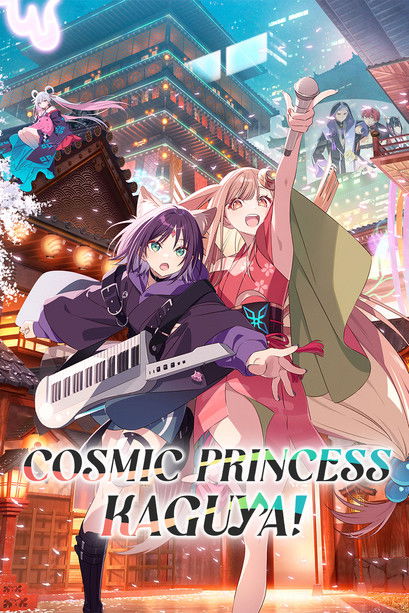
Cosmic Princess Kaguya!
2026 · Shingo Yamashita
For when you want pure audiovisual spectacle with a beating heart — a turn-the-lights-off, turn-the-sound-up kind of night, especially if animation itself is what you come to movies for.
What it's about
Iroha's quiet earthbound life gets knocked off its axis when Kaguya — a carefree runaway from the Moon — moves in and talks her into performing together inside a virtual world. It's Japan's oldest story, the moon princess of The Tale of the Bamboo Cutter, reborn in the age of virtual idols and online performance, and its real subject is the gap between an avatar and the person animating it.
The experience
A rush of color and music — light that behaves like weather, linework that dissolves into bloom and flare, performance sequences built to overwhelm. It's exuberant and a little melancholy underneath, the way stories about borrowed time tend to be.
The craft
Director Shingo Yamashita made his name as one of the defining animators of the web generation — his series openings get dissected frame by frame by devotees — and this feature is that sensibility at full scale: digital light as the star of the show. The concert sequences and virtual-world imagery are built for the biggest screen and best speakers you can find.
Why it matters
A milestone in the rise of web-generation animators to feature directing, and a snapshot of the moment virtual-idol culture became a subject for cinema rather than a curiosity.
Shingo Yamashita made his name as one of the defining animators of the web generation — a colorist of digital light whose openings for series like Jujutsu Kaisen were dissected frame by frame by animation devotees — and this feature hands Japan's oldest story to that sensibility. The moon princess of The Tale of the Bamboo Cutter is reimagined as a carefree runaway who crashes into the orbit of Iroha, an earthbound girl, and talks her into performing alongside her inside a virtual world. The premise fuses tenth-century folklore with the culture of virtual idols and online performance, and the film's real subject is the distance between an avatar and the person animating it. Yamashita's signature — loose linework dissolving into bloom and flare, color that behaves like weather — is built for exactly this collision of the celestial and the streamed. A musical fantasy at heart, it arrives as a statement that the animators raised on the internet are now making cinema about it.
Reception
How Cosmic Princess Kaguya! was received, from release to now →
Influences: the films it descends from and the films it influenced
- The Tale of the Princess Kaguya (2013) — Draws from the same Taketori Monogatari source and models the folklore-adaptation structure — earthly upbringing, suitor trials, lunar reclamation — that Yamashita retools, inverting Takahata's charcoal rushing-line minimalism into saturated digital bloom.
- Belle (2021) — Its 'U' network and the diva Bell established the virtual-idol concert set piece — a shy avatar singing to a spherical crowd — plus the avatar-versus-self reveal that Kaguya's streamed-idol arc directly extends.
- Summer Wars (2009) — Codified the OZ 'virtual world' as a bright white-void social space with iconographic avatars, giving anime its template for staging identity and spectacle inside a networked interface.
- Perfect Blue (1997) — Origin of the idol-identity-split montage — a pop performer stalked by her own online persona ('Mima's Room') — the online-performance-versus-self device Kaguya inherits wholesale.
- Macross Plus (1995) — Sharon Apple, the AI hologram diva performing to stadium crowds, is the prototype virtual idol whose light-projected concert staging Kaguya's celestial-meets-streamed shows echo.
- Your Name. (2016) — Canonized the bloom-and-flare digital-light grammar — anamorphic lens streaks, glazed skies, comet-light haloes — that defines Kaguya's cinematography of the descending moon.
- Weathering with You (2019) — Pushed volumetric god-rays and rain-refracted light as emotional weather, the layered digital-light compositing Yamashita borrows for celestial-beam sequences.
- Interstella 5555 (2003) — The wordless pop-idol musical-anime feature — narrative carried entirely by staged band performances — establishing the idol-as-plot-engine form Kaguya adopts.
- Paprika (2006) — Its parade of avatars and match-cut slides between dream, screen and reality prefigure the fluid persona-swapping and reality/performance dissolves in Kaguya's online spaces.
- Digimon Adventure: Our War Game (2000) — Hosoda's early network-space battle staged combat inside internet architecture with pop-flat UI, the seed of the virtual-world spectacle Kaguya's streamed contests build on.
- Promare (2019) — Shares the web-generation animation vocabulary — geometric impact frames, chromatic bloom, flat-shaded digital fire in candy hues — that Yamashita's sakuga-heavy crew deploys.
- Inu-Oh (2021) — Reframes medieval folklore as an anachronistic rock-idol concert, the same fusion of period myth with arena idol-performance staging that drives Kaguya.
- Ride Your Wave (2019) — Uses recurring J-pop musical numbers and fluid, light-catching water animation as a structural refrain, the musical-fantasy scaffolding Kaguya parallels.
- Sing a Bit of Harmony (2021) — Built around an artificial singer whose virtual-idol performances are the narrative's musical set pieces, a near-contemporary take on the AI/streamed-idol premise.
- Redline (2009) — Its hyper-kinetic hand-drawn effects animation is the sakuga lineage Shingo Yamashita himself comes from, sharing the smear-frame, explosive-motion craft on display in Kaguya's action-musical numbers.
- Millennium Actress (2001) — Folds a performer's public image and private self across eras via seamless media-to-media match cuts, the avatar-versus-self editing logic Kaguya applies to a streaming star.
Similar films
- Weathering with You (2019) — influence & lineage · often watched together
- The Tale of The Princess Kaguya (2013) — influence & lineage
- Your Name. (2016) — influence & lineage
- Liz and the Blue Bird (2018) — same viewing thread · often watched together
- Kaguya-sama: Love Is War -The First Kiss That Never Ends- (2022) — same viewing thread
- The Girl Who Leapt Through Time (2006) — same viewing thread
- Night Is Short, Walk On Girl (2017) — same viewing thread
- Violet Evergarden: The Movie (2020) — same viewing thread
All the films related to Cosmic Princess Kaguya! →
Watch it with: curated runs of related films
- Anime's Dreaming Adolescents — Watch these together for the ache of being young — first crushes, imaginary worlds, and the small transformations that feel enormous when you're inside them.