Redline
2009 · Takeshi Koike
For when you want to blast off the couch — max volume, zero homework, a movie that treats speed as a religion. Pure comfort for anyone who loves cartoons that go too hard.
What it's about
A pompadoured daredevil named JP wants one thing: a spot in Redline, the biggest, most lawless race in the galaxy, held only once every five years. This time it's set on a militarized planet whose government wants no spectators and no survivors, and to even reach the starting grid he has to get past the mafia, his own shady past, and a rival racer he can't stop falling for.
The experience
It plays like a shot of pure adrenaline — bodies stretch, engines scream, colors hit like strobe lights, and it barely lets you exhale between setpieces. Loud, funny, sincere, and faster than almost anything else animation has produced.
The craft
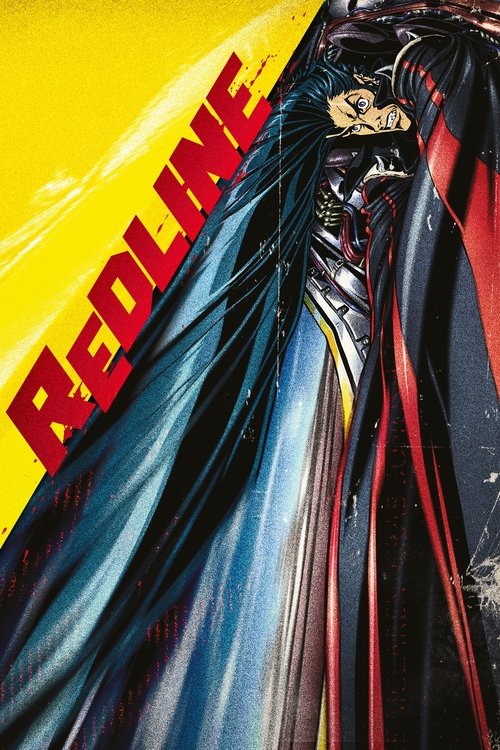
Seven years in production and more than 100,000 hand-drawn frames without a single computer-generated one: thick black outlines, acid color, motion smeared into pure abstraction. James Shimoji's electro-funk score drives the film like a second engine. This one begs for the biggest screen and loudest speakers you can find.
Why it matters
It flopped in Japanese theaters and then became exactly the cult object it deserved to be — passed hand to hand on home video as a high-water mark animators still point to.
Seven years in production, more than 100,000 hand-drawn frames, and not one of them computer-generated: Takeshi Koike's debut feature is the maximalist terminal point of Japanese cel-style animation. Koike, a protégé of Yoshiaki Kawajiri at the Madhouse studio, honed his high-contrast, speed-smeared style on the Animatrix short World Record; here, with writer-producer Katsuhito Ishii, he pours it into the oldest pulp premise there is — a pompadoured daredevil, an intergalactic race, a militarized planet that wants no visitors — and detonates it. Bodies stretch like taffy, engines bloom into pure abstraction, thick black outlines throb against acid color, and James Shimoji's electro-funk score drives the whole thing like a second engine. The film flopped in Japanese theaters in 2010, then did what such objects do: became a home-video cult, and eventually a canonical one. Nothing on this scale has been hand-drawn since, and likely nothing will be — Redline is the medium showing off everything it could do, once, at full throttle.
A Deleuzian reading
The picture stops.
The full Deleuzian reading of Redline →
Reception
Redline flopped at the Japanese box office in 2010 after seven years in production, a failure that reportedly stung Madhouse — but within a few years it was being passed around by animation fans as a must-see, and it's now routinely called one of the best-animated films ever made.
How Redline was received, from release to now →
Influences: the films it descends from and the films it influenced
- The Animatrix: World Record (2003) — Koike's own directorial breakthrough that codified the muscular, thick-inked character designs and hand-drawn motion-smear he later scaled to feature length in Redline.
- Trava: Fist Planet (2002) — The OVA where Koike and writer Katsuhito Ishii first fused a pulp premise with retro-heavy linework, the direct prototype for Redline's exact creative team and look.
- Golgo 13: The Professional (1983) — Madhouse hardboiled pulp built on dramatic chiaroscuro and Dezaki's held 'postcard memory' freeze-frames, a device Koike quotes in Redline's frozen high-contrast hero poses.
- Space Adventure Cobra (1982) — Lurid pulp sci-fi assembled from saturated color holds and harmony-cel bravado, the comic-book showmanship Redline inherits and cranks up.
- Akira (1988) — Benchmark for exhaustively detailed cel machinery and physically weighted crash choreography that Redline's abstract machinery and pile-up action answer to.
- Ashita no Joe 2 (1980) — Harmonized-cel painterly stills and high-contrast impact frames from which Koike's thick-ink, deep-shadow drawing style descends.
- Mach GoGoGo (Speed Racer) (1967) — The ur-anime racing spectacle whose gadget-cars and race-as-narrative engine Redline pulps up into a galaxy-wide grand prix.
- Heavy Metal (1981) — Adult animated pulp anthology that welds genre trash to a driving rock/synth score, the exact sound-and-image mode Redline's electro-funk soundtrack extends.
- Cowboy Bebop: The Movie (2001) — Doubles down on maximalist all-hand-drawn animation as a craft statement, extending Bebop's pre-digital, motion-dense aesthetic into pure kinetic spectacle.
- Sword of the Stranger (2007) — Extends the 'animate the action whole' ethos to its limit — kinetic sequences drawn as continuous physical events rather than cut together — the same trust in draftsmanship Ando's finale advertised.
- Neo Tokyo (1989) — Koike, trained under Kawajiri at Madhouse, builds an entire feature from the 'Running Man' toolkit — hand-drawn smear and speed distortion, extreme wide-angle vehicle foreshortening, high-contrast black shadow shapes — with no CG assistance in the race animation.
- Promare (2019) — Carries Redline's flat high-contrast palette and maximalist action set-pieces forward into a hybrid cel/CG spectacle of racing-grade velocity.
- Kill la Kill (2013) — Trigger's smear-heavy, boldly graphic cel and explosive limited animation extend the Redline maximalist line into television.
- Spider-Man: Into the Spider-Verse (2018) — Foregrounds the drawn medium via halftone dots, motion-smear and hand-stepped framerates — the same 'medium showing off' impulse that animates every Redline frame.
- HAIKYU!! The Dumpster Battle (2024) — Hand-drawn hyperkinetic racing that turns whip-pans and full-frame speed smears into pure velocity — the direct debt for Haikyu's whip-pan camera during spikes and serves.
- Jujutsu Kaisen 0 (2021) — Koike's hyper-kinetic, elastic hand-drawn motion with exaggerated smears and impact holds anticipates the frame-rate-modulated 'ones and threes' rhythm MAPPA uses to punch its action beats.
- The Legend of Hei 2 (2025) — The benchmark for fully hand-drawn action animated 'on ones' — every frame a discrete drawing — establishing the frame-by-frame density that Hei 2's fight sequences pursue as a domestic high-water mark.
- Dead Leaves (2004) — A maximalist cel sprint of grotesque, elastic action and pose-over-physics kinetics, a contemporary parallel to Redline's frame density.
- Tengen Toppa Gurren Lagann (2007) — Escalation animation that prizes kinetic excess and heroic silhouette over plausibility, sharing Redline's maximalist cel ethos and thick graphic linework.
- Mind Game (2004) — Studio 4°C's medium-flaunting experiment where drawing style mutates shot to shot, kin to Redline's 'look what hand-drawn animation can still do' bravado.
- Speed Racer (2008) — Live-action racing rebuilt from candy-saturated color, speed-smeared motion and stacked graphic planes, a non-anime cousin to Redline's chromatic velocity.
- Chainsaw Man - The Movie: Reze Arc (2025) — Hand-drawn hyper-kinetic action built on exaggerated impact frames and smear—the animation-craft peer to Yoshihara's physically weighty fight choreography.
- Cosmic Princess Kaguya! (2026) — Its hyper-kinetic hand-drawn effects animation is the sakuga lineage Shingo Yamashita himself comes from, sharing the smear-frame, explosive-motion craft on display in Kaguya's action-musical numbers.
- Tekkonkinkreet (2006) — Extends the maximalist, fisheye-warped, hand-drawn urban collage into pure kinetic spectacle, sharing Tekkon's density-over-legibility staging philosophy.
- 100 METERS (2025) — Its wholly hand-drawn hyper-kinetic racing, where speed and motion are the film's entire subject, is a sibling pursuit of drawn velocity that 100 Meters channels into the 100-meter dash.
- Porco Rosso (1992) — Carries forward the pre-digital feat Porco's dogfights demonstrate: vehicles hand-drawn through full perspective rotation at speed, with each engine given its own timbre so the race stays followable by ear.
Similar films
- Akira (1988) — influence & lineage
- Mind Game (2004) — influence & lineage
- 100 METERS (2025) — shared sensibility
- Neo Tokyo (1989) — shared sensibility
- Cowboy Bebop: The Movie (2001) — shared sensibility
- F1 (2025) — shared sensibility
- Sword of the Stranger (2007) — shared sensibility
- Blue Giant (2023) — shared sensibility
All the films related to Redline →