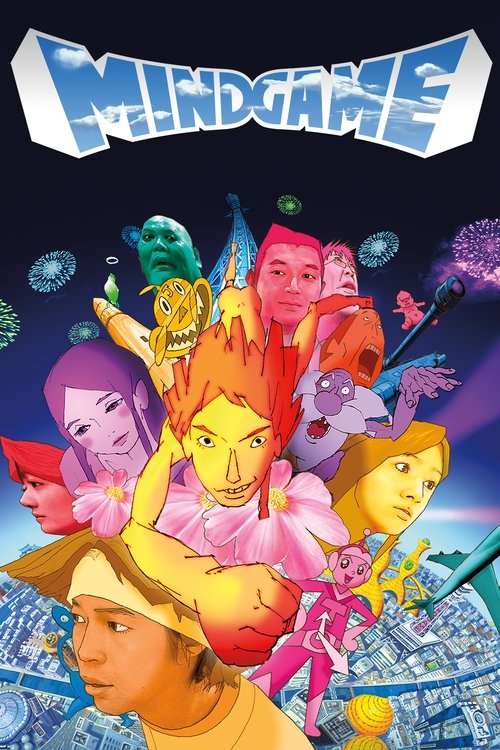
Mind Game
2004 · Masaaki Yuasa
For when you want your brain rewired and your spirits lifted in the same two hours — reach for it when you're stuck in a rut and need a film that grabs you by the collar and yells 'live.' Wild, but ultimately a feel-great movie.
What it's about
Nishi is a timid would-be manga artist still carrying a torch for Myon, his childhood sweetheart, when a run-in with yakuza thugs in an Osaka bar hurls him clean out of his ordinary life — through an audience with a gleefully shape-shifting God and back into the world with a ferocious new appetite for living. What follows is a headlong flight with Myon and her sister that lands the three of them somewhere no chase movie has ever gone. It's a love story, a getaway, and a second chance, all moving at a sprint.
The experience
Pure jet fuel — the animation mutates style from shot to shot, faces melt into photographs, colors detonate, and the whole thing vibrates with a joy that's almost physical. Underneath the chaos it's surprisingly warm, and it ends on a high that can leave you buzzing for days.
The craft
Masaaki Yuasa's debut throws out every rule of consistent animation: drawing styles, media, and registers change freely — crude scrawl one moment, rotoscoped photography the next — all in service of raw feeling and momentum. Studio 4°C's craft makes the anarchy precise rather than sloppy, and the editing has the rhythm of great jazz. The louder and bigger you can play it, the better.
Why it matters
A cult landmark of adult animation that announced Yuasa as one of the medium's true originals, its anything-goes visual freedom influencing a generation of animators far beyond Japan.
Snapshot
Mind Game is the feature directorial debut of Masaaki Yuasa, produced by the experimental Tokyo house Studio 4°C and adapted from Robin Nishi's manga. It is a picaresque, formally omnivorous odyssey: a diffident would-be manga artist named Nishi is killed by a yakuza in a Osaka yakitori bar, argues his way past a shape-shifting God, is returned to life, and — with his childhood love Myon and her sister Yan — flees a car chase only to be swallowed whole by a whale, inside whose belly the trio share an extended interlude with a marooned old man before bursting back toward the world. The film is celebrated less for this plot than for the velocity and plasticity with which it is told: a work that changes drawing style, medium, and register from shot to shot in service of a single, insistent message about seizing one's own life. Within Japanese animation it functions as a manifesto for a non-conformist, auteur-driven mode of cartooning, and it inaugurated the aesthetic vocabulary Yuasa would carry through the rest of his career.
Industry & production
Mind Game was made at Studio 4°C, the studio founded in 1986 by producer Eiko Tanaka and animators including Kōji Morimoto, which by the early 2000s had built a reputation for short-form and anthology work (Memories, Digital Juice, contributions to The Animatrix) prioritizing directorial signature over commercial formula. That institutional context matters: 4°C was one of the few Japanese producers willing to bankroll a first-time feature director working in a deliberately unstable style. Tanaka is credited among the film's producers, and the project drew Yuasa — then a seasoned animator without a feature-directing credit — into the lead creative role.
Yuasa arrived with a substantial industry apprenticeship rather than a film-school pedigree. He had spent years as an animator and animation director on long-running commercial television, including Crayon Shin-chan and Chibi Maruko-chan, work that trained him in fast, economical, highly expressive drawing. Mind Game channeled that television-forged fluency into an ambitious auteur feature. The film received a limited theatrical release in Japan in 2004; precise box-office figures are not something I can reliably attest, and it is fair to say the film was a critical and festival success rather than a mainstream commercial one. For years it circulated internationally largely through festivals and word of mouth, and a wider Western release came much later — the North American distributor GKIDS handled a restored theatrical and home-video release in the following decade, which substantially raised its profile abroad.
Technology
The film sits at the hinge between cel-era craft and digital production. It was made with digital ink-and-paint and digital compositing rather than photographed cels, and this digital pipeline is essential to its method: it allowed Yuasa's team to layer hand-drawn animation against photographic textures, live-action inserts, and manipulated still images within the same frame. Real photographed faces are grafted onto drawn bodies; photographs of streets, food, and skies are pulled through the animation as backgrounds and intrusions; passages shift between clean digital line, rough sketch, and near-abstraction. Limited computer-generated 3D is used at points for camera moves through space that hand-drawing could not easily sustain, though the film never surrenders its hand-drawn character to CG polish. The technological argument of Mind Game is that the digital compositing environment of the early 2000s could be used not to smooth animation toward realism but to widen its expressive range — to make heterogeneity of media itself a storytelling instrument.
Technique
Cinematography
Because this is drawn animation, "cinematography" means the constructed camera. Mind Game's virtual camera is exceptionally mobile and aggressive: it swoops, spirals, and races through impossible spaces, frequently taking first-person or near-first-person vantages that put the viewer inside Nishi's panic and exhilaration. Yuasa favors extreme wide angles, warped perspective, and lens-like distortion that bends architecture and faces. Framing is unstable by design — the film will hold a flat, graphic composition for a beat and then plunge into deep, rushing z-axis movement. This restlessness is the visual correlate of the film's theme; the camera behaves like a life that refuses to stay still.
Editing
The cutting is one of the film's defining features. It ranges from breathless, near-subliminal montage — the opening is a rapid-fire barrage of images and faces that precedes the story proper — to long, relaxed passages inside the whale where time seems to pool. The film's structure is itself an editing statement: it opens with a flash-forward/flash-around collage, tells its central story, and closes with an accelerating montage that scatters forward and backward across the characters' possible and actual lives, refusing a single fixed ending. The contrast between the manic montage bookends and the becalmed middle gives the film its distinctive breathing rhythm.
Mise-en-scène / staging
Staging is governed by metamorphosis. Bodies stretch, squash, liquefy, and re-form; a face can slide across the frame as a smear of motion; characters transform in scale and shape to express emotion rather than to depict literal events. Yuasa exploits the freedom of the medium to make the drawn world elastic, so that interior states — desire, terror, elation — are staged directly as physical transformation. The whale interior, by contrast, is staged with a hand-built, almost diorama-like domesticity: the old man's improvised home, fishing rituals, and hoarded objects ground the fantasy in tactile detail before the film launches its final escape.
Sound
The score is by Seiichi Yamamoto, the guitarist and composer associated with the Japanese experimental and psychedelic-rock scene (including work with Boredoms and Rovo). His music gives the film an eclectic, rock- and jazz-inflected energy well matched to its shifts in register, from propulsive chase music to quieter, wistful passages. The sound design leans into the film's collage aesthetic, mixing music, voice, and effects with the same freedom the images show.
Performance
Mind Game was made with an unusual voice methodology: the principal dialogue was recorded first, and the animation was drawn to match the actors' delivery and even their filmed facial movements — a prescoring approach that inverts the standard Japanese practice of dubbing to finished picture. The casting drew notably on comedians and television personalities rather than exclusively on professional voice actors, which contributes to the loose, spontaneous, sometimes improvisational texture of the performances. Kōji Imada voices the protagonist Nishi and Sayaka Maeda voices Myon; the ensemble's naturalistic, colloquial Osaka-inflected delivery is a deliberate counterweight to the extravagance of the images, keeping the characters human amid the visual frenzy.
Narrative & dramatic mode
The dramatic mode is comic-existential picaresque. The narrative is episodic and digressive, moving through discrete zones — the reunion, the yakuza killing, the confrontation with God, the resurrection, the chase, the whale — each with its own tonal logic. Framing this is a structure of rupture and repetition: the film shows Nishi's death, rewinds, and lets him choose differently, and its finale explodes linear time into a simultaneous fan of outcomes. This is less a plot to be resolved than a proposition to be dramatized: that a life is the accumulating product of one's own choices, and that the difference between defeat and vitality lies in refusing to accept a fixed script. The whale sequence, which could read as a dead-end detour, is the thematic core — a purgatorial pause in which the characters must decide whether to resign themselves to survival-as-stasis or to risk everything on escape.
Genre & cycle
The film is generically promiscuous, which is part of its point. TMDB's tag cloud — animation, romance, comedy, drama, fantasy, adventure — is accurate precisely because Mind Game refuses to settle. It contains a yakuza thriller, a romance, a metaphysical fantasy, a survival adventure, and slapstick comedy, cycling among them. Within animation history it belongs to a cycle of early-2000s Japanese art-house features that pushed the medium toward adult, formally experimental territory outside both the Ghibli family-fantasy mainstream and the otaku genre pipeline — a cycle in which Studio 4°C was a central player. It is best understood as auteur animation rather than as an entry in any single genre tradition.
Authorship & method
The controlling authorship is Yuasa's: he directed and wrote the screenplay adaptation, and the film's method — style-shifting, metamorphic drawing, camera aggression, prescored performance — is the seed of a coherent personal aesthetic he would develop for two decades. His formation as a television animator gave him a fluency with expressive, limited-but-lively motion that he here liberated from commercial constraint.
The key collaborations are legible in the finished work. The source is Robin Nishi's manga, and the film retains the author's surname in its hero, foregrounding its origin in a specific idiosyncratic sensibility rather than a franchise. Producer Eiko Tanaka and Studio 4°C supplied the institutional daring and technical infrastructure. Composer Seiichi Yamamoto supplied the film's sonic identity from the experimental-rock world. The animation was executed by a 4°C team whose members were central to realizing the metamorphic style; I will not attribute specific animation-director credits I cannot verify precisely here, but the collective achievement of that drawing team is inseparable from the film's reputation. What unifies these collaborators is a shared willingness to treat animation as an open, mixed-media form rather than a fixed house style.
Movement / national cinema
Mind Game is a Japanese film, but its natural affiliation is transnational art-house animation rather than any nationally bounded school. It stands within a lineage of Japanese experimental animation reaching back to Osamu Tezuka's Mushi Pro art shorts and forward through Studio 4°C's anthology culture — a tradition that valued personal expression, medium-mixing, and formal risk over industrial uniformity. At the same time it is legibly rooted in a specific vernacular Japan: Osaka settings, working-class milieux, comedian voice culture, and the rhythms of manzai comedy inform its texture. It thus reads simultaneously as an intensely local film and as a contribution to a global conversation about what drawn cinema can do.
Era / period
The film is a product of the early-2000s digital transition in animation. It arrives at the moment when Japanese studios had absorbed digital ink-and-paint and compositing but had not yet standardized them into a smooth house look, leaving a window in which a director could use new tools idiosyncratically. It also belongs to a period of confidence in Japanese art animation's international standing, in the wake of the global success of Ghibli and of Akira-era prestige, when festivals and distributors were increasingly attentive to Japanese features. Mind Game both benefits from and pushes against that moment: it uses the era's technology to reject the era's growing polish.
Themes
The governing theme is self-authorship: your life is the sum of your decisions, and freedom lies in refusing predetermined roles. Around this cluster several others. Death and its refusal — Nishi literally talks his way out of death and re-enters life on new terms. The unfixed nature of God — divinity is depicted as an incessantly morphing figure, a refusal of any single authoritative image, mirroring the film's resistance to fixed form. Stasis versus vitality — the whale is a comfortable trap, survival mistaken for living, and the drama turns on the courage to leave it. Desire and second chances — Nishi's love for Myon is the engine that converts passivity into action. And, reflexively, the theme of creativity and expression itself: Nishi is an aspiring artist, and the film's own stylistic exuberance enacts the liberation it preaches.
Reception, canon & influence
Critically, Mind Game was received as a startling, singular achievement and quickly accrued a devoted following. It was recognized on the festival and awards circuit — it was honored at the Japan Media Arts Festival and is widely cited as a winner of the Ōfuji Noburō Award at the Mainichi Film Concours for 2004, the prize reserved for formally innovative animation; readers should treat the exact roster of its awards as worth confirming against primary records, but its strong critical standing at the time is not in doubt. For much of the 2000s its reputation outpaced its availability, and it lived as a semi-legendary cult object among animation enthusiasts until a restored international release broadened access and cemented its canonical status. It now appears regularly on critics' and practitioners' lists of the most important animated films.
Looking backward, the film synthesizes several inheritances: the experimental, medium-mixing spirit of Tezuka's art shorts; the elastic, transformation-driven cartooning associated with the American squash-and-stretch tradition (Tex Avery's plasticity is a frequent point of comparison); the vernacular energy of Japanese comedy and manga; and Robin Nishi's specific source sensibility. Studio 4°C's anthology ethos gave that synthesis a home.
Looking forward, its influence is most directly and profoundly visible in Yuasa's own subsequent career, which effectively extends Mind Game's vocabulary: the television series Kemonozume, Kaiba, The Tatami Galaxy, and Ping Pong the Animation, and later features including Lu Over the Wall, Night Is Short, Walk On Girl, and Devilman Crybaby (made at the studio Science SARU he co-founded). More broadly, the film became a touchstone and permission-giving example for a generation of animators pursuing fluid, expressive, style-shifting work as an alternative to both Ghibli naturalism and genre-anime convention. Its long-delayed Western release turned it into a rediscovered classic, and it is now routinely invoked in discussions of animation's expressive frontiers — a debut that continues to define its director's reputation and to expand the sense of what the medium is capable of.
A Deleuzian reading
God will not hold still.
The full Deleuzian reading of Mind Game →
Reception
Barely seen on release — a tiny Japanese theatrical run and no official US release for over a decade — it circulated as a fansub legend before GKIDS finally brought it to America in 2018, by which point Yuasa's later fame (Tatami Galaxy, Devilman Crybaby) had retroactively crowned it his big-bang debut.
How Mind Game was received, from release to now →
How to watch Mind Game: what to notice on a first viewing
- Watch the camera swoop through impossible warped space. Yuasa's virtual camera spirals, dives, and races through bent perspectives, frequently dropping into a first-person view that puts you inside Nishi's own panic. The instability of the camera is doing the same work as the story's chaos.
- Watch a character's body stretch when they feel something. Bodies squash, balloon, and liquefy throughout the film, faces smearing across the frame, transformations standing in for feelings rather than illustrating events. Emotion here is shown as literal physical distortion, not through expression alone.
- Notice photographed textures mixed into the drawn images. Real photographs of faces, food, and streets get pulled directly into the animation alongside hand-drawn sequences, several visual registers sitting inside the same shot. The film keeps reminding you it is built, not just drawn.
- Listen for how naturally the dialogue lands, unhurried. The voice actors, many of them comedians rather than trained performers, recorded their lines first, and the animation was drawn to match their actual timing and delivery. The most extreme images in the film are pinned to real, unscripted-sounding human speech.
- Watch the opening barrage of images move almost too fast to follow. The film opens with a near-subliminal rush of pictures and faces before the story proper begins, establishing speed as a baseline the rest of the film will depart from. You are trained from the first seconds to expect a film that will not sit still.
The whole guide to watching Mind Game, with the keys for a rewatch →
Influences: the films it descends from and the films it influenced
- King-Size Canary (1947) — The gag-logic of infinite squash-and-stretch — bodies elongating, ballooning and snapping past any physical limit — is the plasticity Mind Game reweaponizes for its character metamorphoses.
- Jumping (1984) — An unbroken first-person subjective-camera flight through continuously metamorphosing landscapes, the direct precedent for Mind Game's roaring POV rushes and its refusal to cut away from a moving eye.
- Belladonna of Sadness (1973) — Mushi Pro's experimental method of animating across held watercolor illustrations and abruptly switching drawing registers within a single film — the mixed-media, style-shifting license Yuasa inherits.
- Yellow Submarine (1968) — Deploys sequence-by-sequence style changes and pop collage as a structural narrative device rather than decoration, modeling Mind Game's promiscuous shifts of medium and register.
- American Pop (1981) — Fuses rotoscope, cutout and painterly collage inside an adult picaresque that treats mismatched textures as expressive tools — a template for Mind Game's mixed-media compositing and comic-existential sprawl.
- Noiseman Sound Insect (1997) — Establishes the Studio 4°C house grammar of aggressive virtual-camera swoops and warped-space digital compositing that Mind Game's production team scaled up into a feature.
- Akira (1988) — Sets the technical bar for hand-drawn extreme-speed layout and warped-perspective motion — the kinetic-camera vocabulary Mind Game pushes into cartoon elasticity.
- Princess Mononoke (1997) — Exemplifies the adult-animation seriousness Mononoke legitimized in Japan, using hand-drawn feature form to carry violence, mortality, and unresolved moral argument for grown audiences.
- The Tatami Galaxy (2010) — Yuasa serializes Mind Game's nonlinear branching structure and prescored rapid-fire dialogue, turning the film's what-if bifurcation into an episodic reset engine.
- Ping Pong the Animation (2014) — Directly extends the aggressive warped virtual camera and expressive character deformation, treating distorted panels and elastic bodies as emotional notation.
- Devilman Crybaby (2018) — At Science SARU, carries forward the pairing of staging-driven metamorphosis with an experimental-rock/electronic score as the film's primary sensory identity.
- Everything Everywhere All at Once (2022) — A live-action inheritor of Mind Game's branching self-authorship picaresque and genre-promiscuous montage, where existential choice is dramatized as forking realities and abrupt style-hopping.
- Spider-Man: Into the Spider-Verse (2018) — Mainstreams Mind Game's mixed-media compositing and per-character style-shifting, using clashing rendering registers within one frame as a deliberate expressive tool.
- Night Is Short, Walk On Girl (2017) — Yuasa's debut feature codified his rubber-limbed, medium-hopping collage — figures stretch, flatten and swap into photo-collage and hand-drawn scribble mid-motion — the exact plasticity Night Is Short deploys on its Kyoto revelers.
- Look Back (2024) — Yuasa's elastic, style-shifting hand-drawn line — figures stretching and deforming with raw energy rather than model-sheet consistency — is the Science Saru/Studio Durian lineage Oshiyama trained inside, and directly licenses Look Back's loose, animator-forward drawing over polished uniformity.
- Cat Soup (2001) — A near-contemporary surreal short built on wordless metamorphosis and shifting mixed textures, sharing Mind Game's willingness to let transformation itself carry the narrative.
- Paprika (2006) — Uses match-cut metamorphosis and dream-logic montage in which one image physically morphs into the next — the same editing-as-transformation impulse, applied to live-action-style density.
- Tekkonkinkreet (2006) — Studio 4°C's digital-ink pipeline pushing warped, fisheyed cityscapes and a roaming virtual camera — the same institutional tech infrastructure and spatial distortion as Mind Game.
- Redline (2009) — Hyper-kinetic all-hand-drawn action driven by exaggerated smear frames and elastic deformation prized over naturalism, extending the same plasticity-first drawing ethos.
- Survive Style 5+ (2004) — The animated wing of 2000s Japanese pop-surrealism — mixed media, elastic style-shifting and a love-and-mortality core delivered as pure formal exuberance.
- Kizumonogatari Part 3: Reiketsu (2017) — Whiplashes between full animation, photographic collage, and abstract graphic registers within single scenes, the animation-eclecticism logic Oishi uses to switch between lavish motion and SHAFT stillness.
- 100 METERS (2025) — Its collage of hand-drawn animation with rotoscoped and photo-traced live-action faces pioneered the hybrid traditional/photographic register that 100 Meters adopts for its bodies-in-motion.
- Millennium Actress (2002) — A Madhouse life-review structure that switches rendering technique mid-scene — rotoscope, photo-collage, flat cel — extending the premise that a character's history is narrated by changing the medium's surface, not the plot.
Similar films
- Paprika (2006) — influence & lineage · same viewing thread
- Akira (1988) — influence & lineage · often watched together
- Belladonna of Sadness (1973) — influence & lineage · same viewing thread · often watched together
- Redline (2009) — influence & lineage
- Millennium Actress (2002) — same viewing thread
- Angel's Egg (1985) — same viewing thread
- House (1977) — same viewing thread
- Ghost in the Shell 2: Innocence (2004) — same viewing thread
All the films related to Mind Game →
Watch it with: curated runs of related films
- Doubles, Dreams, and Dissolving Selves — Watch these when you want the floor to give way — dream machines, hypnotists, doppelgängers, and haunted houses where perception and identity quietly come undone.