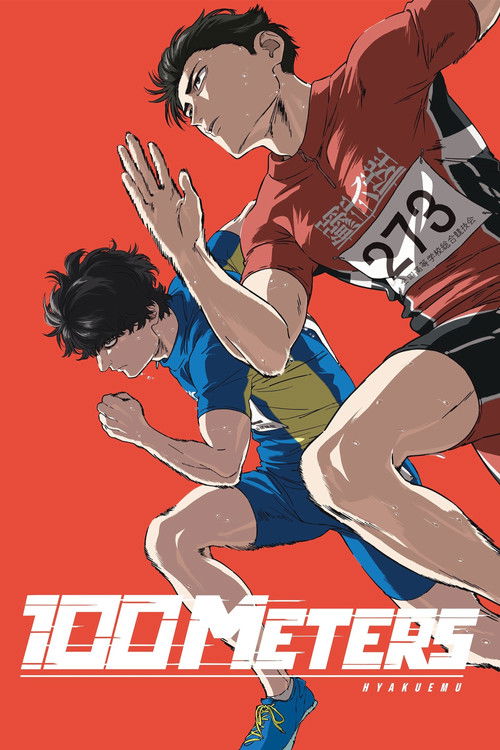
100 METERS
2025 · Kenji Iwaisawa
For when you want to feel fired up about your own life again — a get-back-to-work movie that earns its goosebumps. Comfort food for anyone who loves a rivalry that's really a friendship.
What it's about
A naturally gifted schoolboy sprinter teaches a lonely, awkward transfer student how to run — and unwittingly builds his own lifelong rival. Adapted from Uoto's manga, it follows the two of them from childhood through adolescence and into adulthood, their whole relationship compressed into a single event: the ten seconds of the 100-meter dash. It's a sports story, but really it's about talent versus obsession, and what you owe the person who pushes you.
The experience
The races hit like panic attacks — heartbeat, breath, blurred lanes — while the years between them move with a quiet, melancholy patience. It's inspiring in the way honest things are inspiring: it takes failure, plateaus, and self-doubt seriously before it lets you feel the rush.
The craft
Kenji Iwaisawa animates by hand at a small independent studio, and it shows in the best way: sprints rendered as raw, expressionistic bursts of line and motion rather than polished spectacle, with the style itself shifting to match how running feels from inside a body. The sound of footfalls, starting guns, and breath does enormous work — worth good speakers, and the race sequences beg for a big screen.
Why it matters
Iwaisawa's long-awaited second feature after his cult debut On-Gaku: Our Sound, it cements him as one of the most distinctive voices in independent Japanese animation working outside the big-studio pipeline.
Snapshot
100 Meters (Japanese title Hyakuemu, 100メートル) is a feature-length animated sports drama directed by Kenji Iwaisawa, adapted from the manga by Uoto and produced by the small Tokyo studio Rock 'n' Roll Mountain. It is Iwaisawa's second feature, arriving six years after his cult-praised debut On-Gaku: Our Sound (2019), and it confirms him as one of the most distinctive stylists working in independent Japanese animation. The premise is deceptively simple: Togashi, a naturally gifted sprinter, and Komiya, a lonely transfer student who latches onto running with obsessive determination, are bound together across childhood, adolescence, and adulthood by the same ten-second event — the 100-meter dash. Out of that brevity the film builds a long-form meditation on talent, failure, and self-improvement, rendered through an intensely physical, rotoscope-driven animation style that turns each sprint into a set piece of near-documentary corporeality. Premiering at the Annecy International Animation Film Festival in June 2025 before a Japanese theatrical release that September and a worldwide Netflix debut at the end of the year, it is both an auteur art film and a genre picture, and it was received as one of the more striking animated features of its year.
Industry & production
The film was produced by Rock 'n' Roll Mountain, the same modest studio associated with On-Gaku, and it belongs squarely to the tradition of small-scale, labor-intensive Japanese independent animation rather than to the industrial pipeline of the major TV-anime studios. It was announced publicly at Annecy in May 2024, roughly a year ahead of its festival premiere, and adapts a comparatively short-run manga: Uoto's 100 Meters was serialized on Kodansha's Magazine Pocket platform from November 2018 to August 2019 and collected in five volumes, growing out of an award-winning one-shot titled 100'M. (Uoto is now far better known for the historical epic Chi: On the Movements of the Earth, but 100 Meters predates that breakthrough.)
The adaptation gathered a notably experienced crew around Iwaisawa: a screenplay by veteran writer Yasuyuki Mutō, character designs by Keisuke Kojima, and a score by Hiroaki Tsutsumi. Distribution reflected the contemporary festival-to-streaming model: the world premiere came at Annecy on June 12, 2025; Japanese theaters followed on September 19, 2025; GKIDS handled the North American release in October, with an English dub, and Sugoi Co. released it in Australia; and Netflix carried it worldwide from December 31, 2025. The production's most-cited statistic captures its economy of ambition — a single rain-drenched sequence of roughly three minutes and forty seconds is reported to have required some 9,800 drawings and over a year to animate — a figure that signals a film made under artisanal rather than assembly-line conditions.
Technology
The film's defining technical choice is rotoscoping: animators worked over live-action reference footage, tracing and reinterpreting the recorded motion of real runners to achieve a naturalism of gait, weight, and acceleration that conventional key-frame animation rarely reaches. This is not a novelty grafted onto the project but the load-bearing method, particularly in the race sequences, where each character is given a subtly individuated sprinting form that visibly evolves as they train and mature. Around that rotoscoped figure animation the production layered a hybrid of digital and traditional craft: painted environmental backgrounds — tracks, stands, skies, rain — supply atmosphere and emotional register, while digital compositing binds the traced human motion to those hand-worked settings. The result reads as a deliberate tension between the photographic (motion sourced from real bodies) and the painterly (worlds rendered by hand), a combination Iwaisawa had already explored in the rotoscoped concert finale of On-Gaku and here extends across an entire feature.
Technique
Cinematography
In animation, "cinematography" lives in layout, virtual camera, and staging rather than in a lens, and 100 Meters uses those tools to dramatize velocity and spatial compression. Reviewers singled out the running sequences as the film's showpiece, emphasizing their physicality and detail; the 100-meter straight becomes a recurring axis of framing, exploited for lateral tracking that races alongside the runners, for foreshortened head-on approaches, and for the isolating geometry of marked lanes. Because the figure motion derives from live reference, the camera can hold on the body longer than stylized animation usually permits, letting the drama play out in the mechanics of stride and breath. Specific shot-by-shot description beyond what critics have documented would be speculative, but the consensus is clear that the film's visual argument is carried by kinetic, corporeally grounded coverage of the sprint itself.
Editing
The editorial problem the film sets itself is temporal paradox: a 100-meter race lasts around ten seconds, yet the story spans from elementary school to the adult professional circuit. The cutting therefore works on two scales at once — the microscopic dilation of individual races, where seconds are stretched into sustained sequences, and the macroscopic elision of years, compressing the passage from childhood rivalry to grown competition. This is a structure inherited from sports narrative but bent toward interiority. Some critics flagged pacing as the film's weaker dimension, noting that the long arc can feel uneven against the intensity of the race set pieces — a fair marker that the film's rhythmic ambitions are not uniformly sustained.
Mise-en-scène / staging
The painted backgrounds are central to the film's staging: environments are not merely backdrops but carriers of mood, with weather (the celebrated rain sequence above all) doing much of the emotional work. Character staging tracks the drama's central asymmetry — Togashi's ease and Komiya's isolation — positioning the outsider figure against crowds, empty tracks, and open skies to externalize loneliness and obsession. The supporting field of runners (the national-record holder Zaitsu, the injured junior champion Nigami, the supportive Asakusa) populates the world with rival forms and competing bodies, so that staging becomes a way of charting where each character stands in the sport's hierarchy at any given moment.
Sound
Hiroaki Tsutsumi's score anchors the film's emotional dynamics, and in a running drama sound design carries unusual weight: footfalls, breath, the starter's report, and the roar or hush of a crowd are the natural vocabulary of the 100-meter event. The precise mix strategies are not exhaustively documented in the available record, so it is safer to say that the film treats aural texture as a partner to its physical animation than to attribute specific silences or cues. Music-and-image integration was, notably, the entire subject of Iwaisawa's previous film, and 100 Meters extends that sensibility from rock performance to athletic rhythm.
Performance
Performance in 100 Meters is doubled. On one layer sits the vocal cast — Tori Matsuzaka, Shota Sometani, Koki Uchiyama, and Kenjiro Tsuda among the ensemble — delivering the interior and dramatic register of the characters; GKIDS and its dub partners produced an English-language version for Western release. On another layer sits the physical performance of the live-action reference runners whose motion the rotoscoping preserves: the film's characterization is partly athletic, expressed through how a body starts, drives, and decelerates. This division of labor — voice actors supplying psychology, reference performers supplying kinetics — is intrinsic to the rotoscope method and gives the running an authenticity that pure animation seldom achieves.
Narrative & dramatic mode
The film's dramatic mode is the bildungsroman crossed with the rivalry drama. It follows two protagonists from youth into professional adulthood, using the fixed constant of the 100 meters as a measuring stick against which growth, decline, pressure, and persistence are read. Togashi embodies the burden of natural talent — gifted, but vulnerable to the psychological weight of expectation — while Komiya embodies willed transformation, an outsider who converts obsession into competence. The rivalry is less a zero-sum contest than a mutual mirror, each runner defining the other. This is emotionally serious sports fiction: the animation-magazine and festival framing consistently describe a film about failure and self-improvement rather than triumph, and its long time-horizon lets it dwell on the cumulative texture of a life organized around a single, brutally short event.
Genre & cycle
100 Meters sits at the intersection of two cycles. It is a sports anime, drawing on a deep manga-and-anime lineage of athletic drama; but it stands apart from the typical shonen sports formula — tournament ladders, team ensembles, escalating spectacle — by narrowing to an individual event and an adult, introspective register. In this it belongs equally to the cycle of auteur-driven animated features aimed at older audiences and the festival circuit, alongside the wave of arthouse anime that streaming platforms and distributors like GKIDS have helped bring to Western attention. Its rotoscoped realism further distances it from genre convention, aligning it with a tradition of animation that pursues corporeal truth rather than stylized exaggeration.
Authorship & method
Iwaisawa is the film's clear author, and his method is the story of his career. On-Gaku: Our Sound was famously built over roughly seven years with Iwaisawa handling an extraordinary share of the labor himself — tens of thousands of hand-drawn frames, deadpan comic timing, and a rotoscoped festival climax that became the film's signature and won it the Grand Prize at the Ottawa International Animation Festival. 100 Meters scales that sensibility up into a more resourced production while keeping the handcrafted, rotoscope-forward identity intact. Here Iwaisawa works with named collaborators who shape the film's texture: screenwriter Yasuyuki Mutō adapts Uoto's manga into feature structure; character designer Keisuke Kojima translates the source's figures into animated form; composer Hiroaki Tsutsumi supplies the score; and Uoto's original manga furnishes the narrative spine and thematic preoccupations. The authorship is thus genuinely collaborative in execution while remaining unmistakably Iwaisawa's in style and method.
Movement / national cinema
The film belongs to the current of Japanese independent and auteur animation that operates outside the Ghibli-scaled and mass-TV-production systems — a space where a small studio and a strong individual vision can produce a feature on artisanal terms. Its rotoscope aesthetic connects it to a broader, cross-national lineage of the technique in animation, but within Japanese cinema specifically it exemplifies a 2020s tendency toward adult-oriented, formally adventurous animated features that reach international audiences via festivals and streaming rather than through domestic blockbuster machinery. That positioning — small studio, auteur director, global festival-and-Netflix distribution — is characteristic of how independent anime now travels.
Era / period
100 Meters is a product of the mid-2020s anime landscape, shaped by two forces: the festival circuit as a legitimizing venue for animated features (Annecy above all) and the streaming platforms as their primary means of global distribution (Netflix's worldwide release here). It also reflects the era's appetite for animation addressed to adults and to non-genre-native viewers, and for source material — like Uoto's introspective sports manga — that trades spectacle for psychological seriousness. The theatrical-then-streaming rollout across mid-to-late 2025 is a textbook example of the contemporary release architecture for prestige anime.
Themes
At its core the film is about the relationship between innate talent and cultivated effort, dramatized through the contrast of its two runners. The 100 meters functions as an existential compression: a distance short enough to be run in seconds yet demanding of years, so that the event becomes a metaphor for how much of a life can be invested in a single, unforgiving pursuit. Failure is a governing theme — the film is repeatedly described as an exploration of failure and self-improvement rather than of victory — and around it cluster loneliness and connection (Komiya's isolation and the bond the rivalry forges), the psychology of pressure (Togashi's struggle with the weight of his gift), and the passage of time (the arc from childhood to the professional circuit). The sprint's brevity and the narrative's length are held in productive tension: everything meaningful happens in ten seconds, and everything that makes those ten seconds possible takes a lifetime.
Reception, canon & influence
Critical reception was strongly positive. The film drew praise at its Annecy premiere and, in Western coverage, accumulated a near-unanimous positive critical record — reported as 100% positive across eighteen reviews on Rotten Tomatoes and a 72/100 on Metacritic — with the animation and rotoscoped running sequences singled out as its triumph and pacing the most common reservation. Commercially it was a modest but real success for an independent animated feature, with worldwide box office reported around $3.6 million and a strong showing on Netflix's non-English film chart during its premiere week; Japanese opening-weekend rankings placed it among the week's top films despite a limited footprint.
The influences flowing into the film are legible. Most immediate is Iwaisawa's own On-Gaku, whose rotoscoped climax is the direct methodological ancestor of 100 Meters' entire approach; behind that stands the longer tradition of rotoscoping in animation, used across decades and cultures to pursue lifelike human motion. On the narrative side, Uoto's manga and the wider heritage of Japanese sports storytelling supply the genre framework the film then reshapes toward art-cinema ends.
Its influence forward is, honestly, too early to assess — the film is only months old at the time of writing, and any claim about a lasting legacy would be premature. What can be said is that 100 Meters strengthens the case, already advanced by On-Gaku, that rotoscope-driven, artisanally produced independent anime can reach the festival circuit, prestige distributors, and a global streaming audience at once. If it proves durable, it will most plausibly be remembered as a landmark of that model and as the film that consolidated Kenji Iwaisawa's reputation beyond a single cult title.
Sources consulted for grounding include the Wikipedia entry on the 100 Meters manga and film adaptation), Sakuga Blog, Animation Magazine's interview with Kenji Iwaisawa, Slant Magazine's review, and Hypebeast's release coverage.
Reception
Too new for a reappraisal arc — it arrived already anointed: a buzzy Annecy 2025 world premiere, a GKIDS theatrical run in October, then a December Netflix drop that took it from festival darling to everybody's-seen-it in about three months.
How 100 METERS was received, from release to now →
How to watch 100 METERS: what to notice on a first viewing
- Watch the camera track laterally alongside each runner. The 100-meter straight becomes a recurring axis for the frame, racing beside the sprinters and cutting to foreshortened head-on approaches. The tracking puts you at running speed with them, rather than watching the race from a fixed spectator's seat.
- Notice how much weather does the emotional work. Painted backgrounds, especially a recurring rain sequence, carry mood the way a score might in another kind of film. Watch the sky before you watch the runners' faces; the environment is telling you how to feel first.
- Notice a ten-second race stretched into a long sequence. Individual sprints are dilated far beyond their real ten seconds, while whole years between races get compressed into almost nothing. The editing argues that a life's meaning concentrates into moments too short to properly live inside otherwise.
- Watch how differently the two runners' bodies move at the start. The rotoscoped motion, traced from real runners, gives each sprinter a distinct physical signature, easy stride against effortful drive. The animation lets you read character through how a body starts and accelerates, not just through dialogue.
The whole guide to watching 100 METERS, with the keys for a rewatch →
Influences: the films it descends from and the films it influenced
- On-Gaku: Our Sound (2019) — Its live-recorded rock-festival climax was traced frame-by-frame from filmed footage; 100 Meters expands that single rotoscoped set-piece into a feature-length running method and inherits its deadpan, minimalist figure-drawing over hand-painted stillness.
- Out of the Inkwell (Koko the Clown) (1919) — Fleischer's patented rotoscope device — projecting live-action footage to trace lifelike human movement frame-by-frame — is the root technology 100 Meters uses to render its sprinters' gait with photographic accuracy.
- Snow White and the Seven Dwarfs (1937) — Disney rotoscoped filmed actors to naturalize the human figures' walking and dancing, establishing rotoscope as a tool for grounding animated bodies in real kinesthetic weight — the same aim 100 Meters applies to athletic motion.
- Belladonna of Sadness (1973) — Its watercolor still frames animated chiefly by lateral camera pans across painted backgrounds is the direct precedent for 100 Meters' staging of painted backdrops swept past runners via lateral tracking.
- Chariots of Fire (1981) — It codified the slow-motion sprint scored to insistent rhythmic music, dilating race time into felt exertion — the exact time-dilation-plus-athletic-rhythm grammar 100 Meters translates into drawn frames.
- Mind Game (2004) — Its collage of hand-drawn animation with rotoscoped and photo-traced live-action faces pioneered the hybrid traditional/photographic register that 100 Meters adopts for its bodies-in-motion.
- Waking Life (2001) — Bob Sabiston's Rotoshop proved rotoscope could carry an entire auteur art-film rather than a single effect, legitimizing the artisanal digital-rotoscope feature model 100 Meters works within.
- A Scanner Darkly (2006) — Its interpolated rotoscoping refined the technique for narrative feature drama, demonstrating rotoscope as a means of stylizing performance rather than merely copying it — the balance 100 Meters strikes in its runners' faces.
- Flowers of Evil (Aku no Hana) (2013) — It pushed full-length rotoscoping into serialized Japanese animation to pursue an uncanny lifelike human motion, the closest domestic precedent for 100 Meters' rotoscope-forward realism.
- Ping Pong the Animation (2014) — It reinvented the sports anime by abstracting athletic bodies into elastic, smeared limb distortions timed to the game's rhythm, the art-cinema reworking of sport that 100 Meters continues by other means.
- REDLINE (2009) — Its wholly hand-drawn hyper-kinetic racing, where speed and motion are the film's entire subject, is a sibling pursuit of drawn velocity that 100 Meters channels into the 100-meter dash.
- The First Slam Dunk (2022) — A mangaka adapting his own sports manga used motion-capture-driven CG — a digital cousin of rotoscope — to capture real athletes' movement, the same manga-adaptation-meets-motion-realism problem 100 Meters solves with traditional rotoscope.
Similar films
- Look Back (2024) — influence & lineage · same viewing thread
- The First Slam Dunk (2022) — influence & lineage
- Blue Giant (2023) — influence & lineage
- Redline (2009) — influence & lineage
- Mind Game (2004) — influence & lineage
- Dou kyu sei – Classmates (2016) — same viewing thread
- The Boy and the Beast (2015) — same viewing thread
- Kaguya-sama: Love Is War -The First Kiss That Never Ends- (2022) — same viewing thread
All the films related to 100 METERS →
Watch it with: curated runs of related films
- Anime's Dreaming Adolescents — Watch these together for the ache of being young — first crushes, imaginary worlds, and the small transformations that feel enormous when you're inside them.