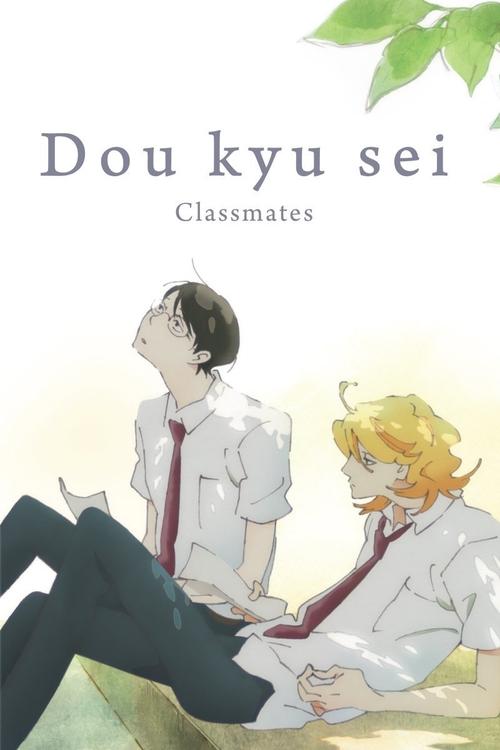
Dou kyu sei – Classmates
2016 · Shoko Nakamura
For when you want to feel your chest go warm — a short, soft, low-stakes romance for a quiet night in, no dread required. Pure comfort viewing that still leaves an ache.
What it's about
Two high schoolers who'd never otherwise cross paths — a bespectacled honor student who can't carry a tune and an easygoing guitarist popular with girls — start meeting after class when one offers to help the other sing for the school chorus festival. Out of those rehearsals grows something neither boy has words for yet. A first-love story told in an hour, small on purpose.
The experience
Gentle almost to the point of weightlessness — long silences, held breaths, the vertigo of noticing another person. It's sweet without being saccharine, and it treats every small gesture like the enormous event it actually is when you're seventeen.
The craft
The animation honors its manga source with pencil-thin linework, watercolor washes that bleed at the edges, and generous white space that lets a single glance fill the frame. Music is the film's architecture — two voices literally learning to harmonize — so good speakers earn their keep. At sixty minutes, not a frame is wasted.
Why it matters
A quiet landmark for boys' love animation: a same-sex first-love story with no tragedy, no coercion, and no apology, it reset what the genre could be and became a touchstone passed hand to hand among romance fans.
A sixty-minute miniature that became a landmark: Shoko Nakamura's adaptation of Asumiko Nakamura's manga about two boys — a bespectacled honor student and an easygoing guitarist — who drift together over rehearsals for a school chorus festival. Boys' love animation had long been a niche shaped by melodrama and troubling power dynamics; Doukyusei quietly reset the terms, telling a same-sex first-love story with no tragedy, no coercion, and no apology, just the ordinary vertigo of noticing another person. The style honors its source's delicacy — pencil-thin linework, watercolor washes that bleed at the edges, expanses of white that let a glance or a held breath fill the frame. Music is the film's whole architecture: two voices learning, literally, to harmonize. Produced by A-1 Pictures and directed by one of the few women then helming theatrical anime, it has since become a touchstone for a gentler, truer strain of queer romance in Japanese animation. Its most eloquent moments are nearly silent.
Reception
A modest Japanese theatrical release in February 2016 that quietly outperformed expectations for a boys-love film, it spent years hard to see in the West before word-of-mouth on Letterboxd and Tumblr turned it into the go-to answer for 'BL anime done right.'
How Dou kyu sei – Classmates was received, from release to now →
Influences: the films it descends from and the films it influenced
- Only Yesterday (1991) — Takahata's technique of rendering faces and backgrounds with soft, watercolor-thin edges and deliberately underfinished linework — leaving space blank to hold interior emotion — is the visual grammar Nakamura adapts into Doukyusei's sketch-and-wash palette.
- Whisper of the Heart (1995) — Establishes the Ghibli mode of building an adolescent first-love entirely from small everyday gestures, ambient room-tone and glances rather than plot beats — the low-incident, feeling-forward structure Doukyusei inherits.
- Ocean Waves (1993) — A short-feature TV-budget teen romance that proves emotional weight can come from restraint and understated staging, prefiguring Doukyusei's compressed short-feature runtime and refusal of melodrama.
- 5 Centimeters per Second (2007) — Structures romantic longing through ma — held negative space, empty frames and near-wordless montage set to music — the exact device Nakamura uses to let silence carry the confession scenes.
- The Garden of Words (2013) — A ~46-minute short feature where layered environmental sound (rain, station ambience) functions as emotional architecture around near-silent characters — the sound-as-architecture / near-silence pairing Doukyusei runs on.
- Colorful (2010) — Muted, desaturated realist palette and patient stillness applied to adolescent interiority — a precedent for treating a teen's inner life through quiet, unglamorous color rather than sparkle.
- Given (2019) — Extends Doukyusei's no-tragedy queer-romance reset into a band story where music is the emotional architecture — a warm BL feature that assumes the tender, non-doomed register Doukyusei made viable.
- The Stranger by the Shore (2020) — A gentle no-tragedy BL feature in a watercolor-soft seaside palette with unhurried near-silent pacing — the most direct heir to Doukyusei's warm-romance, soft-wash aesthetic.
- Twittering Birds Never Fly: The Clouds Gather (2020) — Follows Doukyusei in bringing adult BL to the theatrical feature form with a female director's restrained, character-interior framing — inheriting the theatrical-BL legitimacy Doukyusei's success opened.
- Words Bubble Up Like Soda Pop (2021) — Renders first love in flat pastel color fields and generous negative space, letting shy silence and a recurring musical/haiku motif structure the romance — Doukyusei's quiet-first-love grammar in a candy palette.
- Josee, the Tiger and the Fish (2020) — A short-feature romance that stages tenderness through soft light, restrained gesture and negative space rather than incident — continuing Doukyusei's low-key, feeling-first approach to young love.
- The Anthem of the Heart (2015) — Same A-1 Pictures house sensibility, using music (a song, a performance) as the literal structural spine of a repressed teen's emotional release — Doukyusei's music-as-architecture cousin from the same studio.
- A Silent Voice (2016) — Yamada's signature of framing hands, feet and averted gazes inside negative space, letting near-silence and body language voice what dialogue won't — the identical intimacy-through-omission craft as Doukyusei, released the same year.
- In This Corner of the World (2016) — Chooses a hand-drawn colored-pencil / watercolor surface texture over photoreal precision, valuing the softness of the mark itself — the same anti-slick, illustrative finish Doukyusei foregrounds.
- Liz and the Blue Bird (2018) — Fuses negative-space staging, near-silent glances and music-as-emotional-structure to render a queer-coded intimacy between two girls — the fullest sibling extension of Doukyusei's exact craft toolkit.
Similar films
- Liz and the Blue Bird (2018) — influence & lineage · same viewing thread
- In This Corner of the World (2016) — influence & lineage · same viewing thread
- Whisper of the Heart (1995) — influence & lineage · same viewing thread
- Kaguya-sama: Love Is War -The First Kiss That Never Ends- (2022) — same viewing thread
- Look Back (2024) — same viewing thread
- I Want to Eat Your Pancreas (2018) — same viewing thread
- 100 METERS (2025) — same viewing thread
- A Silent Voice: The Movie (2016) — same viewing thread
All the films related to Dou kyu sei – Classmates →
Watch it with: curated runs of related films
- Anime's Dreaming Adolescents — Watch these together for the ache of being young — first crushes, imaginary worlds, and the small transformations that feel enormous when you're inside them.