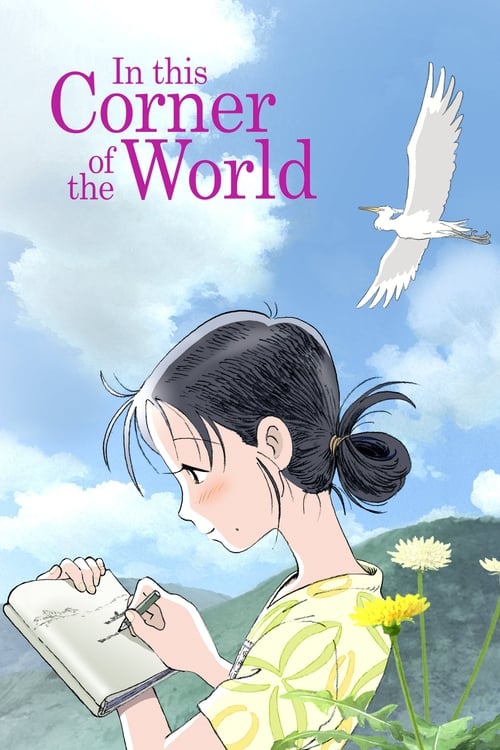
In This Corner of the World
2016 · Sunao Katabuchi
For when you want to feel something deep and true and don't mind crying — a slow, humane film for a quiet evening when you have the patience to let it accumulate.
What it's about
Suzu is a daydreaming young woman from a village near Hiroshima who, in 1943, marries into a family in Kure, a naval port city, and learns to run a wartime household. The film follows her through rationing, cooking, mending, and drawing — the small inventions of daily life — as the Pacific War creeps from the edges of her world toward its center.
The experience
Gentle, funny, and quietly heartbreaking — it lulls you with the warmth of ordinary routines so that each intrusion of the war lands with terrible force. Tender is the word, but it has a spine of steel.
The craft
The hand-drawn animation is built from meticulous period research — streets, ships, and kitchens reconstructed in soft watercolor light — and Suzu's own sketches bleed into the film's style, so her imagination becomes part of how it sees. Its restraint is the craft: history arrives at the frame's edges before it arrives at the door.
Why it matters
One of the most acclaimed Japanese animated films of its decade, it reframed how cinema depicts the Hiroshima era — through domestic daily life rather than spectacle — and stands as a landmark of adult-oriented anime.
Snapshot
In This Corner of the World (Kono Sekai no Katasumi ni) is a hand-drawn Japanese animated feature adapted from Fumiyo Kōno's manga, directed by Sunao Katabuchi and produced at studio MAPPA. It follows Suzu Urano, a gentle, absent-minded girl from a seaweed-harvesting family near Hiroshima, from her childhood in the 1930s through her marriage into the Hōjō household in the naval port city of Kure and into the final, catastrophic years of the Pacific War. Rather than staging the war as spectacle, the film anchors itself in domestic labor — rationing, cooking, mending, drawing — and lets history intrude at the edges of the frame until it finally arrives at the center. The result is one of the most acclaimed Japanese animated films of its decade, a work that reframes the atomic destruction of Hiroshima by watching it from an ordinary kitchen a few miles away. Its reputation rests on a rare fusion of meticulous historical reconstruction and a lyrical, watercolor-soft visual register drawn directly from its source manga.
Industry & production
The film emerged outside the dominant Studio Ghibli / Toho pipeline, and its financing became part of its legend. Katabuchi and producer Masao Maruyama — the veteran founder of Madhouse and, later, MAPPA — spent years developing the project, and the production famously turned to crowdfunding through the Japanese platform Makuake to help fund a pilot reel and demonstrate demand to backers. Maruyama, a tireless champion of director-driven animation, is widely credited with keeping the project alive across a long and difficult gestation. Production was carried out at MAPPA, then a relatively young studio, and the film was Katabuchi's return to features after Mai Mai Miracle (2009).
The film opened in Japanese cinemas in November 2016 on a modest number of screens and became a genuine sleeper: strong word of mouth and critical enthusiasm expanded its release and sustained an unusually long theatrical run. I will not cite specific gross figures, as I cannot verify them reliably, but its commercial trajectory — a slow-building, long-tail success rather than an opening-weekend event — is well documented in the trade record. In 2019, Katabuchi released a substantially extended version, In This Corner (and Other Corners) of the World, adding roughly forty minutes of footage that restored material trimmed from the theatrical cut, most notably deepening the subplot of Rin, a woman working in Kure's licensed pleasure quarter.
Technology
This is a fully hand-drawn 2D production executed with digital tools — digital ink-and-paint and compositing — rather than cel-based photochemical animation, in line with standard practice for its era. What distinguishes it technologically is not any single innovation but the disciplined subordination of the toolset to a soft, hand-made surface. The palette and line work are kept deliberately gentle, evoking colored pencil and watercolor wash to remain faithful to Kōno's manga art. Digital layering allowed the filmmakers to integrate delicate atmospheric elements — cloud banks, drifting smoke, the shifting light on Kure's harbor — while preserving the tactile imperfection of drawn animation. The film's most striking effects are stylistic rather than technical: sequences in which the image deliberately regresses into cruder, more abstract mark-making, discussed below.
Technique
Cinematography
As an animated work, the film's "cinematography" is a matter of virtual layout, framing, and staged depth. Katabuchi favors patient, often static or slow compositions that hold on domestic space — a stovetop, a sewing needle, a hillside path — treating everyday chores with the attentiveness usually reserved for dramatic action. Wide establishing views of Kure and Hiroshima are rendered with topographical care, so that the geography of the harbor, the hills, and the streetcar lines becomes legible and lived-in. The framing repeatedly locates Suzu at the margins of large events, literally placing her in a "corner" of the composition, so that warships, air raids, and finally the atomic flash appear as things glimpsed from a domestic vantage rather than confronted head-on.
Editing
The cutting is governed by the rhythms of daily life and the passage of seasons; title cards marking dates advance the chronology toward August 1945, lending an almost documentary, calendar-like structure to the accumulation of ordinary days. The pacing is deliberately unhurried in its first movements, which makes the compression and violence of the late-war sequences land with greater force. The editing credit is not well documented in English-language sources, so I will refrain from attributing it to a named individual; what is clear is the strategy — long stretches of gentle continuity punctuated by sudden, disorienting ruptures at moments of bombardment.
Mise-en-scène / staging
Staging is the film's great strength. The Hōjō home, the terraced hills of Kure, the ration lines, and the wartime kitchen are reconstructed with obsessive specificity, and the drama is built from the choreography of household work: stretching scarce rice, foraging for wild greens, hanging laundry between air-raid warnings. This granular materialism is thematic — it insists that history is lived through such gestures. Against this ordinariness, the intrusions of war are staged as violations of domestic order rather than as set pieces.
Sound
Sound design contributes crucially to the film's shift from idyll to horror. The naturalistic soundscape of daily life — cicadas, kitchen sounds, distant harbor noise — is periodically shattered by air-raid sirens and anti-aircraft fire. The score by Kotringo (Rieko Miyoshi) is spare and folk-inflected, built around gentle piano and voice. The film's use of "Kanashikute yarikirenai" ("Unbearably Sad"), a song originally associated with the 1960s group The Folk Crusaders, gives the film an aching musical motif that binds its emotional arc.
Performance
The voice performances are pitched toward understatement. The actress Non (Rena Nōnen) voices Suzu, and her soft, halting delivery is central to the characterization — dreamy, self-effacing, quietly resilient. The vocal ensemble around her renders the Hiroshima–Kure regional idiom and the textures of family life, and much of the film's emotional weight is carried by restraint: the performances rarely reach for melodrama even as the events turn devastating.
Narrative & dramatic mode
The film operates in a mode of accretive domestic realism rather than conventional dramatic plotting. There is no villain and little of the goal-driven structure of classical narrative; instead, the story accumulates the texture of one woman's days until the historical catastrophe becomes inseparable from the personal one. Its dramatic turn arrives when a delayed-action bomb kills Suzu's young niece Harumi and destroys Suzu's right hand — the hand with which she draws, so that the trauma is at once physical, familial, and creative. From there the film moves through the atomic bombing of Hiroshima (registered from Kure as a distant flash and a spreading horror), the Emperor's surrender broadcast, and a fraught, tentative healing. The famous surrender scene inverts expected sentiment: Suzu reacts not with relief but with fury and disillusion, a rupture in the national narrative that is among the film's most discussed passages.
Genre & cycle
The film belongs to the enduring cycle of Japanese anti-war and war-memory animation, and it is most often placed in dialogue with Isao Takahata's Grave of the Fireflies (1988) and the Barefoot Gen films. Within that lineage it is distinctly a home-front, women's-experience war film, aligned with the "everyday life" (nichijō) aesthetic that finds drama in the mundane. It is also a literary adaptation and a period drama, and it participates in a broader Japanese cultural project of memorializing 1945 — Kōno's own earlier work Town of Evening Calm, Country of Cherry Blossoms addressed the aftermath of Hiroshima directly, making In This Corner of the World part of her sustained engagement with that history.
Authorship & method
Sunao Katabuchi is the film's controlling authorial intelligence. He came up through the Studio Ghibli orbit — he is often noted as an assistant on Hayao Miyazaki's Kiki's Delivery Service — and directed Princess Arete (2001), the Black Lagoon television series, and the acclaimed Mai Mai Miracle (2009). His signature is an almost scholarly commitment to historical reconstruction: for this film he undertook extensive research into wartime Kure and Hiroshima, studying period photographs, maps, weather, and the layout of streets and buildings later erased, in order to rebuild the vanished city faithfully. He wrote the screenplay himself, adapting Kōno's manga, and worked with Chie Uratani in an assistant/associate directing capacity.
His key collaborators shaped the film's distinctive surface. The composer Kotringo provided both score and songs, and her folk-pop sensibility is inseparable from the film's tone. The animation direction and character design are credited to Hidenori Matsubara, a veteran animator, whose work translates Kōno's soft, rounded figures into movement while preserving their hand-drawn warmth. The source author, Fumiyo Kōno, is effectively a co-author in spirit: the film's visual language, its structural device of Suzu-as-artist, and its blend of gentle comedy and grief all derive from her manga. As noted above, the editing credit is not clearly established in the English-language record, and I decline to invent an attribution.
Movement / national cinema
The film is a landmark of post-Ghibli Japanese auteur animation — director-driven, hand-drawn, adult-oriented work produced outside the biggest studios. It helped announce MAPPA as a home for ambitious feature animation and stands alongside the mid-2010s surge of Japanese animated features that reached both domestic acclaim and international audiences. Within Japanese national cinema it occupies a notable place as an animated film embraced by the mainstream critical establishment, crossing the boundary that often separates anime from "serious" cinema in awards and critical discourse.
Era / period
Set principally between the 1930s and 1946, the film is a period reconstruction of the Japanese home front during the Second World War, centered on the naval city of Kure — a legitimate strategic target as home to the Imperial Japanese Navy — and its proximity to Hiroshima. It is unusually attentive to the material specifics of that era: wartime rationing and food substitution, civilian air-defense routines, the presence of warships (including, as a distant motif, the battleship Yamato), and the social world of a provincial military port, including its licensed brothels. The film's fidelity to the pre-bomb cityscape gives it documentary value as a reconstruction of places largely destroyed in August 1945.
Themes
At its core the film is about the persistence of ordinary life — and the ethics of ordinariness — under the pressure of total war. Suzu's creativity, her habit of transfiguring scarcity into small beauty, is both a survival strategy and the film's central metaphor; the loss of her drawing hand marks the war's assault on imagination itself. Other governing themes include the invisibility and labor of women on the home front; the tension between the state's grand narrative and individual experience, crystallized in Suzu's angry response to the surrender; complicity and innocence, as the film quietly acknowledges that the same "ordinary" citizens sustained a nation at war; and memory and erasure, as the film reconstructs a world that history obliterated. Grief and endurance intertwine without resolving into either despair or false uplift.
Reception, canon & influence
Critically, the film was received as a major achievement, praised for the delicacy of its animation, the depth of its research, and its refusal of both sentimentality and didacticism. It was widely honored in Japan; it received the Japan Academy Prize for Animation of the Year and was recognized by major Japanese critical bodies, and it was notably ranked at the top of Kinema Junpo's Best Ten for 2016 — a rare distinction for an animated film competing against live-action cinema, which I flag as the most striking marker of its critical standing. (I state the specific slate of awards conservatively, as citations vary across sources.) It also traveled internationally to festival and arthouse audiences, extending Katabuchi's reputation abroad.
Its influences run backward to Kōno's manga above all, and beyond that to the tradition of Japanese war-memory animation — the shadow of Grave of the Fireflies is impossible to ignore, though Katabuchi's film is gentler and more diffuse in its structure. The Ghibli inheritance, particularly Takahata's interest in the textures of the everyday, is also palpable. Looking forward, its legacy is twofold: it strengthened the commercial and critical case for serious, historically grounded, hand-drawn feature animation aimed at adult audiences, and it consolidated MAPPA's and Katabuchi's standing. Katabuchi's subsequent return to the material in the 2019 extended edition underscores the film's status as a living, revisited work rather than a fixed text — an ongoing act of remembrance consistent with the film's own preoccupations. Its most durable influence may be as a model of how animation can reconstruct historical trauma from the margins, through the "corner" of ordinary life rather than the center of catastrophe.
Reception
It opened quietly in Japan on just 63 screens in late 2016, then word of mouth kept it in theaters for over a year — and it famously beat the box-office juggernaut Your Name for the Japan Academy Prize for Animation of the Year.
How In This Corner of the World was received, from release to now →
How to watch In This Corner of the World: what to notice on a first viewing
- Watch where Suzu stands in the frame during big events. Katabuchi keeps placing her at the edge of the composition, so warships and air raids are glimpsed from a domestic corner rather than shown head on. History enters this film sideways, exactly the way it would enter an ordinary life.
- Notice the date cards counting down toward 1945. Title cards mark the calendar across the film, giving the accumulation of ordinary days an almost documentary structure as the dates close in on a known catastrophe. You are always aware of how much time is left, even when nothing dramatic is happening.
- Listen for ordinary sound getting cut off by a siren. Cicadas and kitchen noise carry most scenes, then an air-raid siren or anti-aircraft fire breaks in abruptly, with no musical cue preparing you for it. The interruption is meant to feel like a violation of daily life, not a set piece.
- Watch how much time the film gives to ordinary chores. Stretching rice, foraging greens, hanging laundry between air-raid warnings are staged with the same care other films give to action scenes. The film insists history is lived through exactly this kind of labor, not around it.
- Watch Suzu's voice stay soft even as things get harder. Non voices her with a halting, dreamy delivery that barely changes register as the story moves from comedy toward hardship. The restraint keeps the film from telling you how to feel about what is happening to her.
The whole guide to watching In This Corner of the World, with the keys for a rewatch →
Influences: the films it descends from and the films it influenced
- Grave of the Fireflies (1988) — Establishes the WWII home-front-from-the-margins template Katabuchi inherits — civilian domestic detail (food, chores, weather) rendered with documentary precision, then punctured by sudden ruptures of bombing violence rather than framed as battlefield spectacle.
- Only Yesterday (1991) — Model for the calendar/seasonal-memory chronology and the elevation of a woman's ordinary agricultural and domestic labor into the actual substance of narrative, interleaving remembered time with present tense.
- My Neighbors the Yamadas (1999) — Pioneers the soft watercolor line that preserves the sketch's hand-drawn warmth and the accretive, episodic vignette structure — small domestic comedy accumulating into meaning — that Suzu's daily life is built from.
- Kiki's Delivery Service (1989) — Katabuchi worked as assistant director here, learning the choreography of mundane labor — sweeping, baking, hanging laundry — animated as full physical performance, which becomes Suzu's domestic-labor staging.
- The Wind Rises (2013) — Parallel project of scholarly period reconstruction of 1930s–40s Japan in hand-drawn 2D, and shares the strategy of rendering wartime machinery/soundscape through stylized, non-naturalistic aural design against everyday calm.
- Mai Mai Miracle (2009) — Katabuchi's own prior method: reconstructing a vanished historical Japanese town from period photographs and maps, and overlaying a child's imaginative vision onto the real landscape — directly rehearsing this film's research praxis and Suzu's imagination.
- Princess Arete (2001) — His earlier authorship establishes the restrained, non-heroic female protagonist and the understated staging that resists melodramatic emphasis, seeding the 'ordinariness' register.
- Barefoot Gen (1983) — Precedent for animating the Hiroshima atomic bombing itself — the technique of shattering a naturalistic domestic soundscape and visual field with the blast's white rupture, which Katabuchi echoes in his handling of the explosion and its aftermath.
- Who's Left Behind? (Ushiro no Shōmen Daare) (1991) — Earlier home-front animation narrated through a girl/woman's-eye view of daily Tokyo wartime life — rationing, air-raid routine, family — sharing the accretive-domestic-realism approach to total war seen from ordinary rooms.
- Nausicaä of the Valley of the Wind (1984) — Foundational Ghibli-orbit training text for the marginal, off-center framing and static compositions that hold characters at the edge of the frame within a fully imagined environment, a spatial grammar Katabuchi adopts for Suzu's cornered viewpoint.
- From Up on Poppy Hill (2011) — Carries forward the hand-drawn everyday-life reconstruction of a precise Shōwa historical moment, foregrounding ordinary domestic labor lived against national history.
- Okko's Inn (2018) — Later hand-drawn feature built on quotidian domestic-labor choreography — a girl learning the physical routines of running an inn — extending the post-Ghibli auteur mode of animating ordinary work with tactile realism for adult-inclusive audiences.
- The Wonderland / historically-grounded 2D features post-2016 (2019) — Its Kinema Junpo top ranking strengthened the commercial-critical case for serious, research-driven hand-drawn adult features, a legacy carried by MAPPA-adjacent and post-Ghibli auteur productions that treat 2D animation as a vehicle for historical reconstruction.
- The Tale of the Princess Kaguya (2013) — Shares the 'hand-as-imagination' device by leaving the drawn brushstroke visibly unfinished and expressive, foregrounding the mark-making gesture the way Suzu's own drawing and watercolor sequences do.
- Millennium Actress (2001) — Shares the era-spanning rupture editing that folds a woman's life across 20th-century Japanese history via match-cut transitions, a montage grammar cousin to this film's calendar-chronology and rupture-punctuation.
- Town of Evening Calm, Country of Cherry Blossoms (2007) — Adapts Fumiyo Kōno's other Hiroshima manga; shares the source author's tonal signature — gentle everyday comedy braided with atomic grief, memory transmitted through quiet domestic ordinariness rather than catastrophe's center.
- Giovanni's Island (2014) — Contemporary hand-drawn WWII/postwar home-front film centering children in soft, rounded character design with meticulous historical-location reconstruction, extending the same margin-of-catastrophe realism.
- A Silent Voice: The Movie (2016) — Contemporary sibling in emotional understatement — accumulating tiny domestic gestures so that trauma lands obliquely, never announced.
- Dou kyu sei – Classmates (2016) — Chooses a hand-drawn colored-pencil / watercolor surface texture over photoreal precision, valuing the softness of the mark itself — the same anti-slick, illustrative finish Doukyusei foregrounds.
- Violet Evergarden: The Movie (2020) — Absorbs wartime loss into quiet domestic routine with soft hand-drawn tactility rather than spectacle — the same 'grief metabolized through daily craft' approach in a postwar setting.
- Wolf Children (2012) — Shares the durational realism of domestic labor — cooking, chores, household improvisation rendered in delicate everyday texture — building an animated melodrama around a woman's ordinary, unspectacular heroism.
- When Marnie Was There (2014) — A sibling in realist hand-drawn animation of a girl's everyday interior life, using watercolor-soft environments and ambient period detail rather than spectacle to carry memory and loss.
- Suzume (2022) — Contemporary anime that maps national catastrophe onto specific geography and everyday endurance, a memory-of-disaster companion to Suzume's journey across real, named Japanese sites of loss.
- Maquia: When the Promised Flower Blooms (2018) — Shares the accumulating-loss structure built from everyday domestic texture and ellipsis-driven time skips, an unsentimental melodrama that earns catharsis through the patient rendering of ordinary life.
- Jin-Roh: The Wolf Brigade (1999) — Katabuchi's restrained, everyday-realist hand-drawn wartime tragedy continues the lineage of anime as austere, morally serious historical drama that eschews action-genre concessions.
Similar films
- Grave of the Fireflies (1988) — influence & lineage
- The Tale of The Princess Kaguya (2013) — influence & lineage
- Only Yesterday (1991) — influence & lineage
- Barefoot Gen (1983) — influence & lineage
- The Wind Rises (2013) — influence & lineage
- Kiki's Delivery Service (1989) — influence & lineage
- I Want to Eat Your Pancreas (2018) — same viewing thread · often watched together
- Suzume (2022) — same viewing thread
All the films related to In This Corner of the World →
Watch it with: curated runs of related films
- Anime's Dreaming Adolescents — Watch these together for the ache of being young — first crushes, imaginary worlds, and the small transformations that feel enormous when you're inside them.