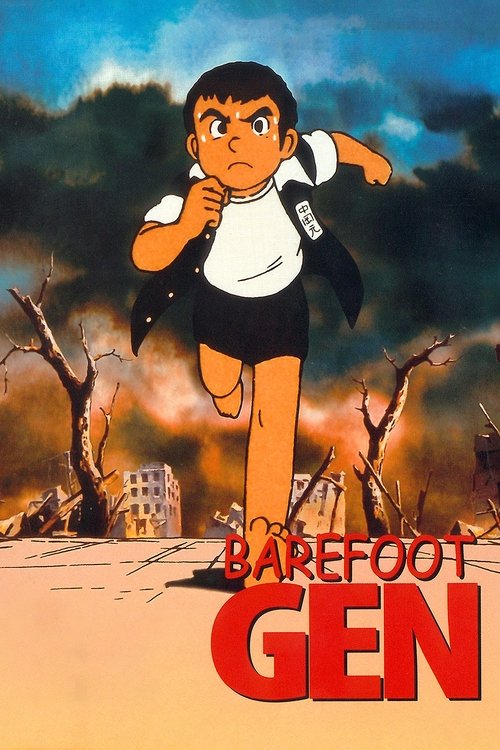
Barefoot Gen
1983 · Mori Masaki
Not a casual watch — reach for it when you're ready to be devastated by something true, and when you want to understand what nuclear war actually means at the level of one family. It rewards courage more than comfort.
What it's about
Hiroshima, the last days of the war. Six-year-old Gen Nakaoka lives with his family through rationing, air-raid sirens, and hunger — until the morning of August 6, 1945, when the atomic bomb falls on his city. Adapted from Keiji Nakazawa's autobiographical manga — Nakazawa was himself a child survivor of Hiroshima — the film follows Gen and his family through the blast and the scorched days after, as a boy tries to keep the people he loves alive in a city that has ceased to exist.
The experience
It starts warm, almost gentle — a family drawn with cartoon roundness — and then becomes one of the most harrowing things ever put in animation. The tenderness never leaves, which is exactly what makes the horror land; you come out shaken, and grateful for every small act of stubborn hope the film insists on.
The craft
The animation dares to show what live action barely could: the bomb sequence renders the instant of the blast with an unflinching, almost documentary specificity that no photograph survives to give us. The soft, child-friendly character designs collide with imagery of ruin and radiation sickness, and that collision is the film's whole method — innocence and catastrophe drawn in the same hand.
Why it matters
A fixture of peace education in Japan, shown to generations of schoolchildren, and a landmark proof that animation could carry the heaviest historical testimony. It stands with the essential works of atomic-bomb memory, made by a survivor's own account.
Snapshot
Barefoot Gen (Hadashi no Gen) is an animated feature that dramatizes the atomic bombing of Hiroshima and its aftermath through the eyes of Gen Nakaoka, a boy of roughly six years old whose family is caught in the catastrophe of August 6, 1945. Adapted from the long-running autobiographical manga by Keiji Nakazawa — himself a Hiroshima survivor (hibakusha) who was near the hypocenter as a child — the film compresses the manga's opening arc into a roughly ninety-minute account that moves from the anxious final days of wartime scarcity, through the blinding instant of the bomb, into the scorched, corpse-strewn city and the improvised survival that follows. It is one of the most unflinching depictions of nuclear war ever committed to animation, and its cultural function in Japan — as a fixture of peace education shown to schoolchildren for decades — is inseparable from its status as a film. The dossier below treats it as a work of animated cinema and as a document of testimony, tracing how its production circumstances, its craft choices, and its moral urgency reinforce one another.
Industry & production
The film was produced in the early 1980s within the Japanese theatrical-anime economy, animated by Madhouse, the studio founded in 1972 by animators including Osamu Dezaki and Rintaro that had built a reputation for artistically ambitious, often adult-facing work distinct from the television-franchise mainstream. The project's defining feature is that it originated less from a commercial studio calculation than from the source material's standing as a landmark of anti-war literature. Nakazawa's manga had been serialized from the early 1970s (beginning in Weekly Shōnen Jump) and had already reached international readers through a pioneering volunteer translation effort, giving the story a grassroots constituency invested in seeing it adapted with fidelity to its testimony rather than softened for entertainment. Contemporary accounts describe the production as bound up with citizen and peace-movement support rather than a purely industrial financing model; the precise financial architecture and any box-office figures are not something I can state reliably, and I will not invent numbers — on the commercial specifics the public record available to me is thin. What is clear is that the film was made as a theatrical feature with the moral weight of Nakazawa's survivor account behind it, and that it was successful enough culturally to spawn a sequel, Barefoot Gen 2, in 1986 (directed by Toshio Hirata), covering the manga's later chapters.
Technology
Barefoot Gen is a work of traditional hand-drawn cel animation, produced photochemically on 35mm in the pre-digital era: pencil drawings inked and painted onto celluloid sheets, laid over painted background art, and shot frame by frame under an animation camera. This technological baseline matters to the film's meaning. The bomb's central event — a sudden, total whiteout of light — is achievable through the medium's fundamentals: overexposure of the frame, the sheer white of the cel, and the abrupt discontinuity that hand-drawn animation can execute between one image and the next. The horrors that follow (skin sloughing from bodies, figures reduced to shadow and ash) are rendered through drawing and paint rather than photographed reality, which is precisely what lets the film show what live action could not stage without either falling short or becoming unwatchable. There is no meaningful use of the era's nascent computer imagery here; the film's power is entirely a matter of draftsmanship, ink, paint, and the optical printer, and its restraint or explicitness is a decision made at the drawing board.
Technique
Cinematography
Because this is animation, "cinematography" describes the design of layouts, the implied camera, and the compositing of drawn elements. The film's visual grammar shifts deliberately across its two great movements. The pre-bomb Hiroshima is staged with relatively stable, legible framing — domestic interiors, streets, the human scale of a family scraping by — establishing an ordinary world so that its annihilation registers. The bombing itself is the film's cinematographic tour de force: the approach of the aircraft, the fall, and then the flash handled as a violent rupture in the image plane, followed by imagery of the blast wave and the fireball that abandons naturalistic framing for something closer to nightmare. In the ruined city, the "camera" surveys devastation in long, held compositions that force the viewer to look. The film is unafraid of the tableau — arranging its horror within the frame and refusing to cut away — which is its most consequential formal decision.
Editing
The editing enacts the story's structural break. The first act accumulates domestic detail at a measured pace, building attachment to the Nakaoka family. The bomb functions as an editorial caesura — an instant that severs the film into "before" and "after." What follows is looser and more episodic, tracking survival across a shattered landscape in a series of encounters and ordeals rather than a tightly plotted arc, mirroring the manga's serial origins. This rhythm — patient setup, catastrophic pivot, and then a harrowing, wandering aftermath — is the film's fundamental shape.
Mise-en-scène / staging
Staging is where the film's testimony lives. The production is meticulous about the material texture of wartime Hiroshima: the scarcity, the makeshift meals, the civilian-defense routines, the specific fabric of a working-class family's home. This groundedness is a moral strategy — the more ordinary and specific the world, the more devastating its erasure. In the aftermath, the mise-en-scène becomes a catalog of the bomb's effects rendered with a directness that was, and remains, startling for animation: bodies with skin hanging loose, the dead and dying filling the frame, a child moving through a hellscape. The staging never treats this as spectacle for its own sake; it is presented as witness, held long enough to be understood rather than consumed.
Sound
Sound is used both for realism and for rupture. The score, credited to Kentarō Haneda, works against the imagery in the film's most affecting passages, and the sound design marks the bombing with the medium's tools — the silence-then-roar of the blast, the ambient horror of the burning city. As with the visuals, the strongest choices are often the sparest: allowing the imagery of suffering to carry with minimal underscoring. I will not attribute specific cues or claim details of the mix I cannot verify.
Performance
Performance in animation resides in two registers: character animation and voice. The character animation carries the film's emotional range from the boisterous energy of Gen — a resilient, almost defiantly lively child — to the collapse of adults under grief and radiation sickness. Gen's physical vitality is itself a performance choice, a life-force set against death. The voice cast delivers the family dynamic and the shifts from ordinary bickering to terror and mourning; I am not able to reliably attribute individual voice roles here and will not guess at casting.
Narrative & dramatic mode
The film's dramatic mode is testimony rendered as melodrama in the classical sense — heightened family feeling under extreme circumstance — anchored by autobiographical truth. It is structured around a child protagonist, which is decisive: Gen's limited comprehension and undimmable will give the audience both an innocent's-eye view of atrocity and a figure of endurance to hold onto. The narrative refuses consolation of the easy kind. Death arrives arbitrarily and en masse; the family that the first act so carefully builds is largely destroyed; survival is not victory but a grim continuation. Yet the film is not nihilistic — Gen's persistence, and the symbolic imagery of regrowth associated with him, frame endurance itself as the meaning. This tension between unbearable loss and stubborn life is the film's dramatic engine.
Genre & cycle
Barefoot Gen sits at the intersection of the war film, the animated feature, and the specifically Japanese genre of hibakusha narrative — art made by and about atomic-bomb survivors. It belongs to a broader postwar Japanese reckoning with the bomb that spans literature, live-action cinema, and the kaijū allegory of the Godzilla films, but it is distinguished by its refusal of allegory: it depicts the event itself, literally, from a child's vantage. Within animation, it is part of a small but crucial cycle of anime that treats the Second World War's civilian catastrophe with adult seriousness. It is most often discussed alongside Isao Takahata's later Grave of the Fireflies (1988), the two forming an informal pair in critical conversation about anime as a vehicle for historical mourning — though Barefoot Gen precedes that film by several years.
Authorship & method
The film is a collaboration between two authorial forces. The first is Keiji Nakazawa (1939–2012), the manga's creator, whose autobiographical experience is the work's foundation: as a child he survived the bombing while members of his family perished, and Barefoot Gen transmutes that trauma into narrative. His authorship is the film's moral and factual spine, and the adaptation's fidelity to the source's unsparing honesty reflects his continuing stake in it. The second is director Mori Masaki, whose task was to translate Nakazawa's sprawling, serialized testimony into a coherent feature and to make the fateful decision of how much to show — a decision he resolved on the side of directness. The score is credited to composer Kentarō Haneda, and the animation was executed at Madhouse. On the finer division of labor — precise screenwriting, editing, and key-animation credits — I will note honestly that I cannot confirm every individual attribution and decline to fabricate them; the essential authorial fact is the partnership of a survivor's testimony with a director willing to honor it uncompromisingly.
Movement / national cinema
The film is a product of Japanese animation's maturation into a medium capable of serious historical and political subject matter, distinct from the export-oriented robot and fantasy franchises of its era. It is deeply national — rooted in Hiroshima, in the specific catastrophe of Japanese civilians, and in Japan's postwar culture of memory and peace advocacy. At the same time, Nakazawa's manga was among the first to travel abroad through grassroots translation, so the film arrived with an existing international audience predisposed to receive it as a universal anti-war statement rather than a purely domestic one. It thus occupies a hinge between national testimony and global humanist appeal.
Era / period
Made in 1983, the film emerges into the renewed nuclear anxiety of the late Cold War, when arms-race tensions and anti-nuclear movements were resurgent worldwide. Depicting 1945, it speaks pointedly to its own moment: a reminder, addressed to a generation with no direct memory of the war, of what nuclear weapons actually do to human bodies and cities. Its period setting and its year of release are in dialogue, the historical horror mobilized as contemporary warning.
Themes
The film's governing theme is the human cost of nuclear war rendered concrete and personal — not statistics but a specific family, a specific child. Bound to this is an anti-war and anti-militarist argument that, in Nakazawa's source, extends to critique of the wartime state and the ideology that led ordinary people to ruin. A second major theme is endurance and the persistence of life: Gen's irrepressible vitality, and the recurring imagery of new growth from scorched earth, insist on continuation against annihilation. Family, and its shattering, is the emotional heart. And underlying all of it is the ethical imperative of witness — the conviction that these horrors must be shown, not sanitized, so that they are neither forgotten nor repeated.
Reception, canon & influence
Barefoot Gen is canonized less through conventional critical acclaim than through its enduring cultural function: in Japan it became a standard text of peace education, shown to generations of schoolchildren, and internationally it stands as a reference point in any serious discussion of animation's capacity to address atrocity. Its reputation rests above all on its moral courage — its willingness to depict the unbearable — which critics and viewers have long regarded as its defining achievement.
Influences on the film (backward): The overwhelming source is Nakazawa's own experience and his manga, itself part of the postwar hibakusha literary and artistic tradition of bearing witness to the bomb. The manga's serialization in a mass-market boys' magazine also shaped the film's accessible, child-centered mode of address.
Legacy (forward): The most concrete descendant is the direct sequel, Barefoot Gen 2 (1986). More broadly, the film helped establish anime as a legitimate vehicle for grave historical subject matter and is perpetually discussed in tandem with Grave of the Fireflies as part of that lineage — though direct causal influence on Takahata's film is not something I can assert, and the two are best understood as companion works in a shared project of animated mourning. Its most lasting influence may be pedagogical and ethical: it set a benchmark for confronting nuclear horror honestly on screen, and it remains, decades on, a primary means by which the reality of Hiroshima is transmitted to those who did not live it.
Reception
A modest release in 1983 Japan, it spread abroad through grainy VHS dubs and classroom screenings, and is now firmly canonized alongside Grave of the Fireflies as one of the essential anti-war anime — often described as the more unflinching of the two.
How Barefoot Gen was received, from release to now →
How to watch Barefoot Gen: what to notice on a first viewing
- Watch the ordinary meals and routines of one family. The film spends real time on Gen's family's daily scarcity and small comforts before anything else happens, building a specific, lived-in household. The detail is deliberate. The more ordinary this family feels, the harder what comes next lands.
- Watch the screen turn to pure white without warning. At the moment of the blast, the animation breaks from its normal drawn style into a sudden overexposed whiteout, a visual discontinuity unlike anything before it in the film. The image itself breaks apart, not just the world inside it.
- Notice how long the camera holds on the ruins. In the aftermath, the film lingers on devastated streets in long, static compositions rather than cutting quickly away from what it shows. You are being asked to actually look, not to glance and move on.
- Watch how much energy Gen's body has before the bomb. The character animation gives Gen a boisterous, almost defiantly lively physicality in the early scenes, distinct from the more subdued adults around him. His vitality is built into the drawing itself, a life force set against everything to come.
- Notice the film's rhythm change after a single moment. The first act moves at a patient, accumulating pace, then the storytelling loosens into a series of separate encounters and ordeals rather than one tight plot line. The structure itself marks the difference between a world that was ordered and one that no longer is.
The whole guide to watching Barefoot Gen, with the keys for a rewatch →
Influences: the films it descends from and the films it influenced
- Children of Hiroshima (1952) — Establishes the hibakusha aftermath-catalog mode Gen inherits — a survivor moving through a landscape of scarred and dying bodies, testimony structured as a guided witnessing of injury rather than plot.
- Hiroshima (1953) — Its mass-tableau reconstruction of the blast and the queues of the burned — held, populated wide shots of the wounded — is the live-action template for Gen's held-tableau staging of the ruined city.
- Hiroshima Mon Amour (1959) — Codifies the whiteout/flash cut and the fusing of archival aftermath imagery with the witness imperative — the argument that the bomb can only be approached through the impossibility of showing it, which Gen answers by choosing to show.
- Night and Fog (1955) — The slow tracking survey of an atrocity's physical residue as an ethical act of cataloging sets the model for Gen's aftermath-catalog staging and its refusal to look away.
- Fires on the Plain (1959) — Its unflinching rendering of wartime bodily degradation — starvation, decay, the human reduced to flesh — licenses Gen's directness in depicting melting and burned bodies without euphemism.
- Bambi (1942) — The cel-animation prototype for a child-innocent's endurance through catastrophe — the offscreen death of a parent and the fire-whiteout forest — that Gen weaponizes toward historical horror.
- Astro Boy (1963) — The boys'-magazine child-hero mode and the big-eyed cel idiom Madhouse animators were trained in — the very accessibility of address that lets Gen smuggle atrocity to schoolchildren.
- Barefoot Gen 2 (1986) — Direct sequel that continues the same survivor-testimony melodrama and endurance-regrowth arc, extending Nakazawa's autobiography into the reconstruction years.
- Grave of the Fireflies (1988) — The companion work in animated mourning — a child protagonist and younger sibling starving in wartime Japan, built on held domestic tableaux and score-against-image, sharing Gen's project of civilian testimony.
- Akira (1988) — Turns Gen's whiteout blast-flash and expanding annihilating shockwave into a signature formal device of adult anime, carrying the nuclear-caesura image into a new register.
- Persepolis (2007) — Adapts the author's own autobiographical comic into stylized cel animation, inheriting Gen's model of animation as a legitimate vehicle for a child-protagonist's first-person historical testimony.
- Waltz with Bashir (2008) — Uses animation to reconstruct war trauma as testimony and then breaks to un-animated atrocity footage — the direct descendant of Gen's wager that drawn images can carry the witness imperative.
- In This Corner of the World (2016) — Renders home-front child vitality in the Hiroshima region up to the bomb's whiteout flash and aftermath, extending Gen's fusion of everyday endurance with the catastrophic caesura.
- Giovanni's Island (2014) — Continues the animated child-protagonist testimony-melodrama of war's aftermath, using held tableaux and endurance-regrowth to transmit historical trauma to a young audience.
- Godzilla Minus One (2023) — Mori's hibakusha-survival narrative renders institutional abandonment as the failure to deliver food and medicine rather than as military defeat, and structures atomic aftermath through a child civilian's unbroken POV — the survivor-guilt-as-forward-drive grammar Yamazaki transposes into Kōichi's failed-kamikaze backstory as the engine of the whole film.
- When the Wind Blows (1986) — Animates the nuclear attack via the same whiteout blast-flash and then the slow onset of radiation sickness, scoring domestic ordinariness against oncoming annihilation exactly as Gen does.
- Threads (1984) — Shares the late-Cold-War structure of banal domestic life ruptured by a catastrophic caesura, then a clinical aftermath-catalog of societal and bodily breakdown.
- Black Rain (1989) — Live-action hibakusha narrative built on delayed radiation sickness and quiet aftermath testimony, extending the same witness imperative into the years after the flash.
Similar films
- Akira (1988) — influence & lineage · same viewing thread
- When the Wind Blows (1986) — influence & lineage · often watched together
- Grave of the Fireflies (1988) — influence & lineage
- In This Corner of the World (2016) — influence & lineage
- Fires on the Plain (1959) — influence & lineage
- Waltz with Bashir (2008) — influence & lineage
- Hiroshima Mon Amour (1959) — influence & lineage
- Battle Royale (2000) — same viewing thread · often watched together
All the films related to Barefoot Gen →
Watch it with: curated runs of related films
- Bodies at the End of the World — A run of visionary, punishing films where flesh is scarred, melted, mechanized or sacrificed while the world tips into its last days — watch these back to back when you want cinema at its most extreme and transcendent.