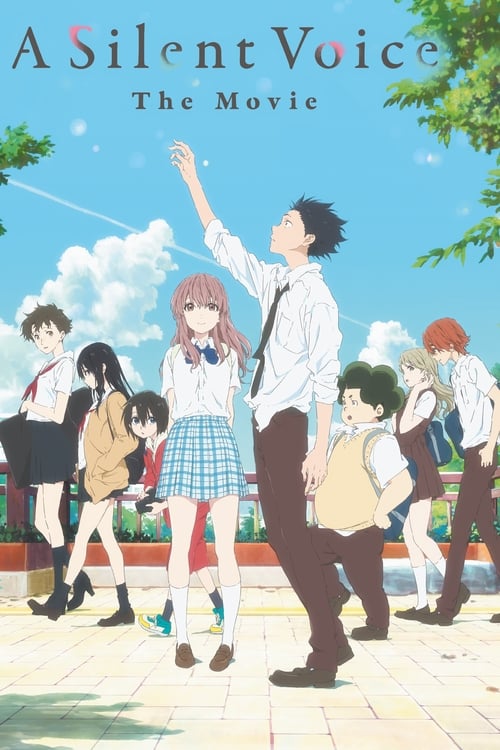
A Silent Voice: The Movie
2016 · Naoko Yamada
For when you need a good cry and want it to mean something — or when you're chewing on guilt, forgiveness, or your own school years. Heavy in places, but it leaves you consoled rather than crushed.
What it's about
In elementary school, Shouya led the class in bullying Shouko, the new girl, because she was deaf — until the cruelty rebounded and made him the outcast. Years later, a withdrawn, guilt-crushed teenage Shouya seeks her out, and the film follows his halting attempt to make amends, rebuild the friendships he burned, and figure out whether he's allowed to forgive himself.
The experience
Quiet, delicate, and emotionally enormous — it inhabits social anxiety so precisely you feel it in your chest, then releases the pressure in scenes of almost unbearable tenderness. Expect to cry; it deals frankly with bullying, isolation, and suicidal feelings, and it earns every tear.
The craft
Naoko Yamada directs with radical restraint: she frames people at knees and feet so posture speaks where faces won't, and covers classmates' faces with floating X marks — social anxiety made instantly visible. Kensuke Ushio's score, built partly from sounds recorded inside a piano, hums at the threshold of hearing; watch it with good sound and the design of silence itself becomes the point.
Why it matters
It confirmed Yamada as one of animation's great directors and became a touchstone for how animated film can handle disability, bullying, and mental health with seriousness and grace.
Naoko Yamada, the finest director to emerge from Kyoto Animation, adapts Yoshitoki Ōima's manga about a former bully seeking out the deaf girl he tormented in elementary school — a premise that sounds like an apology tour and becomes something far thornier: a study of shame, self-erasure, and the near-impossibility of forgiving yourself. Yamada's craft signature is radical restraint. She frames people at the knees and feet, letting posture carry what faces won't; she cancels the faces of her protagonist's classmates with floating X marks, a visualization of social anxiety so intuitive it barely needs explaining. Kensuke Ushio's score, built partly from sounds recorded inside a piano, hums at the threshold of hearing — apt for a film in which communication keeps failing across the gap between sound and silence. Released the same year as Your Name and initially overshadowed by it, A Silent Voice has steadily emerged as the more formally daring work, and Yamada — one of the few women to direct at this level in the anime industry — as a filmmaker whose gentleness is a form of precision.
A Deleuzian reading
An X floats over a classmate's face.
The full Deleuzian reading of A Silent Voice: The Movie →
Reception
In 2016 it had the misfortune of opening in Your Name's shadow, forever cast as 'the other anime tear-jerker' of that year — but streaming turned the tables, and it's now routinely argued to be the better, braver film.
How A Silent Voice: The Movie was received, from release to now →
Influences: the films it descends from and the films it influenced
- K-On! The Movie (2011) — Yamada's own template: knee- and foot-height framing plus fixation on hands, hair and sneakers, letting everyday physical gesture rather than dialogue carry adolescent feeling.
- Tamako Love Story (2014) — Perfects Yamada's 'radical restraint' — a confession staged almost entirely through posture, breath and averted eyes, the emotional peak withheld from words.
- Only Yesterday (1991) — Grounds the ancestral method of undramatized realist introspection, mining ordinary memory and minute behavioral detail instead of plot mechanics.
- Whisper of the Heart (1995) — Model for interior adolescent drama built from mundane, precisely observed daily spaces and small social embarrassments.
- Grave of the Fireflies (1988) — Ancestor in tonal control — handling potentially maudlin material (guilt, self-destruction) with an unsentimental, observational refusal to underline the pain.
- Tokyo Story (1953) — Source of the low, tatami-level camera and 'pillow shot' inserts of empty space that Yamada translates into her low-framing and floating cutaways.
- Ping Pong the Animation (2014) — Introduces composer Kensuke Ushio's textural scoring — prepared piano, breath, ambient hum — the exact palette he brings to A Silent Voice's 'threshold of hearing' soundworld.
- Liz and the Blue Bird (2018) — Direct descendant reuniting Yamada and Ushio: extends the muffled-hearing sound design and footstep foley into an entire film built on physical proximity and the acoustics of unspoken feeling.
- The Colors Within (2024) — Later Yamada + Ushio: swaps deafness for synesthesia but keeps the sensory-disability lens, converting one character's inner perception into the film's formal system.
- Sound! Euphonium (2015) — Sibling from Kyoto Animation — the same house style of soft rim-light, realist school geography and micro-gesture animation supporting a restrained ensemble drama.
- Your Name (2016) — The box-office sibling that 'overshadowed' it — released the same year, defining the 2016 teen-anime-drama moment against which A Silent Voice's quieter craft is measured.
- The Garden of Words (2013) — Sibling in intimate two-hander construction — a slow, rain-and-silence relationship film carried by restraint and hyper-detailed environmental sound rather than incident.
Similar films
- Liz and the Blue Bird (2018) — influence & lineage · same viewing thread
- I Want to Eat Your Pancreas (2018) — influence & lineage · same viewing thread
- K-ON! The Movie (2011) — influence & lineage
- Your Name. (2016) — influence & lineage
- Only Yesterday (1991) — influence & lineage
- Whisper of the Heart (1995) — influence & lineage · same viewing thread
- In This Corner of the World (2016) — influence & lineage · same viewing thread
- Violet Evergarden: The Movie (2020) — same viewing thread
All the films related to A Silent Voice: The Movie →
Watch it with: curated runs of related films
- Anime's Dreaming Adolescents — Watch these together for the ache of being young — first crushes, imaginary worlds, and the small transformations that feel enormous when you're inside them.