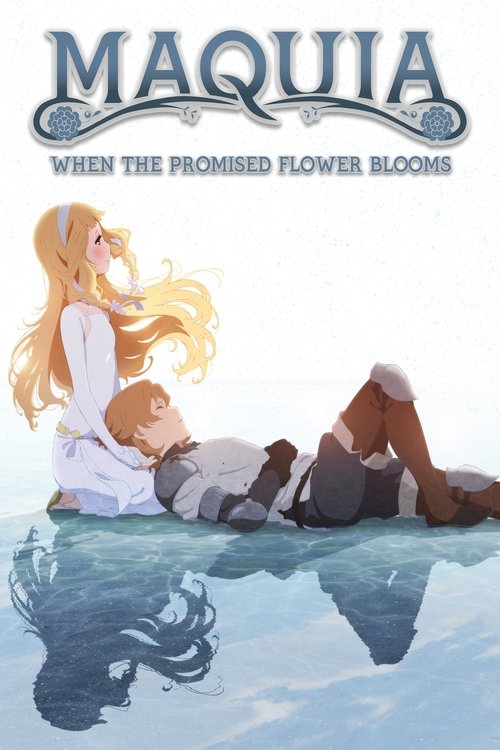
Maquia: When the Promised Flower Blooms
2018 · Mari Okada
For when you need a good cry and want it to mean something — a film about parenthood, time, and letting go. Comforting and wrenching at once; keep tissues within reach.
What it's about
Maquia belongs to a secluded, near-immortal people who stop aging in their teens and weave the passage of time into cloth. When war scatters her clan, she finds an orphaned human baby in a forest and decides to raise him as her own — a mother who will never grow older, and a son who will. Against a backdrop of dragons, doomed royal ambitions, and a vanishing people, the film follows their bond across the whole arc of a human life.
The experience
Openly, unashamedly emotional — a sweeping fantasy that keeps circling back to quiet domestic moments, then hits you with the weight of years passing. It's gentle in texture but devastating in accumulation; it earns its tears rather than jerking them.
The craft
Mari Okada, one of anime's most prolific screenwriters, directs her own script for the first time and structures it boldly — leaping across years so you feel time the way an ageless mother would. P.A. Works' hand-drawn animation gives the fantasy world painterly light and detail, and the sweeping score and vistas genuinely reward a big screen.
Why it matters
A rare original anime fantasy — no manga or novel behind it — that proved a star screenwriter could carry a feature as director, and it has become a byword for emotionally devastating animation about parenthood.
Snapshot
Maquia: When the Promised Flower Blooms (Japanese title Sayonara no Asa ni Yakusoku no Hana o Kazarō, roughly "Let us adorn the morning of our farewells with promised flowers") is the feature directorial debut of Mari Okada, one of the most prolific and recognizable screenwriters in twenty-first-century Japanese animation. Produced by the studio P.A. Works and released in Japan in February 2018, it is an original fantasy — not an adaptation of a manga, light novel, or game — built around a single, unusually severe premise: a member of a near-immortal people raises a mortal human child, and must live through his entire life while remaining outwardly a teenage girl. The film uses a secondary-world fantasy of dragons, doomed dynasties, and a vanishing clan as the scaffolding for what is essentially a chamber drama about parenthood, aging, and grief. It arrived as a statement of authorship: the industry's best-known "writer for hire" stepping into the director's chair to control a story end to end.
Industry & production
The film was animated by P.A. Works, the Toyama-based studio founded by Kenji Horikawa and known through the 2010s for character-driven television series with strong background art — Hanasaku Iroha, Nagi no Asukara, Shirobako — several of them written by Okada. That prior collaboration matters: Maquia is in part the product of a studio and a writer who had already built a working relationship across multiple series. The project was positioned as an original theatrical feature, a comparatively high-risk proposition in an anime market where films are more often extensions of proven franchises.
Distribution in Japan was handled by Shochiku, one of the country's oldest film companies. Internationally the film circulated heavily through festivals and specialist anime distributors, with English-language handling by Eleven Arts in North America and Anime Limited in the UK. It played the festival circuit in 2018, including genre and animation festivals in Europe and North America, and was received warmly on that circuit. Precise budget and box-office figures are not something I can state reliably, and I will not invent them; the record available to a general scholarly account treats Maquia as a mid-scale prestige feature rather than a blockbuster, and its reputation has grown more through home video, streaming, and word of mouth than through theatrical gross.
Technology
Maquia is made in the mainstream contemporary anime idiom: 2D character animation, drawn and then processed digitally, composited over elaborately painted or digitally rendered backgrounds. Like most P.A. Works productions of the period, it relies on a digital pipeline for coloring, compositing (satsuei), and effects work, while retaining hand-drawn key animation as the expressive core. Three-dimensional CG is used selectively — most visibly for the Renato, the great winged dragon-beasts, and for certain crowded battle and architectural spaces where sustained 2D animation would be prohibitively costly. The integration of CG creatures with 2D figures is handled conservatively, kept at a distance or in motion so that the seams are minimized rather than foregrounded. The film's technological ambition is not in novel tools but in the density and finish of its imagery: layered lighting, atmospheric depth, and a large volume of full animation in emotionally pivotal scenes.
Technique
Cinematography
In animation the "cinematographer" function is distributed across layout, background art, and the satsuei (photography/compositing) department, and Maquia is a showcase for all three. The film favors expansive establishing views — mountain valleys, the loom-halls of the Iorph, the stone capital of Mezarte — that establish scale against which the small, unchanging figure of Maquia can be measured. The staging repeatedly contrasts the vast and the intimate: sweeping vistas of a world in historical motion, then tight, low-key interiors of a single hearth. Lighting is a principal storytelling tool, with warm domestic light standing in for the fragile, temporary shelter of family and cold blues and grays marking the encroachment of war and time.
Editing
The film's editing carries an ambitious structural burden: it must compress a human lifetime — infancy, boyhood, adolescence, adulthood, old age — while its protagonist does not visibly change. The cutting therefore leans on ellipsis, using time-skips that drop years between sequences and force the viewer to register elapsed time through the aging of the mortal characters and the changing world around Maquia. This produces the film's characteristic melancholy rhythm: scenes of settled domesticity are cut short, and each reunion is shadowed by how much has passed off-screen. The editing's success is precisely in making absence legible.
Mise-en-scène / staging
Okada and her team build a coherent invented world — a pastoral realm of weavers set against an aggressive human kingdom that covets immortality — and use its objects as recurring dramatic motifs. Chief among them is the Hibiol, the cloth the Iorph weave to record their days; the loom and the woven record become the film's central visual metaphor for memory, history, and the passage of time. Staging consistently places Maquia's ageless body inside frames full of change: growing children, aging companions, decaying dynasties. The design idiom is a European-inflected medieval fantasy, familiar from the character designer's other work, but the mise-en-scène pointedly domesticates it — much of the drama plays out over cooking, farmwork, and childrearing rather than in throne rooms.
Sound
The score is by Kenji Kawai, a veteran composer whose reputation rests on landmark work for Ghost in the Shell, the Ring films, and the Patlabor features. His contribution here is notable precisely because it departs from the propulsive or eerie registers he is best known for: the Maquia score is largely lyrical and elegiac, using strings and voice to underline the film's emotional swells. Kawai's presence lends the production considerable prestige and signals its ambitions as a serious dramatic feature. Sound design otherwise follows convention, with the roar and wingbeat of the Renato providing the film's principal sonic spectacle against an otherwise restrained, domestic soundscape.
Performance
The Japanese voice cast is led by Manaka Iwami as Maquia, in a performance that must carry the film's central paradox — a voice that ages emotionally while the body it belongs to does not. The vocal performances are pitched toward naturalistic emotional intensity rather than stylized delivery, consistent with Okada's writing, which repeatedly asks actors to play raw grief, rage, and tenderness. Because the child Ariel is voiced across a span of ages, the performance work also includes the recasting or re-pitching required to convey a character moving from infancy to old age opposite an unchanging mother.
Narrative & dramatic mode
The dramatic mode is domestic melodrama in fantasy dress. Maquia takes the machinery of epic fantasy — an immortal clan, a conquering empire hungry for the secret of eternal life, dragons dying of a plague — and consistently subordinates it to the interior emotional register of family drama. The film's true subject is not the war but the impossibility at the heart of Maquia's choice: to love a mortal child is to guarantee her own bereavement. Its narrative engine is therefore not plot resolution but accumulating loss. Okada structures the film as a series of partings — the "farewells" of the Japanese title — each one a variation on the same theme, building toward a final separation the premise makes inevitable from the first act. This is unabashedly a "tearjerker," but one organized with real structural rigor around the asymmetry of two life spans.
Genre & cycle
Maquia sits at the intersection of several traditions: the theatrical fantasy anime, the original (non-adapted) auteur feature, and a lineage of anime concerned with mortality, memory, and the pain of outliving those one loves. Within Okada's own output it belongs to a recognizable cycle of emotionally maximal dramas about family estrangement and adolescent feeling — AnoHana, The Anthem of the Heart, Nagi no Asukara — here elevated to a mythic register. Within the broader field it can be read against films that use fantastic longevity or non-human protagonists to interrogate human attachment. It is not part of a franchise and spawned none; its "cycle" is authorial and thematic rather than commercial.
Authorship & method
The film is most legible as an authorial project. Mari Okada wrote the original screenplay and made her directorial debut with it, and the film reads as a deliberate consolidation of her recurring preoccupations under her own direction rather than filtered through another director. Okada's biography is relevant here in a way it rarely is for a screenwriter: she has written publicly, including in a memoir, about school refusal, a fraught relationship with her mother, and the experience of being an outsider, and critics have widely connected Maquia's intense focus on maternal love and estrangement to that background. Making the leap from writer to director was itself the film's central creative gamble.
Her key collaborators reinforce the project's seriousness. Kenji Kawai (composer) brings an established cinematic pedigree. Akihiko Yoshida — celebrated as a character designer and illustrator for Square/Square Enix titles such as Final Fantasy Tactics and Vagrant Story — provides the character designs, giving the film a distinctive, slightly austere fantasy look that sets it apart from typical television-derived character art. The animation was carried out at P.A. Works under producer Kenji Horikawa's studio, drawing on the house's strengths in background art and layout. On the specific attribution of roles such as chief animation direction, art direction, and editing, the widely circulated record is thinner than for the headline credits above, and I would rather flag that than assign names I cannot verify; the safe and accurate claim is that the film was executed by an experienced P.A. Works staff working to Okada's script and direction and to Yoshida's designs.
Movement / national cinema
Maquia is firmly a work of the Japanese commercial animation industry, but it belongs to a specific tendency within it: the studio-driven, television-adjacent theatrical feature, as opposed to the auteur houses (Studio Ghibli) or the blockbuster-event model. P.A. Works represents a strand of anime built on regional production (the studio's Toyama base), meticulous background painting, and grounded character drama. Placing a nationally prominent screenwriter in the director's chair for an original feature also reflects a broader industry pattern of the 2010s, in which writers, animators, and directors from television built individual creative reputations and were given theatrical vehicles to match.
Era / period
The film is a product of the late-2010s anime moment, released in 2018 in the wake of the extraordinary commercial success of Makoto Shinkai's Your Name (2016), which had renewed industry and investor appetite for original, emotionally driven theatrical anime aimed at broad audiences. Maquia can be situated in that opening — a period in which non-franchise features with strong emotional hooks were seen as viable — even though its own reputation grew more slowly and through non-theatrical channels. Technologically and stylistically it reflects the fully digital, hybrid 2D/CG production norms of its moment.
Themes
The film's dominant theme is motherhood and chosen family: Maquia's decision to raise Ariel is an act of will against biology, and the film treats parenthood as the deliberate acceptance of future loss. Braided with this is the theme of mortality and time, dramatized through the structural device of a protagonist who cannot age beside people who do; the film asks what it means to love within a lifespan you do not share. Loneliness and belonging run throughout — the Iorph are warned against forming attachments to outsiders precisely because such love guarantees grief, and Maquia's story is a sustained refutation of that warning. The Hibiol, the woven record of days, gives the film its governing metaphor: life as something woven and finished, memory as the thread that outlasts the loom. Finally, the film engages the corruption of the desire for immortality, embodied in the human kingdom that hunts the Iorph for their blood, contrasting a covetous grasp at eternal life against Maquia's willing embrace of transience.
Reception, canon & influence
Critically, Maquia was received as an emotionally powerful, visually accomplished debut, with much of the discussion centered on Okada's transition from screenwriter to director and on the film's frank sentimentality — praised by many as earned and cathartic, viewed by some as heavy-handed. It performed strongly on the international festival and awards circuit for animation, and its reputation has consolidated over time as one of the notable original anime features of its decade. I am wary of citing specific award wins or box-office figures from memory; where the precise competitive record is concerned, the responsible summary is that the film was well regarded at genre and animation festivals and found a durable audience through home and streaming release rather than through a large theatrical gross.
Looking backward, the influences on the film are legible: Okada's own body of television and film writing about family, adolescence, and estrangement; the P.A. Works house style of grounded emotional drama with lavish backgrounds; Yoshida's design lineage in Japanese fantasy illustration; and Kenji Kawai's tradition of cinematic scoring. The broader lineage of anime that uses the fantastic to examine mortality and memory forms its wider inheritance.
Looking forward, Maquia's principal legacy is as the launch of Mari Okada as a director. It established that one of the industry's leading writers could also direct, and it stands as a reference point for the argument that original, emotionally maximal fantasy features have a place alongside franchise and adaptation work. As an original property it founded no franchise and had no direct sequels; its influence is reputational and authorial — a proof of concept for writer-driven original anime cinema — more than a template subsequently copied wholesale.
Reception
It slipped into Western theaters in 2018 via a small limited release, then spent the next few years growing by pure word of mouth into THE 'I was not emotionally prepared' anime film — the one fans dare each other to watch without crying.
How Maquia: When the Promised Flower Blooms was received, from release to now →
How to watch Maquia: When the Promised Flower Blooms: what to notice on a first viewing
- Notice warm light in the home, cold blue outside it. Interiors of the household glow warm and golden, while war and the passing world outside are lit in cold blues and grays. You can tell how safe a scene is just from its color before anything happens in it.
- Notice the cloth being woven on the loom throughout. The Iorph record their days by weaving them into cloth, and the film keeps returning to the loom as its central image for memory and passing time. A life here is something woven and eventually finished, not just something lived.
- Track how much older Ariel looks between one scene and the next. The film cuts across years at a time, so you register how much has passed by how much the mortal characters around Maquia have changed rather than by any clock. You measure time passing the same way Maquia has to: by looking at everyone but herself.
- Notice the swap between huge landscapes and one small room. The film alternates sweeping views of valleys and kingdoms with tight, low-key shots of a single hearth, measuring the world's scale against one unchanging girl. Against a whole moving world, one still, ageless figure stands out every single time.
- Listen for strings and voice carrying the quiet, emotional scenes. Kenji Kawai scores the film lyrically and elegiacally rather than with tension or spectacle, leaning on strings and voice to underline domestic, emotional moments. The music treats an ordinary morning with the same weight most films save for a battle.
The whole guide to watching Maquia: When the Promised Flower Blooms, with the keys for a rewatch →
Influences: the films it descends from and the films it influenced
- Grave of the Fireflies (1988) — Establishes Maquia's melodramatic engine: a feature structured around the day-to-day labor of caretaking and a slow accumulation of irreversible loss, refusing rescue-plot beats in favor of dwelling on domestic ritual until it becomes elegy.
- Only Yesterday (1991) — Model for the dual-timeline ellipsis and time-skip structure filtered through an adult woman's reflective register, prioritizing grounded emotional realism over fantasy spectacle.
- The Tale of the Princess Kaguya (2013) — Directly prefigures the immortal-observer premise — a being outside human time who must watch mortals age and die — treated as a tragedy of time itself rather than as a plot device.
- Wolf Children (2012) — The proximate template: an anime feature built entirely on maternal labor and years-long child-rearing, its arc the watching of children grow and depart — the exact chosen-mother spine Maquia inherits.
- 5 Centimeters per Second (2007) — Source of the elegiac montage editing across large time gaps, using seasonal and lighting transitions plus a score-driven passage of years to render longing and separation.
- Ghost in the Shell (1995) — Defines Kenji Kawai's scoring signature — ancient-modal choral chant over percussive ostinato — the mythic, funereal palette Kawai redeploys to give Maquia its elegiac weight.
- The Girl Who Leapt Through Time (2006) — Early model for the anime feature that makes the felt weight of time and its irreversibility — not the mechanism — the true subject, treating temporal dislocation as emotional loss.
- Maboroshi (Alice and Therese's Illusory Factory) (2023) — Okada's second directorial feature extending her own newly-established craft: a frozen-time town, adolescent longing, and the maximal emotional register now staged by her hand rather than written for someone else's.
- Josee, the Tiger and the Fish (2020) — Post-Maquia earnest melodrama in the same emotionally frank register, staging disability and care through intimate two-hander scenes and P.A.-Works-adjacent grounded background realism.
- The Anthem of the Heart (2015) — Okada's own screenwriting method in full — wounded adolescents, emotionally maximal confession scenes, cathartic breakdown as climax — which Maquia consolidates under her own direction rather than another director's filter.
- Her Blue Sky (2019) — Continues the Okada-Nagai-Tanaka team method and her signature melodrama of estranged family and collapsed time, running parallel to Maquia as her screenwriting practice.
- In This Corner of the World (2016) — Shares the accumulating-loss structure built from everyday domestic texture and ellipsis-driven time skips, an unsentimental melodrama that earns catharsis through the patient rendering of ordinary life.
- A Silent Voice (2016) — Parallel case for character-acting-driven earnest emotional melodrama, using restrained gesture and pointed lighting cues to carry catharsis in the same original-feature space.
- Liz and the Blue Bird (2018) — Extends the same lighting-as-storytelling craft — hushed, color-graded interiors and performance-of-restraint — that Maquia uses to externalize interior feeling.
- Weathering with You (2019) — A post-Your Name original-auteur fantasy feature betting on emotional maximalism and lavish weather/lighting spectacle in the same original-IP theatrical lane Maquia argues for.
- Belle (2021) — Continues Hosoda's melodrama-through-transformation while pushing the hybrid 2D/CG technique — CG spectacle wed to hand-drawn intimate emotion — that Maquia also negotiates in its vast-versus-intimate staging.
- Violet Evergarden: The Movie (2020) — A non-aging outsider who must learn love and mortal loss, with a woven-cloth craft as the emotional metaphor — a parallel treatment of the caretaker learning human feeling that Violet dramatizes through letter-writing.
Similar films
- The Tale of The Princess Kaguya (2013) — influence & lineage
- Wolf Children (2012) — influence & lineage
- Weathering with You (2019) — influence & lineage
- Only Yesterday (1991) — influence & lineage
- Grave of the Fireflies (1988) — influence & lineage
- The Girl Who Leapt Through Time (2006) — influence & lineage
- When Marnie Was There (2014) — shared sensibility
- The Boy and the Heron (2023) — shared sensibility
All the films related to Maquia: When the Promised Flower Blooms →