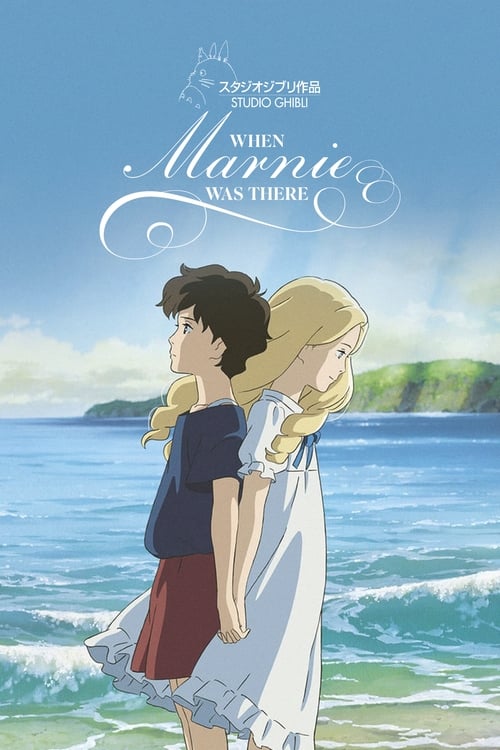
When Marnie Was There
2014 · Hiromasa Yonebayashi
When you need a good cry, or a tender, contemplative film about loneliness that ends in consolation rather than despair. Perfect for a quiet solo evening when you're feeling a little unmoored yourself.
What it's about
Anna, a withdrawn, asthmatic twelve-year-old who keeps everyone at arm's length, is sent from Sapporo to stay with relatives in a sleepy seaside town for her health. There she becomes fixated on a derelict mansion across the marsh — and on Marnie, a golden-haired girl who appears there, radiant and strangely out of time. Their intense friendship becomes the key to a mystery about memory, family, and where Anna actually comes from.
The experience
Hushed and melancholy, moving at the pace of tides and long summer evenings, with a ghost-story shimmer that keeps you unsure what's real. It builds quietly toward an emotional payoff that catches many viewers completely off guard — this one is a genuine tear-jerker.
The craft
Hiromasa Yonebayashi adapts Joan G. Robinson's 1967 English novel with Studio Ghibli's signature naturalism — marsh light, water, and weather are practically characters — while threading a delicate supernatural ambiguity through the realism. The restraint of the storytelling, holding its secrets until exactly the right moment, is the craft achievement here.
Why it matters
Effectively the final feature of Ghibli's classic era before the studio paused production in 2014, which gives it the poignancy of a farewell — and it earned an Academy Award nomination's worth of attention as proof the studio's magic extended beyond its founders.
Snapshot
When Marnie Was There (Omoide no Marnie, literally "Marnie of the Memories") is a Studio Ghibli feature directed by Hiromasa Yonebayashi, adapted from Joan G. Robinson's 1967 English children's novel. It follows Anna Sasaki, a withdrawn, asthmatic adolescent sent from Sapporo to relatives in a quiet seaside town, where she becomes fixated on a derelict marsh house and on Marnie, a golden-haired girl who seems to belong to another time. The film is at once a naturalistic study of a foster child's alienation and a ghost-tinged mystery whose emotional resolution hinges on memory and lineage. It carries lasting significance as effectively the last feature Ghibli produced before the 2014 dissolution of its production division — a coda to the studio's classic era — and as the second and, to date, final feature by Yonebayashi under the Ghibli banner. It received an Academy Award nomination for Best Animated Feature.
Industry & production
The film was produced by Studio Ghibli, with Yoshiaki Nishimura as producer, and distributed in Japan by Toho; it opened on July 19, 2014. Its production sits at a pivotal, melancholy juncture in the studio's history. It arrived immediately after the twin valedictions of 2013 — Hayao Miyazaki's The Wind Rises and Isao Takahata's The Tale of Princess Kaguya — and after Miyazaki's announced retirement from feature directing. With both founding masters stepping back, Marnie was positioned, implicitly, as a test of whether a younger generation could carry the studio forward. It could not, at least not on the old model: shortly after the film's release, Ghibli announced a restructuring that paused in-house feature production. That context frames Marnie as an end point rather than a passing of the torch.
Commercially, the film performed respectably in Japan but well below the studio's Miyazaki-era peaks; precise figures are best checked against distributor records rather than asserted here. Internationally it was handled by GKIDS in North America, continuing that distributor's stewardship of Ghibli's arthouse-facing titles, with an English dub featuring Hailee Steinfeld as Anna and Kiernan Shipka as Marnie. The Oscar nomination, announced in early 2016, gave the film a prestige afterlife disproportionate to its modest theatrical footprint.
Technology
Marnie was made with the hybrid pipeline Ghibli had refined across the 2000s: hand-drawn key animation and layouts on paper, scanned and composited digitally, with digital ink-and-paint and digital compositing replacing the photochemical cel-and-camera process of the studio's earliest years. Ghibli was a longtime user of the Toonz software family (the studio's involvement helped seed what later became the open-source OpenToonz), and the film's look depends on that digital coloring and multiplane-style compositing to preserve a hand-painted surface while enabling subtle atmospheric layering — mist over the marsh, shifting tidal light, lamplit interiors. Computer-generated elements are used sparingly and subordinated to the drawn image, consistent with Ghibli house practice; the film does not foreground CG as spectacle. Its technological interest lies less in innovation than in the disciplined maintenance of a hand-drawn aesthetic at a moment when most of the global feature-animation industry had moved to full CGI.
Technique
Cinematography
As an animated film, Marnie's "cinematography" is a matter of layout, staging, and virtual camera decisions rather than photographed light, but its visual grammar is deliberate and restrained. The film favors held wide shots that place Anna small within landscape — the tidal marsh, the flats at low water, the looming silhouette of the abandoned mansion — establishing isolation spatially before it is spoken. Water is the recurring optical motif: reflections, the mirror-like inlet at high tide, the boat crossings that carry Anna toward Marnie. The palette shifts with emotional register, from the muted, desaturated tones of Anna's depression to the warmer, storybook luminosity that attends Marnie's world, a chromatic strategy that quietly encodes the film's question of what is real and what is remembered.
Editing
The cutting is patient and classically Ghibli in its willingness to let scenes breathe, but Marnie is more structurally intricate than most of the studio's output because it is built as a mystery. The edit withholds and doles out information about Marnie's status — apparition, memory, dream, or living person — sustaining ambiguity across the middle of the film before a final movement that reorders earlier images through revelation. This retrospective logic asks the editing to plant details that only resolve in hindsight, and the film's climax depends on a controlled release of exposition that recontextualizes what the audience has seen.
Mise-en-scène / staging
The film's most distinctive achievement is atmospheric. The marsh, the tides, and the decaying mansion are staged as psychological space as much as physical setting: the house is simultaneously alluring and forbidding, a threshold between Anna's loneliness and the intimacy she craves. Interiors — the relatives' home, the mansion's shadowed rooms, a windmill/silo used in the tense later scenes — are dressed with the tactile density Ghibli is known for. The staging repeatedly frames Anna at edges and boundaries (shorelines, windows, doorways), a visual insistence on her sense of standing outside the "magic circle" of belonging that the dialogue names directly.
Sound
The soundscape leans on natural ambience — wind across the wetland, water, insects, the creak of boats and old timber — to build the film's hushed, liminal mood. Silence and environmental sound are used to isolate Anna and to lend Marnie's appearances an uncanny stillness. The score is by Takatsugu Muramatsu, in his first feature work for Ghibli, and the film's end theme, "Fine on the Outside," is performed by the American singer-songwriter Priscilla Ahn; the song's title and lyric of concealed loneliness map closely onto Anna's interior life.
Performance
Vocal performance carries the film's emotional freight, since so much of Anna's state is conveyed through withheld affect. In the Japanese version Anna is voiced by Sara Takatsuki and Marnie by Kasumi Arimura; the English dub built its central pairing around Hailee Steinfeld's guarded, prickly Anna and Kiernan Shipka's warmer, more effusive Marnie, with a supporting cast including John C. Reilly and Grey Griffin (Grey DeLisle). The interplay between the two girls — one closed, one open — is the performative engine of the picture, and the direction of the voices sustains the ambiguity of whether their relationship is friendship, longing, or something closer to communion with the self.
Narrative & dramatic mode
The film operates in a mode of psychological realism shading into the supernatural, then resolving into what might be called memory-realism. On its surface it is a summer-in-the-country coming-of-age drama; underneath it runs a ghost story whose apparition proves to be a vehicle for buried family history. Robinson's novel and Yonebayashi's adaptation both keep the reader/viewer uncertain about Marnie's ontological status for most of the running time, and the dramatic satisfaction depends on a late reversal that reframes the "romance" or infatuation between the two girls as an encounter across generations. This gives the film an unusual dramatic shape for children's animation: its climax is not action but revelation and reconciliation, and its stakes are internal — Anna's capacity to feel loved and to forgive.
Genre & cycle
Marnie belongs to several overlapping traditions: the Ghibli "quiet realist" cycle of intimate, domestically scaled stories — the lineage of Takahata's Only Yesterday and Ocean Waves and, within Yonebayashi's own filmography, The Secret World of Arrietty — rather than the fantastical-adventure cycle of Miyazaki's best-known work. It is also a children's-literary adaptation, part of Ghibli's long practice of drawing on Western and Japanese source novels. And it participates in the ghost-story-as-family-mystery genre, where the uncanny ultimately serves a therapeutic, memorial function. Its emotional and thematic emphasis on foster care, self-worth, and belonging places it near the realist end of the studio's spectrum.
Authorship & method
Hiromasa Yonebayashi, born 1973, rose through Ghibli as a gifted key animator on films including Spirited Away, Howl's Moving Castle, and Ponyo before Miyazaki elevated him to direct The Secret World of Arrietty (2010) — at the time one of the studio's youngest feature directors. Marnie is his second and last Ghibli feature; he subsequently co-founded Studio Ponoc, where he directed Mary and the Witch's Flower (2017). His authorship is marked by fidelity to the Ghibli house style, a sensitivity to childhood interiority, and a preference for the intimate over the epic. He has spoken of relating personally to Anna's outsider feeling, though specific published statements should be quoted from primary interviews rather than paraphrased as fact here.
The adaptation transposed Robinson's Norfolk setting to a marshland town in Hokkaido, an act of cultural relocation that nonetheless preserves the novel's tidal geography and Marnie's coded Western, storybook quality (her blonde hair and manor house read as slightly foreign within the Japanese setting, a deliberate marker of her otherness). The screenplay is credited to Keiko Niwa, Masashi Ando, and Yonebayashi. Ando, a distinguished animator (notably supervising animator on Princess Mononoke and Spirited Away), also contributed to the animation direction, lending the character work its expressive restraint. The producer Yoshiaki Nishimura would go on to co-found Studio Ponoc with Yonebayashi. The score marks the feature debut for Ghibli of composer Takatsugu Muramatsu. Precise credits for art direction and supervising animation are better confirmed against the film's official records than asserted from memory; the record on the exact division of those roles is one place where secondary summaries vary.
A frequently cited point of origin is that Miyazaki had long included Robinson's novel among children's books he recommended, which is often given as the reason the property was in Ghibli's orbit; this is well attested in the studio's promotional history, though the precise chain of decision-making leading to production is thinly documented in English-language sources.
Movement / national cinema
The film is a product of the Japanese commercial animation tradition at its most artisanal, and specifically of Studio Ghibli's distinctive position within it: a studio that resisted full digital conversion and outsourced-CG economics to preserve auteur-driven, hand-drawn feature animation. Marnie should be read against the broader landscape of 2010s anime, in which Ghibli's painterly realism stood increasingly apart from both the CG mainstream and the emergent style of directors like Makoto Shinkai. It also belongs to a Japanese literary-cinematic sensibility — the summer countryside, the convalescent child, the encounter with the past — that connects it to a long tradition of nostalgic, seasonally attuned storytelling.
Era / period
Released in 2014, Marnie is a late-classic-Ghibli film, made at the exact moment the studio's founding generation withdrew and its production model became unsustainable. Its era is thus doubly inscribed: within the fiction, it looks backward across two generations of family history; within industry history, it stands at the threshold between Ghibli's active-studio period and its subsequent, more intermittent existence. It is fair to treat it as the closing bracket of the studio's continuous feature output that began in the 1980s.
Themes
The film's central theme is belonging — Anna's conviction that she stands outside an "invisible magic circle" that separates the loved from the unloved. Radiating from this are foster care and adoption (Anna's discovery that her guardians receive a subsidy wounds her deeply), self-worth and depression rendered with unusual directness for a family film, and the reparative power of memory and forgiveness. Marnie functions as a mechanism for Anna to reconcile with her own history and, ultimately, to accept love. Critics have also discussed the intense, ambiguous intimacy between the two girls; the narrative's final turn recasts that intimacy in familial terms, but the film's willingness to let the relationship read as tender and romantic before its resolution has been a significant point of interpretation. Water, tides, and the cyclical return of the sea recur as images of memory's ebb and flow.
Reception, canon & influence
Critical reception was warm if not ecstatic. Reviewers praised the film's atmosphere, its emotional sincerity, and its beautiful hand-drawn craft while sometimes finding its mystery structure or its late exposition less assured than Ghibli's finest work; it was widely received as a minor-key but affecting entry rather than a masterpiece on the order of the studio's canonical titles. Its Academy Award nomination for Best Animated Feature (for the 2015 awards, announced 2016) confirmed its standing as a work of international note and gave it durable visibility.
Its influences run backward to Joan G. Robinson's novel and to the English tradition of the eerie children's story, and within Ghibli to Takahata's realist strain and to Yonebayashi's own Arrietty. Forward, its most concrete legacy is institutional and personal: the creative partnership of Yonebayashi and Nishimura carried directly into Studio Ponoc, founded in 2015, whose Mary and the Witch's Flower can be read as a continuation of the sensibility Marnie refined. Within the Ghibli canon the film has accrued affection over time, particularly among viewers drawn to its themes of queerness-adjacent longing, adoption, and mental health, and it is frequently reassessed as an underrated late work. Its largest historical resonance, finally, is elegiac: as the final feature of Ghibli's classic production era, When Marnie Was There now reads as a quiet farewell, a film about reconciling with the past that became, by circumstance, the studio's own act of looking back.
A Deleuzian reading
At high tide the inlet goes glassy and the old marsh house stands there twice, once on its bank and once upside down in the water.
The full Deleuzian reading of When Marnie Was There →
Reception
Released under a cloud — it landed just as Studio Ghibli announced its production halt, so it was received as a melancholy 'last Ghibli film' and a minor one at that, despite an Oscar nomination. A decade on it's been warmly reappraised, especially by queer viewers, as one of the studio's most quietly devastating works.
How When Marnie Was There was received, from release to now →
How to watch When Marnie Was There: what to notice on a first viewing
- Notice how small Anna looks against the marsh and mansion. The film favors held wide shots that place Anna small within the tidal landscape, establishing her isolation spatially before anyone says a word about it. You feel how alone she is just from how much empty space surrounds her.
- Watch the palette warm whenever Marnie appears nearby. Anna's world stays muted and desaturated, while scenes with Marnie shift toward a warmer, storybook luminosity that stands out against it. The color alone is telling you these two worlds don't quite belong to the same register.
- Listen for wind, water, and silence instead of music. The soundscape leans on natural ambience, wind, insects, creaking timber, using quiet to isolate Anna and give Marnie's appearances an uncanny stillness. The hush itself becomes part of what feels unresolved about every scene they share.
- Notice how often Anna stands at a threshold or edge. She keeps being framed at shorelines, windows, and doorways, boundary positions that visually repeat her sense of standing outside where she wants to belong. Her body keeps landing at the edge of things, which is exactly how she feels.
- Watch the tide change what you can reach on foot. The inlet goes glassy at high tide and walkable at low tide, so the same crossing to the mansion is possible or impossible by the hour. Whether Anna can reach the house at all depends on something she cannot control.
The whole guide to watching When Marnie Was There, with the keys for a rewatch →
Influences: the films it descends from and the films it influenced
- The Secret World of Arrietty (2010) — Yonebayashi's own directing debut established the method Marnie repeats — transposing a classic British children's novel to a Japanese setting while preserving its miniaturist attention and held, low-key domestic wides that let stillness carry emotion.
- Only Yesterday (1991) — Takahata's realist strain — recollection braided into present action, naturalistic everyday staging without fantasy spectacle — is the direct model for Marnie's memory-realism and its refusal to animate feeling as exaggeration.
- Whisper of the Heart (1995) — Kondō's quiet adolescent coming-of-age supplies the template of restrained interiority and observational domestic realism — long scenes of a lonely girl's private world rendered with withheld affect rather than plot momentum.
- Grave of the Fireflies (1988) — Takahata's naturalist register — coastal/marshland environmental detail, ambient sound over score, grief conveyed through composed distance — is the emotional-grammar ancestor of Marnie's held wides and natural ambience.
- Princess Mononoke (1997) — Supervising animator Masashi Ando, who co-directed Marnie's animation, brought here the same expressive restraint in facial acting — emotion legible in micro-shifts rather than broad cartoon gesture.
- Spirited Away (2001) — Yonebayashi keyed animation and Ando supervised here; the film is the training ground where Marnie's makers refined the digital-ink-and-paint house craft and the animation of a displaced, watchful girl entering an uncanny space.
- Ponyo (2008) — Yonebayashi animated on Ponyo, whose tidal seaside imagery and fascination with water surfaces feed directly into Marnie's water-reflection cinematography and its estuary-as-boundary geography.
- My Neighbor Totoro (1988) — The child's-eye rural landscape and immersive natural sound design — insects, wind, water as continuous ambient bed — is the Ghibli sensory grammar Marnie inherits for its Hokkaido marsh town.
- The Innocents (1961) — The English eerie-children's-ghost-story tradition Marnie descends from — an apparition perceived only by a sensitive, isolated protagonist, staged with sustained ambiguity so the audience withholds judgment on whether the ghost is real until late.
- The Go-Between (1971) — Losey's memory-frame structure — a manor-house past coded as class and foreignness, revealed through withheld exposition and a late recognition — parallels Marnie's storybook Western otherness (the blonde girl in the mansion) and its buried-relation reversal.
- Kiki's Delivery Service (1989) — A Ghibli adolescent-girl bildungsroman driven by internalized emotion and a European-flavored seaside town, inheriting Kiki's restraint about naming feelings and its place-as-character setting.
- The Cat Returns (2002) — Closes the succession line begun here — a second elevated in-house animator directing a girls'-fiction adaptation with the same veteran department heads, Takeshi Seyama's editing among them, supplying the continuity of look the director cannot.
- Mary and the Witch's Flower (2017) — The most concrete legacy: the Yonebayashi–Nishimura partnership carried directly into Studio Ponoc, continuing Marnie's refined house style, its lonely-girl interiority, and its adaptation of a British children's book.
- The Red Turtle (2016) — A late-Ghibli-adjacent co-production sharing Marnie's minimalism — wordless stretches, held wide compositions, tidal geography, and natural ambience carrying a story of belonging without dialogue exposition.
- A Silent Voice (2016) — Yamada extends the same craft — held wides, water-reflection motifs, boundary framing through railings and edges, and adolescent shame rendered as withheld affect rather than spoken confession.
- Liz and the Blue Bird (2018) — A parallel refinement of queerness-adjacent longing between two girls, built from micro-gestures, negative space, and quiet held framing — the same restraint-as-intimacy grammar Marnie uses for Anna and Marnie.
- In This Corner of the World (2016) — A sibling in realist hand-drawn animation of a girl's everyday interior life, using watercolor-soft environments and ambient period detail rather than spectacle to carry memory and loss.
- Your Name (2016) — A contemporaneous sibling built on the same structural device — a late reversal that reframes an intimate cross-time relationship, with the emotional payload deliberately withheld until the mechanism of connection is revealed.
- From Up on Poppy Hill (2011) — Late-Ghibli realist shōjo adaptation whose drama turns, like Poppy Hill's, on a suspected-then-resolved consanguinity/kinship secret and a seaside house as emotional anchor.
- The Boy and the Heron (2023) — The Ghibli film immediately preceding it: a grieving, displaced child meeting a spectral relative across a liminal threshold, working the same grief-and-memory register in hand-drawn form.
Similar films
- My Neighbor Totoro (1988) — influence & lineage · same viewing thread · often watched together
- The Secret World of Arrietty (2010) — influence & lineage · same viewing thread · often watched together
- Spirited Away (2001) — influence & lineage · same viewing thread · often watched together
- Only Yesterday (1991) — influence & lineage · same viewing thread · often watched together
- Ponyo (2008) — influence & lineage · same viewing thread · often watched together
- Princess Mononoke (1997) — influence & lineage · same viewing thread · often watched together
- Your Name. (2016) — influence & lineage
- From Up on Poppy Hill (2011) — same viewing thread · often watched together
All the films related to When Marnie Was There →
Watch it with: curated runs of related films
- The Studio Ghibli Canon — A run through the whole hand-drawn shelf of Miyazaki and Takahata — start with the childhood-wonder crowd-pleasers and drift toward the studio's quieter, adult, more elegiac corners.