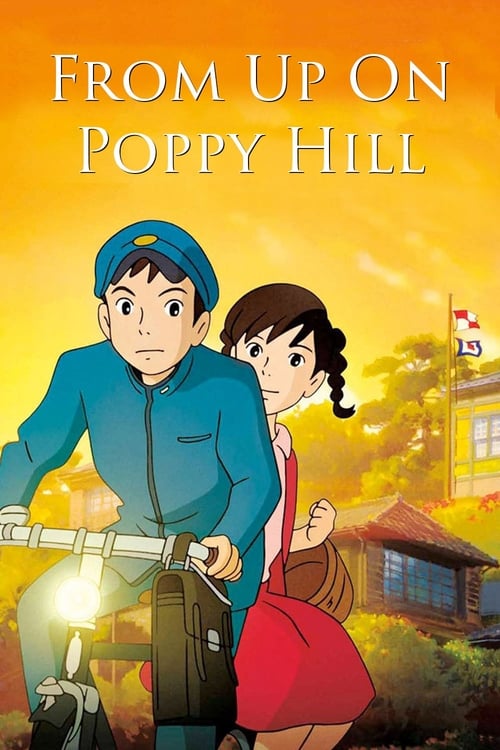
From Up on Poppy Hill
2011 · Goro Miyazaki
For a calm, cozy evening when you want something sweet and sincere — a low-stakes first love and a lovingly rebuilt past rather than thrills. Pure comfort viewing, with just enough melancholy to feel earned.
What it's about
Yokohama, 1963: a port city rebuilding itself as Japan gets ready for the Tokyo Olympics. Umi is a diligent high-school girl who runs her family's hilltop boarding house and raises signal flags to the harbor every morning; Shun is a classmate leading a scrappy student campaign to save their school's ramshackle old clubhouse from demolition. As the two work side by side, a first romance takes root — until a question buried in their fathers' wartime pasts complicates everything.
The experience
Gentle, unhurried, and quietly moving — it runs on small rituals, shared work, and the warm buzz of teenagers fixing up a beloved old building. There's real ache underneath the nostalgia, but the film never raises its voice; it leaves you with a soft, hopeful glow.
The craft
A Studio Ghibli production directed by Goro Miyazaki from a screenplay co-written by his father Hayao, and the period detail is the star: hand-drawn trams, harbor light, cluttered clubhouse staircases, and kitchens rendered with documentary affection. The early-sixties setting comes alive through texture and music rather than exposition, and the film's warm, painterly palette rewards an attentive watch.
Why it matters
A key chapter in the Ghibli succession story — Goro Miyazaki's second feature and the collaboration that steadied his footing as a director — and one of the studio's clearest expressions of its everyday-realist, non-fantasy mode.
Snapshot
From Up on Poppy Hill (Japanese title Kokuriko-zaka kara, "From Kokuriko Hill") is a Studio Ghibli feature set in Yokohama in 1963, in the interval between postwar reconstruction and the 1964 Tokyo Olympics. It follows Umi Matsuzaki, a diligent high-school girl who runs a boarding house and raises signal flags each morning toward the harbor, and Shun Kazama, a boy at the center of a student campaign to save a ramshackle clubhouse from demolition. Their tentative romance is complicated by the fear that they may be siblings — a secret rooted in the tangled fates of their fathers during the Korean War era. It is the second feature directed by Goro Miyazaki, working from a screenplay by his father Hayao Miyazaki and Keiko Niwa, and it adapts a shōjo manga from 1980. The film is unusual within the Ghibli canon for being wholly grounded, non-fantastical, and steeped in period nostalgia — a small-scale drama of memory, work, and generational inheritance rather than flight or enchantment.
Industry & production
The film was produced by Studio Ghibli and shepherded by producer Toshio Suzuki, with Hayao Miyazaki taking an unusually direct hand as co-screenwriter and planner. That involvement is the central industrial fact of the production. Goro's directorial debut, Tales from Earthsea (2006), had been made over his father's objections and strained their relationship publicly; Poppy Hill functioned, by the accounts of those involved, as both a professional rehabilitation and a familial reconciliation, with Hayao supplying the script that Goro would stage.
The production is also inseparable from the March 2011 Tōhoku earthquake and tsunami, which struck during the film's making. Studio Ghibli continued work amid the disaster's aftermath and the rolling electrical blackouts that followed, and the studio publicly framed the film's themes of resilience and rebuilding as newly resonant with a country once again picking itself up. The film opened in Japanese theaters in July 2011 and became one of the year's top-performing domestic releases; it is widely reported as the highest-grossing Japanese film of 2011, though precise figures should be checked against box-office records rather than asserted here. It later reached English-language audiences through GKIDS, which handled the North American release in 2013 with a dubbed version featuring Sarah Bolger and Anton Yelchin in the lead roles.
Technology
Poppy Hill was made with Studio Ghibli's characteristic hybrid pipeline: predominantly hand-drawn 2D character animation composited digitally, with digital ink-and-paint, digital compositing, and selective, restrained use of CGI and digital camera moves integrated so as not to disturb the drawn surface. By 2011 this was mature technology at Ghibli rather than experimental, and the film makes no ostentatious display of it. If anything the technological posture is deliberately conservative and even nostalgic: the imagery favors the tactile, slightly imperfect look of traditional cel-style animation appropriate to a story about preserving old things. The most notable technological circumstance surrounding the film is external — the constraints imposed by post-earthquake power rationing on the studio's workflow — rather than any innovation on screen.
Technique
Cinematography
The film's "camera," in the sense of drawn framing and composition, favors stable, legible, horizontally organized shots that emphasize place: the hillside house overlooking the harbor, the cluttered vertical warren of the clubhouse, the port with its ships and flags. Yokohama's topography — the hill, the sea, the working harbor — is treated almost as a character, and the compositions repeatedly stage the pull between the domestic interior (the boarding house, the kitchen) and the wider world glimpsed through windows and from vantage points. Color and light lean warm and softened, an autumnal, memory-tinted palette suited to period nostalgia. The art direction (with Noboru Yoshida among the credited art staff, per the film's crediting, which is worth verifying against the print) invests heavily in the density of period detail — signage, textiles, kitchen implements, the accreted clutter of the clubhouse.
Editing
The cutting, in keeping with Ghibli house style, is patient and unhurried, allowing scenes of ordinary labor — cooking, cleaning, climbing stairs, raising flags — to play at something like their natural rhythm. Studio Ghibli's longtime editor Takeshi Seyama is associated with the studio's work of this period; his specific credit on this title should be confirmed against the film's records rather than assumed. The film's dramatic architecture depends on editing that withholds and gradually discloses the truth about the two fathers, and the pacing is calibrated to the melodrama's slow reveal rather than to action.
Mise-en-scène / staging
Mise-en-scène is the film's true strength and its principal vehicle of meaning. Two spaces anchor it. The first is Umi's boarding house, a domain of routine, food, and care where Umi's daily flag-raising is a private ritual of mourning and communication. The second is the "Quartier Latin" (Latin Quarter) clubhouse — a teetering, book-crammed, all-male hive of student societies threatened with demolition ahead of the Olympics. Its eventual cleaning and restoration by the students, girls included, is staged as a communal act that literalizes the film's thesis: the past is worth preserving, but only if it is actively cared for and made habitable for the present. Staging consistently uses verticality (stairs, the multi-storey clubhouse, the hill itself) and thresholds to organize the drama.
Sound
The soundscape is grounded and period-conscious: harbor sounds, kitchen sounds, the ambient texture of a working port city. Music is used to signal the era through a nostalgic, occasionally jazz- and pop-inflected register rather than the symphonic sweep of the studio's fantasy films. The film's theme song, "Sayonara no Natsu ~Kokuriko-zaka kara~," performed by Aoi Teshima, is a wistful ballad that frames the film's romantic-melancholic mood; the film also draws on period-evocative popular music to place the audience in early-1960s Japan. Specific song attributions and their origins should be verified individually rather than characterized in detail here.
Performance
Vocal performance is restrained and naturalistic in the original Japanese, with Masami Nagasawa voicing Umi and Junichi Okada voicing Shun. The drama asks its leads to underplay — the emotional peaks are handled with reticence characteristic of the material's period and register. The English-language GKIDS dub recast the roles with Sarah Bolger as Umi and Anton Yelchin as Shun, supported by an ensemble of established performers; as with all dubs, it substitutes a distinct set of performances and cannot be treated as identical to the original.
Narrative & dramatic mode
The film operates in the register of restrained domestic melodrama crossed with a coming-of-age story and a mild civic comedy (the campaign to save the clubhouse). Its engine is a classic melodramatic device — the suspicion of consanguinity between two young lovers, and the buried parental history that must be excavated to resolve it. Yet the film refuses histrionics; the mode is elegiac and matter-of-fact rather than fevered. Two plots braid together: the intimate mystery of Umi and Shun's possible kinship, resolved through inquiry into their fathers' Korean War-era fates, and the collective effort to preserve the clubhouse. Both plots are ultimately about the same thing — reckoning honestly with an inherited past in order to move forward — and the film's resolution grants its young people a future without erasing the losses that shaped them.
Genre & cycle
Within Ghibli's output, Poppy Hill belongs to the studio's realist, non-fantastical strain — the lineage of Only Yesterday (1991) and Ocean Waves (1993), and adjacent to the nostalgic-historical impulse that would later inform The Wind Rises (2013). More broadly it sits within the Japanese tradition of nostalgic period drama centered on postwar reconstruction and the Shōwa era's high-growth years — a cultural cycle preoccupied with the early 1960s as a threshold moment of optimism. It is at once a shōjo adaptation, a seishun (youth) film, and a work of period reconstruction, none of which requires the supernatural machinery for which the studio is best known.
Authorship & method
The authorship question is genuinely double. The film is directed by Goro Miyazaki, but its screenplay is by Hayao Miyazaki and Keiko Niwa, and Hayao's conceptual imprint — the veneration of hand-work and communal effort, the theme of preservation, the period fidelity — is legible throughout. This makes Poppy Hill a revealing case study in divided authorship: a son staging a father's script, in a story that is itself about children reckoning with what their fathers left them. The film has often been read, plausibly, through that biographical lens. Toshio Suzuki produced. The score is by Satoshi Takebe, whose music leans toward the intimate and period-appropriate rather than the grand. The source is a 1980 shōjo manga written by Tetsurō Sayama and drawn by Chizuru Takahashi, which the film updates in emphasis — foregrounding the clubhouse-preservation strand and the postwar-historical dimension. Precise divisions of labor among the animation direction, art direction, and editing staff should be read off the film's own credits; where I am uncertain of an individual attribution I have flagged it rather than guessed.
Movement / national cinema
The film is a product of Studio Ghibli, itself the central institution of prestige Japanese animation and, by 2011, a globally recognized auteurist brand. It participates in the broader project of Japanese national self-narration around the Shōwa 30s (late 1950s–early 1960s) — the moment of recovery, the 1964 Olympics, and the promise of modernity — that recurs across Japanese cinema, literature, and popular memory. Ghibli's investment in traditional 2D animation also positions the film, implicitly, within a cultural argument about preserving craft against the tide of digital and computer-generated animation — an argument the film's very subject matter (saving an old building from demolition) mirrors.
Era / period
The setting — Yokohama, 1963 — is chosen with precision. It is the year before the Tokyo Olympics, a national coming-out party that symbolized Japan's return to the international stage, and the demolition impulse threatening the clubhouse is explicitly tied to that modernizing, Olympics-driven fervor. The parental backstory reaches further back, into the Korean War years of the early 1950s and the maritime losses of that period, binding the intimate plot to a specific and painful national history: the fathers' generation shaped by war and its immediate aftermath. The film thus stages a dialogue between two postwar moments — the traumatized early 1950s and the hopeful early 1960s — and asks how the second should carry the first.
Themes
The governing theme is inheritance: what one generation owes to the past and passes to the next, both intimately (Umi and Shun and their fathers' story) and collectively (the students and the clubhouse). Closely bound to it is preservation versus erasure — the argument that progress need not mean demolition, that the old can be cleaned, honored, and made livable rather than swept away. Other threads include work and care as forms of love (Umi's domestic labor, the daily flags), mourning and communication with the absent (the flags raised toward a lost father), and honest reckoning with history as the precondition for a hopeful future. The film's optimism is earned rather than naïve: it insists that looking clearly at loss is the only sound basis for moving on.
Reception, canon & influence
Critical reception was warm but comparatively measured within the Ghibli canon. Reviewers widely regarded Poppy Hill as a marked advance on Goro Miyazaki's debut, Tales from Earthsea, praising its craftsmanship, its evocative period atmosphere, and its unusual restraint, while some found its drama slight or its melodramatic pivot conventional beside the studio's more ambitious work. In Japan the film was a strong commercial performer and a critical honoree: it won the Japan Academy Prize for Animation of the Year (awarded in 2012). Its international profile, aided by the GKIDS release, was solid though below that of the Hayao Miyazaki fantasies.
Influences on the film run in two directions. Backward, it draws on its 1980 manga source; on Ghibli's own realist tradition (Only Yesterday, Ocean Waves); and on the deep well of Japanese nostalgic-period culture surrounding the pre-Olympics early 1960s. Hayao Miyazaki's screenwriting sensibility — his humanism, his reverence for craft and collective effort — is the strongest authorial influence shaping it.
Its legacy forward is best understood as a step in Goro Miyazaki's development as a filmmaker: it re-established him as a viable Ghibli director and preceded his later work in television (Ronja, the Robber's Daughter) and his move into full CGI with Earwig and the Witch (2020). Thematically and tonally, Poppy Hill's grounded, historically-minded nostalgia anticipates the reflective register of Hayao Miyazaki's The Wind Rises two years later, and the film stands as one of the clearest examples in the studio's catalog of Ghibli's realist, non-fantastical mode. Any broader claim about its influence on other filmmakers would overstate a thin record; the film's significance is felt most concretely within Ghibli's own house history and the Miyazaki family story it so plainly reflects.
A Deleuzian reading
Every morning before school, a girl on a hill runs the signal flags up a pole and turns to face the harbor.
The full Deleuzian reading of From Up on Poppy Hill →
Reception
Arriving after the drubbing Goro Miyazaki took for Tales from Earthsea, this was widely read as his redemption film — and it's since settled into 'quietly lovely, unfairly overlooked' status among Ghibli fans who champion the studio's non-fantasy side.
How From Up on Poppy Hill was received, from release to now →
How to watch From Up on Poppy Hill: what to notice on a first viewing
- Watch Umi raise the signal flags each morning. Every day before school she runs two flags up the pole and turns to face the harbor, a routine nobody in the house treats as remarkable. A signal only means something if someone is there to read it, and that is the film's real subject.
- Count how many staircases the characters climb. Miyazaki stages nearly every scene on a slope: the hill home, the stairs to the harbor, the multi-story clubhouse, characters constantly moving up or down. The verticality makes effort and inheritance physical instead of just spoken about.
- Watch the clubhouse fill with students holding buckets. Instead of fighting the demolition order, the students scrub, sort and rebuild the cluttered Quartier Latin themselves, girls included in a building that had never admitted them. Cleaning, not confrontation, is the film's idea of how you actually save something.
- Listen for the ballad that returns through the film. Aoi Teshima's theme song and period pop recur instead of a symphonic score, tying the story to a specific, dated soundscape rather than an abstract emotional cue. The music fixes the film in 1963 as precisely as any prop on screen.
- Notice the warm, softened color on every interior. The palette stays autumnal and memory-tinted throughout, and the art department fills each room with period signage, textiles and kitchen implements. The drawing does the work photography usually does: making 1963 Yokohama feel like a real place you could touch.
The whole guide to watching From Up on Poppy Hill, with the keys for a rewatch →
Influences: the films it descends from and the films it influenced
- Only Yesterday (1991) — Establishes Ghibli's non-fantastical realist mode, animating mundane gesture and remembered period texture with naturalistic timing rather than fantasy spectacle — the exact register Poppy Hill works in.
- Whisper of the Heart (1995) — The direct template: a Hayao Miyazaki screenplay reworking a shōjo manga into a grounded youth romance built around a place-as-character and the veneration of collective, hand-made craft.
- Ocean Waves (1993) — Ghibli's young-staff experiment in realist adolescent melodrama — a low-fantasy shōjo-adjacent coming-of-age drama — supplies the small-scale domestic template Poppy Hill scales up.
- Grave of the Fireflies (1988) — Pioneers Ghibli's meticulous hand-drawn reconstruction of a specific Shōwa historical moment, treating period architecture and daily objects with documentary fidelity.
- Tokyo Story (1953) — Codifies the Japanese domestic-melodrama grammar Poppy Hill inherits: framing family drama through thresholds, doorways and staircases, with generational inheritance staged in the passage between rooms.
- Twenty-Four Eyes (1954) — Model for sentimental Shōwa period drama scored with era-specific popular songs, using diegetic period music to fix a nostalgic historical moment emotionally.
- Tales from Earthsea (2006) — Goro's debut whose staging and pacing weaknesses he corrects here — the same authorial hand, now disciplined toward restraint and grounded blocking.
- The Wind Rises (2013) — Extends Poppy Hill's grounded, historically-minded Shōwa nostalgia and craft-veneration into Hayao's own reflective realist register, hand-drawn and non-fantastical.
- In This Corner of the World (2016) — Carries forward the hand-drawn everyday-life reconstruction of a precise Shōwa historical moment, foregrounding ordinary domestic labor lived against national history.
- Ronja, the Robber's Daughter (2014) — Goro's next step, applying Poppy Hill's patient character-grounded direction to serialized television, extending his authorial development.
- Earwig and the Witch (2020) — Marks the endpoint of Goro's trajectory begun here — the move from Poppy Hill's hand-drawn 2D pipeline into Ghibli's first full-CGI feature.
- Always: Sunset on Third Street (2005) — Crystallizes pre-Olympics Shōwa high-growth nostalgia into a national genre — warm reconstruction of an idealized early-1960s townscape as the emotional subject itself.
- When Marnie Was There (2014) — Late-Ghibli realist shōjo adaptation whose drama turns, like Poppy Hill's, on a suspected-then-resolved consanguinity/kinship secret and a seaside house as emotional anchor.
- The Secret World of Arrietty (2010) — Contemporary Hayao-scripted realist adaptation prizing hand-drawn material detail and a single dwelling rendered as a character through light and domestic texture.
- Wolf Children (2012) — Non-Ghibli hand-drawn domestic melodrama grounding maternal/family drama in naturalistically observed place and season rather than spectacle.
- Your Name (2016) — Shares the dual-braided two-strand plot architecture and a hyper-warm, nostalgic-longing color palette in which townscape and light do much of the emotional work.
Similar films
- Only Yesterday (1991) — influence & lineage · same viewing thread · often watched together
- The Secret World of Arrietty (2010) — influence & lineage · same viewing thread · often watched together
- The Wind Rises (2013) — influence & lineage · same viewing thread · often watched together
- When Marnie Was There (2014) — influence & lineage · same viewing thread · often watched together
- Wolf Children (2012) — influence & lineage · same viewing thread
- Whisper of the Heart (1995) — influence & lineage · often watched together
- Tokyo Story (1953) — influence & lineage
- In This Corner of the World (2016) — influence & lineage
All the films related to From Up on Poppy Hill →
Watch it with: curated runs of related films
- The Studio Ghibli Canon — A run through the whole hand-drawn shelf of Miyazaki and Takahata — start with the childhood-wonder crowd-pleasers and drift toward the studio's quieter, adult, more elegiac corners.