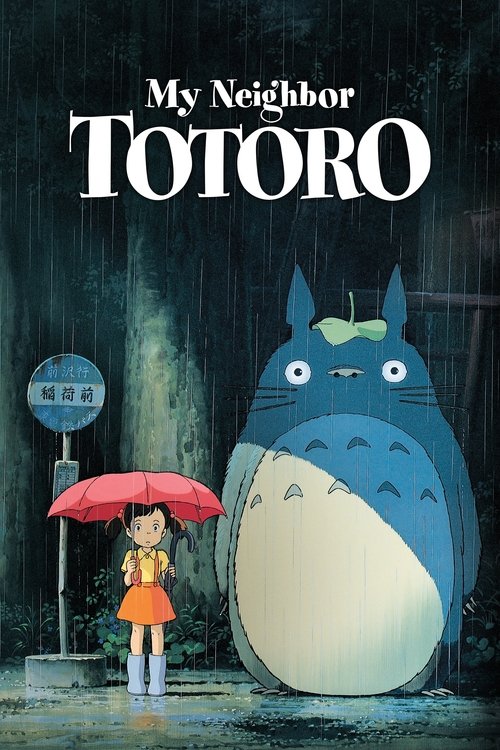
My Neighbor Totoro
1988 · Hayao Miyazaki
The Boy and the Heron's no-marketing release and second Oscar fueled the eternal "final film" watch, while his resurfaced "an insult to life itself" AI clip made him the patron saint of anti-AI-art sentiment. Ghibli-style AI image generation controversies keep him at the center of a fight he never asked to join.
The ultimate comfort film — for when you're frazzled, sad, or watching with a small child and want ninety minutes of pure wonder and calm. Reach for it the way you'd reach for a nap in the grass.
What it's about
Two young sisters move with their father to a rambling old house in the Japanese countryside, to be nearer the hospital where their mother is recovering from a long illness. In the woods next door live spirits only children can see — including Totoro, an enormous, furry, benevolent creature — and when the youngest girl goes missing, the magic of the forest becomes the family's best hope.
The experience
Gentle almost beyond description — no villain, no menace, just the textures of childhood, weather, and countryside, with a quiet hum of worry about the mother underneath that keeps it honest. It's the rare film that slows your heartbeat while you watch it.
The craft
Miyazaki's hand-drawn animation makes rain on an umbrella, wind through a camphor tree, and light through a dusty house feel more vivid than most live action, and Joe Hisaishi's score is one of the most beloved in animation. It dares to build a children's film almost entirely from atmosphere instead of plot, and the gamble pays off completely.
Why it matters
A founding classic of Studio Ghibli — Totoro himself became the studio's logo and one of the most recognizable characters in world animation, shaping how generations think about childhood on screen.
Snapshot
My Neighbor Totoro (となりのトトロ, Tonari no Totoro) is Hayao Miyazaki's fourth feature and one of the founding works of Studio Ghibli's classical period. It follows two young sisters, Satsuki and Mei Kusakabe, who move with their academic father to a rural house while their mother convalesces from a long illness in a nearby hospital, and who encounter the forest spirits — the great furred Totoro and the grinning Catbus — that inhabit the surrounding woods. Released in Japan on 16 April 1988 on a double bill with Isao Takahata's Grave of the Fireflies, the film is remarkable for its near-total absence of villain, conflict, or conventional plot engine: its drama is atmospheric and emotional, built from the textures of childhood, the rhythms of the countryside, and the low hum of a family's anxiety. It has since become Ghibli's emblem — the studio's corporate logo is a Totoro silhouette — and a globally recognized touchstone of hand-drawn animation.
Industry & production
The film was made early in the life of Studio Ghibli, which Miyazaki and Takahata had established in 1985 in the wake of Nausicaä of the Valley of the Wind (1984). Totoro was a commercially precarious proposition: a gentle, quiet, plotless children's film with no marketable action and a preschool-aged co-protagonist. By most accounts the project was greenlit only through pairing with Takahata's harrowing wartime film Grave of the Fireflies, the two features produced under the Ghibli banner and distributed by Toho as a single program — a strategy meant to hedge an unusual double bill against the market. The combination itself is now legendary for its tonal whiplash, one film a pastoral idyll, the other a story of children dying in wartime privation.
Theatrical returns for the double bill were modest, and the honest record is that Totoro did not perform as a hit on first release. Its extraordinary afterlife came instead through licensing and merchandise: the plush Totoro and associated goods generated ongoing revenue that helped stabilize Ghibli's finances, and repeated television broadcasts and home-video sales turned the film into a perennial. The commonly repeated claim that "Totoro merchandise saved the studio" captures a real dynamic, even if precise figures are not something I can responsibly cite here. Internationally, the film reached English-speaking audiences first through a Streamline Pictures dub in the early 1990s and later through the Walt Disney–produced Ghibli dub of 2005, the latter featuring the sisters Dakota and Elle Fanning as Satsuki and Mei.
Technology
Totoro is a work of traditional, fully hand-drawn cel animation, produced entirely without computer imagery. Every frame originated as pencil drawings inked and painted onto celluloid and photographed over painted backgrounds on an animation stand. The film's technical ambition lies not in novelty of apparatus but in the density and consistency of its handcraft: the naturalistic weight of running children, the play of wind through grass and rice paddies, the tactile rendering of water, dust, and light. Kazuo Oga's background paintings — executed in a luminous poster-color and watercolor idiom — represent one of the film's signal technical achievements, establishing a saturated, sun-warmed palette for the satoyama (the managed countryside where village and forest meet) that would influence Ghibli's house style thereafter.
Technique
Cinematography
Because this is drawn animation, "cinematography" resides in Miyazaki's staging, storyboarding (e-konte), and the studio's photographic composition of the cels; Hisao Shirai is credited with photography/direction of photography on the film. The visual grammar favors patient, eye-level framing that respects a child's scale of the world — low angles that make the house, the camphor tree, and Totoro himself loom — and long-held compositions that let the viewer simply watch weather, foliage, and daylight. Miyazaki repeatedly stages depth into the frame: children run toward and away from the camera through fields and corridors, and the countryside is rendered as a navigable three-dimensional space rather than a flat backdrop.
Editing
The film's cutting, credited to editor Takeshi Seyama (a longtime Ghibli collaborator), is unhurried and observational. Its most discussed formal quality is what Miyazaki and critics describe using the Japanese aesthetic concept of ma — the deliberate pause or interval, the "empty" beat held past the point a conventional edit would cut away. Scenes are allowed to breathe: a bus stop wait in the rain, the sisters settling into sleep, the slow swell of a seed sprouting. This refusal of relentless momentum is central to the film's spell; the editing serves mood and presence rather than plot advancement.
Mise-en-scène / staging
The domestic and natural spaces are the film's true subject. The Kusakabe house is a lived-in old farmhouse with sliding doors, dark rafters, and a genkan; the surrounding landscape — rice paddies, a stream, the great camphor and its shrine — is drawn with ethnographic care for a vanishing rural Japan. The staging is animist in emphasis: the susuwatari ("soot sprites," also called makkuro kurosuke") that infest the house, the offerings and rope (shimenawa*) marking the camphor as a sacred tree, the small roadside Jizō statues. Miyazaki fills the mise-en-scène with the ordinary business of chores, cooking, and play, grounding the fantastical apparitions in a concrete, credible everyday.
Sound
Joe Hisaishi's score — his continuing collaboration with Miyazaki, begun on Nausicaä — is one of the film's defining elements, ranging from the bouncy, indelible title song to tender, pastoral cues and passages of hushed wonder. The theme songs (with lyrics by Rieko Nakagawa) became broadly familiar in Japan. Equally important is the film's sound design and its use of silence: birdsong, cicadas, wind, rain, and the creak of the old house build a dense ambient realism, against which Totoro's rumbling roar and the Catbus's purring register as marvels erupting from an otherwise naturalistic soundscape.
Performance
The vocal performances are pitched toward unforced naturalism. Noriko Hidaka voices the elder sister Satsuki with an age-appropriate poise shading into strain, while Chika Sakamoto's Mei is a small triumph of animation-and-voice collaboration — her tantrums, babble, and toddler physicality are observed with unusual accuracy. Hitoshi Takagi gives Totoro his wordless, resonant vocalizations. The animation of performance is as crucial as the voice work: the sisters' body language, running gaits, and small gestures carry much of the characterization, an area where Miyazaki's team set a benchmark for depicting children on screen.
Narrative & dramatic mode
Totoro is often cited as a landmark of nearly conflict-free storytelling. There is no antagonist, no quest object, and no clear escalating threat until late, when Mei goes missing and the film briefly tightens into suspense. Its dramatic mode is lyric and episodic — a series of encounters and everyday incidents (arriving at the house, the acorn seeds, the bus-stop meeting, planting) organized less by causality than by the emotional undertow of the mother's illness and the children's need to metabolize fear and hope. The Totoros function ambiguously: guardians, imaginative projections, expressions of nature's benevolence. The film withholds the reassurance of the mother's outcome (it ends before a full resolution of her convalescence), trusting mood and image over plot mechanics.
Genre & cycle
The film sits at the intersection of fantasy, family drama, and what might be called the animated pastoral. It draws on Japanese folkloric and animist traditions — yōkai and kami, forest spirits, the sacred tree — and on the older tradition of children's literature about the countryside; Miyazaki has acknowledged influences from Japanese children's books, and the film shares DNA with tales of children crossing thresholds into hidden worlds. Within Miyazaki's own output it belongs to his cycle of films centered on young female protagonists and on the relationship between human settlement and nature, a lineage running from Nausicaä through Kiki's Delivery Service (1989), Princess Mononoke (1997), and Ponyo (2008).
Authorship & method
Totoro is a near-total auteur work: Miyazaki wrote, directed, and storyboarded it, and his practice of drawing detailed e-konte that effectively serve as the film's blueprint is well documented. The project germinated over years — imagery of a large forest creature meeting a child had long preoccupied him. His key collaborators form the core Ghibli team: composer Joe Hisaishi, whose partnership with Miyazaki is among the most celebrated in animation; art director Kazuo Oga, whose background paintings established the film's visual signature; editor Takeshi Seyama; and photography under Hisao Shirai. Isao Takahata, though directing the companion film rather than this one, was Miyazaki's lifelong creative interlocutor and Ghibli co-founder, and the studio's collaborative ethos shaped the production. The autobiographical dimension is significant: Miyazaki has spoken of his own mother's long hospitalization with tuberculosis of the spine during his childhood, an experience that plainly informs the film's central situation, though he has resisted reducing the film to strict autobiography.
Movement / national cinema
The film is a cornerstone of postwar Japanese animation and of the Studio Ghibli tradition specifically — a body of work that positioned feature animation as a vehicle for humanist, personally authored cinema rather than franchise product. It participates in a distinctly Japanese aesthetic sensibility: the valuation of ma, the animist reverence for nature, and a nostalgia for the satoyama countryside being lost to postwar development. Set in an unspecified past before the spread of television — commonly read as the mid-to-late 1950s, though Miyazaki keeps the dating deliberately soft — the film is also an act of cultural memory, preserving a rural Japan already receding at the time of production. The Sayama Hills area near Tokorozawa in Saitama, an inspiration for the setting, later became the object of a conservation campaign associated with the film (the "Totoro Forest").
Era / period
Made at the end of the 1980s, Totoro arrived as Japanese animation was consolidating both its domestic prestige and its international reputation. It stands at the threshold of Ghibli's golden run of the late 1980s and 1990s. Its handcrafted method represents a high-water mark of pre-digital cel animation, produced just before computer techniques began to reshape the field industry-wide. Within Miyazaki's career it marks the moment his gentler, more intimate register — as distinct from the epic-ecological mode of Nausicaä — found its fullest expression.
Themes
The film's governing themes are childhood perception, the sacredness of nature, and the family under the strain of illness. It treats the child's-eye view with rare seriousness, honoring both the boundless wonder and the genuine terror of being small in a large world. Its animism frames the forest as alive and benevolent, mediated by spirits who reward attentiveness and patience. Underneath the enchantment runs an undercurrent of anxiety and loss — the absent, ailing mother — which the film neither sensationalizes nor resolves neatly; the fantasy functions partly as the children's means of holding fear at bay. Wonder, care, siblinghood, and the consolations of the natural and domestic world are its emotional bedrock.
Reception, canon & influence
Though its theatrical debut was commercially quiet, My Neighbor Totoro accrued critical esteem and popular affection steadily, and it is now widely regarded as one of the greatest animated films ever made and a canonical work of world cinema. Backward, its influences include Miyazaki's own biography, Japanese folklore and children's literature, and the satoyama landscape tradition; the pastoral, animist sensibility owes to a deep well of Japanese cultural forms rather than to a single cited source. Forward, its legacy is vast. Totoro became Studio Ghibli's mascot and enters the studio's brand identity directly. The film's influence on international animators is well attested — Pixar's leadership, notably John Lasseter, has publicly championed Miyazaki, and Totoro appears as a plush cameo in Toy Story 3 (2010) as an homage. More broadly, the film helped establish that animated features could be slow, atmospheric, emotionally serious, and free of conventional villainy, expanding the expressive range of the medium and setting an enduring standard for the depiction of children and of the natural world in animation. Its imagery — the bus-stop encounter under an umbrella, the grinning Catbus, the great gray forest spirit — has become part of the shared visual vocabulary of global popular culture.
A Deleuzian reading
Rain at a country bus stop, after dark.
The full Deleuzian reading of My Neighbor Totoro →
Reception
It opened in Japan in 1988 as a double bill with Grave of the Fireflies and did only modest business — it was merchandise and TV airings that slowly turned it into a phenomenon. Today it's the consensus heart of the Ghibli canon and arguably the most beloved animated film ever made.
How My Neighbor Totoro was received, from release to now →
How to watch My Neighbor Totoro: what to notice on a first viewing
- Notice how low the camera sits, at a child's eye height. Miyazaki frames the farmhouse, the camphor tree, and Totoro himself from below, so everything looms. He also stages deep space, letting the girls run toward and away from you down paths and corridors. You are put at the sisters' height, so the world feels as large to you as it does to them.
- Count the seconds a shot stays after the action ends. Seyama's cutting holds past the moment a normal edit would leave: a wait in the rain, the sisters settling into sleep, wind moving through rice paddies. Nothing advances during these beats. The held interval is the film's main effect. You feel time passing instead of watching a plot move.
- Listen for cicadas, wind, rain, and the old house creaking. The soundtrack is dense with ordinary country noise, and Hisaishi's score drops away for long stretches. Totoro's rumbling roar and the Catbus's purr arrive inside that realistic sound world. The marvels sound like they belong to the same place as the frogs and the rain, so you believe them.
- Watch Mei's walk, her waddle, her stumbles, her full-tilt running. Sakamoto's babble and the animators' observation build a real toddler. Satsuki's poise carries a strain you can see in her posture. Almost all the characterization arrives through bodies, not lines. You learn who these children are from how they move, which is what the reading calls a cinema of the body.
- Look for the rope and offerings around the great camphor tree. Miyazaki fills the countryside with signs of an inhabited world: soot sprites in the dark house, small roadside Jizō statues, the marked sacred tree. They sit beside chores, cooking, and laundry. The spirits are placed in the same frame as the housework, so the magic reads as part of the farmland.
The whole guide to watching My Neighbor Totoro, with the keys for a rewatch →
Influences: the films it descends from and the films it influenced
- Panda! Go, Panda! (1972) — Miyazaki wrote and designed this Takahata short whose plot — a self-reliant little girl left near woods bonding with a huge, benign, sleepy creature — is the direct structural and character prototype for Totoro's conflict-free, episodic warmth.
- The Little Norse Prince (Horus: Prince of the Sun) (1968) — As key animator, Miyazaki absorbed the Toei collaborative full-animation method and its expressive, weighted naturalistic character acting, which he later systematized into the Ghibli house style.
- The Snow Queen (1957) — Miyazaki repeatedly credited this Soviet feature for convincing him that animation could sustain fluid, sincere full animation, shaping his lifelong commitment to lavish, believable movement over limited-animation shortcuts.
- Tokyo Story (1953) — Ozu's low tatami-height camera and 'pillow shot' cutaways to empty landscape map directly onto Totoro's low-angle child-scale framing and its ma-pause inserts of wind, water, and stillness.
- Future Boy Conan (1978) — In this TV series Miyazaki perfected the staged-depth layout, gravity-and-weight physical animation, and child protagonists navigating fully realized rural space that Totoro brings to feature scale.
- Castle in the Sky (1986) — Extends the Hisaishi-Miyazaki scoring partnership launched here and pushes the 'ma' pause pacing — quiet dead-time between events — into a full aesthetic.
- Kiki's Delivery Service (1989) — The immediate follow-up extends Totoro's low-stakes, villain-free coming-of-age structure and Joe Hisaishi's leitmotif-driven scoring of everyday wonder.
- Only Yesterday (1991) — Extends Totoro's satoyama-nostalgia and observational ma pauses into live-action-grade naturalistic rural realism, foregrounding the farmed countryside as an animist emotional space.
- Ponyo (2008) — Recapitulates the small-child-meets-nature-spirit bond and child-scale sense of wonder using deliberately hand-drawn, crayon-textured animism and the same wordless, low-angle observation of a toddler.
- Wolf Children (2012) — Transplants Totoro's premise wholesale — a family relocating to a satoyama farmhouse where nature is animate — using low-angle child framing and ambient-realist countryside sound.
- The Iron Giant (1999) — Bird, an avowed Miyazaki admirer, builds a hand-drawn child-and-gentle-giant bond with restrained pacing and emotional seriousness rather than conventional villainy, following Totoro's expansion of what animation can hold.
- Song of the Sea (2014) — Moore cites Miyazaki directly; the film renders folkloric animist spirits through a young child's perception in hand-drawn, atmosphere-first imagery descended from Totoro's nature-animism.
- The Red Turtle (2016) — A Ghibli-produced, near-wordless work whose animist reading of the natural world and ambient-realist sound design extend Totoro's dialogue-light lyricism.
- Up (2009) — Docter openly credits Miyazaki's concept of 'ma' — pauses of stillness that let feeling breathe — as the model for the film's wordless emotional montage and its refusal to fill every beat with plot.
- Toy Story 3 (2010) — Totoro appears as a plush cameo in explicit homage, marking how John Lasseter's championing institutionalized Miyazaki's atmosphere-and-character-first sensibility inside Pixar.
- Beasts of the Southern Wild (2012) — The animist ecological fantasy the dossier cites, where a child's wonder conjures benign-monstrous nature spirits as ordinary fact.
- Spirited Away (2001) — Miyazaki's own prototype for a small girl encountering benign spirits through curiosity, including the soot-sprite (susuwatari) design and the calm, wordless 'ma' pauses later expanded in the bathhouse.
- How to Train Your Dragon (2010) — Toothless's cat-like, purely non-verbal expressiveness — communicating character through ear-flicks, pupil dilation, and posture with zero speech — extends Totoro's model of animal charisma without language.
- Grave of the Fireflies (1988) — Produced and released simultaneously by Ghibli, it shared Kazuo Oga's background-art department and the same naturalistic child animation, inverting Totoro's animist-pastoral optimism into wartime tragedy.
- Warriors of the Wind (1984) — Carries forward Nausicaä's reverence-for-nature staging into the domestic register, keeping the wind-in-the-grass, breath-in-the-forest ambient animation as an emotional device rather than plot.
- Lilo & Stitch (2002) — Shares the watercolor natural backgrounds, the mostly wordless creature-companion to a grieving/lonely child, and the Ozu-like patience with everyday domestic rhythm.
Similar films
- Ponyo (2008) — influence & lineage · same viewing thread · often watched together
- Kiki's Delivery Service (1989) — influence & lineage · same viewing thread · often watched together
- Only Yesterday (1991) — influence & lineage · same viewing thread · often watched together
- Wolf Children (2012) — influence & lineage · same viewing thread
- Grave of the Fireflies (1988) — influence & lineage
- Tokyo Story (1953) — influence & lineage
- Spirited Away (2001) — same viewing thread · often watched together
- The Secret World of Arrietty (2010) — same viewing thread · often watched together
All the films related to My Neighbor Totoro →
Watch it with: curated runs of related films
- The Studio Ghibli Canon — A run through the whole hand-drawn shelf of Miyazaki and Takahata — start with the childhood-wonder crowd-pleasers and drift toward the studio's quieter, adult, more elegiac corners.