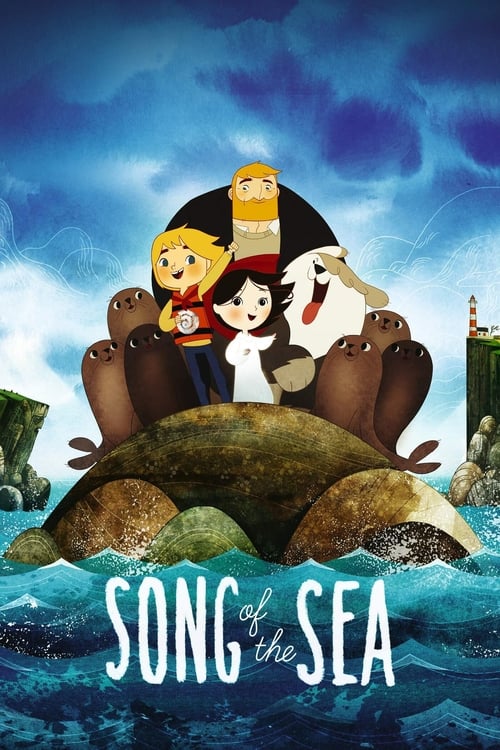
Song of the Sea
2014 · Tomm Moore
For a quiet night when you want to be enchanted and maybe cry a little — comfort viewing with a soul, perfect for watching with kids or for anyone who misses being read a bedtime story.
What it's about
On a windswept Irish coast, a lighthouse keeper's son named Ben resents his little sister Saoirse, who hasn't spoken a word since their mother vanished. When the two are packed off to their grandmother in the city, they run away toward home — and stumble into the world of their mother's folktales, where owls, giants, and fairy folk are real and Saoirse's connection to the selkies, the seal-people of legend, turns their journey into a race against time.
The experience
Gentle and melancholy with bursts of wonder — it moves like a lullaby, but there's real grief underneath, and by the end it earns its tears honestly. Kids will follow the adventure; adults will feel the story about loss working on them the whole time.
The craft
Every frame is hand-drawn like an illuminated manuscript come to life — flat perspectives, spirals, and circles that make the ordinary world and the fairy world feel like one continuous place. Bruno Coulais's score, woven through with the Irish group Kíla, gives the whole film a tidal pull; it rewards a good screen and speakers more than most animation.
Why it matters
The middle film of Tomm Moore's Irish folklore trilogy, it earned an Oscar nomination and proved that a small studio in Kilkenny could make hand-drawn animation matter in a computer-animated world.
The second feature from Tomm Moore and Ireland's Cartoon Saloon takes the selkie myth — the seal-woman who must choose between sea and shore — and folds it into a story about a family hollowed out by loss: a boy, his silent little sister, and the coat that could carry her away. Moore's studio, working from Kilkenny far outside the Disney-Pixar orbit, draws in a flattened, medieval-manuscript perspective, all spirals and concentric circles, so that landscape and legend share one continuous surface; owls, giants, and motorway roundabouts belong to the same enchanted geometry. Bruno Coulais's score, threaded with the Irish group Kíla, gives the film its tidal pull. The middle panel of Moore's folklore trilogy, between The Secret of Kells and Wolfwalkers, it earned an Oscar nomination and confirmed that hand-drawn animation still had territories the computer hadn't mapped. Its real subject is grief that cannot speak — and the film's most piercing idea is that bottling sorrow up doesn't kill it, only turns it to stone.
A Deleuzian reading
A roundabout, seen from above, is a circle with a circle inside it.
The full Deleuzian reading of Song of the Sea →
Reception
A small Irish hand-drawn film that critics adored on release but few actually saw in cinemas, its surprise 2015 Oscar nomination put it on the map — and it's since grown into a Letterboxd comfort-film staple as Cartoon Saloon's reputation has soared.
How Song of the Sea was received, from release to now →
Influences: the films it descends from and the films it influenced
- The Secret of Kells (2009) — The first panel of the same Irish Folklore Trilogy that established Moore's flattened, depth-denying compositions built from illuminated-manuscript interlace and concentric Celtic ornament, which Song of the Sea inherits wholesale.
- Sleeping Beauty (1959) — Eyvind Earle's angular, medieval-tapestry backgrounds — stylized foliage and gothic verticality flattened against the picture plane — are the direct precedent for Moore's decorative, perspective-refusing landscapes.
- Yellow Submarine (1968) — Heinz Edelmann's flat pop-graphic design stacks color-field planes as layered 2D cutouts rather than modeling depth, the same graphic-layering logic behind Song of the Sea's staging.
- My Neighbor Totoro (1988) — Miyazaki's child-scale register of quiet domestic grief and benevolent mute nature-spirits (Totoro anticipates Saoirse the silent selkie) models the tone Moore adopts for loss softened by the numinous.
- Kirikou and the Sorceress (1998) — Ocelot's flat, frontal, decoratively-silhouetted folk animation proved a European hand-drawn film could stage myth as ornamental 2D pattern rather than illusionistic space.
- The Adventures of Prince Achmed (1926) — Reiniger's silhouette folklore, told entirely in flattened cut-out planes, is the ancestral proof-of-concept that legend reads best as pure graphic shape against layered backgrounds.
- The Thief and the Cobbler (1993) — Williams's obsessively geometric interlace and dense hand-drawn ornament — patterns tiling the frame into flat mandalas — prefigure Moore's spiral-and-concentric-circle staging.
- Gerald McBoing-Boing (1950) — UPA's modernist limited animation abandoned Disney volume for flat graphic abstraction and expressive color-shape, the design lineage that licenses Moore's non-volumetric character drawing.
- Spirited Away (2001) — Explicitly Miyazaki-indebted: hand-drawn animation using folk-spirit cosmology (selkies, the Owl Witch) as a child's grief-work, with a Yubaba-like witch who hoards emotion/identity.
- Howl's Moving Castle (2004) — Extends the Miyazaki lineage of gentle-fantasy transformation and flight animated as buoyant, weighted movement over a Hisaishi-like folk-orchestral score.
- Ponyo (2008) — Directly channels Ponyo's hand-drawn selkie/mermaid folklore, child-scaled magic, and sea-as-living-force, using flat decorative backgrounds in the same anti-photoreal, storybook register Miyazaki reclaimed.
- Azur & Asmar: The Princes' Quest (2006) — Extends the flat folk-art-patterned 2D as a tender moral fable where visual beauty itself carries ethical weight, the same beauty-as-moral-value ethos Ocelot practices.
- Wolfwalkers (2020) — The trilogy's final panel pushes the same concentric/spiral compositional grammar and hand-drawn line further, using rougher woodcut linework as a deliberate evolution of Song of the Sea's illuminated smoothness.
- The Breadwinner (2017) — Cartoon Saloon's contemporaneous film uses the same flat storybook palette and a distinct cut-out layer for its embedded folk-tale, extending Moore's manuscript-page approach to nested narration.
- The Red Turtle (2016) — A wordless myth of the sea carried by mute characters and negative-space silence, extending Song of the Sea's staging of loss through landscape and withheld speech rather than dialogue.
- Klaus (2019) — Part of the 2010s hand-drawn revival Song of the Sea helped legitimize, using volumetric lighting painted over 2D line to argue traditional animation could look contemporary.
- Long Way North (2015) — Chayé's lineless, flat color-block design (characters defined by shape and shadow, no outlines) is a descendant experiment in the same flattened-perspective, decorative-graphic tradition.
- In Waves (2026) — Illustrator-driven flat 2D design in which the ocean and its folklore carry the story's mourning, proving a graphic, decorative surface can hold deep emotional weight in a feature.
- Arco (2025) — Cartoon Saloon's flat decorative illustration where color fields, not depth, organize the frame — the color-as-structure staging Arco borrows from illustration rather than cinematography.
- The Tale of the Princess Kaguya (2013) — Takahata's minimalist brush-and-watercolor rendering of a national folk tale, leaving the paper's whiteness as active negative space, is a parallel commitment to hand-drawn folklore as graphic minimalism.
- Ernest & Celestine (2012) — A concurrent European feature built on loose watercolor washes and open, un-inked frames, sharing Song of the Sea's rejection of digital gloss for visible hand-drawn media.
- The Girl Without Hands (2016) — A loose ink-and-wash retelling of a Grimm folk tale where gestural brushmarks stay visibly incomplete, a parallel case for animating myth as raw hand-made mark rather than finished illusion.
- Little Amélie or the Character of Rain (2025) — Shares the watercolor-flat, folklore-tinged palette and a small child's metaphysical relationship to the sea, using water motifs as the visual grammar of memory and grief.
- Kubo and the Two Strings (2016) — Cartoon Saloon's hand-drawn film mines national folklore through a flat, ornamental folk-art graphic design — the 2D counterpart to Kubo's case that handmade craft and myth can stand against all-digital spectacle.
- Luca (2021) — Hand-crafted illustrative flatness carrying a selkie (seal-human) transformation myth about belonging, a parallel anti-photorealist folk-fantasy approach.
- Ethel & Ernest (2016) — A European art-animation coproduction sustaining hand-drawn 2D feature-making as a vehicle for intimate family stories, deliberately positioned against CG spectacle.
- The Little Prince (2015) — Cartoon Saloon's flat, illustration-honoring hand-drawn line treats folk imagery as design vocabulary, the contemporary European-auteur counterpart to the film's book-faithful surfaces.
- Boy & the World (2014) — Same-year proof of the flat-graphic auteur feature: planar frontal staging and compositions built from decorative folk pattern and geometric flat color rather than volumetric perspective, with national vernacular ornament used as the primary design system.
Similar films
- The Secret of Kells (2009) — influence & lineage · same viewing thread
- Wolfwalkers (2020) — influence & lineage · same viewing thread
- The Breadwinner (2017) — influence & lineage · same viewing thread
- My Neighbor Totoro (1988) — influence & lineage
- Ernest & Celestine (2012) — influence & lineage
- Klaus (2019) — influence & lineage
- Kirikou and the Sorceress (1998) — influence & lineage · same viewing thread
- Azur & Asmar: The Princes' Quest (2006) — same viewing thread
All the films related to Song of the Sea →
Watch it with: curated runs of related films
- Hand-Drawn Myths and Fairy Tales — Watch these as a run of traditional 2D animation that reaches back into folklore — Celtic selkies, Islamicate djinn, West African sorcery, English rabbit-lore — each rendered in a distinct storybook line.