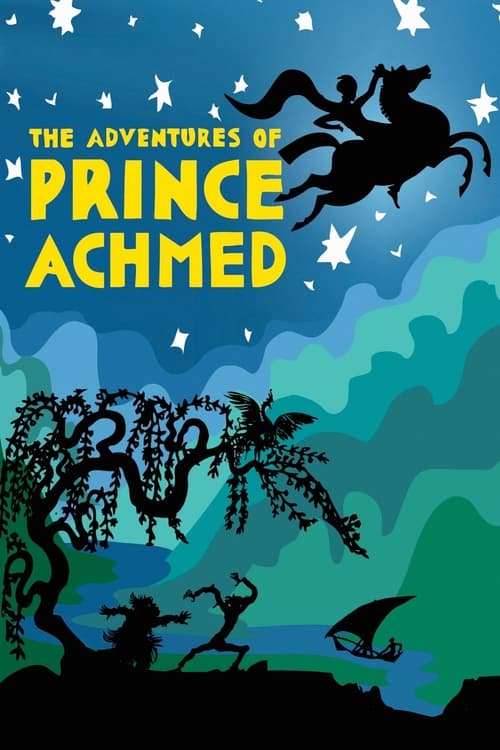
The Adventures of Prince Achmed
1926 · Lotte Reiniger
For when you want to be transported somewhere none of your streaming defaults can take you — a rainy-afternoon curiosity that turns out to be a full enchantment. Great with a good score playing and your phone in another room.
What it's about
Drawn from One Thousand and One Nights, it follows Prince Achmed, tricked onto a magic flying horse by a wicked sorcerer and carried off into a chain of adventures — a beautiful spirit-princess to win, a witch to bargain with, demon armies to face, even a detour with Aladdin and his lamp. The whole tale is told in silhouette: intricate black paper cut-outs moving against glowing, colored backgrounds.
The experience
Genuinely hypnotic — closer to watching a shadow-play or an illustrated book come alive than any cartoon you grew up with. It's brisk, ornate, and strange in the best way, with real menace in its sorcerers and real delight in its flights.
The craft
Lotte Reiniger and her tiny team spent three years animating jointed paper and lead figures frame by frame on back-lit glass, and the filigree detail — lace palaces, feathered wings, curling smoke — is still astonishing. Every frame is handmade shadow-craft, and it rewards a big screen where the silhouettes' delicacy can register.
Why it matters
The oldest surviving animated feature film — predating Disney's features by over a decade — it established that animation could sustain epic storytelling and made Reiniger a pioneer whose silhouette style still echoes through animation today.
Snapshot
The Adventures of Prince Achmed (Die Abenteuer des Prinzen Achmed) is a feature-length work of silhouette animation drawn from One Thousand and One Nights, made in Germany across roughly three years and released in 1926. It is the earliest surviving animated feature film — a distinction it holds because the pioneering Argentine features of Quirino Cristiani (notably El Apóstol, 1917) are lost, leaving Reiniger's film as the oldest that can still be watched. Executed almost entirely through jointed black paper and lead cut-outs photographed against back-lit glass, the film compresses several tales from the Nights — the wicked African sorcerer, the magic flying horse, Prince Achmed's love for Pari Banu, an interlude with Aladdin and his lamp, and a climactic battle involving a witch and an army of demons — into an unbroken fairy-tale arc of about sixty-five minutes. Beyond its status as a first, it is a genuinely beautiful and inventive object: a demonstration that animation could sustain feature length, carry an emotional narrative, and function as art cinema rather than novelty.
Industry & production
The film was made outside the standard studio system, which is central to understanding both its freedom and its difficulty. Reiniger had built a reputation in Weimar Berlin for short silhouette films and for title and effects work — she came up through the theatrical orbit of Max Reinhardt and had contributed silhouette sequences to Paul Wegener's fantasy films. The banker Louis Hagen, an admirer of her work, financed Prince Achmed privately, in effect commissioning a feature and providing Reiniger and her collaborators a studio (widely reported to have been fitted out above his premises near Potsdam). This patronage model — a single private backer rather than a production company — freed the project from commercial deadlines and let the team refine a labor-intensive technique over years, but it also left the finished film without an obvious distributor.
German exhibitors were wary of a feature-length "cartoon," a form that had no precedent, and the film reportedly struggled to secure a domestic release. It found an early champion in France: a celebrated screening in Paris in 1926 (Reiniger and her circle were connected to French filmmakers, Jean Renoir among them, through her husband Carl Koch) helped establish the film's reputation before its German premiere the same year. The precise commercial performance is poorly documented; there are no reliable box-office figures, and the honest summary is that the film was an artistic landmark whose contemporary earnings and distribution reach are not well recorded.
Technology
The technology of Prince Achmed is inseparable from its aesthetic. Reiniger and Koch worked on an animation stand — a Tricktisch, or trick table — in which figures lay flat on a sheet of glass lit from beneath and were photographed by a camera mounted vertically above, pointing down. The silhouettes read as pure black against illuminated ground, so the "image" is essentially a controlled shadow. The figures themselves were cut from thin cardboard and sheet lead, the lead giving weight so pieces stayed put between exposures; limbs, hands, and facial elements were hinged with fine wire and threaded joints so a single figure could be posed through hundreds of incremental positions.
The most historically significant technical development is the layered set-up used for backgrounds and atmospheric effects. To create depth, drifting mist, water, fire, and abstract textures, the production stacked multiple planes of glass at different heights above the light source — an arrangement widely regarded as an important precursor to the multiplane camera later associated with (and independently developed by) the Disney studio. Color was added not photochemically in the modern sense but through tinting and toning of the print, so that scenes carry washes of blue, amber, rose, and green to signal night, fire, magic, or mood — a standard silent-era practice here deployed with unusual sensitivity.
Technique
Cinematography
Because the camera is fixed overhead and the "actors" are flat cut-outs, cinematography here means the design of light, plane, and movement within a frame rather than lens work in the conventional sense. The single strongest expressive tool is the interplay of the opaque silhouette against luminous, often colored grounds, with the layered glass planes producing atmospheric recession — foreground figures crisp and black, background elements softened into haze. Camera movement in the modern sense is minimal; dynamism comes instead from figures scaling toward or away from the picture plane, from the flight paths of the magic horse traced across the frame, and from tinting shifts that function almost as lighting changes. The result is a highly graphic, poster-like image sensibility that anticipates later flat, design-driven animation.
Editing
The film is structured as a continuous chain of interlocking tales rather than a montage-driven work; cutting serves clarity and transition rather than rhythm. Scenes are joined as episodes — the horse's flight, the sorcerer's schemes, the Wak-Wak islands, the Aladdin interlude, the final demon battle — with intertitles carrying narrative connective tissue in the silent-film manner. Within scenes, the labor of the technique means that continuity is largely achieved inside the frame, through the animation itself, so editing operates at the level of scene architecture: braiding the borrowed Nights stories into a single forward-moving quest.
Mise-en-scène / staging
This is where Reiniger's theatrical training and the film's debt to shadow-puppet traditions (Chinese and Javanese/Indonesian wayang forms are the acknowledged lineage) are most visible. Composition is frontal and stage-like, with figures arranged in legible profile — profile being the natural language of silhouette, since a face read edge-on communicates identity and emotion where a frontal black shape would not. Ornament is extraordinarily dense: filigreed palaces, curling foliage, elaborate costumes and headdresses, all cut by hand. Staging exploits the contrast between the delicate, decorative "good" characters and the grotesque, spiky, exaggerated forms of the sorcerer, the witch, and the demons, so that morality is legible purely as shape.
Sound
The film is silent, conceived for musical accompaniment and intertitles rather than synchronized sound. Wolfgang Zeller composed an original orchestral score for the premiere, and that score is treated as integral to the work — an early instance of a purpose-written score for an animated feature. Modern restorations reinstate Zeller's music alongside the restored tinting, and it is by this pairing that the film is now generally experienced. There is, of course, no dialogue or diegetic sound; narrative meaning is carried by image, title card, and music together.
Performance
There are no actors in the conventional sense, so "performance" resides entirely in the animated figures. The expressive achievement is that jointed paper silhouettes convey desire, fear, cunning, and tenderness through posture and gesture alone — the tilt of a head, the reach of a hand, the arch of a back. Reiniger was famous for her scissor-work and for a distinctive fluency in animating gesture, and Achmed, Pari Banu, and the sorcerer register as characters with legible interior states despite having no faces in any detailed sense. This gestural eloquence, achieved without dialogue or facial nuance, is one of the film's quiet marvels.
Narrative & dramatic mode
The dramatic mode is fairy-tale romance and heroic adventure, organized as a nested, episodic quest in the tradition of the Nights itself, where stories open into other stories. A magic flying horse, conjured by the malevolent sorcerer, carries Achmed away and sets the plot in motion; his love for Pari Banu of the Wak-Wak islands provides the emotional spine; the sorcerer supplies recurring antagonism; and a temporary alliance with Aladdin and a benevolent witch enables the climactic defeat of demonic forces. The mode is frankly enchanted — transformation, flight, magic objects, and supernatural combat are the narrative's native grammar — and the film trusts spectacle and wonder as much as causal plotting. Emotional stakes (love, jealousy, loyalty) are simple and archetypal, which suits both the source material and the abstracted, non-realist medium.
Genre & cycle
The film sits at the intersection of the German Märchenfilm (fairy-tale film) tradition and the emerging field of animation, while also touching the Weimar avant-garde. As fantasy-adventure it belongs to the same broad Orientalist vogue that produced lavish live-action Arabian Nights imagery across 1920s European and American cinema. As animation it effectively inaugurates a "cycle" that barely existed — the animated feature — years before the American features usually cited as the form's beginning. And through its collaborators it brushes against the German "absolute film"/abstract-animation movement, lending an experimental, art-cinema inflection to what is on its surface a children's story.
Authorship & method
Reiniger is unambiguously the author: she designed and cut the figures, conceived the visual world, and animated the great majority of the film, working frame by frame at a painstaking pace over roughly three years. The commonly cited figures — on the order of a quarter-million frames photographed with perhaps a third of them used in the final cut — should be treated as widely repeated estimates rather than precisely audited counts, but they convey the scale of the labor accurately.
Her key collaborators formed a small, remarkable team. Carl Koch, her husband, handled production and the technical/camera apparatus, and was central to devising the trick-table and layered-glass method. Walter Ruttmann — soon to make the landmark city symphony Berlin: Symphony of a Great City (1927) — contributed abstract, atmospheric background effects, bringing avant-garde experimental technique to the film's magical sequences. Berthold Bartosch, later celebrated for L'Idée (1932), also worked on backgrounds and effects. The score is by Wolfgang Zeller. There is no single "screenwriter" in the modern sense; the scenario is Reiniger's adaptation of the Nights. The exact division of labor between Reiniger, Ruttmann, and Bartosch on the effects work is not documented frame by frame, and accounts vary in emphasis — a point worth flagging rather than resolving with false precision.
Movement / national cinema
The film is a product of Weimar-era German cinema, the same fertile 1920s environment that produced Expressionism, the Kammerspielfilm, and the abstract-film experiments of Ruttmann, Viking Eggeling, and Hans Richter. Reiniger stands somewhat apart from Expressionism proper — her sensibility is decorative, lyrical, and folk-rooted rather than anguished or distorted — but she shares that culture's willingness to treat film as a plastic, designed art form, and her collaboration with Ruttmann ties the film directly to the German avant-garde. It belongs, in short, to Weimar art cinema more than to any commercial genre stream.
Era / period
Made 1923–1926 and released in 1926, the film sits in the late silent era, before synchronized sound and before the industrialized cel-animation pipelines that would dominate the 1930s. This timing is essential: it is a handcrafted, artisanal object from a moment when animation's methods were still open and improvised, and when a private patron could underwrite years of experiment. It predates the standardization of the animated feature as a studio product, which is precisely why its techniques feel invented from first principles.
Themes
Thematically the film works in archetypes: the struggle of good against evil, rendered legible as the contrast between graceful and grotesque forms; romantic love as a force that motivates heroism and endures trial; and transformation and metamorphosis, both literal (shape-shifting, magic) and formal (the constant fluid becoming of the silhouettes themselves). Enchantment and wonder are treated as ends in themselves. There is also, unavoidably, the period's Orientalist framing of the Arabian Nights material — an exoticized "East" of sorcerers, harems, and magic — which a contemporary account should name plainly as part of the film's inheritance rather than pass over.
Reception, canon & influence
Critically, the film has come to be regarded as a foundational monument of animation history and of Reiniger's singular career; its Paris reception in 1926 was warm and helped cement its early reputation among cinephiles, even as its commercial path in Germany was uncertain and its detailed contemporary reviews and earnings are thinly recorded. Its canonization is largely retrospective, secured by film historians and by restoration — notably the German-led restoration work of the late 1990s that recovered the original tinting and reunited the images with Zeller's score, making the film widely accessible and reasserting its stature.
Looking backward, the film's influences are clear and openly avowed: Asian shadow-puppet traditions (Chinese shadow theater and Javanese wayang), the European silhouette-portrait craft, and the theatrical world of Reinhardt from which Reiniger emerged. Looking forward, its legacy runs along two lines. First, it established the animated feature as a possibility years ahead of the form's popular flowering, and it advanced the layered-plane approach to depth that anticipates multiplane practice. Second, and more directly, it seeded a continuing lineage of silhouette and cut-out animation: the tradition is most visibly carried on by Michel Ocelot, whose silhouette works (Princes et princesses, and the flat cut-out sensibility of Kirikou et la sorcière) are widely read as heirs to Reiniger, and it resonates with the broader cut-out animation practice later popularized in different registers (for instance Terry Gilliam's collage animation). Reiniger herself extended the method across a long subsequent career of shorts, including Mozart adaptations such as Papageno (1935). Prince Achmed remains both a historical first and a living influence — proof that a technique often dismissed as primitive could, in the right hands, produce a feature of lasting grace.
A Deleuzian reading
A black horse crosses a field of amber light with a black rider on its back.
The full Deleuzian reading of The Adventures of Prince Achmed →
Reception
German distributors initially wouldn't touch it and it needed a champion-led Paris screening (Jean Renoir among its admirers) to catch on; after decades of semi-obscurity — the original negative was destroyed in WWII — a 1999 restoration from a surviving tinted print sealed its status as a landmark of animation history.
How The Adventures of Prince Achmed was received, from release to now →
How to watch The Adventures of Prince Achmed: what to notice on a first viewing
- Notice every figure is a solid black paper silhouette. Lotte Reiniger cuts each character from black card and lead, jointed at the limbs, so nothing on screen has a face in any detailed sense, only an outline. You end up reading feeling entirely from posture and edge, proof that a face was never strictly necessary.
- Notice the tint of the print change with each scene's mood. Blue signals night, amber signals fire, rose and green signal magic, so color functions almost like lighting design laid directly over the black-and-white figures. The color doesn't belong to any single object; it takes over the whole scene as one mood.
- Watch how the good and evil characters are shaped differently. Achmed and Pari Banu are cut in graceful, curling lines while the sorcerer and his demons are drawn in spikes and jagged barbs. You can tell who is good or evil from across the room, just from the shape of the silhouette.
- Notice the lovers are almost always shown in profile. Profile is the only angle at which a flat black shape reads clearly as a person, so tenderness has to come through the tilt of a head or the reach of a hand. Without a face at all, the film still finds a way to make you feel exactly what a character wants.
The whole guide to watching The Adventures of Prince Achmed, with the keys for a rewatch →
Influences: the films it descends from and the films it influenced
- Fantasmagorie (1908) — Establishes the frame-by-frame animation of continuously metamorphosing figures — forms dissolving one into the next — the transformation-as-drawn-technique that Achmed relies on for its shape-shifting sorcery duels.
- Le Voyage dans la Lune (1902) — Model for hand-applied stencil/tint coloring of fantasy imagery and for staging spectacle in flat frontal theatrical tableaux, the compositional grammar Reiniger inherits from the féerie.
- The Cameraman's Revenge (1912) — Demonstrates the single-author, single-camera discipline of animating articulated figures one exposure at a time, the same patient months-long frame labor Achmed's quarter-million exposures required.
- El Apóstol (1917) — The first animated feature, built from jointed cardboard cut-out figures photographed frame-by-frame on a horizontal table — the exact cut-out-feature precedent Achmed is usually miscredited as inventing.
- Lichtspiel: Opus I (1921) — Ruttmann's hand-painted-on-glass abstract moving forms are the literal technique he brought to Achmed as effects collaborator, generating its swirling fire, smoke and magical atmospherics.
- Das Ornament des verliebten Herzens (1919) — Reiniger's own debut in scissor-cut black silhouette figures animated under a downward camera — the personal method she scaled up, unchanged in principle, into the feature.
- L'Idée (1932) — Bartosch, an Achmed backgrounds collaborator, built a multi-tiered glass rig to layer figures and light into atmospheric depth — directly extending the layered-plane approach he and Koch devised on Achmed.
- Papageno (1935) — Reiniger herself carries the silhouette method forward, now cutting figure movement to fit pre-existing Mozart music, tightening the score-to-gesture synchronization pioneered with Zeller.
- The Old Mill (1937) — Disney's multiplane camera industrializes the depth-through-stacked-planes principle of Koch and Reiniger's layered-glass trick-table into a motorized apparatus for parallax.
- Hedgehog in the Fog (1975) — Norstein animates hinged paper cut-out figures across multiple glass layers lit for haze and depth — the most sophisticated technical heir to Achmed's layered silhouette-and-glass rig.
- Monty Python and the Holy Grail (1975) — Gilliam revives the flat articulated cut-out figure moved frame-by-frame under a camera, transposing Reiniger's silhouette-collage craft into absurdist satire.
- The Spirit of Christmas (1995) — Construction-paper cut-out characters shot in stop-motion — the jointed-flat-figure-under-camera tradition of Achmed and El Apóstol repurposed for crude comedy.
- Kirikou et la sorcière (1998) — Ocelot's flat cut-out figures posed in frontal and pure-profile compositions against saturated luminous grounds openly rework Reiniger's frontal-profile silhouette staging.
- Princes et princesses (2000) — Solid black silhouette figures acting through gestural profile against glowing colored backdrops — an explicit, avowed homage to Reiniger's silhouette-against-luminous-ground technique.
- Les Contes de la nuit (2011) — Carries the silhouette-against-luminous-ground device into digital cut-out compositing, preserving Reiniger's frontal figures and backlit color while shedding the physical trick-table.
- Persepolis (2007) — Founded silhouette animation as an expressive form of flat black-shape figures against light, the visual grammar Persepolis draws on in its stark cut-out-like silhouette sequences of crowds and war.
- Azur & Asmar: The Princes' Quest (2006) — Reiniger's backlit cut-paper silhouette theater staging an Arabian Nights fable is the direct formal ancestor of Ocelot's own silhouette method, which he then recolors into Azur's flat frieze-like figures.
- Song of the Sea (2014) — Reiniger's silhouette folklore, told entirely in flattened cut-out planes, is the ancestral proof-of-concept that legend reads best as pure graphic shape against layered backgrounds.
- Berlin: Symphony of a Great City (1927) — Shares Achmed's Weimar avant-garde workshop and Ruttmann's rhythmic, music-driven montage sensibility, applying the same abstract-motion craft to documentary rather than fairy tale.
- Die Nibelungen: Siegfried (1924) — Carries the film's abstract-animation-interlude impulse into a full silhouette-animated Germanic-Orientalist fantasy, treating figure and ornament as flat designed pattern.
- The Tale of the Fox (1941) — The other European animated feature made as a family cottage industry — years of hand labor by two or three people, a folk-literary source, and a commissioned continuous orchestral score treated as the film's spine rather than as accompaniment.
Similar films
- Princes and Princesses (2000) — influence & lineage
- Son of the White Mare (1981) — often watched together
- Azur & Asmar: The Princes' Quest (2006) — often watched together
- Fantasia (1940) — often watched together
- The Night of Counting the Years (1969) — often watched together
- Beauty and the Beast (1946) — often watched together
- The Thief of Bagdad (1940) — shared sensibility
- The Snow Queen (1957) — shared sensibility