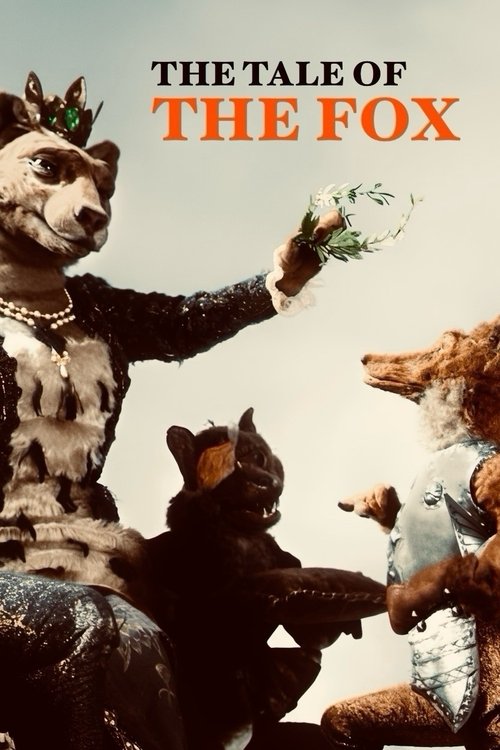
The Tale of the Fox
1941 · Władysław Starewicz
For when you want something old, odd, and wonderful — a curiosity night, or an antidote to the sameness of modern animation. More enchantment than comfort food; it asks a little patience and repays it.
What it's about
In a medieval kingdom of animals, a fox has made an art of swindling everyone — the wolf, the rooster, the cat, nobody is safe. Complaints pile up at the court of the lion king until he orders the trickster arrested and brought to justice. What follows is a battle of wits between one cunning outlaw and an entire royal establishment, drawn from the centuries-old French beast epic of Renard.
The experience
Sly, mischievous fun with a genuinely strange undertow — these are furred, expressive puppets performing courtly intrigue, and the handmade texture of every frame keeps you slightly off balance even as the jokes land. It moves briskly for its age and rewards close watching.
The craft
Władysław Starewicz animated this almost single-handedly in his home studio over roughly eighteen months, posing dozens of articulated animal puppets with fur, whiskers, and startlingly nuanced facial expression — decades before such detail was common. The density of movement in the crowd and battle scenes remains jaw-dropping when you remember every gesture was set by hand. It's a film to lean close to; the texture is the show.
Why it matters
One of the first stop-motion feature films ever completed, made entirely outside any studio system, and a touchstone for generations of puppet animators who point to it as proof of what one obsessive craftsman could do.
Snapshot
Le Roman de Renard is a 65-minute stop-motion puppet feature adapted from the medieval French beast epic Roman de Renart and its later German recension, Goethe's Reineke Fuchs. It is the summit of a career built almost entirely outside any studio system, by a man who taught himself animation in a provincial natural-history museum and never really stopped working like a museum preparator. The film's chronology is as strange as its images: the animation was shot in Starewicz's home studio at Fontenay-sous-Bois across roughly eighteen months around 1929–30, then sat without a soundtrack for years while financing failed; a German-language version premiered in Berlin in 1937, and the French version — the one that gives the film its 1941 date — opened in Paris under the Occupation. A film conceived at the end of the silent era thus reached its home audience in the middle of the Second World War, by which time Disney's Snow White had already rewritten what "animated feature" meant.
What survives is a work of near-absolute authorial control and startling formal sophistication: a fully articulated animal court, staged and cut like a live-action costume picture, performed by puppets whose faces move. It is routinely cited as the first feature-length stop-motion puppet film, a claim best stated carefully — the animation predates Aleksandr Ptushko's The New Gulliver (1935), but Ptushko's hybrid reached screens first.
Industry & production
Starewicz operated as a cottage industry. After leaving Russia in the wake of the Revolution and settling in France around 1920, he built a studio in his house at Fontenay-sous-Bois and produced a stream of shorts — La Voix du rossignol (1923), the Fétiche films of the early 1930s — with a workforce that consisted largely of his own family. His daughter Irène (Irina) Starewitch was his principal collaborator on puppet construction and animation; the household absorbed most other functions. This is not a romantic detail but the determining industrial fact about the film: there was no producer imposing a schedule, no unit, no division of labor, and correspondingly no capital.
That absence of capital is what stranded the film. The picture was finished as picture and then could not be finished as film, because sound in 1930 meant recording studios, musicians, actors, and optical printing — services Starewicz could not perform at home. The usually cited account is that French backing never materialized and that German money eventually paid for a soundtrack, producing the Berlin release of April 1937 under the Goethe-sanctioned title Reineke Fuchs. The French version, with new dialogue and a new score, followed in 1941 through Roger Richebé, one of the more established producer-distributors of the French sound era.
The 1941 French release lands in a specific and uncomfortable market. American films had been shut out of the occupied zone, French production had reorganized under Vichy and under the German-financed Continental Films, and a domestic feature-length animation had an artificial clearing to open into. Nothing in the record suggests Starewicz was politically implicated; the German financing looks like what an artisan does after seven years of failing to raise money at home. But the film's provenance — Berlin first, Paris under occupation second — is part of its history and should not be tidied away.
Technology
The technical basis is single-frame 35mm exposure, the same procedure Starewicz had invented for himself in Kaunas around 1910 when he tried to film stag beetles fighting, found that the insects went inert under the lights, and reconstructed them as posable models from their own dried carapaces. Two decades later the method is unchanged in principle and transformed in refinement.
The puppets are built on articulated internal armatures, skinned in fur, felt, and leather, and dressed in miniature period costume with functioning props. The decisive engineering is in the heads. Rather than accept the fixed carved mask that would define the later Czech school, Starewicz built mechanically expressive faces: movable eyes and lids, hinged jaws, mobile brows and lips, supplemented by interchangeable parts. A Starewicz animal can squint, sneer, register a thought, and change its mind on camera. Sets are miniature architecture — the Lion King's throne room, Renard's fortress at Maupertuis, forest and farmyard — built to depth and lit with hard sources for modeling and cast shadow, so the frame behaves photographically rather than graphically.
Sound was, of necessity, a separate technology arriving a decade late. Because the images were exposed silent and then fitted with two different languages, the film's speech is post-synchronised in the strictest sense: dialogue written to picture, not picture animated to dialogue.
Technique
Cinematography
Starewicz shot the film himself, and the camerawork is the element that most consistently surprises. Most animation of the period, including much of Disney's, is staged frontally within a stable proscenium. Le Roman de Renard is not: it uses low angles to monumentalise the throne, close-ups for reaction, depth staging with foreground occlusion, and camera movement that travels through the miniature sets rather than merely panning across them. The lighting is chiaroscuro rather than flat, with pools and shafts that model fur and throw shadows onto walls — an approach that treats the puppets as photographed objects with mass, not as drawings. The result reads less like a cartoon than like a costume film shot at one-sixth scale.
Editing
The cutting follows live-action continuity grammar: establishing shot, coverage, shot/reverse-shot across dialogue, inserts on objects and hands. For animation of 1930 this is close to radical, and it is expensive in a way audiences cannot see — every angle change means restaging and relighting a set and re-registering puppet positions by hand. The episodic structure of the source is managed through relatively long scenes with internal cutting rather than the rapid gag-to-gag rhythm of contemporary short-form animation. The film's pacing is its most dated aspect; it moves at the deliberate speed of the late silent feature.
Mise-en-scène / staging
The staging is medieval-burlesque: a feudal court rendered with heraldic banners, thrones, gallows, siege engines and monastic interiors, all populated by animals in doublets. The visual world has an obvious affinity with the nineteenth-century illustrative tradition around Goethe's Reineke Fuchs — Wilhelm von Kaulbach's designs are the touchstone — though the extent of direct borrowing is not something the record settles. The staging's governing principle is density: crowd scenes at court, animals stacked in depth, business happening at the edges of frame. Starewicz fills the miniature the way a Bruegel fills a panel.
Sound
The French soundtrack was assembled by two figures from the world of French popular song and radio. Vincent Scotto — one of the most prolific chanson composers of the century, and the musical voice of Pagnol's films — supplies a score that functions less like modern film scoring than like the continuous accompaniment of a silent feature, carrying scenes wholesale and cueing gags. Jean Nohain provided the French adaptation and dialogue, bringing a music-hall, rhyming, patter sensibility. The vocal cast for the French version is led by Claude Dauphin, Nohain's brother (both were sons of the poet Franc-Nohain); the full attribution of individual voices to individual animals is inconsistently documented and worth stating as uncertain rather than guessing at.
The post-synchronisation produces a genuine aesthetic effect. Lip movement is expressive but generically so — it had to serve German and French alike — so the voices sit slightly upon the bodies rather than inside them. The film gains a faintly ventriloquial quality that suits a story about creatures whose mouths are their weapons.
Performance
The performance is entirely Starewicz's, executed twelve or twenty-four times per second of screen time. What distinguishes it from most puppet animation before and much after is timing on the beat of thought: pauses, double-takes, small anticipatory shifts of weight, a head turning before the eyes do. Because the film was animated silent, the acting is fully legible with the sound off — the pantomimic clarity of the late silent cinema, transferred to objects. The mechanical faces make possible a register of sly, small-scale comedy that carved-face puppetry cannot reach.
Narrative & dramatic mode
The mode is picaresque comedy organized around a trial. Complaints against Renard accumulate at the court of Noble the Lion; successive envoys — the bear, the cat, the badger — are dispatched to bring him in and are each mutilated by their own greed en route, since Renard's method is never force but the manufacture of an irresistible temptation. Arrest and condemnation follow; Renard talks himself off the gallows with a fabricated conspiracy and a story about buried treasure; the siege of his fortress at Maupertuis and a judicial duel with the wolf Ysengrin resolve the plot not with justice but with amnesty and promotion.
Dramatically this is a satire that refuses catharsis. The trickster is not reformed, punished, or exiled; he is absorbed into the state, which is the medieval source's joke and the film's. The episodic construction — a chain of self-contained cruelties strung on a legal thread — is inherited wholesale from the Renart branches, and it gives the film a shape closer to an anthology than to the goal-directed feature structure Hollywood was standardizing in the same years.
Genre & cycle
The film sits in the beast fable, the oldest satirical genre in European vernacular literature, and in the much younger cycle of the animated feature. In 1930 that cycle barely existed: El Apóstol (1917) was lost, Lotte Reiniger's silhouette feature The Adventures of Prince Achmed (1926) was the surviving precedent, and dimensional puppet animation had produced nothing at length. By 1941, the cycle belonged to Disney. Le Roman de Renard therefore reaches audiences as a member of a genre it helped invent and had already been outrun by.
Authorship & method
This is as close to single authorship as narrative filmmaking gets. Starewicz designed, built, staged, lit, photographed, animated, and largely wrote the film, with Irène Starewitch as the essential second pair of hands on construction and animation. The collaborators of record arrive late and from outside: Scotto's score, Nohain's dialogue, Richebé's distribution, the anonymous technicians of the German 1937 version.
His method is best understood as taxidermic rather than graphic. He came to cinema from natural history, and his first puppets were made of actual insects; the animals of Renard retain that quality of specimens reanimated. Where the Disney method abstracted animals toward the human infant — round, soft, appealing — Starewicz's animals stay hairy, sharp-toothed, and slightly dead. This is the source of both the film's charm and its persistent low-grade unease.
Movement / national cinema
Le Roman de Renard belongs to no national cinema cleanly. Starewicz was of Polish parentage, born in Moscow, formed in Kaunas, made his name in Imperial Russian cinema under Aleksandr Khanzhonkov with The Beautiful Lukanida and The Cameraman's Revenge (both 1912), emigrated after 1917, and worked the rest of his life in France. The film was financed and first shown in Germany, released in France, and adapted from a text both cultures claim.
Its nearest context is the émigré artisanal animation of interwar Paris — Berthold Bartosch's L'Idée (1932), Alexandre Alexeïeff and Claire Parker's pinscreen Une nuit sur le mont chauve (1933) — a milieu of one- and two-person workshops rather than a movement. Starewicz was older than these figures and less interested in the avant-garde; he wanted narrative, character, and laughs. He was adjacent to that scene, not of it.
Era / period
The film straddles the two great ruptures of its moment. Formally it is a silent film: pantomimic acting, continuous musical accompaniment, dialogue as a late graft. Industrially it arrives into the sound-and-studio era, and into the specific market conditions of occupied France. Its production years, 1929 to 1941, cover the Depression that dried up its funding, the German rearmament that eventually supplied it, and the war that framed its premiere. Few films carry their decade so legibly in their release history.
Themes
Language as predation. Renard's weapon is rhetoric — confession, flattery, legal procedure, the invented treasure. The film's central irony is that a picture animated in silence turns out to be about the sovereignty of speech.
Law as theater. The court's procedures are elaborate and entirely ineffective; the trial produces spectacle, not justice, and ends in the criminal's promotion. The satire is aimed at institutional performance rather than at individual vice.
Appetite. The medieval Renart is a literature of hunger, and the film keeps that center: every trap is baited with food, every victim is caught by wanting to eat.
Comic cruelty. Bodies are crushed, scalded, flayed, and hung, and the mutilations are timed as slapstick. The film sustains a tone — genuinely violent, genuinely funny — that later feature animation, shaped by Disney's family address, largely abandoned.
The animate corpse. Fur, hide, and glass eyes made to move. The uncanny is structural to the technique, not an effect layered onto it.
Reception, canon & influence
Contemporary reception is thinly documented, and it would be easy to invent a consensus that no accessible record supports. What can be said reliably: the film had two separate national premieres four years apart, both into difficult circumstances; it did not establish a French puppet-feature industry; and it did not enter general international circulation for decades. Starewicz's reputation in the intervening period rested more on his shorts, particularly Fétiche (The Mascot, 1933) and the early Russian work, than on the feature. Restoration and home-video release, driven substantially by the family archive maintained by his descendants, brought the film to a wide audience only in the late twentieth and early twenty-first centuries.
Backward. The film draws on the Roman de Renart branches, on Goethe's 1794 Reineke Fuchs, and on the nineteenth-century illustrative tradition that grew around Goethe's poem. Technically it draws on nothing but Starewicz's own 1910–13 experiments; there was no puppet-animation tradition to inherit. Its cinematographic grammar comes from the live-action silent feature — the same schooling in coverage and lighting that any European narrative director of the 1920s absorbed.
Forward. Three lines descend from it. First, Soviet dimensional animation, where Starewicz's Khanzhonkov-era work was foundational and where Ptushko's The New Gulliver (1935) and the later Soyuzmultfilm puppet unit carried the form. Second, the Central European puppet feature, above all Jiří Trnka, whose postwar features made the puppet feature a legitimate art-cinema object — and who chose the opposite solution to the face, using immobile carved masks and letting light and posture do the acting, a decision only legible as a decision against Starewicz's mechanical expressivity. Third, the modern auteur strand of stop-motion, where the debt is openly acknowledged: Terry Gilliam has named Starewicz among the great animators, and the Quay Brothers' fur-and-dust puppet worlds are unthinkable without him; Švankmajer's animated meat and objects belong to the same lineage of the reanimated dead thing.
The rhyme with Wes Anderson's Fantastic Mr Fox (2009) — a stop-motion feature about a fur-covered fox trickster who outwits a hostile society and is finally accommodated by it — is unmistakable, though it derives from Roald Dahl and I would not claim a documented line of transmission. What is fair to say is that Le Roman de Renard established, seventy years early, the terms on which such a film is possible: real fur, real light, real shadow, a camera that moves, and an animal protagonist whose charm is entirely a function of his dishonesty.
A Deleuzian reading
A complaint is being read against the fox, and the fox is listening.
The full Deleuzian reading of The Tale of the Fox →
Reception
Barely seen on its delayed release, it spent decades as a footnote before animation historians rescued it — now it's routinely cited as one of the great early animated features and the crowning work of stop-motion's first master.
How The Tale of the Fox was received, from release to now →
How to watch The Tale of the Fox: what to notice on a first viewing
- Watch the fox's face think before he lies each time. Starewicz built movable eyes, hinged jaws, and mobile brows into these puppets, so the fox's face can hesitate and change its mind mid-shot. A carved mask can look grave or frightening but it can't do this, squint and reconsider in real time.
- Notice hard shadows and light shafts modeling the fur itself. Sets are lit with hard, raking sources that carve deep shadow onto fur and throw shadows across the walls, treating puppets as photographed objects with real mass. It reads less like a cartoon than a costume picture shot at a fraction of the size.
- Watch the camera actually travel through these tiny sets. Instead of the flat, frontal staging most animation used, this camera moves through the miniature world with low angles and foreground occlusion. This tiny court gets filmed like an actual costume epic, not like a children's cartoon.
- Notice how many animals are stacked in depth at court. Crowd scenes pack animals in depth with business happening at the very edges of frame, filling the miniature the way a Bruegel painting fills its panel. There's always something happening at the edge of the frame worth a second look.
- Listen for how the voices sit slightly apart from the mouths. Because the lip movement had to serve two languages, it stays expressive but generic, so the voices sit upon the bodies rather than inside them. That slight mismatch gives the film a faintly haunted quality that fits creatures whose mouths are their weapons.
The whole guide to watching The Tale of the Fox, with the keys for a rewatch →
Influences: the films it descends from and the films it influenced
- The Beautiful Leukanida (1912) — Starewicz's first stag-beetle film establishes the taxidermic method the fox inherits — puppets built on and around actual dried specimens, wired at the joints so the animated body reads as a real dead creature reanimated rather than a designed cartoon shape.
- The Cameraman's Revenge (1912) — The template for the whole feature: animal puppets performing an adulterous bourgeois farce in fully dressed miniature interiors, shot with the shot/reverse-shot and eyeline coverage of live-action comedy rather than the frontal tableau staging animation then used.
- The Frogs Who Wanted a King (1922) — His first large-crowd animal-fable satire — dozens of frog puppets massed in depth before a throne — is the direct rehearsal for Renard's Bruegelian court density and its picaresque trial structure that ends in accommodation rather than moral resolution.
- The Voice of the Nightingale (1923) — The Paris-period work where Starewicz solved chiaroscuro lighting at miniature scale, using hard raking key and deep shadow on fur so that a 20cm puppet holds the tonal range of a photographed face.
- The Mascot (1933) — The Devil's Ball sequence is the technical proof-of-concept for Renard: a camera that dollies and cranes through a crowded miniature set while dozens of stuffed-and-furred puppets animate simultaneously in the same take.
- Die Nibelungen (1924) — The medieval-court grammar Renard applies at 1:6 scale — low-angle framing that monumentalises throne architecture, symmetrical courtier ranks, and torchlit modeling of stone — is the German silent monumental style transposed into a puppet stage.
- The Last Laugh (1924) — The entfesselte Kamera is what Starewicz smuggles into animation: Renard's dollies and reframes inside sets barely a meter deep require rebuilding the camera mount on a rail for single-frame increments, an idea that only makes sense if you've seen the live-action unchained camera first.
- The New Gulliver (1935) — Ptushko industrializes Starewicz's mechanically articulated head into a replacement system — thousands of interchangeable Lilliputian faces cycled frame by frame — building the Soviet dimensional-animation unit on the Khanzhonkov-era method Starewicz had left behind.
- The Emperor's Nightingale (1949) — Trnka legitimizes the puppet feature as art cinema by taking the opposite solution to the face: immobile carved masks, with all expression carried by light, head angle and body posture — a choice only legible as a refusal of Starewicz's mechanical mouths and rolling eyes.
- The Fabulous Baron Munchausen (1962) — Zeman derives his entire pictorial system from the nineteenth-century engraved illustration of his source, exactly as Renard derives its court from the Kaulbach-tradition plates for Goethe's Reineke Fuchs — animation as the reanimation of a book's pictures.
- Street of Crocodiles (1986) — The Quays extend the taxidermic strand directly — fur, dust, screws, offal-like organic matter, shallow-focus lenses racking inside sets a few inches deep — treating the puppet as a decayed specimen rather than a character design.
- Alice (1988) — The White Rabbit is a taxidermied specimen that pulls itself off its display board and leaks sawdust as it moves — the reanimated dead animal, made from an actual dead animal, that Starewicz invented in 1912 and carried into the feature.
- The Nightmare Before Christmas (1993) — Jack's library of interchangeable machined heads is the industrial descendant of Starewicz's mechanically articulated puppet skull, and Selick shoots it with the same borrowed live-action grammar — crane moves, rack focus, coverage cut for continuity.
- Fantastic Mr Fox (2009) — Whatever the Dahl provenance, Anderson works on the terms Renard set seventy years earlier: real fur left visibly boiling frame to frame, real practical lighting and cast shadow in the miniature, a tracking camera through burrow sets, and a fox whose appeal is entirely a function of his dishonesty.
- The Adventures of Prince Achmed (1926) — The other European animated feature made as a family cottage industry — years of hand labor by two or three people, a folk-literary source, and a commissioned continuous orchestral score treated as the film's spine rather than as accompaniment.
- King Kong (1933) — Willis O'Brien's rabbit-fur pelt over an articulated armature produces the same visibly boiling coat that Starewicz accepts on his fox — parallel invention of the furred dimensional puppet, where the animator's own fingerprints in the pile become part of the creature's presence.
- Snow White and the Seven Dwarfs (1937) — The contemporaneous animated feature Renard defines itself against on the specific question of the animal body — Disney rounds and infantilises the muzzle toward human appeal, Starewicz keeps the snout sharp, the teeth real, and the eyes glassy.
Similar films
- Fantastic Mr. Fox (2009) — influence & lineage
- The Adventures of Prince Achmed (1926) — influence & lineage
- Guillermo del Toro's Pinocchio (2022) — shared sensibility
- The Pied Piper (1986) — shared sensibility
- The Wolf House (2018) — shared sensibility
- Wallace & Gromit: The Curse of the Were-Rabbit (2005) — shared sensibility
- Wallace & Gromit: Vengeance Most Fowl (2024) — shared sensibility
- Fantasia (1940) — shared sensibility