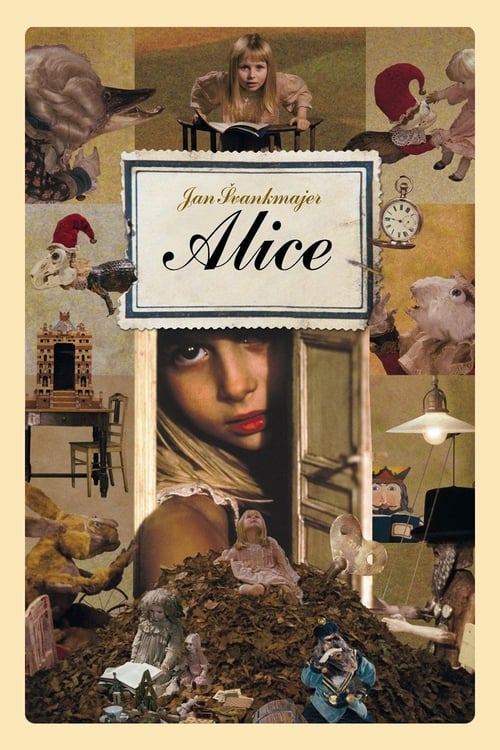
Alice
1988 · Jan Švankmajer
For when you want strange — a late-night, lights-off film for the adventurous, closer to a waking dream than a bedtime story. Challenge, not comfort, though it's mesmerizing rather than frightening.
What it's about
A quiet girl follows a taxidermied white rabbit — one that leaks sawdust from its chest and eats it back with a spoon — into a Wonderland built from a cramped apartment-world of drawers, jars, and stains. Alone among living objects and stuffed dead animals, she has to find her way out of a dream that plays by its own tactile, menacing rules.
The experience
Hypnotic and quietly unnerving — less a story than a dream you can touch, where socks burrow like worms and bread sprouts nails. It's slow, wordless for long stretches, and it gets under your skin the way real dreams do: matter-of-factly.
The craft
Jan Švankmajer animates real objects — bones, scraps, taxidermy — with stop-motion so textured you can practically feel the sawdust, mixing them with his single live actor, Kristýna Kohoutová, who speaks every voice herself, each line punctuated by an extreme close-up of her lips. The sound design of creaks, scrapes, and chewing does as much work as the images.
Why it matters
The Prague surrealist's first feature after decades of censored shorts, it became a touchstone of dark animation — proof that Carroll's dream logic could be restored to its true unsettling register, and a lasting influence on stop-motion filmmakers.
After two decades of short films that kept running afoul of Czechoslovak censors, the Prague surrealist Jan Švankmajer made his first feature at fifty-three — and chose Lewis Carroll, whom he insisted he was not adapting but having a dialogue with. His Wonderland is a cramped apartment-world of drawers, jars, and stains, where a live-action girl (Kristýna Kohoutová, the film's only human) pursues a taxidermied rabbit that leaks sawdust from its chest and eats it back with a spoon. Dream logic here has texture: socks burrow like worms, bread sprouts nails, skeletal creatures assemble themselves from museum scraps. Švankmajer strips Carroll of Victorian whimsy and restores the dream's actual register — matter-of-fact, tactile, faintly menacing — while Alice speaks every voice herself, each line punctuated by an extreme close-up of her lips. The Quay Brothers, Terry Gilliam, and Guillermo del Toro have all acknowledged the debt. The prologue offers fair warning: a film made for children. Perhaps.
A Deleuzian reading
Sawdust.
The full Deleuzian reading of Alice →
Reception
A festival-circuit success on release, it has steadily climbed from arthouse curiosity to the consensus pick among cinephiles as the definitive screen Alice — the adaptation people now hold up against Disney's.
How Alice was received, from release to now →
Influences: the films it descends from and the films it influenced
- The Cameraman's Revenge (1912) — Pioneers the animation of dead insect bodies frame-by-frame, establishing the taxidermic, tactile-object stop-motion — animating real dried skeletons and creatures rather than designed puppets — that Alice inherits in its dancing skulls, socks, and slab of raw meat.
- The Hand (1965) — The Czech puppet-film tradition Švankmajer descends from, animating a wooden marionette against oppressive authority; Alice extends its handmade puppet craft and its allegorical use of the puppet-as-vulnerable-body under threat.
- Invention for Destruction (1958) — The Czech live-action/animation hybrid grammar — combining a real human performer with animated engraving-style artifice — that Alice's apartment-wonderland compositing of a live girl among animated objects directly inherits.
- Un Chien Andalou (1929) — Codifies the Surrealist editing logic in which disjunctive cuts and impossible spatial transitions (a room opening onto a beach) obey dream-association rather than continuity — the exact non-Euclidean, doors-into-drawers dream grammar of Alice.
- The Vanishing Lady (1896) — Invents the stop-substitution splice — halting the camera to swap or transform an object mid-shot — the foundational trick behind Alice's constant metamorphoses (the White Rabbit sawdust-bleeding, objects becoming other objects between frames).
- Renaissance (1964) — Object animation of broken, decayed things reassembling themselves in extreme close-up; Švankmajer, who worked in the same Polish-Czech surrealist-animation orbit, extends its fetishistic attention to worn, tactile material and reversed destruction.
- Meshes of the Afternoon (1943) — Establishes the sole-protagonist dream film in which a single female figure moves through a looping, self-multiplying domestic space governed by oneiric repetition — the structural template for Alice's lone-girl, single-apartment dreamscape.
- Tale of Tales (1979) — Eastern-bloc art animation built from textured cut-out and layered materials under dream-logic association rather than plot; shares Alice's use of memory-space montage and tactile, worn surfaces as the emotional substance of the image.
- The Fabulous World of Jules Verne (1958) — Carries forward the Czech live-action/animation hybrid, intercutting a real performer with handmade animated objects, prizing the visible tactile hand of the maker over seamless illusion.
- Valerie and Her Week of Wonders (1970) — Extends Czech Surrealism's tactile object-logic — a child lead who mostly watches and reacts while props transform through animation and substitution, Carroll's unmotivated metamorphosis handled as a materials problem rather than an effects one.
- Alice in Wonderland (1951) — An explicit formal rebuttal built on stop-motion with real taxidermy, sawdust and a live girl in actual rooms — restoring the tactile Victorian object-world and Tenniel's grotesquerie precisely where Disney substituted weightless graphic color.
- A Midsummer's Night Dream (1959) — Inherits Trnka's proof-of-concept — stop-motion as an adult feature-length literary adaptation — while inverting its surface, replacing carved lyricism with tactile found objects, taxidermy and abrasive contact sound.
- Coraline (2009) — Transposes the anti-whimsy Alice-figure — a bored girl passing through a small domestic portal (a drawer/door) into a sinister double-world — into feature stop-motion, inheriting Švankmajer's reading of the Carroll heroine as menaced rather than enchanted.
- Pan's Labyrinth (2006) — Del Toro, a declared Švankmajer admirer, extends the tactile-materiality of practical creatures and the child-in-a-cruel-wonderland structure, favouring physical, slightly repellent hand-built beings over CGI in the Švankmajer manner.
- Institute Benjamenta (1995) — The Quays' first live-action feature carries Švankmajer's Alice innovation forward — real actors moving through a hermetic, dust-laden dream-institution shot in fetishistic close-up, merging performer and animated-object aesthetic.
- The Nightmare Before Christmas (1993) — Popularizes the dark-fantasy stop-motion feature whose grotesque hand-built puppets and death-imagery (skeletons, severed parts made charming-yet-morbid) descend from the European Švankmajer/Trnka lineage of macabre puppet animation.
- Poor Things (2023) — Švankmajer's stop-motion grotesquerie — objects with uncanny autonomy, bodies in states of partial construction, spaces that share their animacy with furniture and creatures equally — shapes the film's staging of Bella's developmental physicality in constructed uncanny interiors.
- The City of Lost Children (1995) — Švankmajer's tactile stop-motion dread and surrealist Carroll-logic — animating found objects into menacing dream-machinery — feeds the film's grotesque, object-fetish texture.
- Institute Benjamenta, or This Dream People Call Human Life (1995) — Švankmajer's tactile object-animation and his fusing of live performer with animated bric-à-brac inside a dark-fairy-tale frame is the direct surrealist-animation method the Quays inherited and extended to feature length.
- Puella Magi Madoka Magica the Movie Part III: Rebellion (2013) — Czech surrealist collage stop-motion of scavenged objects and paper cut-outs is the explicit template Gekidan Inu Curry mimics for the witch labyrinths' tactile scrapbook animation.
- The Wolf House (2018) — Establishes the tactile stop-motion fairy tale as horror, animating taxidermy, wood and found domestic objects inside a claustrophobic house that the child cannot escape — the exact object-animation-plus-flight-and-confinement grammar Wolf House inherits.
- Memoir of a Snail (2024) — Švankmajer's insistence on the tactile materiality of hand-manipulated objects and obsessively accumulated bric-a-brac feeds both Memoir's hoarding motif and its ethic that the handmade surface should remain palpably present.
- Corpse Bride (2005) — Its Czech folktale-surrealist stop-motion, fusing the childlike and the macabre, embodies the Eastern-European folktale sensibility that supplies Corpse Bride's premise.
- Mad God (2021) — Švankmajer's tactile stop-motion animating raw meat, bone, and found objects with visceral texture is the direct European-grotesque line feeding Mad God's fabric.
- Dimensions of Dialogue (1982) — Švankmajer's own immediately prior short perfecting the frame-by-frame morphing of clay and everyday objects into and out of one another — the identical devouring/transforming object-craft deployed throughout Alice.
- Street of Crocodiles (1986) — Made by the Quays, who openly credit Švankmajer; shares the aesthetic of grimy puppets, loose screws, iron filings and decayed materials shot in shallow-focus extreme close-up, treating dust and rust as animate matter exactly as Alice does.
- Otesánek (Little Otik) (2000) — Švankmajer's later feature applying the same live-action-plus-animation hybrid to a Czech folk tale, animating a wooden tree-stump baby among live performers — the direct methodological continuation of Alice's blend of real actor and animated grotesque.
- Faust (1994) — Reuses Alice's device of a lone human wandering a labyrinthine interior populated by animated puppets and clay, sustaining the single-protagonist-among-objects staging and marionette craft on a feature scale.
- Beauty and the Beast (1979) — Fellow Czech puppet-trained surrealist rendering a children's tale as tactile nightmare — grotesque object-life and uncanny materiality kin to Herz's living, decaying castle.
- The Pied Piper (1986) — A near-contemporary Czech feature built on tactile handmade materiality and metamorphic transformation — the same conversion of animation's physical stuff into allegorical unease.
Similar films
- Pan's Labyrinth (2006) — influence & lineage · often watched together
- Coraline (2009) — influence & lineage
- The Nightmare Before Christmas (1993) — influence & lineage
- Un Chien Andalou (1929) — influence & lineage
- Son of the White Mare (1981) — same viewing thread
- The Wolf House (2018) — often watched together
- Alice in Wonderland (1951) — shared sensibility
- Memoir of a Snail (2024) — shared sensibility
All the films related to Alice →
Watch it with: curated runs of related films
- Dream Logic, Made by Hand — A run for when you want films where imagination doesn't just appear onscreen but rebuilds the world — stories nested inside stories, daydreams that leak into daylight, realities that quietly dissolve.