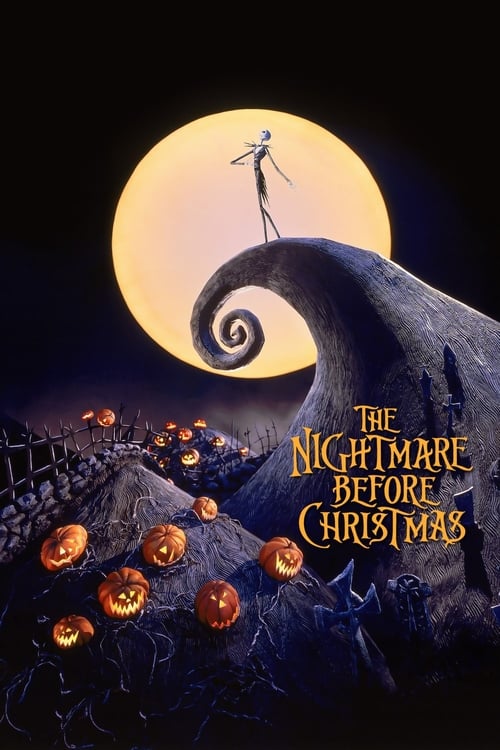
The Nightmare Before Christmas
1993 · Henry Selick
The perfect answer to 'is it a Halloween movie or a Christmas movie' — reach for it in either season, or whenever you want something spooky that still feels like a warm blanket. A comfort film for people who like their comfort a little crooked.
What it's about
Jack Skellington is the Pumpkin King of Halloween Town, the best there's ever been at scaring people — and he's bored to death of it. When he stumbles into Christmas Town and falls in love with its lights and warmth, he decides Halloween Town will run Christmas this year: Santa will be relieved of duty, and the ghouls will handle the gifts. Only Sally, a rag-doll woman who loves him and sees disaster coming, understands how badly this will go.
The experience
Macabre and cozy at once — skeletons and shrunken heads delivered with genuine sweetness, all of it sung. It's brisk, funny, a little melancholy, and endlessly rewatchable.
The craft
Every frame is stop-motion — hand-posed puppets, hundreds of Jack heads for every expression — under Henry Selick's meticulous direction, from Tim Burton's story and designs. Danny Elfman's songs and score do the heavy lifting; it's as much a musical as an animated film, and the handmade texture rewards a close, attentive watch.
Why it matters
A box-office modest release that grew into one of the most durable cult properties in American animation — so macabre Disney initially wouldn't put its name on it, now a merchandising and seasonal institution. It proved feature stop-motion could be mainstream.
Snapshot
The Nightmare Before Christmas is a feature-length stop-motion musical fantasy in which Jack Skellington, the ceremonial "Pumpkin King" of Halloween Town, stumbles through a portal into Christmas Town, becomes enchanted by its warmth, and attempts to appropriate the holiday for himself — with grotesque, well-meaning, and ultimately disastrous results. Directed by Henry Selick from a story and character designs by Tim Burton, with songs and score by Danny Elfman, the film is at once a technical landmark in puppet animation and a genre curiosity: a Disney-produced feature too macabre to carry the Disney name, released instead under the Touchstone Pictures banner. Modest in its initial commercial performance, it grew over the following decade into one of the most durable cult properties in American animation, and it remains the reference point against which the modern revival of feature stop-motion is measured. Its enduring reputation rests on an unusual fusion: a hand-built, tactile world of extraordinary craft yoked to a through-composed song score, wrapped around a slender but emotionally legible fable about identity and belonging.
Industry & production
The project's origin lies in the early 1980s, when Burton was a young animator at Walt Disney Productions and wrote a poem — modeled on Clement Clarke Moore's "'Twas the Night Before Christmas" and colored by the Rankin/Bass holiday television specials of his childhood — imagining a Halloween figure who discovers Christmas. Burton developed concept art and a story but could not mount it as a production at the time; he left Disney and built his reputation as a live-action director (Pee-wee's Big Adventure, Beetlejuice, Batman). By the early 1990s his commercial standing gave Disney reason to revive the dormant idea, and the studio retained the rights.
Crucially, Burton did not direct. Committed to Batman Returns and Ed Wood, he served as producer and originating author, and the studio hired Henry Selick — a former Disney and CalArts colleague with a background in stop-motion and commercial work — to direct. Production was based in San Francisco at a facility that became known as Skellington Productions, drawing on the Bay Area's concentration of stop-motion and effects talent. The shoot was famously protracted: a crew of animators worked for roughly three years, and the film's several dozen stages could yield only a few seconds of finished footage per animator per week. Disney released the completed film in October 1993 under Touchstone rather than its flagship label — an explicit branding decision reflecting the studio's worry that the film's ghoulish imagery was ill-suited to the Disney name, and the marketing carried the possessive title Tim Burton's The Nightmare Before Christmas, foregrounding the more famous author over the director. Public accounts of the film's exact production budget vary and I won't assign a firm figure here; its theatrical earnings were respectable rather than spectacular, with the outsized commercial return arriving later through home video, a 2006 Disney Digital 3-D reissue, and a vast, sustained merchandising afterlife.
Technology
The film was made almost entirely through stop-motion puppet animation — physical armatured figures on miniature sets, photographed one frame at a time. Its most cited technical innovation is the use of replacement animation for facial performance. Rather than manipulating a single flexible face, animators swapped interchangeable sculpted heads and face-parts to build expression and lip movement frame by frame; Jack Skellington's smooth skull-head was produced in a large library of subtly different versions, and Sally's expressive face likewise depended on many replacement pieces. Contemporary accounts commonly cite figures on the order of several hundred heads for Jack; the precise count varies between sources, so treat any single number as approximate.
Beyond the puppets, the production leaned on motion-control camera systems to execute smooth, repeatable moves impossible to hand-crank reliably, and it made early use of digital compositing to combine separately photographed elements — characters, backgrounds, atmospheric effects — into finished shots. This places the film at a transitional technological moment: a fundamentally analog, handmade craft augmented by the emerging digital tools of the early 1990s. It stands as a proof of concept that feature-length stop-motion, long thought commercially unviable, could sustain a mainstream theatrical release.
Technique
Cinematography
Director of photography Pete Kozachik shot the film with a painterly, high-contrast sensibility that distinguishes the two title worlds. Halloween Town is rendered in desaturated blacks, grays, and sickly greens under a spiral-hilled moon, its lighting steep and expressionistic; Christmas Town by contrast glows with saturated reds and warm whites. The camera is unusually mobile for stop-motion — craning, tracking, and swooping in ways that emphasize the dimensionality of the built sets rather than treating them as flat tableaux. Kozachik's lighting frequently borrows the vocabulary of horror and German Expressionism, using hard key lights, long shadows, and canted angles to charge otherwise gentle material with menace.
Editing
Cut by Stan Webb, the film runs a lean roughly-76 minutes and is structured almost like a stage musical, its rhythm dictated by the song score. Because Elfman's numbers were largely written and recorded before animation, editing worked in service of pre-existing musical architecture, tightly synchronizing action to melody and lyric. Transitions between the two worlds are handled with a fairytale economy, and the compression of the storytelling — establishing a whole cosmology of holidays, a romance, a heist, and a redemption in a short span — depends on brisk, elliptical cutting.
Mise-en-scène / staging
The film's staging is its signature achievement. Burton's design language — spindly verticals, spirals, curls, off-kilter geometry — governs every set and prop, producing a world that reads instantly as a single authored imagination. Halloween Town is a warren of skewed architecture populated by vampires, witches, a two-faced mayor, and assorted monsters; Christmas Town is its rounded, cheerful inverse. Depth is exploited constantly: figures move through layered foreground and background planes, and the physical reality of the miniatures gives the imagery a tactile weight that drawn or digital animation of the period could not replicate.
Sound
Danny Elfman's contribution is foundational rather than incidental. He wrote ten songs and the orchestral score, and the film was essentially built outward from that music, making it closer to an animated operetta than a conventional feature with songs inserted. Elfman also performed the singing voice of Jack Skellington, so the character's interior life is voiced, in its most expressive register, by the composer himself. The sound design supports the visual dichotomy — clanks, creaks, and eerie textures for Halloween Town against sleigh bells and choral warmth for Christmas.
Performance
Vocal performance is split and layered. Chris Sarandon provides Jack's speaking voice, blended with Elfman's singing to create a single character across two performers. Catherine O'Hara voices Sally with a wistful tenderness; Ken Page gives Oogie Boogie a booming, jazz-inflected malevolence; William Hickey plays the wheezing Dr. Finkelstein; and Ed Ivory narrates and voices Santa Claus. The animators are, in effect, a second tier of performers, translating recorded vocals into the physical acting of the puppets — gesture, posture, and the replacement-face expressions that carry the emotional beats.
Narrative & dramatic mode
The film operates in the mode of the fable or fairy tale: archetypal, morally legible, and organized around a clear arc of desire, transgression, failure, and self-recognition. Jack is a figure of existential restlessness — a master of his domain who no longer finds meaning in it — and his attempt to seize Christmas is less villainy than misdirected yearning. The dramatic engine is the gap between intention and comprehension: Jack loves what he does not understand, and his earnest efforts to reproduce Christmas curdle into horror precisely because he applies Halloween Town's logic to it. Running beneath the spectacle is a quiet romance plot, in which the rag-doll Sally alone perceives the danger and offers Jack the recognition he actually needs. The resolution is one of return and reconciliation rather than conquest, closing the fable on acceptance of one's nature.
Genre & cycle
The film is a deliberate hybrid, splicing the musical, the fantasy, and the family film with the iconography of horror. It belongs to a small tradition of holiday fantasies — its DNA visibly traces to the Rankin/Bass stop-motion television specials of the 1960s and 1970s — while inverting their sweetness with gothic imagery. Within animation history it sits at the head of a cycle it helped make possible: the modern feature-length stop-motion film. It also functions as a keystone of the broader "Tim Burton" brand aesthetic, a recognizable gothic-whimsical mode that the film crystallized and that subsequent Burton-associated projects (including the later stop-motion features Corpse Bride and Frankenweenie) would extend.
Authorship & method
The film is a genuinely divided authorship, and the division is part of its history. Tim Burton is the originating author — the source of the story, the characters, the visual design, and the sensibility — and the marketing made his name the title. Henry Selick is the director who actually mounted and executed the film over its multi-year shoot, and he has periodically noted, with some justice, that his directorial authorship tends to be eclipsed by Burton's brand. The honest account is that the film is Burton's in conception and Selick's in realization, and that its quality depends on both. Beyond the two, Danny Elfman (songs and score, plus Jack's singing voice) is arguably the third principal author, given how thoroughly the music shaped the film's structure. Caroline Thompson, a frequent Burton collaborator, wrote the screenplay that expanded Burton's poem and story into a full narrative, with earlier story development contributed by Michael McDowell. Pete Kozachik (cinematography) and Stan Webb (editing) round out the key creative team, alongside the large corps of animators whose frame-by-frame labor constitutes the film's actual performance.
Movement / national cinema
As an American production, the film sits somewhat apart from mainstream Hollywood animation, which in 1993 was dominated by Disney's hand-drawn musical renaissance and stood on the cusp of the computer-animation era that Pixar would inaugurate two years later. It is better understood within a craft lineage: the West Coast, and specifically Bay Area, tradition of stop-motion and practical effects work, and the older international heritage of puppet animation stretching back through figures such as Ladislas Starevich, George Pál, and the Eastern European puppet-film schools. Selick's own subsequent career — notably Coraline (2009), which helped launch the studio Laika — extends this Bay Area-rooted stop-motion practice into the twenty-first century.
Era / period
The film is a product of the early 1990s inflection point in animation technology and industry. It arrived during Disney's commercially triumphant hand-drawn period, was withheld from the Disney label for tonal reasons, and preceded the CGI feature era by a narrow margin. Its handmade method already carried, at release, a slightly anachronistic, artisanal quality — which became a large part of its appeal as digital animation subsequently came to dominate. In cultural terms it also anticipated a broadening mainstream appetite for gothic and "spooky" aesthetics within family entertainment, a taste it did much to normalize over the following decades.
Themes
The film's central theme is identity and self-acceptance: Jack's crisis is one of vocation and self-knowledge, and his arc resolves not by becoming something new but by reconciling with what he is. Closely related is the tension between longing and belonging — the desire for a life or a world other than one's own, and the recognition that appropriating it distorts both parties. The film stages a persistent dialectic of darkness and light, horror and warmth, refusing to treat them as simple opposites; Halloween Town's monsters are affectionate and communal, and its "villainy" is mostly misunderstanding. Sally's storyline introduces a theme of unrecognized love and quiet perceptiveness, the outsider who sees clearly what the celebrated hero cannot. And across the whole runs a meta-theme of creativity and its hazards — the artist's compulsion to make, and the danger of making without understanding.
Reception, canon & influence
Critical reception at release was largely admiring, particularly toward the animation, design, and Elfman's score, even as some reviewers found the story slight relative to the visual invention. The film earned an Academy Award nomination for Best Visual Effects, a notable recognition for an animated feature at a time when a dedicated animation Oscar category did not yet exist. Its initial theatrical business was solid but not extraordinary; the film's canonization was a gradual, post-release phenomenon driven by home video, a devoted fan culture, the 2006 3-D theatrical reissue, and an enormous and still-growing merchandising presence that turned Jack Skellington into a year-round retail icon.
Backward influences on the film are clear and well documented: Clement Clarke Moore's poem as structural template; the Rankin/Bass holiday specials as tonal and technical model; the broader puppet-animation tradition; and the visual grammar of horror and Expressionist cinema as filtered through Burton's design sensibility. Forward influences are equally substantial. The film's commercial and critical afterlife demonstrated that feature-length stop-motion was viable, helping open the door for later work by Selick (Coraline), the emergence of Laika as a studio, the stop-motion features associated with Burton (Corpse Bride, Frankenweenie), and a wider revival of the form. It also entrenched a durable "gothic-whimsical" aesthetic in popular culture and stands as one of the most influential holiday films of its generation — an object lesson in how a modestly received release can, through craft and cult devotion, become canonical.
A Deleuzian reading
Watch Jack's grin.
The full Deleuzian reading of The Nightmare Before Christmas →
Reception
Disney thought it was too weird and scary for the family brand in 1993, so it went out under the Touchstone label to modest box office — three decades later Disney has fully reclaimed it, with annual re-releases, a Disneyland Haunted Mansion takeover every fall, and merch empires built on Jack's face.
How The Nightmare Before Christmas was received, from release to now →
How to watch The Nightmare Before Christmas: what to notice on a first viewing
- Watch Jack's mouth change and try to catch the switch. His face is not bending. The animators lift one sculpted head off and set another down, frame by frame, from a library of hundreds. The changes run past faster than you can catch them. Hundreds of separate hand-finished poses get destroyed at speed in order to make one continuous expression.
- Watch the hard shadows and leaning spires in Halloween Town. Pete Kozachik lights the town with steep keys, long shadows, and canted angles, in desaturated blacks, grays, and sickly greens. Every fence and spire leans. The sets themselves look hungry. The light gives objects and shadows an appetite of their own, which a stop-motion film can mean literally.
- Watch what happens to the light when Jack steps through. Christmas Town arrives as white, saturated red, and snow, with choral warmth underneath. Nothing is graded into shadow any more. The entire lighting system changes under his feet at the doorway. He does not find a place so much as another way of being lit, then tries to carry it home.
- Watch the spirals, curls, and spindly verticals in every prop. Burton's geometry governs the sets, the fences, the hills, the furniture. Figures move through layered foreground and background planes, and the miniatures carry a physical weight drawn animation of the period could not fake. Everything on screen came out of one imagination and one workshop, which is why the world holds together.
- Listen for the cuts landing on Elfman's beats. The ten songs were written and recorded before the animation existed. Stan Webb cuts in service of a musical structure that predates the images, so action locks to melody and lyric instead of the reverse. Movement arrives from outside the puppets here, which is a plain fact of the method rather than a figure of speech.
The whole guide to watching The Nightmare Before Christmas, with the keys for a rewatch →
Influences: the films it descends from and the films it influenced
- Mad Monster Party? (1967) — Rankin/Bass's feature-length 'Animagic' stop-motion — a gothic monster comedy with musical numbers and a Boris Karloff lead voice — is the direct tonal-and-technical template for a puppet-animated monster musical.
- Rudolph the Red-Nosed Reindeer (1964) — Establishes the Rankin/Bass holiday-special grammar — replacement/armature puppet animation wrapped around a song-driven seasonal fable — that the film both inherits and gently subverts.
- The Skeleton Dance (1929) — The 'danse macabre' set exactly to score — skeleton bodies choreographed frame-by-frame to musical beats — is the ancestor of Jack Skellington's music-locked physical staging.
- Fantasia (1940) — Pioneers the through-composed, music-first structure in which animation and cutting are subordinated to a pre-existing score, the method Elfman's operetta imposes on the film.
- The Cabinet of Dr. Caligari (1920) — German Expressionist painted sets — jagged forced-perspective architecture, hand-drawn shadows, leaning spires — supply the warped spatial vocabulary of Halloween Town.
- Vincent (1982) — Burton's own black-and-white stop-motion short (with Rick Heinrichs) is the direct aesthetic prototype: spindly Expressionist puppet design plus a narrated verse structure.
- Hansel and Gretel: An Opera Fantasy (1954) — An early feature-length stop-motion operetta ('Kinemins') that proves the through-composed puppet musical as a form decades before Selick scales it.
- The 7th Voyage of Sinbad (1958) — Ray Harryhausen's armature-driven Dynamation — expressive frame-by-frame performance from metal-skeletoned puppets — is the technical bloodline of the film's animator-as-actor craft.
- King Kong (1933) — Willis O'Brien's expressive armature stop-motion — coaxing emotional performance from a puppet's incremental posing — founds the whole puppet-performance tradition the film advances.
- Beetlejuice (1988) — Realizes the gothic-cute afterlife world fully in stop-motion with Elfman songcraft, the handmade-macabre sensibility Beetlejuice licensed.
- Alice (1988) — Popularizes the dark-fantasy stop-motion feature whose grotesque hand-built puppets and death-imagery (skeletons, severed parts made charming-yet-morbid) descend from the European Švankmajer/Trnka lineage of macabre puppet animation.
- The Secret of NIMH (1982) — Carries forward the dark-family-animation lineage NIMH legitimized — chiaroscuro Gothic design and a sweeping symphonic score foregrounding menace within a children's frame.
- James and the Giant Peach (1996) — Selick reunites the same San Francisco crew and replacement-animation methods, extending the technique into a live-action/stop-motion hybrid immediately after Nightmare.
- Corpse Bride (2005) — Repeats the gothic stop-motion musical with an inverted two-world palette — drab, desaturated Land of the Living vs. vibrant Land of the Dead — mirroring the Halloween/Christmas split.
- Coraline (2009) — Scales Nightmare's replacement-face principle into rapid-prototyped, color-3D-printed facial sets, industrializing the hand-swapped-head method Selick used here.
- ParaNorman (2012) — Laika's 3D-printed replacement-face rigs are the direct engineering descendant of the swappable-head performance system pioneered on this film.
- Frankenweenie (2012) — Burton expands his own earlier short into a feature in black-and-white stop-motion, repeating the Vincent-to-feature pipeline and Expressionist puppet design language.
- Fantastic Mr. Fox (2009) — Rides the feature stop-motion revival Nightmare made commercially viable, foregrounding visible handcraft (fur ripple, seam lines) as an intentional stylistic signature.
- Anomalisa (2015) — Carries replacement-face stop-motion into adult drama, its deliberately visible face-plate seams a direct conceptual heir to the swapped-expression puppet head.
- Isle of Dogs (2018) — Selick's replacement-face system and obsessively detailed miniature sets set the modern feature-scale stop-motion bar Anderson's crew builds on shot-for-shot.
- Memoir of a Snail (2024) — Established the feature-length stop-motion built around a melancholic outsider protagonist, proving armatured puppets could sustain adult-adjacent tonal registers rather than only slapstick.
- Kubo and the Two Strings (2016) — Established that armature-based stop-motion could sustain a feature-length narrative at studio scale, the production model Laika institutionalized.
- Guillermo del Toro's Pinocchio (2022) — Established the feature-length gothic stop-motion musical built on ball-and-socket armature puppetry and aimed past the nursery, the template for adult-facing puppet features.
- Rise of the Guardians (2012) — Invents the ontology Joyce systematizes — each holiday as a sovereign realm with its own closed art-direction ruleset (palette, geometry, creature anatomy) — so crossing between Santoff Claussen, the Warren and Pitch's underworld reads as a change of design grammar, not just of location.
- Beetlejuice Beetlejuice (2024) — Burton-produced, Elfman-scored: its carnival-waltz songcraft and armature-performance stop-motion establish the puppet-driven macabre-musical mode the sequel's Netherworld extends.
- The Muppet Christmas Carol (1992) — A practically-fabricated family Christmas musical built on a composer's through-sung songcycle (Elfman) carrying the emotional arc, the same genre fusion arriving a year later.
Similar films
- Corpse Bride (2005) — influence & lineage
- Coraline (2009) — influence & lineage
- ParaNorman (2012) — influence & lineage
- King Kong (1933) — influence & lineage
- Edward Scissorhands (1990) — shared sensibility
- The Muppet Christmas Carol (1992) — shared sensibility
- Beetlejuice (1988) — shared sensibility
- Guillermo del Toro's Pinocchio (2022) — shared sensibility