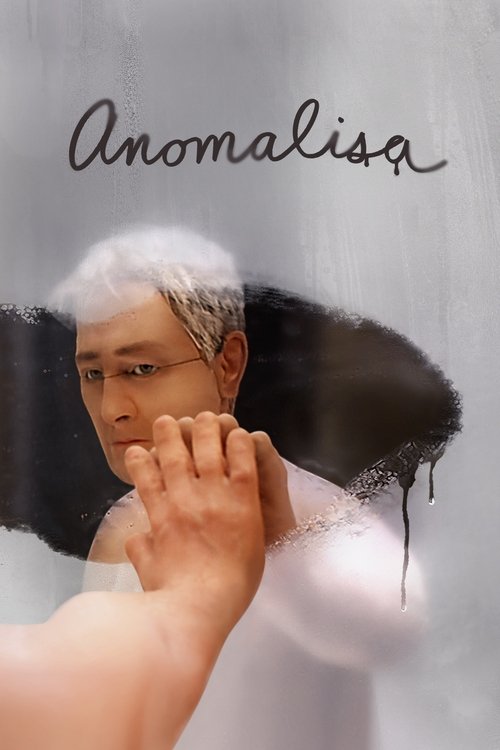
Anomalisa
2015 · Duke Johnson
For a solitary, contemplative night when you want something small, strange, and true about loneliness — this is a film to sit with, not comfort food.
What it's about
Michael Stone, a middle-aged customer-service guru, flies into Cincinnati to give a speech at a convention and checks into a beige hotel where every person he meets — colleagues, strangers, family on the phone — looks and sounds eerily identical to him. Then he hears one voice that's different: Lisa, a shy fan attending his talk, and one night with her briefly cracks open his numbed existence. It's all performed by stop-motion puppets, and it's very much for adults.
The experience
Quiet, sad, squirmingly intimate, and funnier than it has any right to be — the mundane details of hotel life become both comic and devastating. It gets under your skin slowly and stays there.
Performances
David Thewlis voices Michael with exhausted precision, Jennifer Jason Leigh makes Lisa heartbreakingly real, and Tom Noonan voices literally every other character — a single flattened voice for the whole world — which is the film's boldest and most unnerving idea.
The craft
Charlie Kaufman and Duke Johnson use stop-motion where you'd least expect it: puppets with visible face-plate seams performing scenes of aching realism, including one of the most tender and awkward intimate scenes ever animated. The sound design — one voice for everyone but two people — turns a psychological state into something you physically hear. Headphones or good speakers matter here.
Why it matters
It won the Grand Jury Prize at Venice and became the first R-rated stop-motion feature nominated for the Best Animated Feature Oscar, widening the case for animation as a serious adult medium.
Snapshot
Anomalisa is a stop-motion animated film about a middle-aged man who checks into a Cincinnati hotel, has a one-night encounter with a stranger, and returns home more or less as he was. It was co-directed by Duke Johnson and Charlie Kaufman, adapted from a Kaufman "sound play" first performed in 2005, and produced through Starburns Industries with a Kickstarter campaign supplying a substantial portion of the budget. It won the Grand Jury Prize at the 2015 Venice Film Festival and was nominated for the Academy Award for Best Animated Feature — the first stop-motion feature released with an R rating in the United States to reach that category, and a film whose entire method is built around the friction between a medium associated with children's entertainment and a story about adult loneliness, sexual disappointment, and the failure of empathy.
The film's central conceit is auditory before it is visual: every character except the protagonist, Michael Stone, and the woman he meets, Lisa Hesselman, speaks with the same voice — Tom Noonan's — regardless of age or gender. Michael is played by David Thewlis, Lisa by Jennifer Jason Leigh. Puppets are rendered with visible faceplate seams running across the brow and under the eyes, a fabrication artifact the filmmakers chose not to conceal. The result is a film in which the apparatus of its own construction is permanently on view, and in which that visibility is not a stylistic flourish but the argument.
Industry & production
Anomalisa originated outside cinema entirely. Kaufman wrote it under the pseudonym Francis Fregoli for the Theater of the New Ear, a series of staged "sound plays" produced by Carter Burwell in 2005, performed with actors at microphones and a live orchestra, with foley executed in view of the audience. The pseudonym is a joke that carries the film's premise: the Fregoli delusion is a psychiatric condition in which a patient believes that different people are in fact a single person in disguise. The hotel Michael stays in is called the Fregoli.
The film's route to production ran through Starburns Industries, the Burbank animation studio founded by Dan Harmon, Joe Russo, Dino Stamatopoulos, and Duke Johnson, which had built its reputation on television stop-motion — including the "Abed's Uncontrollable Christmas" episode of Community, directed by Johnson. Johnson approached Kaufman about adapting the play; Kaufman, whose Synecdoche, New York (2008) had not been a commercial success and who had struggled for years to get further features financed, agreed. Financing came in part from a Kickstarter campaign launched in 2012, which raised more than its target from several thousand backers — an unusually visible instance of crowdfunding used not for a low-stakes passion project but for a feature with an Oscar-winning screenwriter attached and no studio willing to fund it. Additional financing came from Snoot Entertainment and from Keith Calder and Jessica Wu as producers; Paramount Animation was not involved, and the film was ultimately distributed in the United States by Paramount Pictures after a competitive festival acquisition.
The production was small and slow by the standards of feature animation. Stop-motion at feature length is a labor arithmetic problem: a crew of animators each produce a few seconds of usable footage per week, and the schedule is set by how many units can shoot simultaneously. Anomalisa ran a comparatively modest number of shooting units over roughly two years, in a facility considerably smaller than Laika's or Aardman's. The film's chamber scale — three principal voices, one hotel, a handful of rooms — was a budgetary necessity converted into an aesthetic.
Commercially the film was a limited-release art-house title. It did not approach the returns of the Laika features it was inevitably compared to, and its financial profile was closer to that of an adult independent drama than an animated feature. Its institutional reward was critical and awards recognition rather than box office.
Technology
The film was shot with digital SLR cameras — the standard contemporary stop-motion rig, in which a still camera captures each frame at full resolution — and used 3D-printed faceplates for facial animation, the replacement-animation technique Laika had industrialized on Coraline (2009) and ParaNorman (2012). In replacement animation, a character's expressions are printed as a large library of discrete face parts that are swapped between frames; the technique permits fluid, subtle performance impossible with hand-sculpted or armature-driven faces.
What distinguishes Anomalisa is what it does with the seam. On the Laika films, the horizontal line where the upper and lower faceplates meet is painstakingly removed in digital post — a routine, expensive erasure. Anomalisa leaves it in. A visible line runs across each puppet's forehead and beneath the eyes for the entire film. This is a deliberate refusal of the industry's own polish, and it does specific narrative work: in the film's most vertiginous sequence, Michael's face comes apart, the plate detaching as a discrete object, and the film's ambient anxiety about whether people are people becomes literal. Because the seam has been visible from the first shot, the moment does not arrive as a special effect; it arrives as the logical conclusion of something we have been looking at all along.
The puppets were built at a relatively large scale to permit fine detail in clothing texture and skin, and the film makes conspicuous use of shallow focus and photographic lens behavior — depth-of-field falloff, subtle lens flare, the visual grammar of live-action photography rather than the deep-focus clarity typical of animation. Digital compositing was used for atmosphere, water, and set extension, but the fabricated world is overwhelmingly physical.
Technique
Cinematography
Joe Passarelli photographed the film, and the governing decision was to shoot the puppets as though they were actors in a live-action drama. Handheld-inflected framing, rack focus, over-the-shoulder coverage, wide lenses in cramped hotel corridors: the camera behaves like a camera in a small independent film about a man at a conference. Long takes are used where animation convention would cut, which places extraordinary demand on the animators, since a sustained two-shot must be performed continuously across hundreds of frames.
The Fregoli Hotel is rendered in a palette of sedative browns, ochres, and institutional golds — the specific chromatic depression of business-class accommodation. Lighting is practical-motivated and often low: table lamps, bathroom fluorescents, the flat wash of a hotel corridor at night. When Michael and Lisa are in her room, the film shifts to a warmer, softer key, and the effect is not romantic idealization so much as the visual equivalent of a held breath.
Editing
Garret Elkins cut the film, and the editorial rhythm is closer to intimate drama than to animation, where cutting is typically dictated by the expense of the shot. Scenes are permitted to run past the point of comfort: a taxi ride, a phone call, a shower. The film's most discussed scene — a sex scene played at length, awkwardly, with fumbling and negotiation and no elision — depends entirely on the editor's willingness not to cut away. Elision is animation's default economy; Anomalisa spends where it hurts.
The film also uses editing to manage its central sonic trick. Because Noonan voices everyone, the cut from one character to another does not deliver the usual relief of a new voice. The editing therefore avoids conventional dialogue rhythm and instead lets exchanges flatten into a drone, which is the intended sensation.
Mise-en-scène / staging
The hotel is the film's whole world and is designed with obsessive banality: the room-service tray, the minibar, the shower controls, the bad art, the ice machine. This granular ordinariness is what makes the animation register as uncanny — extraordinary craft applied to a soap dispenser. Staging favors real spatial continuity; characters walk down actual corridors, and the geography of the hotel is legible and consistent, so that Michael's later navigation of it in a dream state reads as a violation of a rule the film established.
The Fregoli's uniformity of faces is achieved through design as much as voice: the supporting puppets share a facial architecture with only minor variation, so that the visual and auditory sameness reinforce each other. Lisa is designed with a facial scar she covers with her hair — a specific imperfection in a world of interchangeable smoothness, and the film's clearest visual statement of what Michael thinks he is responding to.
Sound
Sound is the film's originating medium and remains its most sophisticated department. The Noonan conceit is not a gimmick applied to a script; it is the script's founding condition, inherited directly from the radio-play form. Noonan performs dozens of roles — Michael's wife, his son, his ex-lover, the hotel manager, the cab driver, a toy-store clerk — with only slight modulations of pitch and cadence, so that each new voice is recognizable as the same instrument. The effect on a first viewing is disorienting; on reflection it is claustrophobic.
Carter Burwell's score is spare, piano-led, and deliberately withholding. Burwell, who produced the original stage version, writes here against sentiment: the music does not tell the audience that a love scene is a love scene. The film's other significant musical gesture is Lisa's a cappella performance of Cyndi Lauper's "Girls Just Want to Have Fun," sung hesitantly at Michael's request — a pop song stripped of production and rendered as an act of exposure. It is the film's warmest moment and its most quietly cruel, since the audience knows what Michael does not: that his hearing of her as unique will not survive the night.
Ambient sound design does heavy lifting throughout — HVAC hum, elevator mechanics, the acoustic deadness of carpeted corridors. The film's soundscape is a portrait of a building.
Performance
Three actors carry the film, and their work was recorded before animation, as is standard, but with an unusual emphasis on ensemble recording rather than isolated booth sessions — a practice inherited from the staged original.
Thewlis gives Michael a weary, over-articulated English precision that curdles into peevishness. The performance is calibrated so that Michael's charm and his contempt are the same voice, and the film relies on the audience taking a while to notice. Jennifer Jason Leigh's Lisa is the film's achievement: self-deprecating, uncertain, socially apologetic, and — crucially — not written as a manic pixie corrective but as a person whose ordinariness Michael temporarily mistakes for salvation. Leigh plays hesitation as texture rather than as a tic.
Noonan's task is the hardest and the least showy: he must be maximally uninflected while remaining intelligible as many different people, and must occasionally break through — the moment Lisa's voice begins to modulate toward Noonan's over breakfast is the film's true horror beat, and it is delivered entirely by a performer changing register mid-scene.
Narrative & dramatic mode
Structurally the film is a unity-of-time chamber piece: roughly twenty-four hours, one location, three characters, no subplot. It observes classical constraints with near-theatrical strictness, which is unsurprising given its origin.
Its dramatic mode is a kind of deadpan realism corroded from within by subjective distortion. For long stretches nothing happens that could not happen in a live-action indie film about a business traveler. The distortion is delivered through the sound design and the faces, and escalates only twice: a nightmare sequence in which the hotel's staff pursue Michael with unwanted intimacy, and the faceplate detachment. The film never confirms whether Michael's perception is a delusion, a metaphor, or simply the truth of how he sees people, and it declines to supply an explanatory frame.
The ending is the film's structural argument. Michael returns to a family birthday party, and the film gives its final beat not to him but to Lisa, in a car, reading aloud from a letter, with a Japanese antique toy sitting in Michael's house as a residue of his brief attention. The story refuses the redemption arc that its own premise ("becomes reinvigorated after meeting a lively woman," in the synopsis language) advertises. Michael has learned nothing. Lisa has had an experience. The asymmetry is the point.
Genre & cycle
The film sits at an intersection with almost no other occupants: adult stop-motion animation in a realist register. Animation for adults had precedents — Fritz the Cat (1972), Waltz with Bashir (2008), Persepolis (2007), Fantastic Planet (1973) — but these are largely satirical, documentary, memoiristic, or fantastical. Anomalisa is none of these. It is a domestic drama about a bad night, animated.
In relation to the stop-motion cycle of its moment — Laika's Coraline, ParaNorman, The Boxtrolls (2014), Kubo and the Two Strings (2016); Wes Anderson's Fantastic Mr. Fox (2009) and later Isle of Dogs (2018); Aardman's continuing output — Anomalisa is the outlier that demonstrates the medium's range by declining every one of its genre affordances. There are no monsters, no quests, no children.
Within Kaufman's own cycle it belongs with Synecdoche, New York as late-period work about diminishment, and stands in deliberate contrast to the more elastic, high-concept comedies of his collaborations with Spike Jonze and Michel Gondry.
Authorship & method
Authorship here is genuinely divided, and the record on this is reasonably clear: Kaufman wrote the screenplay and is credited as co-director; Duke Johnson directed the animation and ran the physical production, having initiated the project and brought the craft expertise Kaufman lacked. Johnson's background was in television stop-motion at Starburns — Community, Mary Shelley's Frankenhole, Moral Orel — and Anomalisa was his feature debut. The pairing is unusual: a screenwriter-auteur with a distinct conceptual signature working with a specialist director whose contribution is the entire physical realization.
Key collaborators are consistent with the film's chamber ambitions. Carter Burwell had scored the 2005 stage version and returned; his long association with the Coen brothers gives him a facility with music that refuses to underline, and that facility is central here. Joe Passarelli, whose background includes stop-motion television, shot the film with live-action grammar. Garret Elkins edited. Animation direction and puppet fabrication were handled by Starburns' in-house team, with the 3D-printed faceplate library representing the project's largest craft investment.
The method — build the sound first, then the image — inverts standard animation practice, in which visuals typically drive and audio serves. Here the film is essentially a radio play that has been given bodies, and the bodies are permanently secondary to the voices. That hierarchy explains nearly every formal choice in the picture.
Movement / national cinema
Anomalisa is an American independent film, financed partly by crowdfunding and produced in Burbank, and belongs to the tradition of American art cinema that runs through the specialty-distribution ecosystem of the 2000s and 2010s. It has no meaningful relationship to a national animation school — not to the Czech and Eastern European puppet tradition of Švankmajer and Trnka, not to Japanese anime, not to British Aardman.
Its closer affinities are to European chamber drama and to the theatrical avant-garde. The Fregoli delusion premise, the hotel-as-purgatory setting, and the refusal of catharsis place it in conversation with a certain strand of modernist theater and with the alienation cinema of Antonioni more than with any animation lineage. Where it does touch the Eastern European puppet tradition is in its willingness to make the puppet's puppetness a subject rather than an embarrassment — though Švankmajer's use of that is grotesque and materialist where Kaufman and Johnson's is psychological.
Era / period
The film arrives at a specific moment in animation history: the point at which stop-motion had been fully digitized in its production pipeline (3D printing, digital capture, digital compositing) without ceasing to be handmade. That hybrid condition is what made Anomalisa technically possible on its budget.
It also arrives at a moment of institutional change in film financing. The Kickstarter campaign is a marker of the mid-2010s period when crowdfunding briefly seemed like a viable alternative to studio and specialty-financier gatekeeping for established filmmakers. The specific fact that Charlie Kaufman — an Academy Award winner — had to crowdfund a feature is a piece of industry history in itself, and was widely noted at the time as evidence of how narrow the space for mid-budget adult filmmaking had become.
Culturally, the film's concerns — the interchangeability of people, the exhausting sameness of mediated social life, the customer-service register creeping into intimacy — are legible as a response to the 2010s, though the script was written in 2005 and predates the phenomena it is often read as diagnosing.
Themes
Solipsism and the failure of empathy. The film's Fregoli conceit externalizes a moral condition: Michael cannot hear other people as distinct because he has stopped attending to them as people. Crucially, the film locates the pathology in him, not in the world. The other characters are individuals; Michael's perception flattens them.
The customer-service voice. Michael is a customer-service expert who has written a bestselling book on the subject and cannot manage a single genuine encounter. The film is unusually precise about the language of professional pleasantness — the hotel staff, the cab driver, his own keynote — and about how that register colonizes private speech.
Ordinariness as the thing that cannot be sustained. Lisa is unremarkable, and Michael's discovery of her is real. What the film observes is that his mode of attention has a half-life measured in hours. The tragedy is not that she turns out to be ordinary but that he was only ever capable of a brief exception.
Loneliness inside institutions. The hotel, the conference, the airport, the family home — every space in the film is a machine for processing people, and the film is scrupulous about the textures of those machines.
Consciousness and manufacture. Because the characters are visibly fabricated objects, every question the script raises about whether other people have interior lives is doubled by the medium. When Michael asks whether anyone is real, the audience is looking at a puppet.
Reception, canon & influence
Critical reception was strong and, unusually for an animated feature, engaged almost entirely on dramatic rather than technical grounds. The film won the Grand Jury Prize (Silver Lion) at Venice in 2015 and received an Academy Award nomination for Best Animated Feature, losing to Inside Out. It appeared on a large number of year-end critics' lists, and was frequently described as the year's most emotionally punishing film in any medium. Dissenting criticism was consistent and worth registering: several critics argued that the film's sympathies rest too comfortably with Michael's self-pity, that Lisa is instrumentalized by a script that claims to be critiquing her instrumentalization, and that the Fregoli conceit is a very elaborate delivery mechanism for a fairly familiar observation about male midlife disappointment.
Influences on the film (backward). The most direct is the radio-drama tradition itself — the film is an adaptation of a sound play and retains that form's logic. Kaufman's own prior work supplies the conceptual apparatus: the Fregoli premise extends the identity anxieties of Being John Malkovich (1999) and Synecdoche, New York. The Laika technical lineage — Coraline's replacement-animation pipeline, and before that the Henry Selick and Tim Burton tradition of The Nightmare Before Christmas (1993) — supplies the method, which Anomalisa then deliberately de-polishes. In the broader animation lineage, the Eastern European puppet film's interest in the object-ness of the puppet is a clear if indirect antecedent. Dramatically, the hotel-bound chamber piece and the failed-connection structure connect to a long line of modernist alienation cinema.
Legacy (forward). The film's most concrete effect has been as a proof of concept: it demonstrated that stop-motion could carry an adult, non-genre, R-rated drama and receive both festival honors and an Academy Award nomination for doing so. That demonstration is regularly cited in discussions of animation's adult possibilities, and the film is a standard reference point in the ongoing argument that animation is a medium rather than a genre — an argument that has since gained institutional traction in critical writing and in festival programming.
Direct stylistic descendants are harder to point to, and honesty requires saying so: no significant cycle of adult realist stop-motion features followed, largely because the economics remain forbidding. The film's influence has been diffuse rather than dynastic — visible in the increased willingness of animated features to pursue adult tonal registers, and in the specific technique of leaving fabrication artifacts visible as an expressive choice, which has been adopted selectively elsewhere.
Within Kaufman's career it functions as a hinge: the last film before his long gap and the Netflix-distributed I'm Thinking of Ending Things (2020), and the clearest statement of the late-period concern with the unreliability of a single consciousness. For Duke Johnson it remains, at the time of writing, his signature feature credit. The film's canonical position is secure but specialized — a permanent fixture in accounts of animation history and of American independent cinema in the 2010s, and a film more often admired than revisited.
A Deleuzian reading
A hairline runs across the puppet's forehead, just above the brows.
The full Deleuzian reading of Anomalisa →
Reception
It premiered at Venice 2015 — where it became the first animated film ever to win the Grand Jury Prize — rode raves and an Oscar nomination, then quietly slipped out of the conversation; a decade on, it's routinely called Charlie Kaufman's most underrated film, the one fans insist got memory-holed too fast.
How Anomalisa was received, from release to now →
How to watch Anomalisa: what to notice on a first viewing
- Listen for the same voice coming from everyone except Michael and Lisa. Tom Noonan voices every other character, wife, son, cab driver, hotel staff, with only slight shifts in pitch. Cuts between speakers bring no new timbre. This is the dividual, a whole crowd of people collapsed into one voice, one affective unit.
- Look at the seam line across each puppet's forehead. The film never hides the join where the 3D-printed faceplates meet, unlike Laika's paint-out on Coraline. It stays visible in every scene. This shows the puppet as a made object being photographed, not a drawing pretending it had no maker.
- Notice the handheld sway, rack focus, and over-the-shoulder shots in hallways. Joe Passarelli shoots the puppets like actors in a small independent drama, with long takes where animation convention would cut away. The live-action grammar makes the puppets feel like bodies that were really moving, not illustrations.
- Track how consistently the hotel's corridors connect to each other. The Fregoli Hotel's geography stays legible and stable across the film, room to elevator to lobby to room. A world built this ordinary and consistent lets any later break in the rule register as wrong.
The whole guide to watching Anomalisa, with the keys for a rewatch →
Influences: the films it descends from and the films it influenced
- The Nightmare Before Christmas (1993) — Jack Skellington's library of ~400 interchangeable sculpted heads established replacement-face animation at feature scale — the Selick/Burton pipeline Anomalisa inherits wholesale, then strips of its concealment.
- Coraline (2009) — Laika's rapid-prototyped 3D-printed faceplates, split along a hairline and digitally painted out in post; Anomalisa runs the identical replacement pipeline and simply declines the paint-out, leaving the seam across every brow.
- Fantastic Mr. Fox (2009) — Anderson recorded his cast together on location rather than in isolated booths, and shot puppets with live-action lens logic — shallow focus, rack focus, real depth cues — which is exactly Anomalisa's ensemble-recording and camera grammar.
- Mary and Max (2009) — Proved a feature-length adult clay-animated drama could run on depressive interiority and voice-led performance alone, with no genre engine or child audience to carry it.
- Team America: World Police (2004) — Posed the R-rated puppet sex scene as a formal problem and solved it as burlesque; Anomalisa takes the same physical impossibility and refuses both the joke and the cutaway, holding the scene in real time.
- Being John Malkovich (1999) — Kaufman's restaurant of Malkoviches — one face, one voice, one word on every body — is the direct structural precursor to the Fregoli conceit of casting Tom Noonan as the entire world.
- Synecdoche, New York (2008) — Kaufman's method of building an entire production design as the literal architecture of one man's psychological condition, and of denying the aging male protagonist any redemptive turn before the ending.
- Dimensions of Dialogue (1982) — Animates faces as detachable assemblies of parts that consume and re-form each other — the puppet head as a disassemblable object, which Anomalisa literalizes when Michael's faceplate works loose in the bathroom mirror.
- Street of Crocodiles (1986) — Tactile close-up attention to screws, dust and mechanism as the puppet's true subject — the object-grammar behind Anomalisa's lingering on taps, keycards, minibar bottles and elevator buttons.
- Lost in Translation (2003) — The international business hotel as a sealed chamber shot on long lenses with shallow focus, its drama carried by room tone and corridor acoustics across a two-night transient connection.
- La Notte (1961) — Unity-of-time construction across a single night in which architecture and overheard party chatter do the expository work, and the failure of connection is allowed to end without catharsis.
- Adaptation. (2002) — Continues Kaufman's anatomy of the blocked, self-absorbed creator, literalizing sameness and doubling through identical voices and faces.
- Marcel the Shell with Shoes On (2021) — Inverts standard animation order the way a radio play does: the voice track is improvised and recorded first, the animation built to it, then shot with handheld documentary camera grammar including focus hunting.
- I'm Thinking of Ending Things (2020) — Pushes the single-unreliable-consciousness rule past Anomalisa's: every character is generated by one man's mind, with names, ages and wardrobe mutating within a scene and no diegetic correction offered.
- Guillermo del Toro's Pinocchio (2022) — Adult-register stop-motion at prestige scale shot with live-action lighting and camera logic — practical flares, dolly and crane moves, motion blur — cashing the institutional argument Anomalisa's Venice prize and Oscar nomination opened.
- Her (2013) — Stakes an entire romance on a disembodied vocal performance recorded apart from the frame, making voice casting the film's central formal decision — the inverse of one voice standing in for everyone.
- Kubo and the Two Strings (2016) — Scales the same 3D-printed replacement-faceplate system to a library of tens of millions of expressions with every seam erased — the maximal-polish version of the pipeline Anomalisa deliberately de-polished.
- Isle of Dogs (2018) — Keeps fabrication artifacts in frame as expressive texture — visible fur ruffle from animator handling, cotton-wool smoke, unhidden joins — rather than digitally cleaning them out.
- Mad God (2021) — Refuses digital cleanup outright, letting armature, latex, and set grime read as physical material, and sustains an adult, non-family stop-motion feature financed entirely outside studio economics.
- Eternal Sunshine of the Spotless Mind (2004) — Renders externalized psychology through handmade stop-motion puppetry, fusing Kaufman's recursive interiority with a tactile, in-camera craft aesthetic akin to Gondry's.
- My Life as a Zucchini (2016) — Adult, dialogue-driven stop-motion that turns the puppet's visible face-seams into expressive vulnerability — the same move to puppetry for interior emotional realism.
- It's Such a Beautiful Day (2012) — Kaufman deploys animation specifically to render one ordinary man's existential dread and dissociation, treating mundane hotel-life as a cosmic crisis exactly as Hertzfeldt inflates Bill's small routines.
- The Father (2020) — Uses a single shared voice and face for every 'other' person (a Fregoli-delusion device) — a formal externalization of perceptual disorder cousin to The Father's recast faces.
- Memoir of a Snail (2024) — The nearest sibling: an adult-register stop-motion feature about loneliness that leaves the puppets' face-plate seam lines deliberately unconcealed, treating the visible join as an honesty-of-the-handmade device exactly as Elliot treats thumbprints.
- The Drama (2026) — High-concept existential comedy anatomizing the performance of intimacy and the failure of genuine connection beneath social scripts.
- Waking Life (2001) — Deploys a bespoke animation technique to stage an existential, dreamlike interrogation of perception and selfhood, treating the animated body as a philosophical instrument.
- Ruben Brandt, Collector (2018) — An adult art-animation whose conceptual manipulation of the human face (uniform, interchangeable faces) and deadpan register rhymes with the film's Cubist face-fragmentation.
Similar films
- Being John Malkovich (1999) — influence & lineage
- Mary and Max (2009) — influence & lineage
- Synecdoche, New York (2008) — influence & lineage
- Isle of Dogs (2018) — influence & lineage
- Mad God (2021) — influence & lineage
- Guillermo del Toro's Pinocchio (2022) — influence & lineage
- Her (2013) — influence & lineage
- Marcel the Shell with Shoes On (2022) — shared sensibility