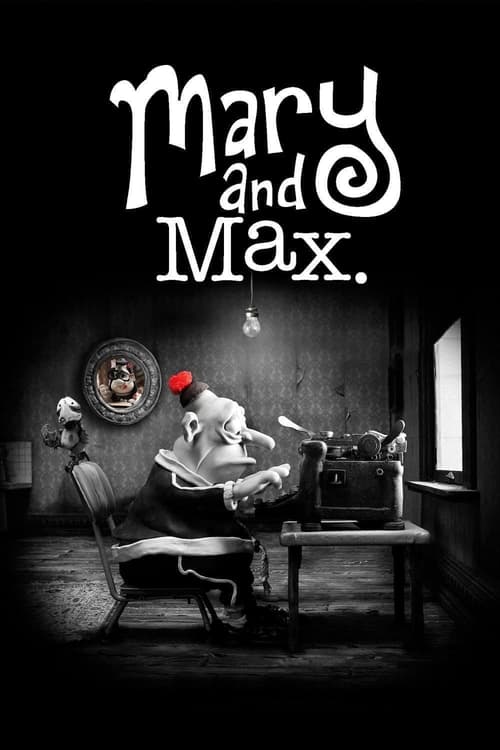
Mary and Max
2009 · Adam Elliot
For when you want a good cry that comes with laughs attached — a film about loneliness that leaves you feeling less alone. Cozy in texture, but it goes to genuinely dark places, so bring a little emotional room.
What it's about
A lonely eight-year-old girl in the Melbourne suburbs picks a name out of a New York phone book and writes a letter. The stranger who answers is Max, a forty-four-year-old man with Asperger's who loves chocolate and finds most people baffling. Their pen-pal friendship stretches across two decades and two hemispheres, carried entirely in letters — and it turns out to be the most important relationship in both their lives.
The experience
Deadpan funny and quietly devastating, often in the same minute — the jokes are morbid and scatological, and then a line lands that catches you completely off guard. It moves at the gentle pace of letters being written and read, and it earns real tears without ever begging for them.
Performances
Philip Seymour Hoffman voices Max almost unrecognizably, finding enormous tenderness in a flat, halting delivery — a whole inner life conveyed through dictated letters.
The craft
Handmade stop-motion clay animation five years in the making, with a strict color scheme: Mary's Australia in muddy sepia, Max's New York in charcoal gray, so every rare splash of red hits like a heartbeat. Every wrinkle, crumb, and raindrop is physically sculpted, and the density of visual gags rewards close watching on a good screen.
Why it matters
It opened Sundance in 2009 — a first for an animated film — and stands as proof that stop-motion animation can carry adult subjects like mental illness, isolation, and grief without losing its warmth.
Adam Elliot calls his work 'clayography' — clay animation as biography — and this feature, five years in the painstaking making, is its fullest expression: an epistolary friendship conducted across two decades and two hemispheres, between a lonely Melbourne schoolgirl and a middle-aged New Yorker with Asperger's, voiced with extraordinary tenderness by Philip Seymour Hoffman. Elliot, already an Oscar winner for the short Harvie Krumpet, built his two worlds in strict palettes — Mary's suburbs in muddy sepia browns, Max's Manhattan in charcoal grays — so that each splash of red registers like a heartbeat. The humor is scatological, morbid, and deadpan-Australian; the sorrow underneath it is genuine, drawn from Elliot's own decades-long correspondence with a pen pal in New York. It opened Sundance in 2009, the first animated film ever to do so, and took the Cristal at Annecy, yet barely saw theatrical release — surviving instead by word of mouth, passed hand to hand like the letters at its center. Every prop, wrinkle, and teardrop was sculpted physically: no digital assistance, just plasticine, patience, and grief given thumbprints.
Reception
Premiered as the first animated film ever to open Sundance in 2009, then was famously snubbed by the Oscars and barely released in US cinemas — but word-of-mouth and streaming turned it into one of the most beloved animated films of its era.
How Mary and Max was received, from release to now →
Influences: the films it descends from and the films it influenced
- Harvie Krumpet (2003) — Elliot's Oscar-winning short established his 'clayography' method — lumpy, fingerprint-scarred hand-sculpted plasticine and a deadpan third-person narrator chronicling an outsider afflicted with a neurological condition (Tourette's), the exact template Max's Asperger's inherits.
- Uncle (1996) — The first of Elliot's narrated clay 'family trilogy' fixed his signature sepia-brown-and-gray monochrome palette and the melancholic, softly voiced character-study structure that Mary and Max scales up to feature length.
- Creature Comforts (1989) — Aardman's technique of animating clay puppets to real documentary interview audio pioneered the mundane, un-theatrical vocal register — ordinary people musing on ordinary lives — that Elliot's deadpan delivery descends from.
- A Grand Day Out (1989) — Aardman's fingerprint-textured plasticine over metal armatures, with visible thumb-worked surfaces treated as a feature not a flaw, is the fabrication craft Elliot deliberately exaggerates into his deliberately 'imperfect' figures.
- The Adventures of Mark Twain (1985) — Vinton's feature-length 'Claymation' (a term he trademarked) proved clay could sustain a full narrative rather than gags, the precedent that makes a 92-minute clay drama like Mary and Max conceivable.
- Dimensions of Dialogue (1982) — Švankmajer's tactile, morphing clay — foregrounding the material's grotesque physicality and squashable mass — underlies Elliot's insistence on clay's lumpen, palpable ugliness as expressive of damaged bodies.
- Amélie (2001) — Jeunet's omniscient whimsical narrator who catalogs a lonely heroine's tiny private likes and dislikes is the exact narrative device Elliot uses to itemize Mary's and Max's quirks and comforts.
- Anomalisa (2015) — A stop-motion puppet feature built entirely around adult isolation and the ache for genuine connection, extending Elliot's proof that hand-animated figures can carry unglamorous grown-up melancholy rather than family whimsy.
- Frankenweenie (2012) — A black-and-white stop-motion feature that weaponizes strict monochrome as an emotional and nostalgic register, extending Elliot's use of near-monochrome palettes to signal an interior, melancholic world.
- My Life as a Courgette (2016) — A stop-motion feature about lonely, neglected, damaged children handled with unsentimental tenderness for adult audiences, carrying forward Elliot's tone of finding warmth in the wounded outsider.
- Memoir of a Snail (2024) — Elliot's later feature reprises the identical clayography — fingerprinted plasticine, near-monochrome with pops of selective color, and a narrated life-story of a lonely, hoarding outsider — the direct continuation of Mary and Max's craft.
- My Life as a Zucchini (2016) — A feature-length clay-puppet drama that trusts stop-motion to carry adult weight — abandonment, loneliness — with deadpan tenderness instead of gag comedy.
- $9.99 (2008) — An Australian-financed adult stop-motion feature (from Etgar Keret stories) of interlinked lonely apartment-dwellers, contemporaneous with Elliot and sharing the melancholic clay-drama-for-grownups register the era-2000s-Australian-animation facet names.
- Coraline (2009) — Selick's stop-motion contrasts a drab, desaturated 'real' world against a heightened 'other' world — the same dual-worlds staging with divergent palettes that separates Mary's ochre Australia from Max's gray New York.
- Fantastic Mr. Fox (2009) — Released the same year, it revived painstaking handmade stop-motion for dry, deadpan comedy under a tightly restricted (autumnal) palette, a parallel bet that artisanal clay/puppetry suits adult-skewing wit.
- Persepolis (2007) — An autobiographical adult animated feature rendered in stark high-contrast monochrome, sharing Mary and Max's marriage of memoir and a deliberately color-drained graphic palette.
- Waltz with Bashir (2008) — A contemporaneous autobiographical adult animated feature that trusts animation to carry heavy, real memory and trauma, part of the same late-2000s wave legitimizing animation as a vehicle for grown-up personal nonfiction.
- Up (2009) — Elliot's contemporaneous claymation feature uses recurring figurine objects (the Noblets) as externalized psychological states with the same structural logic as Up's adventure book, staging adult grief and social isolation in family-adjacent animation without the genre-obligatory tonal relief that both films refuse.
Similar films
- Memoir of a Snail (2024) — influence & lineage · same viewing thread
- Anomalisa (2015) — influence & lineage
- Fantastic Mr. Fox (2009) — influence & lineage
- Robot Dreams (2023) — same viewing thread
- Marcel the Shell with Shoes On (2022) — same viewing thread
- Up (2009) — same viewing thread
- WALL·E (2008) — same viewing thread
- Finding Nemo (2003) — same viewing thread
All the films related to Mary and Max →
Watch it with: curated runs of related films
- Animation That Aches — A run of animated films that take loneliness, grief, and memory as seriously as any live-action drama — watch them in a row and the cartoon surface stops mattering.