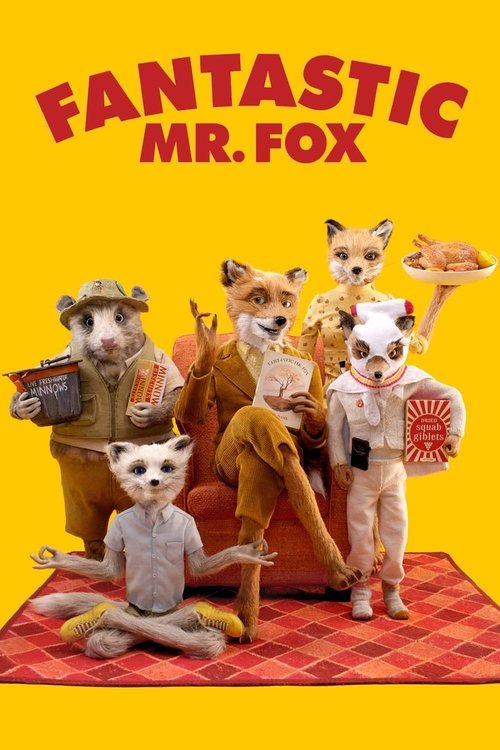
Fantastic Mr. Fox
2009 · Wes Anderson
For when you want something witty and warm the whole household can watch without anyone feeling talked down to — comfort viewing with genuine bite.
What it's about
A fox with a wild past has gone respectable — newspaper column, wife, kid, a nice tree — but he can't resist planning one last run of raids on the three nastiest farmers in the valley. When the farmers strike back, his whole burrowed community pays the price. It's a heist caper, a midlife crisis, and a family comedy in one, adapted from Roald Dahl's book.
The experience
Fast, dry, and constantly funny, with Anderson's deadpan timing somehow made funnier coming out of puppets — and then a real vein of rue underneath, about a charmer who can't stop being what he is. It's over in a brisk ninety minutes and you'll want to rewatch scenes just for the line deliveries.
Performances
George Clooney's vocal turn as Mr. Fox is a small marvel — all silver-tongued confidence with panic just underneath — and Meryl Streep matches him with dry, weary warmth; Anderson recorded his cast outdoors on a working farm, and you can hear the looseness in every scene.
The craft
Anderson shot the stop-motion at a deliberately old-fashioned frame rate and let the puppets' fur ripple with the animators' fingerprints — imperfection as warmth, against the digital smoothness of its era. Every frame is composed like a diorama you want to live in, with an autumn-gold palette that glows on a good screen.
Why it matters
It revitalized Anderson's career after a soft patch and revealed stop-motion as the medium his miniaturist sensibility had been waiting for — its handmade logic flows directly into his later work.
Wes Anderson's first animated feature takes Roald Dahl's slim fable of a chicken-thieving fox and swells it into a rueful comedy about a middle-aged charmer who cannot stop being what he is, to the peril of everyone burrowed around him. Coming after a soft patch in Anderson's live-action career, it proved a revitalizing detour: stop-motion, it turned out, was the medium his dollhouse sensibility had been waiting for, and its miniature logic flows directly into Isle of Dogs and the model work of The Grand Budapest Hotel. Against the digital smoothness of its era, Anderson shot at a deliberately old-fashioned frame rate and let the puppets' fur ripple with the animators' fingerprints — imperfection as warmth. He even marched his cast, George Clooney and Meryl Streep included, out to a working farm to record dialogue in fields and stables rather than sound booths. The whole film glows in an autumnal register of corduroy, cider and turned leaves.
A Deleuzian reading
Anderson took his cast out to a farm.
The full Deleuzian reading of Fantastic Mr. Fox →
Reception
It underperformed at the box office in 2009 and read to some as a strange detour for Wes Anderson — his first animated film — but it's since climbed to the top tier of his filmography, now routinely called one of the best stop-motion films of its era.
How Fantastic Mr. Fox was received, from release to now →
Influences: the films it descends from and the films it influenced
- Le Roman de Renard (The Tale of the Fox) (1937) — The foundational anthropomorphic-fox stop-motion feature — Starevich's wire-armature animal puppets with real fur, tailored waistcoats, and expressive whisker/ear articulation are the exact craft template Anderson revives for Mr. Fox's dandy tailoring and twitching pelt.
- King Kong (1933) — Willis O'Brien's miniature-set armature animation established the tabletop diptych of tiny sculpted landscapes and jointed figures, and its deliberately rippling fur (dimpled by the animator's fingers each frame) is precisely the 'handmade imperfection' Anderson keeps rather than smooths out.
- Rudolph the Red-Nosed Reindeer (1964) — The 'Animagic' puppet look — fuzzy flocked fur, storybook diorama sets, and a warm autumnal-fireside palette — is the mid-century TV-special idiom Anderson quotes in Fox's russet color scheme and picture-book staging.
- Watership Down (1978) — Its English-countryside anthropomorphism, burrow-and-warren geography, and the theme of wild instinct persisting under a civilized veneer feed directly into Fox's 'inescapable nature' arc of a farmer-menaced animal community.
- The Nightmare Before Christmas (1993) — Selick's feature-scale replacement-puppet system and hand-built forced-perspective sets proved stop-motion could sustain a whole feature's tonal control, the production model Anderson inherits and micromanages.
- James and the Giant Peach (1996) — The prior Roald Dahl-to-stop-motion adaptation — same source author, same fidelity to Quentin Blake-ish spindly character design translated into puppet form, the literary-adaptation lineage Fox extends.
- Chicken Run (2000) — Aardman's celebrity-voiced ensemble, clay-fingerprint surface texture left visible, and an animal-community-versus-farmer heist plot are structural and tonal precedents for Fox's 'master plan' caper against Boggis, Bunce and Bean.
- The Life Aquatic with Steve Zissou (2004) — Anderson's own dollhouse cross-section ship set and the stop-motion sea creatures (animated by Henry Selick) are the direct rehearsal for Fox's cutaway burrows and full-puppet aesthetic — his live-action dollhouse sensibility literally becoming a puppet film.
- Rushmore (1998) — The planimetric flat-on symmetrical framing, whip-pans, and chapter-card structure of Anderson's live-action grammar are imported wholesale into Fox, proving the 'authorship' facet survives the switch to miniatures.
- Corpse Bride (2005) — Adopts the digital-still-capture stop-motion workflow Corpse Bride validated, shooting a feature on DSLRs to enable on-set review and precise incremental animation.
- Wallace & Gromit: Vengeance Most Fowl (2024) — Revived the tactile, hand-built stop-motion feature in the Aardman spirit, deliberately foregrounding fingerprints, rippling fur and visible handcraft rather than smoothing them into digital polish.
- The Darjeeling Limited (2007) — The first film after Darjeeling and the first to transpose the newly consolidated Weisblum grammar — whip-pan, snap-frontal cut-in, lateral tracking past a cutaway cross-section — into stop-motion, where the burrow-in-section is the compartment row rebuilt vertically.
- Moonrise Kingdom (2012) — Anderson carries Fox's autumnal storybook palette, on-location naturalistic child dialogue, and narrated chapter-book structure back into live action, treating the real Rhode Island landscape as another dollhouse diorama.
- The Grand Budapest Hotel (2014) — Its miniature-model funicular, hotel, and cable-car — deliberately toy-like handmade builds shot alongside actors — extend Fox's 'miniature model work' facet, and the nested storybook framing echoes its literary staging.
- Anomalisa (2015) — It adopts Fox's naturalistic, on-location-style dialogue recording under stop-motion and its refusal to hide the seam lines (the visible face-plate join becomes expressive), pushing the handmade-imperfection ethic into adult drama.
- Isle of Dogs (2018) — The direct successor — Anderson's second stop-motion feature reuses Fox's exact toolkit: cotton-wool weather effects, fur groomed to ripple on twos, celebrity voice ensemble, and the reduced-frame-rate 'shot on twos' jerk kept as signature rather than corrected.
- Guillermo del Toro's Pinocchio (2022) — Co-directed by Fox's own animation director Mark Gustafson, it inherits the literary-adaptation-as-stop-motion approach and the philosophy of leaving carved-wood and armature texture legible, a direct line of practitioner descent.
- My Life as a Zucchini (2016) — Revived a handmade stop-motion aesthetic that keeps fingerprints, fur-shimmer and visible seams on screen — the anti-slick tactile surface Zucchini's matte puppets share.
- Marcel the Shell with Shoes On (2022) — Frame-by-frame stop-motion with visibly handmade materials (fur, felt, real props) shot flat and deadpan, treating a small fabricated creature as a naturalistic acting subject — the same 'imperfect handcraft left visible' aesthetic Marcel embraces.
- The Mitchells vs. the Machines (2021) — Champions visible authorship and handcrafted, deliberately imperfect texture prized over photoreal smoothness — the aesthetic argument Mitchells advances.
- The Little Prince (2015) — Foregrounds deliberately tactile, imperfect puppet stop-motion so that visible handcraft reads as authenticity and warmth against slicker CG — the value system the film's stop-motion unit is built on.
- Hoppers (2026) — Proved that flat-affect, deadpan line delivery and comic patience survive on animal characters — dialogue cut on the beat after the laugh, not on it — the scene-level rhythm Chong's television grammar brings into Pixar's architecture.
- Rise of the Guardians (2012) — Desplat's animation palette rehearsed — celesta, plucked strings and toy percussion carrying wonder at chamber scale — which he then scales up for Guardians' 'emotional altitude,' the same small-percussion filigree floated over a full orchestral lift.
- The Lego Movie (2014) — Anderson shot miniatures with macro glass at shallow depth and refused to digitally suppress the fur ripple between frames, treating photographic evidence of smallness as the point — the same decision the film fakes in CG through razor-thin focal planes, defocused foreground studs and reintroduced inter-frame jitter.
- Coraline (2009) — Released the same year from Laika, it shares the handmade-puppet ethos and rapid-prototyped faces, staking out the 2009 revival of tactile stop-motion against CG that Fox co-defines.
- Kubo and the Two Strings (2016) — Laika's giant hand-built puppets and room-sized miniature sets share Fox's commitment to physical scale and tactile fabric/fur that reads as 'made by hand,' the counter-current to smooth CG animation.
- Mary and Max (2009) — Released the same year, it revived painstaking handmade stop-motion for dry, deadpan comedy under a tightly restricted (autumnal) palette, a parallel bet that artisanal clay/puppetry suits adult-skewing wit.
- Memoir of a Snail (2024) — Anderson embraced the shimmer of hand-touched fur and visible puppet imperfection as deliberate style rather than error — the same 'tremor-as-style' logic that lets Elliot leave thumbprints in frame.
- The Sheep Detectives (2026) — Meticulously choreographed farm-animal heist ensemble in which each animal is a distinct comic type within a rural caper — animal-collective plotting as precision comedy.
- Paddington 2 (2017) — Kindred handling of a tweed-clad anthropomorphic animal through tactile, handmade British texture and symmetrically composed tableaux, prioritizing craft artifice over photorealist naturalism.
- Rango (2011) — The immediately preceding proof that an animated feature can be authored like a live-action one: cast recorded together on location as a physical ensemble rather than isolated in booths, groomed fur left visibly imperfect, and camera moves restricted to real dolly/pan/snap-zoom vocabulary.
Similar films
- Isle of Dogs (2018) — influence & lineage
- The Grand Budapest Hotel (2014) — influence & lineage
- The Life Aquatic with Steve Zissou (2004) — influence & lineage
- Guillermo del Toro's Pinocchio (2022) — influence & lineage
- Rushmore (1998) — influence & lineage
- Watership Down (1978) — influence & lineage
- The Tale of the Fox (1941) — shared sensibility
- Ratatouille (2007) — shared sensibility