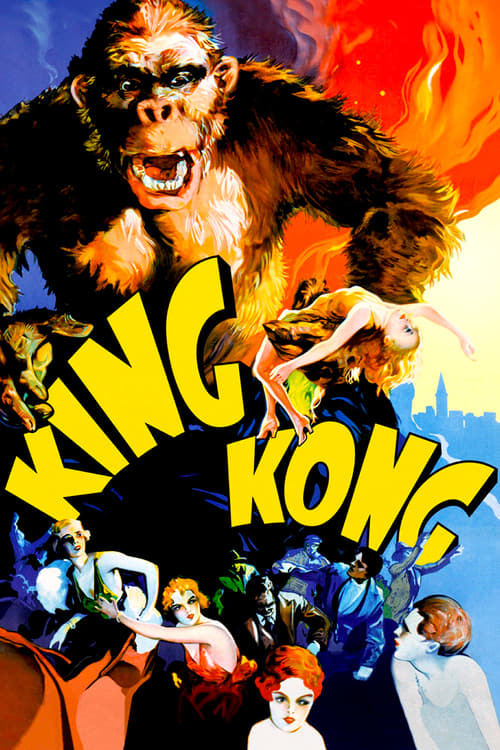
King Kong
1933 · Merian C. Cooper
For when you want to see where blockbusters began — a rousing, big-hearted spectacle night, great for sharing with someone who thinks old movies are homework.
What it's about
A showman filmmaker sails with his crew and a hungry young actress named Ann Darrow to an uncharted island, chasing footage of something no audience has ever seen. What they find is Kong — a colossal ape, worshipped and feared — and the expedition's greatest prize becomes its catastrophe when the showman hauls his discovery back to Broadway as the eighth wonder of the world.
The experience
Ninety years on it still moves like an adventure serial with a fever — jungle terrors arriving one after another, then a finale that turns the spectacle unexpectedly mournful. The monster becomes the character you feel for, and that ache is what stays.
Performances
Fay Wray became the movies' definitive scream queen here, and Robert Armstrong's carnival-barker filmmaker gives the story its reckless engine — but the great performance is Kong himself, animated with more personality than most human casts.
The craft
Willis O'Brien's stop-motion animation, frame by painstaking frame, gave a tabletop puppet rage, curiosity, and grief — a landmark of effects artistry that generations of animators and effects wizards studied like scripture. Max Steiner's score, one of the first full orchestral scores written for a sound film, essentially invented modern film music. It rewards the biggest screen you can find.
Why it matters
The foundation stone of the monster movie and the effects blockbuster alike — it saved its studio during the Depression, inspired countless filmmakers into the profession, and its final image is among the most quoted in all of cinema.
Snapshot
King Kong is the film in which the American cinema's two great appetites — the documentary lure of the faraway and the studio's power to fabricate — collided and fused into a single object. Produced at RKO Radio Pictures during the deepest year of the Depression, credited to Merian C. Cooper and Ernest B. Schoedsack as co-directors, it grafts the travelogue-expedition picture the two men had built their careers on (Grass, 1925; Chang, 1927) onto a fantastic-adventure armature that could only exist in a soundstage, animated frame by frame on tabletop miniatures by Willis O'Brien and his crew.
The result is a work of double consciousness. Its story is about a filmmaker who sails to an uncharted island to shoot something no audience has seen; its production was a filmmaker fabricating that island on the RKO backlot and in the optical printer. Denham's showmanship is Cooper's showmanship, held at just enough distance to be legible as such. Nearly a century on, the film's technical achievements have been superseded a dozen times over, and yet the picture still works — because its effects were never merely demonstrative. O'Brien's Kong has a temperament: he is curious, irritable, vain, tender in ways the screenplay never states and the animation insists upon.
The film also carries, inseparably, the racial imagination of its moment: an island of Black islanders performing ritual terror, a giant Black-coded beast destroyed for desiring a white woman, a climax staged atop the newest skyscraper in the world. Any serious account of King Kong has to hold its formal brilliance and its colonial-racial architecture in the same hand, because they were built by the same hands at the same time.
Industry & production
RKO in 1931–32 was a young studio in trouble. Formed in 1928 out of the RCA–Keith-Albee-Orpheum merger to exploit sound, it entered the Depression overextended and would land in receivership in early 1933 — the very moment King Kong opened. David O. Selznick had arrived as production head in late 1931, and it was under Selznick that Cooper came onto the lot as his executive assistant, then rose to production chief himself when Selznick departed for MGM.
That institutional context matters, because King Kong was made possible by salvage. The studio had already invested in the O'Brien-driven prehistoric picture Creation, a project Cooper reviewed, judged dramatically inert, and shut down — while retaining O'Brien, his technicians, and the accumulated apparatus of stop-motion animation. Cooper redirected that capacity toward his own idea: a giant ape, a girl, a ship, a city. He shot a test reel to sell it internally, a standard Cooper tactic — prove the impossible thing on film, then argue budget.
Economy shaped the picture everywhere. Skull Island's great gate and wall were assembled from standing sets, most famously the Jerusalem set built for The King of Kings (1927) on the Pathé/RKO Culver City lot; the same structures would burn as Atlanta for Gone with the Wind in 1938. The film reused personnel, sets, and shooting time with The Most Dangerous Game (1932), which Schoedsack co-directed on adjacent jungle sets with Fay Wray and Robert Armstrong — a genuine instance of a studio amortizing one jungle across two pictures.
Production ran long by the standards of the day precisely because animation is slow: live-action photography could be completed in weeks, but O'Brien's unit worked in seconds of screen time per day. The budget, frequently reported in the high hundreds of thousands, is one of the figures around which studio accounting and later publicity have blurred; the reliable point is that it was expensive for RKO at that moment and that it returned handsomely on release and again through reissues — a rescue picture in fact as well as legend.
The 1933 release preceded strict Production Code enforcement. The 1938 reissue did not, and censors excised material — Kong peeling Ann's clothing, the New York rampage's more explicit deaths, the sailors falling into the spider pit. Some footage was recovered in later restorations; the notorious spider-pit sequence has never resurfaced and is known only from documentation and testimony, a genuine gap in the record rather than a confirmed lost scene with confirmed content.
Technology
King Kong is a compendium of trick photography, and its importance lies less in inventing techniques than in orchestrating them at feature length with dramatic purpose.
The base was stop-motion model animation: articulated armatures — Kong roughly eighteen inches tall, built by Marcel Delgado under O'Brien's direction, with metal skeletons, rubber musculature, and rabbit-fur covering — photographed one frame at a time against miniature sets. Fur is the tell: because the animator's fingers disturbed it between exposures, Kong's pelt visibly ripples and crawls. Audiences accepted it; some contemporary viewers read it as breathing.
Compositing was where the film leapt. Miniature rear projection — a small translucent screen embedded within the miniature set, onto which previously shot live-action was projected one frame at a time, synchronized to the animation camera — let actors appear inside the animated space rather than beside it. This work is associated above all with Linwood Dunn and RKO's optical department; Dunn's use of the Acme-Dunn optical printer, developed in this period, made frame-accurate recombination of separate elements a standard studio capacity. The Dunning process, an in-camera traveling-matte system using dyed and bipacked film, placed foreground actors against separately photographed backgrounds.
Behind these sat the matte painting and glass shot traditions, executed by Mario Larrinaga and Byron Crabbe, whose Skull Island vistas — layered mist, silhouetted crags — owe a direct compositional debt to Gustave Doré's engravings. Depth in Kong's world is manufactured in layers: painted background, animated middle ground, projected or matted live action.
Rounding this out were full-scale mechanical props for contact shots: a giant bust with articulated features for close-ups, an arm and hand rig that could hold Fay Wray aloft, a leg. The cutting between eighteen-inch armature and full-scale mechanism is the film's most consequential technical judgment.
Technique
Cinematography
Photography is credited to Edward Linden with J.O. Taylor and Vernon Walker; Walker headed RKO's special photographic effects. The live-action idiom is straightforward early-thirties studio work — but the film's real cinematographic argument is made in the composite shots, where the camera must persuade the eye that heterogeneous elements share one space.
The visual scheme is high-contrast and heavily atmospheric: fog and smoke fill the island air, less for mood alone than because diffusion helps disguise the seams where painted, animated, and photographed elements meet. Skull Island is lit as a place of shafts and hollows, and the composition consistently favors extreme foreground silhouette against luminous depth — a Doré device.
Because animation cameras were typically locked off, movement is scarce inside effects shots, and the film compensates with staging in depth and with cutting. Note how often Kong is framed from a low angle in the New York sequences and from a slightly high angle in Ann's point of view on the island — scale is authored by angle, not by camera movement.
Editing
Ted Cheesman is the credited editor. The film's cutting logic is its most underrated achievement, because it is what makes the effects work: rather than sustaining any single technique long enough for the eye to interrogate it, the film rotates among animated long shots, mechanical-prop close-ups, actor reactions, and process composites.
The Empire State Building climax is the clearest demonstration — a cycle of Kong on the mast, biplanes banking in, pilots in cockpits, Ann on the ledge, the city below — each shot short, each from a different technical register, the montage manufacturing a spatial continuity that no single element contains. Eisensteinian in mechanism if not in politics.
The film's pacing is also structurally unusual: a long, talky first act aboard ship and in New York, then relentless incident once the island appears, then a second acceleration in the third act. Kong is withheld for roughly a third of the running time — a suspense architecture that later monster cinema would formalize into doctrine.
Mise-en-scène / staging
Skull Island is designed as a threshold system: sea, beach, village, wall, gate, jungle, plateau, Skull Mountain. Each barrier crossed is a descent further from the modern world, and the film's staging is organized around gates and edges — the great door, the log over the ravine, the cliff face, and finally the skyscraper's setback ledges, which restate the island's vertical geography in steel.
The wall is the film's governing image. It exists to keep Kong out and to deliver sacrifices in, and it makes the racial-colonial logic architectural: an indigenous population living in permanent negotiation with a force the white expedition will simply steal.
The Broadway theater sequence is staged as an ironic inversion: Kong, once framed by jungle, now framed by proscenium, chromium chains, and press flashbulbs. The film cuts from natural to theatrical framing to make its point about spectacle without a line of dialogue doing the work.
Sound
King Kong is a landmark in the design of a film's total sonic architecture at a moment when sound practice was barely five years old.
Murray Spivack, RKO's sound effects head, built Kong's voice by recording lion and tiger vocalizations and playing them back reversed and slowed; the chest-beat and other body sounds were similarly constructed rather than recorded from life. The dinosaurs were given voices assembled from animal recordings and manipulated air. This is sound design in the modern sense — a creature's identity manufactured from materials that have no natural relation to it.
Max Steiner's score is the film's other structural achievement, and arguably the more historically consequential. Studio practice in 1932 leaned toward sparse scoring, on the theory that unexplained orchestras confused audiences. Steiner — pressed by Cooper, who reportedly backed the expense against studio hesitancy — wrote a near-continuous symphonic score for the island and New York sequences, built on leitmotifs: a heavy three-note descending figure for Kong, a lighter theme for Ann, propulsive ostinati for pursuit. He synchronized music to physical action, and he used the score to carry emotional information the animation could not state. The film is routinely, and correctly, identified as a founding text of the Hollywood symphonic score; Steiner's subsequent work at RKO, Warner Bros., and Selznick International codified the practice.
Performance
Two performance systems run in parallel. The human cast plays in the declarative, forward-leaning register of early sound melodrama: Robert Armstrong's Denham is all barking momentum, Bruce Cabot's Driscoll a stiff romantic lead, and Fay Wray delivers what became a defining screen performance of terror. Wray's contribution is more technical than the "scream queen" shorthand suggests — she performed at length against rear-projection plates and mechanical rigs, with no eyeline partner, calibrating fear to a creature she could not see.
The film's real performance is Kong's, and it is authored by animators — O'Brien above all, with Buzz Gibson and E.B. Gibson among the crew — through weight, hesitation, and gesture: the way he examines Ann, sniffs his fingers, cocks his head; the way he tests the biplanes with something like puzzled irritation before rage. That an audience mourns a rubber-and-fur armature is the film's central artistic fact.
Narrative & dramatic mode
The screenplay is credited to James Ashmore Creelman and Ruth Rose, from an idea by Cooper and Edgar Wallace; Wallace died in February 1932, early in development, and the extent of his contribution has long been disputed — his credit is best understood as partly contractual and promotional. Rose, Schoedsack's wife and a veteran of expedition work, is generally credited with humanizing the dialogue and giving Denham his showman's voice.
Structurally the film is a three-act quest that reverses direction at the midpoint: the first half is going to get it, the second half is what it does when brought back. The device that makes this work is the film-within-a-film. Denham's stated purpose — to shoot a picture with a girl in it because "the public wants a pretty face" — allows King Kong to narrate its own conditions of production.
The dramatic mode is melodrama in the strict sense: moral positions externalized as physical peril, emotion carried by music and gesture, coincidence accepted as structure. The Beauty-and-the-Beast frame is stated twice, once as an invented "old Arabian proverb" in the opening and once as Denham's closing line, and this bracketing converts an adventure serial into a fable. The last line is a piece of narrative sleight of hand: it relocates responsibility from the men with rifles, airplanes, and box-office receipts onto Ann, and onto love itself.
Genre & cycle
King Kong sits at the confluence of several early-thirties currents. It belongs to the exotic-expedition cycle that Cooper and Schoedsack themselves helped create and which by 1933 had gone hybrid and fictional. It belongs equally to the Universal horror cycle of 1931–33 — Dracula, Frankenstein, Dr. Jekyll and Mr. Hyde, The Mummy, Island of Lost Souls — and shares that cycle's structure of sympathetic monstrosity destroyed by mobilized modernity. And it belongs to the lost-world fantastic, descending directly from The Lost World (1925), which O'Brien had animated from Conan Doyle.
What it did to genre was consolidate: it fused expedition realism, horror pathos, and fantastic spectacle into a template — creature discovered in a remote place, transported to a metropolis, destroyed by the state's technology — that has organized creature cinema ever since. The pre-Code context is legible in the film's sexual frankness and casual brutality, and the 1938 cuts mark exactly where the new regime drew its lines.
Authorship & method
Authorship here is genuinely distributed, and the honest account names several centers.
Merian C. Cooper is the film's originating intelligence: aviator, veteran of the Kościuszko Squadron, explorer, documentarian, then producer-executive. His method was to fuse authenticated adventure with fabricated spectacle and to sell it with showman's conviction. Ernest B. Schoedsack, his co-director and longtime partner, was the cameraman-in-the-field of the pair and handled much of the live-action staging. The two men famously appear as the airplane crew that kills Kong — a signature that says plainly whose hands did the deed.
Willis O'Brien is the film's other author. Having animated The Lost World, he arrived with a decade of technique and a conviction that stop-motion could carry emotion rather than merely demonstrate a marvel. Marcel Delgado built the models; Mario Larrinaga and Byron Crabbe painted the world; Linwood Dunn and Vernon Walker made the composites hold.
Max Steiner (score) and Murray Spivack (effects) authored the film's sound world. Ted Cheesman cut it; Edward Linden, J.O. Taylor, and Walker photographed it. Ruth Rose and James Ashmore Creelman wrote it. The film is a demonstration that the studio system's division of labor could, in the right configuration, produce something more idiosyncratic than any individual department would have managed alone.
Movement / national cinema
King Kong is a thoroughly American studio product, but its visual imagination is transatlantic. The Skull Island sequences carry a clear debt to German Expressionist lighting and to the fantastic-landscape tradition — the shafts of light, the silhouetted architecture of rock, the monumental gate. Doré's illustrations for Dante, Milton, and the Bible are the acknowledged pictorial source for Larrinaga and Crabbe's compositions.
More broadly, the film belongs to a distinctly American genre of the imperial imagination: the expedition narrative that renders the non-Western world as spectacle to be photographed, collected, and exhibited. Cooper and Schoedsack came out of that tradition honestly — they had actually made Grass and Chang in Persia and Siam — and King Kong is its fictionalized apotheosis and, unintentionally, its critique.
Era / period
March 1933 is the pit of the Depression: Roosevelt's inauguration, the bank holiday, unemployment near its peak. The film's New York is a city of newspapermen, crowds, and unemployed men — Ann is introduced stealing fruit, an image that locates the story in breadline America before a single palm tree appears.
The Empire State Building had opened less than two years earlier, in 1931, largely untenanted — the "Empty State Building" of contemporary wit. Placing Kong on it was topical: the newest, emptiest monument to a boom that had ended. The biplanes that kill him are, likewise, an image of the state's air power at a moment when aviation was the era's dominant symbol of technological modernity, and Cooper — an aviator — knew exactly what he was staging.
Technologically, 1933 is the moment sound cinema stopped being an encumbrance. King Kong is one of the films in which that liberation is audible.
Themes
Spectacle and its cost. The film's deepest subject is exhibition itself. Denham's project — find the marvel, film it, sell it — is the studio's project, and the film follows that logic to its conclusion: the marvel dies on Broadway's terms.
Nature, capital, and extraction. Kong is removed from his ecology, transported, chained, and monetized. The film stages resource extraction as adventure and then shows the extracted thing refusing the terms of its sale.
Race and empire. This cannot be bracketed. The islanders are staged through the full vocabulary of 1930s racial caricature; the chief's offer of trade for the "golden woman" and Kong's fixation on Ann encode a miscegenation anxiety that was, in 1933, explicit American law and social practice. Kong's death — a Black-coded body shot from the sky above a white woman, atop the nation's tallest building — has been read this way persistently and persuasively by scholars since at least the 1970s. Cooper's stated intentions were adventure and showmanship, not allegory; the imagery signifies regardless of intent.
Sympathy for the monster. Against all of the above, the film's animation insists that Kong is a subject. The sympathy is real, and it is what has kept the film alive.
Modernity as machinery. The film's final movement is a machine sequence: elevated trains, subways, searchlights, airplanes. Kong is not defeated by a hero but by infrastructure and ordnance.
Reception, canon & influence
Contemporary reception. The film opened in March 1933 at Radio City Music Hall and the RKO Roxy simultaneously — a double-house Broadway premiere that was itself a piece of showmanship — and was a substantial commercial success at the exact moment RKO needed one. Reviews were broadly enthusiastic about the spectacle and frequently condescending about the story, a pattern that would follow effects-driven cinema for decades. Successive reissues (1938, 1942, 1952, and after) and its arrival on television in the mid-1950s converted a hit into a permanent fixture. Critical reassessment as art rather than sensation accumulated through the 1960s and 1970s, and the film was among the early selections for the National Film Registry.
Influences on the film (backward). The Lost World (1925) supplied the technique and the prehistoric-survivals premise. Conan Doyle's novel, and behind it Verne and Haggard, supplied the lost-world literature. Grass (1925) and Chang (1927) supplied Cooper and Schoedsack's own expedition idiom and their taste for animal spectacle. Doré's engravings supplied the look. Universal's 1931–32 horrors supplied the sympathetic-monster structure and the market. Cooper's stated origin story — an interest in gorillas, a dream of a giant ape atop a New York building — is well attested in his own accounts, which is the appropriate level of confidence to claim for it.
Legacy (forward). The immediate progeny were a rushed sequel, Son of Kong (1933, Schoedsack), and Mighty Joe Young (1949), which brought Cooper, Schoedsack, O'Brien, and Ruth Rose back together and on which a young Ray Harryhausen did much of the animation. Harryhausen is the crucial transmission line: he saw King Kong as a boy, apprenticed to O'Brien, and carried stop-motion through The Beast from 20,000 Fathoms (1953), the Sinbad films, and Jason and the Argonauts (1963).
From there the influence branches. Godzilla (1954) took the metropolis-destroying creature and rebuilt it around nuclear trauma, founding the kaiju tradition. The creature-in-the-city template underwrites an enormous swath of subsequent cinema. Explicit remakes and reworkings — 1976, 2005 (Peter Jackson, an avowed lifelong devotee), 2017's Kong: Skull Island and the subsequent MonsterVerse — keep returning to the same architecture.
More diffusely, King Kong established the effects picture as a legitimate and lucrative studio form, and the effects supervisor as an author. The lineage from O'Brien to Harryhausen to Phil Tippett and the ILM generation is direct and acknowledged; the go-motion and, later, digital-creature traditions understood themselves as continuing this project. Steiner's score set the template for symphonic film music for a generation. And Spivack's constructed roars are the ancestor of every designed creature voice from Godzilla to Jurassic Park.
The film's other legacy is critical. Because its racial and colonial content is so unmistakable, King Kong has become a standard object for film studies work on race, empire, and spectacle — a text taught as much for what it reveals about 1933 as for what it achieved. That double life, as technical monument and as historical evidence, is why it remains among the most written-about films in the American canon.
A Deleuzian reading
Watch the fur.
The full Deleuzian reading of King Kong →
Reception
A sensation on release in 1933 — it did huge business and is widely credited with helping pull RKO back from the financial brink during the Depression. It's never really needed a reappraisal: it went straight from blockbuster to founding text of the monster movie, and it's been enshrined ever since.
How King Kong was received, from release to now →
How to watch King Kong: what to notice on a first viewing
- Notice how Kong's fur never quite sits still. Small disturbances in the animated fur between exposures give the model a constant restless motion no static pose could produce. Every instant of him was made by hand, one at a time, and none of those instants is a held pose.
- Notice whether the camera looks up at Kong or down. New York shots frame Kong from a low angle, while island shots often take a slightly high angle from Ann's point of view. The film authors his scale through camera angle, not through any change in the model itself.
- Listen for three descending notes whenever Kong appears. Steiner's score assigns Kong a heavy, descending three-note figure and Ann a lighter one, synchronized closely to physical action on screen. The music carries emotional information the animation alone cannot state directly.
- Notice each gate and wall the expedition has to cross. The island is built as a series of thresholds, beach, village, wall, jungle, plateau, so each barrier passed marks a further descent. Crossing each threshold shows you a world being entered in stages, not arrived at all at once.
- Watch Kong's hand and head for small, hesitant gestures. The animation gives him moments of sniffing, head cocking, and puzzled irritation that the screenplay never puts into words. This hesitation is what lets you read a temperament in him that the script never states.
The whole guide to watching King Kong, with the keys for a rewatch →
Influences: the films it descends from and the films it influenced
- The Ghost of Slumber Mountain (1918) — O'Brien's first professional dinosaur film fixed the working method Kong scales up wholesale — ball-and-socket armatures under sculpted flesh, animated a frame at a time and matted into live-action plates so actors and creatures share one image.
- The Lost World (1925) — Same animator (O'Brien) and same model-builder (Marcel Delgado, whose latex-over-metal armatures were built for this picture), and the same third act: a captured prehistoric animal breaks its restraints in a modern capital and climbs the city's architecture.
- Grass (1925) — Cooper and Schoedsack's expedition-documentary grammar — mass movement held in extreme long shot, hardship authenticated by first-person titling — is precisely the rhetoric Carl Denham's film-within-a-film borrows to make Skull Island read as a place someone actually reached.
- Chang (1927) — The stockaded jungle village, its great log gate, and the Magnascope-enlarged elephant stampede supply both Skull Island's threshold architecture and the showman's tactic of physically enlarging the projected image for the animal-spectacle climax.
- Metropolis (1927) — Schüfftan-mirror and miniature compositing married to low-angle worship of vertical architecture — the working model for photographing a New York whose towers are optical constructions and whose scale is manufactured by lens height rather than by set size.
- Frankenstein (1931) — Supplies the sympathetic-monster architecture Kong inherits intact: the reveal withheld through a first reel of talk, one tender scene that converts menace into pathos, and a torch-bearing pursuit that kills the creature at the top of a structure.
- Symphony of Six Million (1932) — Steiner's RKO breakthrough in near-continuous non-source symphonic underscore — dramatic scenes carried by orchestra rather than left dry — is the practice he expands into Kong's full leitmotif system a year later.
- Son of Kong (1933) — Rushed out in nine months on reused armatures and standing sets, it repurposes O'Brien's animated performance from menace to comic pantomime — the first demonstration that the transferable asset was the character's acting, not the technique.
- Mighty Joe Young (1949) — Reassembles Cooper, Schoedsack, O'Brien and Ruth Rose, with the bulk of the animation by the young Harryhausen; it refines Kong's facial performance and replaces its hand-built composites with cleaner traveling mattes and rear projection.
- The Beast from 20,000 Fathoms (1953) — Harryhausen's Dynamation — splitting a rear-projected plate with a matted foreground pane so the animated creature walks behind real street furniture — industrializes Kong's laborious miniature rear-projection layering into a budget-scale process.
- Godzilla (1954) — Takes the metropolis-destroying creature and, crucially, the wholly fabricated creature voice: Ifukube's resin-gloved contrabass is the direct method-descendant of Murray Spivack's slowed and reversed lion-and-tiger roars, and his march scores the monster as a Steiner-style leitmotif subject.
- The 7th Voyage of Sinbad (1958) — Harryhausen's Cyclops carries O'Brien's animated character acting — weight shifts, held glances, hesitation before a blow — while Herrmann writes creature-specific leitmotifs, extending Steiner's practice of scoring a monster as a character rather than as a threat cue.
- Jason and the Argonauts (1963) — The skeleton fight choreographs live swordplay to pre-planned animation on rear-projected plates, pushing Kong's multi-register montage of man-and-creature combat to seven simultaneous animated performers cut against one continuous human action.
- The Valley of Gwangi (1969) — O'Brien's own unrealized cowboys-versus-dinosaurs project, finally animated by Harryhausen, replays Kong's capture-exhibit-escape structure beat for beat — the roped allosaurus hauled in for paying audiences, then loose in a cathedral instead of a theater.
- The Empire Strikes Back (1980) — Phil Tippett's go-motion AT-ATs and tauntauns add motorized motion blur to the O'Brien-to-Harryhausen armature tradition he apprenticed into, while ILM's optical compositing bench descends directly from Linwood Dunn's printer work at RKO.
- Jurassic Park (1993) — Tippett's stop-motion animators retrained onto digital rigs carried the armature-performance discipline across the medium change, Gary Rydstrom built each dinosaur voice as a composite of unrelated animal recordings in Spivack's manner, and the T. rex reveal is withheld for an hour.
- King Kong (2005) — Andy Serkis's performance capture is the explicit modern form of animated character acting — gorilla behavior studied from life, then keyframed onto a digital armature — deployed inside near-shot-for-shot restagings of the 1933 low-angle blocking and Skull Island gate.
- Godzilla Minus One (2023) — Cooper and Schoedsack establish the partial-creature-revelation grammar — fragment before whole, bystander reactions as scale proxies, architectural destruction read from street level — that Honda encoded into kaiju-eiga and that Yamazaki reactivates in the overhead-train approach of the Ginza attack sequence.
- Jurassic Park III (2001) — Codified the creature-feature aviary/pterosaur menace and the design-led monster-spectacle staging that JP3's pteranodon aviary sequence reworks.
- The Most Dangerous Game (1932) — Shot at night on the same RKO jungle sets with Wray, Armstrong, Schoedsack and Steiner while Kong was in production — the same arc-lit, fog-diffused foliage photography and the same hunt-as-leitmotif scoring, developed in parallel by one crew on two pictures.
- Godzilla (1998) — Originates the low-angle monumentalism of a colossal creature scaling and threading a named American metropolis, the framing grammar Emmerich reuses on the Chrysler/Flatiron skyline.
- Pacific Rim (2013) — Foundational scale-reference compositing of a giant creature against human-scale environments (the Empire State Building), the rain-and-night atmospheric concealment that lets effects read as massive — visible in the harbor/Hong Kong night fights.
- Mayabazar (1957) — Canonized stop-motion and miniature creature/scale spectacle integrated with live actors, the international reference point for animating an oversized figure into a dramatic scene.
- The Tale of the Fox (1941) — Willis O'Brien's rabbit-fur pelt over an articulated armature produces the same visibly boiling coat that Starewicz accepts on his fox — parallel invention of the furred dimensional puppet, where the animator's own fingerprints in the pile become part of the creature's presence.
Similar films
- King Kong (2005) — influence & lineage
- Frankenstein (1931) — influence & lineage
- Godzilla (1954) — influence & lineage
- Jurassic Park (1993) — influence & lineage
- Jason and the Argonauts (1963) — influence & lineage
- The Invisible Man (1933) — shared sensibility
- Planet of the Apes (1968) — shared sensibility
- Godzilla: King of the Monsters (2019) — shared sensibility