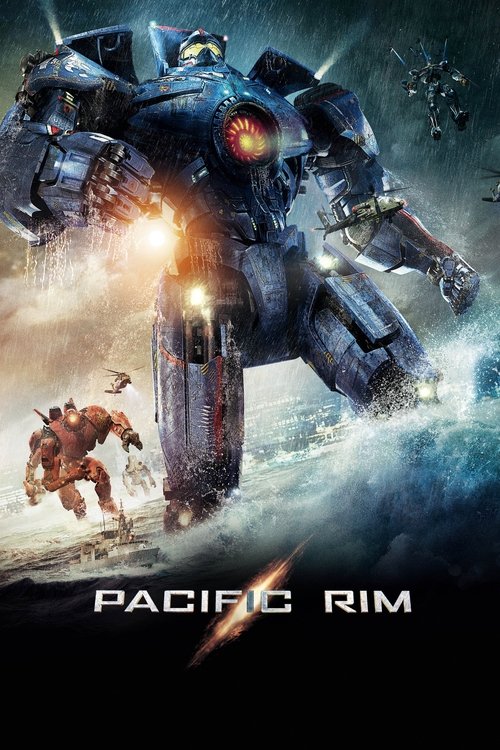
Pacific Rim
2013 · Guillermo del Toro
Pinocchio's stop-motion Oscar and his Frankenstein made him the loudest voice for handmade craft against AI ("I'd rather die than use it") — his interviews are reliably viral anti-algorithm sermons. Cinephile Twitter's beloved uncle.
For a big loud crowd-pleaser night when you want spectacle with heart and zero cynicism — the movie to put on when 'giant robots punch giant monsters' is exactly the sentence you need.
What it's about
Monsters the size of buildings are rising from a rift in the Pacific floor, and humanity's answer is the Jaeger program: skyscraper-tall robots driven by two pilots whose minds are neurally linked. As the attacks escalate toward apocalypse, a washed-out pilot and an untested rookie become the long-shot pairing the last surviving Jaegers depend on. The fight comes to Hong Kong, at night, in the rain.
The experience
Gleeful, thunderous, and sincere — a blockbuster that plays its ridiculous premise absolutely straight and earns it. The monster-robot battles have real weight and scale, and the whole thing radiates the joy of a filmmaker building the toy box he always wanted.
Performances
Idris Elba anchors the whole operation as the Jaeger program's commander, delivering gravitas and one of the great rallying speeches of modern blockbusters with total conviction.
The craft
Del Toro insists that enormous things feel enormous — the robots move with weight, the neon-and-rain color palette makes every frame pop, and the Hong Kong battle is one of the best-staged large-scale action sequences of its decade. The pounding score and dense sound design make this a film that genuinely demands the biggest screen and loudest speakers you can find.
Why it matters
A heartfelt Hollywood tribute that reintroduced Western audiences to giant-monster and giant-robot traditions, found a massive audience in Asia, and spawned a franchise — proof there was appetite for kaiju spectacle made with love rather than irony.
Snapshot
Pacific Rim is Guillermo del Toro's large-scale tribute to two strands of Japanese popular cinema — the kaiju (giant-monster) film and the mecha (piloted-robot) tradition — refracted through the apparatus of a Hollywood tentpole. Produced by Legendary Pictures and released by Warner Bros. in the summer of 2013, it imagines an alternate near-future in which interdimensional monsters, the Kaiju, emerge from a rift on the Pacific floor, and humanity answers with the Jaegers, skyscraper-sized robots piloted in tandem by two neurally linked operators. The film is notable less for narrative novelty than for its commitment to scale, weight, and color as expressive resources, and for del Toro's insistence — unusual among the digitally weightless blockbusters of its moment — that enormous things should feel enormous. It occupies a distinctive place in del Toro's filmography: his most expensive, most overtly commercial work, made between the gothic chamber pieces and dark fairy tales with which he is more readily associated.
Industry & production
Pacific Rim originated from a spec script titled Pacific Rim by Travis Beacham, which del Toro took on and rewrote with Beacham. The project arrived for del Toro at a particular juncture: he had spent years developing an adaptation of H.P. Lovecraft's At the Mountains of Madness with Universal, a passion project that collapsed over budget and the studio's reluctance to commit to an R rating. Pacific Rim, by contrast, was greenlit as a four-quadrant summer event film. It was produced by Legendary Pictures — then in its productive partnership with Warner Bros. — with Thomas Tull and Jon Jashni among the producers, and del Toro and Beacham's collaborator Callan Brunker involved in development; del Toro produced alongside.
The budget was large, widely reported in the region of $190 million before marketing, making it one of the most expensive original (non-sequel, non-adaptation) properties of its year. Principal photography took place largely at Pinewood Toronto Studios in late 2011, with the production building extensive practical sets, including the interior of the Jaeger command facility (the "Shatterdome") and pilot cockpit (the "Conn-Pod") rigs mounted on gimbals. The film's commercial performance was modest in the domestic United States relative to its cost but strong internationally, with China in particular a decisive market — a fact that materially shaped the eventual greenlighting of a sequel. That international skew became part of the film's industrial story: it is frequently cited as an early instance of a Hollywood blockbuster rescued, and sequelized, primarily on the strength of Chinese box office.
Technology
The film is a showcase for the digital-effects house Industrial Light & Magic, which executed the bulk of the Kaiju and Jaeger work, and for the integration of large-scale practical elements with computer-generated imagery. Del Toro's stated ambition was to restore mass and physical consequence to digital giants; the production accordingly emphasized fluid dynamics and the behavior of water, since most of the major combat occurs in rain, in harbors, or in the open ocean. Simulating the displacement of water by colossal bodies, the spray and wake of moving Kaiju, and the interaction of metal and flesh under storm conditions placed heavy demands on the simulation pipeline.
Practical technology was equally central. The Conn-Pod cockpit sets were built on motion bases (gimbals) so that the actors physically lurched, swayed, and absorbed impacts in camera, their harnessed bodies driving the robots through a choreography of mirrored movement. This decision — to capture the pilots' exertion practically rather than against blue screen alone — is a key reason the cockpit sequences carry kinetic conviction. The film's "Drift," the neural-handshake conceit by which two pilots share consciousness and memory to operate a Jaeger, also gave the production a technological metaphor that doubles as its emotional engine.
Technique
Cinematography
Cinematography is by Guillermo Navarro, del Toro's longtime collaborator and the Oscar-winning lensman of Pan's Labyrinth. The visual signature is saturated, high-contrast color — sodium oranges, sickly Kaiju bio-luminescent blues, the cold steel of the Shatterdome — deployed to keep the immense night-and-rain battles legible. Where many contemporaneous effects films defaulted to desaturated, murky palettes, Pacific Rim is aggressively chromatic, using complementary color blocking (warm interiors against cold exteriors, blue Kaiju glow against orange firelight) both to organize the frame and to evoke the candy-toned artificiality of the tokusatsu and anime sources it honors. Navarro and del Toro stage the giants at a deliberate remove, frequently shooting from low or human-scaled vantage points so that the audience reads the combatants as overwhelming.
Editing
The film was edited by Peter Amundson and John Gilroy. The editorial challenge of a kaiju film is comprehensibility: keeping spatial relationships, scale, and stakes clear across battles between two or more multi-hundred-foot bodies. The cutting generally favors slightly longer-held wide shots than the prevailing blockbuster norm, allowing the choreography of a blow to land, in keeping with del Toro's interest in weight and follow-through. The intercutting of cockpit interiors (practical, human, sweating) with exterior monster combat (digital, titanic) is the film's basic rhythmic unit, binding human effort to robotic action.
Mise-en-scène / staging
Del Toro is a maximalist production designer at heart, and Pacific Rim is dense with designed detail: the worn, riveted industriality of the Jaegers; the chitinous, bioluminescent anatomy of the Kaiju; the Hong Kong "Bone Slums" built from monster skeletons; the blackboard-and-specimen clutter of the scientists' lab. Production design was led by Andrew Neskoromny and Carol Spier (a longtime David Cronenberg collaborator). The staging consistently inserts human-scale reference points — boats, buildings, fleeing crowds, a small child — into frames of the giants to enforce scale. Del Toro's fondness for the grotesque-beautiful, familiar from his creature work, animates the Kaiju, which are individuated rather than generic, each given a distinct silhouette and behavior.
Sound
Sound design is among the film's most discussed achievements, with the sonic identity of the Jaegers and Kaiju — the groan of moving metal, the subsonic roar of the monsters, the alarms and impacts of combat — engineered for theatrical low-end impact. Ramin Djawadi's score supplies a driving, electric-guitar-forward main theme that signals the film's debt to anime heroics and arena spectacle rather than to symphonic solemnity. The combination of percussive sound effects and propulsive scoring is integral to communicating mass and momentum.
Performance
The ensemble is led by Charlie Hunnam as the lapsed pilot Raleigh Becket and Rinko Kikuchi as Mako Mori, the film's emotional center, whose backstory — rendered in a celebrated flashback of a child fleeing a Kaiju through a ruined city — supplies its most affecting passage. Idris Elba plays the commander Stacker Pentecost, delivering the film's rousing rhetoric (the "canceling the apocalypse" address) with gravity that critics singled out. Charlie Day and Burn Gorman provide comic-grotesque relief as bickering scientists, and Ron Perlman, a del Toro fixture, appears as the black-market dealer Hannibal Chau. Performances are pitched toward the broad, sincere register of anime and pulp adventure rather than psychological realism — a deliberate tonal choice consistent with the sources.
Narrative & dramatic mode
The dramatic mode is earnest pulp adventure: a last-stand-of-humanity structure organized around a redemption arc (Raleigh's return to the cockpit after loss) and a partnership arc (his Drift compatibility with Mako). The Drift conceit converts the genre's mechanical premise into a relational one — to pilot is to be psychically intimate, to share trauma and memory — so that the film's action and its emotional stakes are mechanically fused. The screenplay is unembarrassed by its archetypes: the haunted veteran, the untested protégé, the stern commander with a secret illness, the rival hotshot, the comic experts. Conflict is externalized and escalating, building toward a sacrificial assault on the rift itself. The mode is closer to sincere myth than to irony; del Toro's avowed intent was to make a film a child could love without condescension.
Genre & cycle
Pacific Rim is a deliberate Hollywood synthesis of two Japanese genre lineages: the kaiju film, descended from Godzilla (1954) and its Toho successors, and the giant-robot (mecha) tradition of anime and tokusatsu, from Mazinger Z and Gundam through Neon Genesis Evangelion. The piloted-robot-versus-monster premise is its own minor cycle in Japanese media; del Toro's film is the most lavishly funded Western entry in it. Within the early-2010s Hollywood landscape it sits alongside the studios' broader appetite for spectacle franchises, but it is conspicuously an original property rather than an adaptation or sequel — a rarity at its budget level — even as it is saturated with allusion. It also belongs to a smaller del Toro lineage of monster cinema running through Mimic, Hellboy, and Blade II.
Authorship & method
The dossier's clearest through-line is authorship. Pacific Rim is unmistakably a del Toro film despite its scale and corporate scaffolding: the loving creature design, the saturated palette, the fascination with hidden worlds and grotesque beauty, the sincerity toward genre, and the recurring collaborators all bear his signature. His method here is one of curated homage — the film is dedicated to Ray Harryhausen and Ishirō Honda, the directors of Godzilla-era effects cinema, an attribution del Toro made explicit, anchoring the work in a named lineage rather than diffuse pastiche.
His key collaborators carry their own authorial weight. Cinematographer Guillermo Navarro had shot del Toro's films since Cronos and brought the chromatic, painterly sensibility evident throughout. Co-writer Travis Beacham supplied the originating concept and world. Composer Ramin Djawadi, then widely known for Game of Thrones, gave the film its anthemic, guitar-driven identity. Editors Peter Amundson and John Gilroy shaped the legibility of the combat. Production designers Andrew Neskoromny and Carol Spier realized the tactile world. The casting of Ron Perlman continues one of the longest actor-director partnerships in contemporary genre cinema. The result is a blockbuster authored rather than merely assembled — a distinction central to its critical standing.
Movement / national cinema
Del Toro is a Mexican filmmaker, one of the so-called "Three Amigos" alongside Alfonso Cuarón and Alejandro González Iñárritu, whose international careers reshaped perceptions of Mexican cinema's global reach in the 2000s and 2010s. Pacific Rim is a transnational object: a Mexican director's American-financed, Canadian-shot homage to Japanese popular cinema, with a deliberately international cast (British, Japanese, American) and a narrative premised on multinational cooperation against a common threat. The film's structural debt is to Japanese national-cinema traditions, while its production belongs to Hollywood's globalized blockbuster system. That hybridity — and the film's eventual dependence on the Chinese market — make it a useful case study in the deterritorialized economics of the contemporary tentpole.
Era / period
The film is a product of the early-2010s effects blockbuster era, a moment defined by maturing fluid-and-destruction simulation, the dominance of 3-D and large-format exhibition, and studios' search for new "universe"-launching properties. It arrived in a crowded summer of franchise spectacle and was, in that company, conspicuous for its lack of an existing fan base to inherit. Its reliance on international and especially Chinese revenue anticipates the dominant industrial logic of the decade that followed. Tonally, it pushes against the prevailing post-Dark Knight grimness with an unfashionable sincerity and brightness, a choice that reads, in retrospect, as both its commercial risk and its enduring appeal.
Themes
The film's governing theme is cooperation as survival — between the two pilots in the Drift, between nations in the Jaeger program, between disciplines in the lab. The Drift literalizes empathy: to share another's mind is the precondition of effective action, and the film treats trauma as something carried together rather than alone. Mako's arc foregrounds inherited loss and the difficulty of converting grief into agency. Running beneath is del Toro's characteristic sympathy for the monstrous and his fascination with the sublime — the terror and grandeur of the impossibly large — alongside an ecological undercurrent in the image of an ocean breached by what humanity has provoked. The film is, finally, about the dignity of collective sacrifice against apocalypse, rendered without irony.
Reception, canon & influence
Critical reception was generally favorable, with reviewers praising the film's spectacle, design, sincerity, and del Toro's evident affection for his sources, while some faulted its thin characterization and reliance on archetype. It was widely received as a superior example of the giant-spectacle film precisely because of its authored sensibility and tactile craft. Commercially it underperformed domestically relative to its cost but succeeded internationally, with China decisive — the combination that made a sequel viable.
The influences ON the film are explicitly named and deeply felt: the Godzilla lineage of Ishirō Honda and Toho's kaiju cinema; the stop-motion creature tradition of Ray Harryhausen, to whom (with Honda) the film is dedicated; the mecha anime tradition (Gundam, Mazinger Z, Neon Genesis Evangelion) and tokusatsu superhero serials; and del Toro's own monster cinema. Its legacy FORWARD includes the 2018 sequel Pacific Rim: Uprising (directed by Steven S. DeKnight, with del Toro producing rather than directing) and an animated continuation, Pacific Rim: The Black, extending the world into serialized television. More diffusely, the film stands as a reference point in arguments about the place of original, author-driven properties within the franchise-dominated blockbuster economy, and as a high-profile Western validation of Japanese kaiju and mecha aesthetics on the largest commercial scale — a bridge that the subsequent, separate Hollywood "MonsterVerse" Godzilla cycle (also launched by Legendary) would build upon in its own way. Within del Toro's career it remains an outlier in scale but consistent in spirit, a reminder that he could deploy the apparatus of the tentpole without surrendering his voice.
A Deleuzian reading
The single red shoe.
The full Deleuzian reading of Pacific Rim →
Reception
Met with decent-but-unspectacular reviews and a soft US box office in 2013 (China famously saved it), it's since been warmly reappraised as one of the last big original blockbusters — del Toro's sincerity now read as a feature, not a bug.
How Pacific Rim was received, from release to now →
Influences: the films it descends from and the films it influenced
- Transformers (2007) — A sibling in CG giant-robot spectacle but a deliberate counter-model: del Toro answers Bay's chaotic close-coverage and metallic incoherence with editing/long-held-wides and scale-reference points to keep combat geographically legible.
- Real Steel (2011) — Extends the same commitment to giving giant fighting machines tactile mass and readable choreography, staging robot combat with inertia and clear spatial geography rather than weightless chaos.
- Pacific Rim: Uprising (2018) — Direct descendant continuing the drift-cockpit mecha grammar and Jaeger-versus-Kaiju combat staging, with del Toro producing — though it trades his long-held wides and saturated palette for brighter, faster daylight action.
- Godzilla (1954) — The suitmation/tokusatsu method of conveying immense scale through a human-sized performer in a city-block miniature shot at high frame rates — del Toro dedicates the film to Honda and replicates the scale-reference staging (figures, ships, buildings dwarfed in frame) that sells kaiju mass.
- The 7th Voyage of Sinbad (1958) — Ray Harryhausen's stop-motion creature articulation, which prized tactile, hand-crafted monster anatomy and weight over smoothness — del Toro's co-dedicatee, and the model for his insistence on creature design as authored sculpture rather than generic VFX asset.
- Cronos (1993) — Establishes the del Toro–Guillermo Navarro partnership and its chromatic, painterly lighting of grotesque-beautiful creature mechanisms in amber and teal — the same complementary-color blocking and fetishized mechanical detail scaled up for the Jaegers and Kaiju.
- Hellboy II: The Golden Army (2008) — Direct precursor in maximalist production design and saturated creature-world worldbuilding; the clockwork Golden Army robots prefigure the Jaegers as authored, ornamented machines, and Ron Perlman anchors the same actor-director continuity.
- Mobile Suit Gundam (1979) — Codifies the 'real robot' mecha grammar of piloted, lived-in war machines with cockpit POV and mechanical weight — the conceptual and staging template for the Jaeger drift-cockpit and the pilots-inside-the-giant framing.
- Neon Genesis Evangelion (1995) — The neural-sync pilot interface (the 'drift') and the framing of mecha combat as a psychic burden shared between operators — del Toro lifts the co-piloting-as-intimacy device and the city-as-battleground spatial logic.
- The Mysterians (1957) — Toho's Eiji Tsuburaya–style miniature-and-optical spectacle of giant machines versus invaders, establishing the cooperation-as-survival, humanity-unites-against-extinction pulp structure del Toro revives sincerely.
- Mazinger Z (1972) — Originates the super-robot iconography of named signature attacks and brightly color-blocked giant fighters — the heroic, primary-colored, finishing-move staging del Toro echoes in the Jaegers' weaponized set-pieces.
- King Kong (1933) — Foundational scale-reference compositing of a giant creature against human-scale environments (the Empire State Building), the rain-and-night atmospheric concealment that lets effects read as massive — visible in the harbor/Hong Kong night fights.
- Aliens (1986) — The power-loader-versus-Queen finale established the human-operated exosuit grappling a monster as kinetic spectacle, plus the militarized-grunt ensemble and industrial-tactile hardware design that the Jaeger combat extends.
- Cloverfield (2008) — Sibling in the post-Godzilla American kaiju revival; its city-scale monster-in-the-rain destruction and fluid-simulation water/debris work feed the same VFX vocabulary del Toro deploys at full wide scale.
- Godzilla (2014) — Descendant launched by the same studio (Legendary), inheriting the reverent-toward-Honda, scale-obsessed staging and atmospheric obscuration of the monster — the MonsterVerse builds on the Western-kaiju legitimacy Pacific Rim established.
Similar films
- Pacific Rim: Uprising (2018) — influence & lineage
- Godzilla (2014) — influence & lineage
- Godzilla (1954) — influence & lineage
- Transformers (2007) — influence & lineage
- King Kong (1933) — influence & lineage
- Jurassic World Rebirth (2025) — same viewing thread
- Kingdom of the Planet of the Apes (2024) — same viewing thread
- Godzilla: King of the Monsters (2019) — shared sensibility
All the films related to Pacific Rim →
Watch it with: curated runs of related films
- Worlds Worth Getting Lost In — A run of maximalist, effects-driven pictures that each conjure a whole world from scratch — watch them when you want to be swept somewhere on the biggest screen you can find.