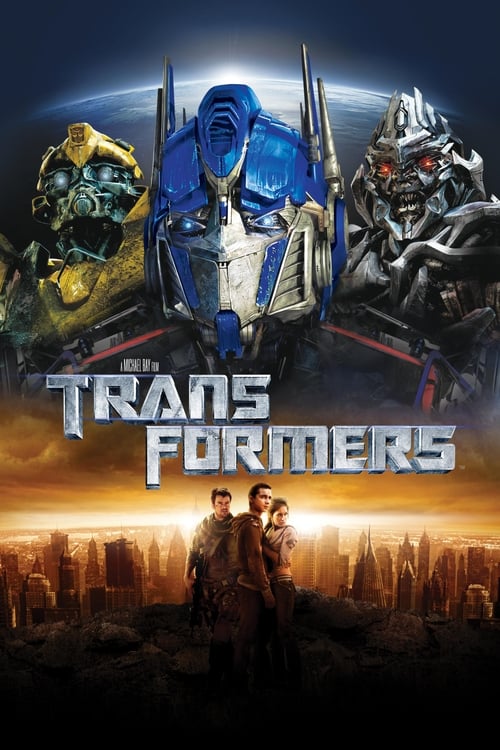
Transformers
2007 · Michael Bay
For popcorn night when you want pure spectacle and zero homework — turn the volume up and let it wash over you. All comfort, no challenge.
What it's about
Sam Witwicky is an ordinary teenager trying to buy his first car and impress a girl — until the car turns out to be a shape-shifting alien robot, and Sam turns out to hold the key to an ancient war. Two factions of transforming machines, the heroic Autobots and the ruthless Decepticons, bring their conflict crashing to Earth, with the military scrambling and Sam caught at the center.
The experience
Loud, kinetic, and unapologetically maximalist — a summer blockbuster that alternates teen comedy with city-leveling robot combat. The scale of the destruction still lands; it's the cinematic equivalent of a rollercoaster with the safety bar rattling.
Performances
Shia LaBeouf's fast-talking, flustered energy grounds the mayhem and made him a star — he sells the absurdity of a kid whose car is an alien.
The craft
The visual effects were a genuine leap: thousands of moving parts per robot, photorealistically integrated into live-action military spectacle, work that reset the bar for CG character animation in blockbusters. Michael Bay's swirling cameras, magic-hour gloss, and wall-of-sound mixing define an entire school of action filmmaking. This is a film built for the biggest screen and loudest speakers you can find.
Why it matters
Launched one of the most lucrative franchises in blockbuster history and established the toy-to-tentpole template the industry chased for a decade; its effects work influenced how digital characters were integrated into live action across the genre.
Snapshot
Transformers is a live-action blockbuster adaptation of the Hasbro toy line and its associated animated franchise, directed by Michael Bay and produced under the shepherding of Steven Spielberg, who is credited as an executive producer. Released by DreamWorks and Paramount in the summer of 2007, the film reframes a children's property — shape-shifting alien robots divided into heroic Autobots and malevolent Decepticons — as a coming-of-age adventure grafted onto a large-scale military-effects spectacle. Its narrative anchor is Sam Witwicky (Shia LaBeouf), an ordinary American teenager who unwittingly inherits a link to an ancient extraterrestrial artifact. The film matters historically less for its story than for its technical achievement: it represented a significant leap in the photorealistic integration of complex, articulated computer-generated characters into live-action plates, and it established a template — and a durable, critically contested franchise — for the toy-to-tentpole pipeline that dominated Hollywood in the following decade.
Industry & production
Transformers emerged from a convergence of corporate and creative interests in the mid-2000s. Hasbro, seeking to extend the value of its intellectual property beyond toys, television, and comics, partnered with DreamWorks and Paramount to mount a live-action feature. Steven Spielberg's involvement as executive producer lent the project prestige and, by numerous accounts in the production's own promotional record, provided the conceptual pivot of centering the story on a boy and his first car. The screenplay was credited to Roberto Orci and Alex Kurtzman, writers then closely associated with producer-writer J.J. Abrams's orbit and later with the rebooted Star Trek.
Michael Bay, by his own repeated public account, was initially reluctant to direct what he characterized as a "stupid toy movie" before committing to the project. The film was made with cooperation from the United States Department of Defense, which granted access to military hardware, aircraft, and personnel — a collaboration Bay had cultivated on earlier films and which supplied the production with materiel that would have been prohibitively expensive to fabricate. This partnership is visible throughout the film's second half in its use of real fighter jets, transport aircraft, and armored vehicles.
The production positioned itself squarely as a summer tentpole, and it was a substantial commercial success on release, launching a franchise that has since produced multiple sequels and spin-offs. Precise budget and box-office figures vary across sources; the safe and well-documented claim is that the film was a major worldwide hit that made the series one of Paramount's most reliable properties for years. The film's marketing leaned heavily on its effects and on a viral, mystery-driven campaign typical of Bay-Abrams-adjacent projects of the era.
Technology
Technologically, Transformers is the film's most consequential dimension. The visual effects were led principally by Industrial Light & Magic, with Scott Farrar serving as visual effects supervisor, and additional work from Digital Domain. The central challenge was rendering robots composed of thousands of individually moving mechanical parts that transform, on screen, from vehicles into humanoid figures — and doing so with enough surface detail, reflectivity, and physical plausibility that they read as photographed objects sharing space with live actors and real environments.
The models were extraordinarily complex by the standards of the time, with the hero characters built from many thousands of separately articulated components. This density created problems not only in animation but in rendering and rendering-pipeline management, and ILM developed and refined tools to handle the scale of geometry and the demands of realistic metal, chrome, and painted surfaces reacting to real-world lighting. The transformation sequences — the signature action of the property — were the hardest technical problem, requiring the parts to reconfigure in ways that suggested mechanical logic even where none could literally exist, a design-and-animation puzzle sometimes described in the production's own accounts as reverse-engineering an impossible mechanism into something that felt convincing at speed.
To integrate the robots into live-action plates, the production relied on carefully matched on-set lighting reference, and the effects team paid close attention to reflections, since the characters' chromed and polished surfaces would betray any mismatch with their surroundings. The result was widely recognized within the industry as a benchmark in CG character integration, and the film was nominated for the Academy Award for Best Visual Effects (among other technical nominations). The film thus sits at an important inflection point in digital effects history, demonstrating that fully synthetic, mechanically intricate characters could carry a live-action blockbuster's action load.
Technique
Cinematography
The film was photographed by Mitchell Amundsen. Its visual grammar is the mature form of what is often called the "Bayhem" style: saturated, high-contrast imagery, frequent low angles that monumentalize both machines and human figures, and a restless, mobile camera. Bay favors sweeping crane and dolly moves, circling "hero shots" in which the camera orbits a character against a dramatically lit sky, and golden-hour or magic-hour lighting that lends even mundane suburban settings a burnished glow. Lens flares, backlighting, and atmospheric haze recur throughout. The photography is designed to make objects — cars, jets, robots, and human bodies alike — appear heroic and kinetic, prioritizing visceral impact and scale over spatial clarity.
Editing
Transformers is edited in the rapid, maximalist mode characteristic of Bay's action cinema, with credited editors including Paul Rubell, Glen Scantlebury, and Thomas A. Muldoon. Cutting rates in the action sequences are extremely fast, and the film layers multiple simultaneous vectors of motion — camera movement, subject movement, and internal transformation of the robots — within very short shots. This approach generates energy and a sense of overwhelming spectacle, and it is also the most frequent target of critical objection: reviewers have long argued that the density of cutting combined with the visual complexity of the robots, particularly in close combat between similarly colored metallic figures, makes the geography of the action difficult to parse. The editing prioritizes momentum and sensation over legible cause-and-effect staging.
Mise-en-scène / staging
The film's staging oscillates between two registers. In its human-scaled first act, it deploys the iconography of American suburbia — the family home, the high school, the used-car lot, the teenager's bedroom — as a recognizable, almost Spielbergian ground against which the fantastic intrudes. In its combat set-pieces, staging expands to encompass city streets, a desert military outpost, and finally an extended urban battle. Bay stages action for maximal physical scale, filling the frame with debris, pyrotechnics, and vehicles, and he repeatedly juxtaposes the enormous robots against ordinary human infrastructure to dramatize their size. Military hardware is staged with documentary specificity, reflecting the Department of Defense cooperation.
Sound
Sound design is a central pleasure and signature of the film. The transformation effect — the cascading, ratcheting mechanical sound of parts folding and locking — became one of the property's most recognizable auditory signatures, a designed sound that gives the impossible mechanism an acoustic reality. The soundtrack is dense and loud, integrating weapon fire, engine roar, and metal impacts into an aggressive mix. The film received recognition in sound categories during awards season, reflecting the craft investment in its aural world.
Performance
Shia LaBeouf anchors the film as Sam Witwicky, bringing a fast-talking, nervous comic energy that gives the human story its momentum and grounds the spectacle in an identifiable adolescent point of view. Megan Fox plays Mikaela Banes, the film's romantic interest, in a role widely noted — and criticized — for its overt objectification. Josh Duhamel and Tyrese Gibson lead the military subplot, John Turturro provides broad comic relief as a government agent, and Jon Voight appears as the Secretary of Defense. Voice performance is essential: Peter Cullen, the original voice of Optimus Prime from the 1980s animated series, reprised the role, an act of continuity that carried significant weight with longtime fans and lent the character gravitas and authority. Hugo Weaving voiced the Decepticon leader Megatron.
Narrative & dramatic mode
The dramatic mode of Transformers is a hybrid: a teen coming-of-age story fused to a military-invasion action spectacle. Its structure follows a classical adventure arc in which an ordinary protagonist is drawn into extraordinary events, gains agency, and proves himself. The "boy and his car" conceit — Sam's first vehicle turns out to be the Autobot Bumblebee — functions as a wish-fulfilment fantasy of adolescent empowerment, mobility, and protection. This human story is intercut with, and eventually subsumed by, escalating action as the artifact known as the AllSpark becomes the object of a race between factions. Tonally the film shifts frequently between broad comedy, romance, sincere heroism, and destruction, a tonal restlessness that is characteristic of the franchise. The dramatic stakes are pitched at the level of planetary survival, but the emotional stakes remain anchored in Sam's personal growth.
Genre & cycle
Transformers belongs to the science-fiction action-adventure genre and, more specifically, to the mid-2000s cycle of effects-driven summer tentpoles built on pre-existing, nostalgia-laden intellectual property. It participates in a long lineage of alien-invasion and giant-robot cinema, and it draws on the "kid meets the fantastic" tradition associated with Amblin-era Spielberg productions such as E.T. and Close Encounters of the Third Kind — a lineage made explicit by Spielberg's producorial role. It is also a foundational entry in the "toy movie" cycle, demonstrating that a licensed plaything could sustain a blockbuster and thereby helping to legitimize a wave of brand-based filmmaking. As a robot-combat spectacle it stands in dialogue with the Japanese mecha tradition from which the original Transformers property partly derived.
Authorship & method
The film is unmistakably a Michael Bay work, bearing the stylistic signatures — kinetic camerawork, patriotic and military iconography, glossy commercial-derived aesthetics, broad humor, and overwhelming sensory scale — that Bay had developed across Bad Boys, The Rock, Armageddon, and Pearl Harbor. Bay's background in music videos and commercials is legible in the film's polished surfaces and montage-driven action. His authorship here is complicated and enriched by collaboration: Spielberg's shaping influence on the story's human-centered premise; writers Orci and Kurtzman's franchise-construction sensibility; and the decisive craft contribution of ILM's effects artists under Scott Farrar, without whom the film's central conceit would be impossible. Cinematographer Mitchell Amundsen executed the visual style, and the score was composed by Steve Jablonsky, whose driving, choir-and-percussion-inflected orchestral idiom became closely identified with the franchise's sound. Voice actor Peter Cullen's continuity with the original series functions as a form of authorial fidelity to the source material amid otherwise sweeping reinvention.
Movement / national cinema
Transformers is a quintessential product of mainstream American commercial cinema — Hollywood's studio blockbuster system at its most globally oriented and technologically ambitious. It reflects no art-cinema movement; rather, it exemplifies the industrial-aesthetic tendency sometimes described as post-classical "spectacle cinema," in which effects, sound, and scale are the primary attractions. Its ancestry, however, is transnational: the Transformers property originated in a collaboration between the American company Hasbro and Japanese toy manufacturer Takara, and the underlying transforming-robot designs draw on Japanese toy and animation traditions. The film thus Americanizes a property with significant Japanese design DNA, filtering the mecha lineage through a distinctly American idiom of suburbia and military might.
Era / period
The film is deeply of its moment — the mid-2000s, a period defined by the maturation of digital effects, the escalating scale and cost of tentpole filmmaking, and Hollywood's intensifying reliance on established brands to de-risk expensive productions. Its post-9/11, wartime-era context is visible in its earnest, cooperative depiction of the U.S. military as competent and heroic, and in the prominence of Middle Eastern desert settings for early combat sequences. The film's confidence in spectacle as its own justification, its integration of viral marketing, and its franchise-first business logic all mark it as a characteristic artifact of Hollywood at the transition into the modern shared-universe, IP-driven blockbuster era.
Themes
Thematically, the film's most sustained concern is the passage from adolescence to adulthood, figured through the acquisition of a car, a girlfriend, and heroic responsibility. Adjacent to this is a recurring franchise theme of freedom and self-determination, voiced through the Autobots' credo that sentient beings have the right to choose — an idea the film gestures toward more than it interrogates. The relationship between humanity and technology is a persistent undercurrent: the robots literalize the anxiety and wonder of machines that possess agency, and the plot's macguffin ties human industry (the discovery that consumer electronics can be spawned from alien technology) to cosmic conflict. Nationalism, military valor, and American exceptionalism are woven throughout, largely uncritically. Commodity and desire — the car as object of longing, the human body as spectacle — pervade the film's visual economy. These themes are handled at the level of spectacle and sentiment rather than sustained inquiry, which is both the film's populist strength and the substance of its critical dismissal.
Reception, canon & influence
Critical reception was sharply divided and, on balance, mixed. Many reviewers praised the film's visual effects and its energy and humor as a piece of summer entertainment, while a substantial body of criticism faulted its incoherent action geography, excessive length, tonal crudeness, product-placement density, and the treatment of its female lead. Over time the film — and especially its sequels — became a recurring reference point in debates about the aesthetic and cultural value of effects-driven blockbuster cinema, with Bay's name becoming shorthand for a maximalist style that critics deplored and audiences frequently rewarded. Its awards recognition centered on technical categories, including an Academy Award nomination for visual effects.
Looking backward, the film's influences are legible: the Amblin/Spielberg tradition of suburban wonder; Bay's own prior action filmography; the alien-invasion and giant-robot genre lineages; and the Japanese mecha and toy traditions embedded in the source property. Looking forward, its legacy is substantial and double-edged. Technically, it advanced the state of the art in integrating hyper-complex CG characters into live action, work that influenced subsequent effects-heavy productions. Industrially, its success accelerated Hollywood's embrace of toy and brand adaptations and the multi-film franchise model, and it cemented Bay's commercial standing. It spawned a long-running series of sequels and spin-offs that became one of the era's defining blockbuster franchises. Its cultural footprint — the transformation sound, Peter Cullen's returning Optimus Prime, the aesthetic label attached to Bay's name — endures well beyond the individual film. The record on many fine-grained financial and production specifics is uneven across sources, but the broad arc is clear: Transformers was a technically pioneering, critically polarizing commercial phenomenon whose principal influence was as much industrial as artistic.
A Deleuzian reading
The camera swings around a man who is standing still.
The full Deleuzian reading of Transformers →
Reception
Critics shrugged in 2007 but audiences made it a near-$710M smash — and after four increasingly bloated sequels, it's been retroactively upgraded to 'the good one,' the Bayformers film even skeptics will defend.
How Transformers was received, from release to now →
How to watch Transformers: what to notice on a first viewing
- Count how many times the camera circles a standing figure. Bay shoots from low angles at magic hour and swings the camera around someone who is doing nothing. The sky goes gold, everything else moves, and the person in the middle is held still and made monumental. The camera does the moving so the figure can pose. Bay gets a statue and a kinetic shot out of the same take.
- Listen to the ratcheting sound of parts folding and locking. The transformation sound is designed, layered, and mechanically specific. No machine that dense could actually fold that way, and the animators were inventing an impossible mechanism at speed. The ear certifies what the eye cannot check. The sound supplies the physics the image only implies. It is why the transformations feel solid even when the fights blur.
- Time how long a single shot lasts during a robot fight. Rubell, Scantlebury, and Muldoon cut the action extremely fast, and each short shot stacks three motions at once. The camera moves, the subject moves, and the robot reconfigures its own body inside the frame. You can be genuinely thrilled by a fight here and understand nothing about it. Sensation arrives whole and the geography never arrives at all.
- Watch Sam's face when he looks up at something offscreen. Bay holds still for these. LaBeouf is otherwise all motion and fast talk, but the film keeps stopping to show his face reacting before it shows you what he is reacting to. That move comes straight from Amblin. Those few seconds are where the film banks its feeling. Everything else is spent, and wonder is the one thing it holds.
- Notice how the camera sections cars, guns, and bodies into parts. Bay shoots a car hood, a gun barrel, and Megan Fox's body with the same sectioned, caressing attention. The robots are built from thousands of separately articulated components. Everything desirable here comes apart and goes back together. The toy line came all the way through into the visual style. Objects matter as parts, and the film treats people the same way.
The whole guide to watching Transformers, with the keys for a rewatch →
Influences: the films it descends from and the films it influenced
- Jurassic Park (1993) — ILM's breakthrough in compositing motion-blurred, texture-mapped photoreal CG creatures into live-action plates built the pipeline Scott Farrar's team scaled up to Transformers' thousand-part articulated robots.
- Terminator 2: Judgment Day (1991) — ILM's liquid-metal T-1000 pioneered seamless shape-shifting morph animation and its accompanying designed metallic sound, the direct precursor to Transformers' transformation sequences and SFX.
- E.T. the Extra-Terrestrial (1982) — Supplies the Amblin template of a suburban boy secretly bonding with a hidden nonhuman, including magic-hour reveal blocking and awe-struck child reaction shots Bay reuses for Sam and Bumblebee.
- Top Gun (1986) — Establishes the Simpson/Bruckheimer glossy military-recruitment aesthetic — sun-flared low-angle hardware worship and magic-hour silhouettes — that Bay inherited and intensified.
- The Rock (1996) — Bay's own codification of the orbiting hero 'money shot,' canted patriotic iconography, and commercial-derived montage that Transformers simply applies to robots.
- Armageddon (1998) — Refines Bay's magic-hour, low-angle flag-draped heroism and percussive rapid-cut action grammar, the direct stylistic blueprint carried into Transformers.
- Independence Day (1996) — Codifies the modern alien-invasion blockbuster's monument-scale destruction and military-mobilization spectacle that Transformers' urban-combat set pieces echo.
- Starship Troopers (1997) — ILM/Tippett's massed CG-creature-versus-military integration proved photoreal armies could share the frame with live soldiers, a precursor to Transformers' robot-vs-army battles.
- RoboCop (1987) — Phil Tippett's ED-209 established the design language of a lumbering, servo-whining bipedal war machine that informs Transformers' robot silhouettes and mechanical articulation sound.
- The Transformers: The Movie (1986) — The source-property feature that fixed Peter Cullen's Optimus Prime voice and franchise iconography Bay preserves as authorial fidelity amid otherwise sweeping reinvention.
- Pearl Harbor (2001) — Extends Pearl Harbor's CGI-practical hybrid and its plunging 'bomb's-eye' camera — the shot riding a falling ordnance to impact — into fully digital, weightless spectacle.
- Transformers: Revenge of the Fallen (2009) — Escalates the original's CG-part count and incoherent action geography, doubling down on the maximalist rapid-cut grammar Bay established in the first film.
- Pacific Rim (2013) — Inherits the giant-mecha spectacle but deliberately rebukes Bay's incoherent geography with legible, slow-weighted, spatially readable robot choreography.
- Battleship (2012) — The clearest imitation of the Hasbro-toy-to-blockbuster template, transplanting Bay's naval-military iconography and alien-machine design language onto another brand property.
- Bumblebee (2018) — Returns the franchise to its Amblin roots with a single-robot, coherent-action, E.T.-style coming-of-age intimacy that the 2007 film only gestured at.
- Man of Steel (2013) — Imports Bay-scale city-leveling destruction and CG-hero collateral spectacle into the superhero film, extending the sensory-overload demolition set piece.
- Pacific Rim: Uprising (2018) — Sets the photoreal CGI metal-on-metal combat standard — articulated giant robots brawling in high-key daylight with crunching low-end sound design and anamorphic scale, the exact register Uprising adopts over del Toro's rain-soaked murk.
- Transformers One (2024) — ILM's photoreal transformation rig codified the visual grammar of thousands of nested hard-surface parts folding through a body, which One inherits and simplifies into caste-legible, animation-friendly silhouettes.
- Star Trek (2009) — Pushes anamorphic lens-flare-as-texture to a self-conscious extreme, part of the same late-2000s blockbuster flare vogue Bay's Transformers helped popularize.
- Avatar (2009) — Extends the same hyper-complex CG-character-integration frontier, pairing performance capture with photoreal live-action compositing beyond what Transformers achieved.
- Pirates of the Caribbean: At World's End (2007) — A same-year Bruckheimer-adjacent tentpole pushing ILM's photoreal integration of complex CG bodies into live plates, sharing the mid-2000s arms race in digital-character compositing.
- Real Steel (2011) — Real Steel defines its craft in opposition — where Bay renders robot combat as fragmented, near-abstract cutting, Levy insists on wide, weighted, spatially legible fights the audience can actually follow.
Similar films
- Independence Day (1996) — influence & lineage
- Pacific Rim (2013) — influence & lineage
- Terminator 2: Judgment Day (1991) — influence & lineage
- Avatar (2009) — influence & lineage
- Star Trek (2009) — influence & lineage
- Jurassic Park (1993) — influence & lineage
- Man of Steel (2013) — influence & lineage
- Transformers One (2024) — shared sensibility