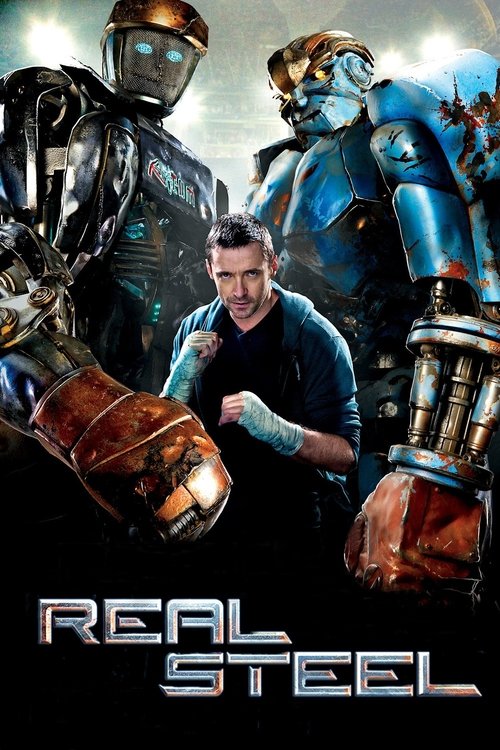
Real Steel
2011 · Shawn Levy
For family movie night, or when you want an uncomplicated feel-good ride that ends with you rooting at the screen. Comfort viewing that earns its fist-pump.
What it's about
In a near future where robots have replaced human boxers, washed-up fighter Charlie Kenton scrapes by on the sport's carnival circuit until he's stuck spending a summer with the eleven-year-old son he abandoned. Together they salvage a discarded sparring robot named Atom and train it into an unlikely contender — while father and son figure out whether they can rebuild each other too.
The experience
A big-hearted crowd-pleaser that moves like a classic underdog boxing picture, complete with training montages and fights that make you want to cheer out loud. Sentimental in the best popcorn way — it knows exactly which buttons to push and pushes them hard.
Performances
Hugh Jackman gives the formula real charge, playing Charlie's selfishness straight enough that the thaw with Dakota Goyo's scrappy, endearing Max actually lands.
The craft
The robot fights are the technical showpiece: motion-captured from real boxing choreography and blended with animatronics and effects so the machines move with genuine pugilistic weight — they hit hard on a big screen. Shawn Levy directs with a warm, sun-flared Americana gloss, produced under Steven Spielberg's DreamWorks banner.
Why it matters
A sleeper hit that became a beloved rewatchable for a generation of kids and earned an Oscar nomination for its visual effects, it stands as a model of how to wrap a classic sports-movie skeleton in blockbuster spectacle.
Snapshot
Real Steel is a near-future sports melodrama that grafts the machinery of a science-fiction premise onto the oldest of American genre skeletons: the boxing comeback and the estranged father who finds his son through the fight game. In a 2020s where human pugilism has been replaced by remote-controlled robot combat, washed-up former boxer Charlie Kenton (Hugh Jackman) grinds through the sport's carnival underworld until circumstance saddles him with the eleven-year-old son (Dakota Goyo) he abandoned, and the pair rebuild a discarded sparring robot, Atom, into an improbable contender. Directed by Shawn Levy for DreamWorks with Steven Spielberg and Robert Zemeckis among its executive producers, the film is best understood as a deliberate, high-gloss hybrid — a Rocky structure re-tooled with the effects vocabulary of the performance-capture era. Its distinction lies less in narrative invention than in its unusually convincing marriage of animatronics and motion capture, and in its earnest, unironic commitment to family-film sentiment at a moment when the genre had tilted toward snark. It is a minor but well-made studio entertainment whose reputation has grown gently through cable and streaming rotation.
Industry & production
Real Steel was a DreamWorks Pictures production, distributed by Touchstone Pictures in the United States under DreamWorks' then-active distribution arrangement with Disney, with Reliance Entertainment among the financing partners. It was produced by Don Murphy and Susan Montford alongside Shawn Levy's own 21 Laps Entertainment; Steven Spielberg and Robert Zemeckis served as executive producers, a pairing that signals the film's lineage in the Amblin tradition of technology-forward family spectacle. The reported production budget sat in the range of roughly $110 million, positioning the film as a mid-to-upper-tier studio tentpole rather than a top-line blockbuster.
The project's development reached back years and passed through several hands before Levy came aboard; John Gatins wrote the shooting screenplay, with story credit shared by Dan Gilroy and Jeremy Leven. Gatins, himself a former athlete and a specialist in the sports-redemption mode, was a natural fit for material that leans so heavily on the underdog template. Principal photography took place largely in and around Detroit and rural Michigan, whose post-industrial landscapes and fairground venues lend the film's carnival-circuit milieu an authentic, weathered texture.
Commercially the film performed solidly if unspectacularly in North America and found stronger traction internationally, with a worldwide gross widely reported at roughly the $290–300 million range — a comfortable but not runaway result against its budget. Exact figures should be treated as approximate here. The performance was strong enough to keep sequel and television-series proposals circulating for years afterward, though as of this writing no follow-up feature has been produced; the record on those aborted projects is thin and shifting, and is best described as "long discussed, never realized."
Technology
The film's central technical achievement is its integration of two effects traditions that are usually deployed separately. For the boxing robots, the production combined full-scale practical animatronics built by Legacy Effects — the successor shop to Stan Winston Studio — with digital characters created by Digital Domain. Legacy fabricated working, articulated robot puppets that stood on set, allowing actors to interact with physical objects and, crucially, giving the cinematographer real chrome and machined surfaces to light. Those practical builds served as the ground truth from which the digital robots inherited their weight, reflectivity, and grime.
The fight choreography was captured through motion capture: performers, including trained boxers, staged the bouts, and their movement data drove the CG robots in the dynamic combat sequences, while animatronics and keyframe animation handled slower, closer, more expressive beats. Sugar Ray Leonard consulted on the boxing, coaching Hugh Jackman and lending the robot combat a plausible pugilistic grammar of footwork, combinations, and defensive posture rather than generic mechanized flailing. This hybrid pipeline — practical reference for lighting and interaction, mocap for kinetic authenticity, and digital extension for the impossible — is the film's signature, and it is the reason the robots read as heavy, damageable machines rather than weightless renders.
Technique
Cinematography
Mauro Fiore, an Academy Award winner for Avatar, shot the film, and his work is central to selling the robots as physical presences. Fiore lights the metal combatants with hard, specular sources that emphasize dents, scoring, and the play of arena light across articulated joints, so that even wholly digital shots inherit the tactile logic of the practical builds. The palette shifts registers with the milieu: the underground and fairground circuits are grimy, sodium-lit, and earthbound, while the climactic large-venue bouts move toward the glossy, saturated spectacle of a televised prizefight. The camera favors a mix of grounded, hand-inflected coverage in the human drama and more muscular, arena-scaled framing in the fights, a division of labor that keeps the sentiment intimate and the combat large.
Editing
Cut by Dean Zimmerman — a long-running Levy collaborator — the film's editing is most tested in the fight sequences, where it must maintain spatial legibility across combatants that are entirely or partly digital. The bouts are generally staged for coherence rather than fragmentation, holding wider angles long enough to register the exchange of blows and the accumulating damage, in keeping with the boxing genre's demand that the audience read a fight as a narrative. In the dramatic passages the cutting is conventional and unhurried, giving the father-son scenes room to breathe.
Mise-en-scène / staging
Production design (Tom Meyer) builds a near-future that is deliberately recognizable — a world adjacent to our own rather than a gleaming utopia. The robot-boxing subculture is imagined as a descendant of low-rent combat sports and county-fair spectacle: junkyards, barns, back-lot arenas, and eventually a glossy corporate coliseum for the finale. The robots themselves are designed with distinct silhouettes and "personalities" — the battered, wide-eyed Atom; the flashy showman Noisy Boy; the monolithic champion Zeus — that let the staging function like a fight card, each machine legible at a glance. The choice to root the future in rust and duct tape rather than sleek minimalism is a mise-en-scène decision that grounds the fantasy.
Sound
The sound design carries much of the robots' physical credibility. Impacts are rendered with a weighty, industrial vocabulary — servos, hydraulics, the clang and crumple of struck metal — that gives the digital combat its felt heft. Danny Elfman's score supplies the emotional architecture, and the film also leans on contemporary needle-drops to energize its training and entrance sequences in the manner sports cinema has favored since Rocky.
Performance
Hugh Jackman anchors the film with a performance that trades on his physicality and charisma while asking him to play, for much of the runtime, an unlikeable man — a selfish, self-sabotaging deadbeat who must earn his redemption. Dakota Goyo, as the son, carries an enormous share of the audience-identification load and matches Jackman in the film's central dynamic, including a much-remarked dance sequence with the robot that has become the film's most-shared moment. Evangeline Lilly grounds the romantic and moral subplot as the gym-owner's daughter, and a supporting bench including Anthony Mackie, Kevin Durand, and Hope Davis fills out the circuit's ecosystem. The performances are pitched, appropriately, to a broad family register.
Narrative & dramatic mode
Structurally, Real Steel is a near-textbook underdog sports narrative fused with a reconciliation drama. Its dramatic mode is sincere melodrama: the film wants the audience to feel, without irony, the stakes of a fight and the mending of a broken family bond. The two plots are engineered to converge — Charlie's redemption as a man is inseparable from Atom's rise as a fighter, and the boy is the hinge between them. The screenplay observes the genre's beats faithfully: the reluctant partnership, the string of scrappy victories, the crushing setback, the training montage, and the climactic bout against an overwhelming favorite whose outcome is less important than what the fight proves about the protagonists. The science-fiction premise is largely a delivery system for this emotional machinery rather than a subject of sustained speculative interest.
Genre & cycle
The film sits at the intersection of three cycles. First and most obviously, it belongs to the boxing-underdog lineage that Rocky (1976) codified and that has proven endlessly renewable. Second, it participates in the father-son sports-reconciliation subgenre, with a particularly direct kinship to Over the Top (1987), where a estranged trucker-father and son bond through arm-wrestling; the resemblance in premise and arc is close enough to be structural rather than incidental. Third, it belongs to the early-2010s wave of effects-driven, machine-centric studio spectacle in the wake of the Transformers films — indeed it shares producer Don Murphy with that franchise — though Real Steel pointedly redirects that robotic spectacle toward family sentiment rather than military scale.
Authorship & method
Shawn Levy is a populist studio craftsman whose sensibility runs to warm, four-quadrant entertainment — Night at the Museum, Date Night, and later Free Guy and The Adam Project, as well as his transformative producing work on Stranger Things and his move into the Marvel arena. Real Steel is arguably his most personal-feeling studio picture of the period precisely because its earnest heart aligns so cleanly with his instincts; he directs the sentiment without embarrassment and stages the spectacle for clarity rather than chaos. His method here is collaborative and technology-forward, drawing on the Spielberg/Zemeckis executive-producer relationship and on a top-tier technical bench.
That bench matters. Cinematographer Mauro Fiore brought post-Avatar authority in integrating live action and digital character. Composer Danny Elfman supplied a score in his idiom of muscular, emotive orchestration. Editor Dean Zimmerman, a recurring Levy partner, shaped both the fights and the family drama. Screenwriter John Gatins contributed genre fluency in the sports-redemption mode. And Legacy Effects, custodians of the Stan Winston animatronics tradition, provided the practical foundation on which the whole illusion rests. The authorship of Real Steel is best read as a craft ensemble under a director whose talent is for calibrated mainstream feeling.
Movement / national cinema
Real Steel is a thoroughly American studio production, both in its financing and in its cultural grammar. It belongs to no art-cinema movement; its idiom is Hollywood populist entertainment in the Amblin tradition — technology harnessed to family sentiment and the mythology of the second chance. Its imagined future is emphatically an American Rust Belt one, shot in Michigan and steeped in the iconography of county fairs, boxing gyms, and blue-collar reinvention. If it has a national-cinematic identity, it is that of the Spielberg-descended, effects-enabled family blockbuster.
Era / period
The film is a product of the early-2010s studio landscape, when performance capture and hybrid practical-digital effects had matured enough to place synthetic characters convincingly alongside stars, and when family-oriented sci-fi spectacle was a reliable tentpole category. It arrived in the post-Avatar, Transformers-saturated moment and represents an attempt to channel that appetite for large-scale robotic action into a more intimate, character-driven register. It also reflects the transitional business circumstances of DreamWorks in that era, distributed through Touchstone and financed with Reliance participation.
Themes
The film's dominant theme is redemption through parenthood: Charlie must relinquish his self-interest to become both a father and, by extension, a man worthy of a second chance in the ring. Closely bound to this is the theme of obsolescence — Charlie is a human fighter made redundant by machines, and his arc mirrors Atom's, the discarded sparring bot who proves he can still take a hit. The film thus quietly literalizes the anxiety of the human rendered surplus by technology, then answers it with a reassuring humanism: it is the human touch — the boy's intuition, Charlie's fighter's instinct, the "shadow function" that lets Atom mirror a human's movements — that makes the machine exceptional. Underdog perseverance, the dignity of the overlooked, and the mending of inherited wounds round out the film's earnest moral vocabulary.
Reception, canon & influence
Critically, Real Steel met a divided but generally lenient reception. Reviewers frequently noted the derivativeness of its "Rocky with robots" premise and the predictability of its arc, while conceding that the film executed the formula with polish, sincerity, and genuinely impressive effects work. The performances of Jackman and Goyo and the tactile credibility of the robot combat were commonly cited strengths; the sentimentality and familiarity were the recurring reservations. It is a film more warmly regarded by general audiences than by critics, and its standing has softened favorably over time through repeat viewing on cable and streaming.
Its influences run backward through a clear genealogy. The premise derives, loosely, from Richard Matheson's 1956 short story "Steel," previously dramatized as a celebrated 1963 Twilight Zone episode with Lee Marvin — a lineage the production acknowledged. Its dramatic architecture descends from Rocky and the boxing-film canon, and its father-son sports arc closely echoes Over the Top. Its effects methodology inherits directly from the Stan Winston animatronics tradition via Legacy Effects and from the performance-capture advances crystallized in the surrounding effects era.
Forward, its legacy is modest but real. It stands as a notable case study in successfully blending practical animatronics with motion capture for convincing character-scale robotics — a middle path between fully practical and fully digital that effects practitioners have continued to value. Within Shawn Levy's career it prefigures his ongoing interest in the human dimension of technological spectacle, a thread that runs through Free Guy and The Adam Project. Talk of a sequel or a television continuation persisted for years without materializing, and the specifics of those unrealized projects remain thin in the public record. Real Steel endures, finally, as a well-crafted minor entry in the family-sci-fi canon: a film whose reach exceeded its ambitions, and whose sincerity has proven more durable than its critics initially allowed.
A Deleuzian reading
A boy dances in a parking lot at night, and eleven feet of salvaged metal dances behind him, half a beat late.
The full Deleuzian reading of Real Steel →
Reception
Written off in 2011 as 'the Rock 'Em Sock 'Em Robots movie' with middling reviews, it's since been reclaimed as one of the great sincere crowd-pleasers of its era — the internet checks in every few years to announce that Real Steel is, actually, good.
How Real Steel was received, from release to now →
How to watch Real Steel: what to notice on a first viewing
- Notice the light change between junkyard scenes and glossy arenas. Mauro Fiore shoots the underground circuit in grimy, sodium-lit tones, and the bigger venues in saturated, glossy broadcast light. The palette tells you which world you are in before a single line does.
- Listen for the servos and clanging metal under every robot hit. The sound design gives each impact a weighty, industrial vocabulary of hydraulics and crumpling metal, not just a generic thud. That sound is what convinces you a digital robot has actual mass and pain.
- Look at each robot's distinct shape and color the moment it appears. Atom, Noisy Boy, and Zeus are designed with different silhouettes and personalities, so you read each fighter instantly like a fight card. Clear design lets a wordless machine carry as much character as an actor's face.
- Watch how unlikeable Hugh Jackman lets Charlie be early on. Jackman plays a selfish, self-sabotaging deadbeat for much of the runtime before the film lets him earn any sympathy. His redemption only lands if you actually watch him deserve it, not assume it.
The whole guide to watching Real Steel, with the keys for a rewatch →
Influences: the films it descends from and the films it influenced
- Steel (The Twilight Zone) (1963) — The direct Matheson adaptation Real Steel expands, it establishes the core device of a washed-up human fighter substituting his own body for a broken combat machine — the man-inside-the-robot pathos the film literalizes through shadow-boxing puppetry.
- Rocky (1976) — Supplies the exact underdog architecture — training montage, the club-fight-to-title-shot escalation, and a climactic 'going the distance' loss staged as moral victory — that Real Steel transposes beat-for-beat onto the Zeus bout.
- Over the Top (1987) — The template for the deadbeat father earning a estranged son's respect through a competitive-sport tournament, where the arena victory and the reconciliation are engineered to land as a single emotional beat.
- The Champ (1931) — Origin of the boxing-melodrama tearjerker built on a broken pugilist father and an adoring child at ringside, the sentimental father-son grammar Real Steel inherits wholesale.
- Cinderella Man (2005) — Models the Depression/rust-belt boxing melodrama with clean, spatially legible fight coverage — wide masters that keep both fighters and the geography of the ring readable rather than fragmenting the action.
- Terminator 2: Judgment Day (1991) — Stan Winston's full-scale endoskeleton animatronics intercut with digital effects set the benchmark for convincing character-scale metal robotics that Legacy Effects, his successors, rebuild for Atom and Zeus.
- Jurassic Park (1993) — The founding case of seamlessly cutting Stan Winston animatronics against ILM CGI so the eye can't find the seam — the exact hybrid-practical-digital methodology Real Steel's robots depend on.
- A.I. Artificial Intelligence (2001) — The Amblin robot-with-a-soul melodrama, mining pathos from a machine's gaze and a parent-child bond, the sentimental register Levy channels through Atom's silent expressiveness.
- Iron Man (2008) — Legacy Effects' practical hero suit augmented by digital extension pioneered the specular-metal lighting and physically-present-then-digitally-completed workflow Real Steel adopts for its fighters.
- Avatar (2009) — DP Mauro Fiore's post-Avatar authority integrating live actors with performance-captured digital characters — the on-set virtual-camera and eyeline discipline he carries directly into Real Steel.
- Pacific Rim (2013) — Extends the same commitment to giving giant fighting machines tactile mass and readable choreography, staging robot combat with inertia and clear spatial geography rather than weightless chaos.
- Creed (2015) — Carries forward the Rocky craft via a generational hand-off structure — a mentor's legacy transmitted to a surrogate son — the same reconciliation-through-the-ring mechanism, now reflexively acknowledged.
- Free Guy (2021) — Levy's later refinement of his signature move: locating a sincere human heartbeat inside large-scale digital spectacle, directing sentiment without embarrassment amid technological effects.
- The Adam Project (2022) — Continues Real Steel's thesis explicitly — a wounded father-son reconciliation staged as an effects-driven genre picture, with Dean Zimmerman again cutting the action and the feeling on the same beat.
- Transformers (2007) — Real Steel defines its craft in opposition — where Bay renders robot combat as fragmented, near-abstract cutting, Levy insists on wide, weighted, spatially legible fights the audience can actually follow.
- Warrior (2011) — Same-year combat-sport family melodrama built on the identical engine: estranged working-class men resolve their wounds inside a bracketed tournament, the fights doubling as the drama's emotional throughline.
- The Wrestler (2008) — Shares the low-rent, rust-belt spectacle-fighting milieu — underground venues, gaudy showmanship, broken men grinding for cash — the down-market texture Real Steel gives its robot-boxing underworld.
- Pacific Rim: Uprising (2018) — Human-controlled fighting robots shot for legible full-figure spatial clarity in well-lit arenas, with motion-captured brawling staged so audiences read every blow — the same readability priority as Uprising's daylight Jaeger fights.
Similar films
- Warrior (2011) — influence & lineage
- Creed (2015) — influence & lineage
- A.I. Artificial Intelligence (2001) — influence & lineage
- The Wrestler (2008) — influence & lineage
- Transformers (2007) — influence & lineage
- Pacific Rim (2013) — influence & lineage
- Chappie (2015) — shared sensibility
- F1 (2025) — shared sensibility